Field Guide
Bobolink
A hayfield in Vermont in late May. The grass is long, not yet cut, and a small bird climbs above it in a stuttering, hovering flight with wings held stiffly down like a helicopter in trouble. The sound coming out of him is unlike anything else in the field: a long, spiraling torrent of metallic bubbles and electronic squeaks, cascading and overlapping, as though a music box had been wound too tight and left to unspool in the open air. The bird is Dolichonyx oryzivorus, the Bobolink, and the name itself is an attempt to catch that song in a word. It does not quite succeed.
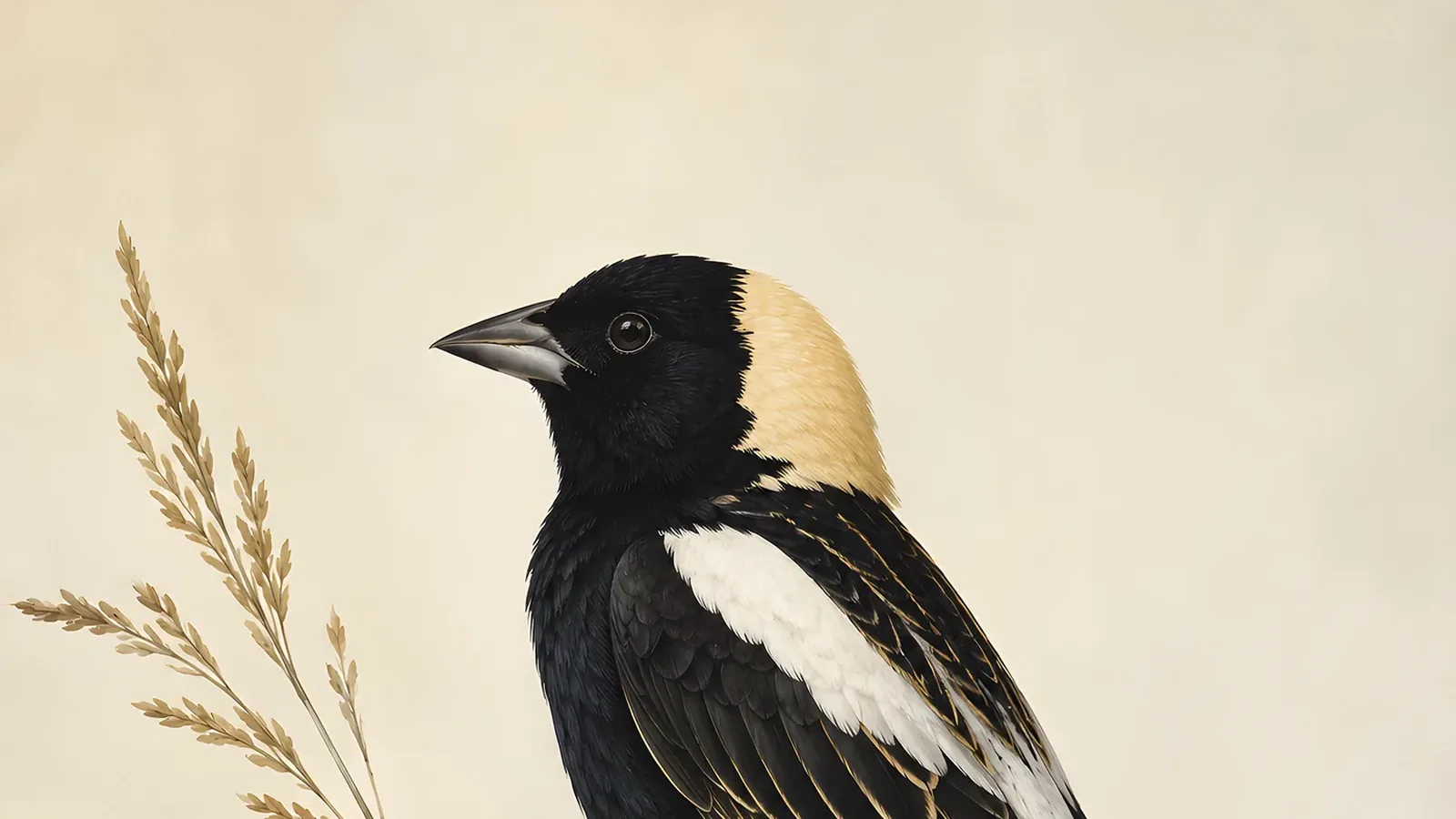
No other common North American bird looks like him. Where every other species is dark above and pale below, the breeding male Bobolink inverts the arrangement entirely - black on the throat, breast, and belly, white and yellow on the back and nape. He is wearing the tuxedo backwards. Cornell Lab of Ornithology confirms he is the only bird on the continent built this way, and it stops every birder the first time they see it.
What he looks like
The breeding male is not subtle. The underparts are solid black from chin to vent. The back and wings carry large white patches, the rump is white, and the nape is a deep, rich buff-yellow - the colour of old straw in low sun. The bill is short and finch-like, pale in summer, and the tail feathers come to sharp pointed tips. Cornell’s Audubon field guide records the body length at 16 to 20 centimetres, the wingspan from 27 to 30 centimetres, and the weight from around 29 grams in a small female to 56 grams in a large male.
| Measurement | Range |
|---|---|
| Length | 16 - 20 cm |
| Wingspan | 27 - 30 cm |
| Weight | 29 - 56 g |
| Lifespan (record) | up to 9 years |
The female is the opposite of conspicuous. She is warm buffy brown striped with dark brown on the back and flanks, with a pale buff eyebrow and a crown striped in two tones. She looks like a large streaked sparrow, and the gap between male and female in this species is one of the widest in any North American songbird. Outside the breeding season the male molts into a plumage almost identical to hers, keeping the disguise for the entire journey south and until spring returns.
The song
The display flight above the hayfield is where the Bobolink argues for his territory, and the song that comes with it is the most mechanically complex in the family Icteridae. The notes are not musical in the way a thrush is musical - they are metallic, rapid, and layered, each phrase seeming to run on top of the last before the first has finished. Ornithologists describe the effect as electronic. Early American naturalists heard the name in it: “bob-o-link,” though what the bird produces is stranger and more complicated than that syllabic summary.
The Smithsonian Migratory Bird Center notes that the male delivers this song in hovering flight with wings angled down, which is unusual. Most songbirds sing from a perch. The Bobolink broadcasts from the air, turning slowly, staking out the field below him with sound that carries well across open grass where trees give no elevation.
“He is the only bird I know whose song is a cascade rather than a phrase - it falls and overflows before it ends.”
The longest commute
Every autumn, the Bobolink abandons the northern hayfield and travels south. Not to the Gulf Coast, not to Central America. All the way to the grasslands of Bolivia, Paraguay, and northern Argentina, a journey the Smithsonian Institution has measured at approximately 20,000 kilometres round trip - one of the longest migrations of any songbird in the Western Hemisphere (Smithsonian Migratory Bird Center). A nine-year-old Bobolink, the record age documented through banding data reported by Cornell Lab, would have covered a distance equivalent to four and a half times around the earth, assuming annual journeys.
The route is complex. Tracking studies with geolocators show that birds make an extended stopover in Venezuela before continuing south. Individuals from Vermont and elsewhere in the Northeast funnel through Florida and then island-hop across the Caribbean before reaching South America. The wintering birds reach the pampas by November and stay through March, timing the southern hemisphere’s summer grasses.
How they find their way across that distance is partly answered by physics. In 1987, Beason and Semm published electrophysiological recordings from the trigeminal nerve of captive Bobolinks and found that 15 percent of spontaneously active cells responded to earth-strength changes in the magnetic field (Beason and Semm, Neuroscience Letters, 1987). The source of that sensitivity lies in the nasal tissue: magnetite crystals, the same iron mineral used in early compass needles, deposited in the upper beak, coupled to the ophthalmic branch of the trigeminal nerve. The Bobolink carries a built-in compass. It is not metaphor - it is histology.
Range and the hayfield problem
The breeding range runs across the northern third of the continent: the upper Midwest, the Great Plains, southern Canada from British Columbia to Nova Scotia, and the hayfields of New England and the maritime provinces. The species expanded eastward as European settlers cleared forest and planted hay through the nineteenth century, then peaked and began to fall as farming changed. Cornell Lab’s population data show a decline of around 65 percent since 1970.
The single largest driver of that decline operates through a simple collision of calendars. Bobolinks nest on the ground in dense grass, and they begin incubating in late May or early June. Modern hay operations cut earlier and more often than they did fifty years ago, driven by market incentives for high-protein early-cut silage. When a mower runs through a hayfield in the first two weeks of June, Bobolink nests fail at rates approaching 100 percent. Bollinger, Bollinger, and Gavin documented this in a landmark 1990 study that measured the relationship between cutting date and nesting success across eastern populations (Wildlife Society Bulletin, 18: 142-150, 1990). Noah Perlut and colleagues at the University of Vermont confirmed the mechanism in Vermont hayfields, finding that early-hayed fields produced near-total nesting failure while late-hayed fields and rotationally grazed pastures produced viable cohorts (Perlut et al., University of Vermont research series, 2002-2006).
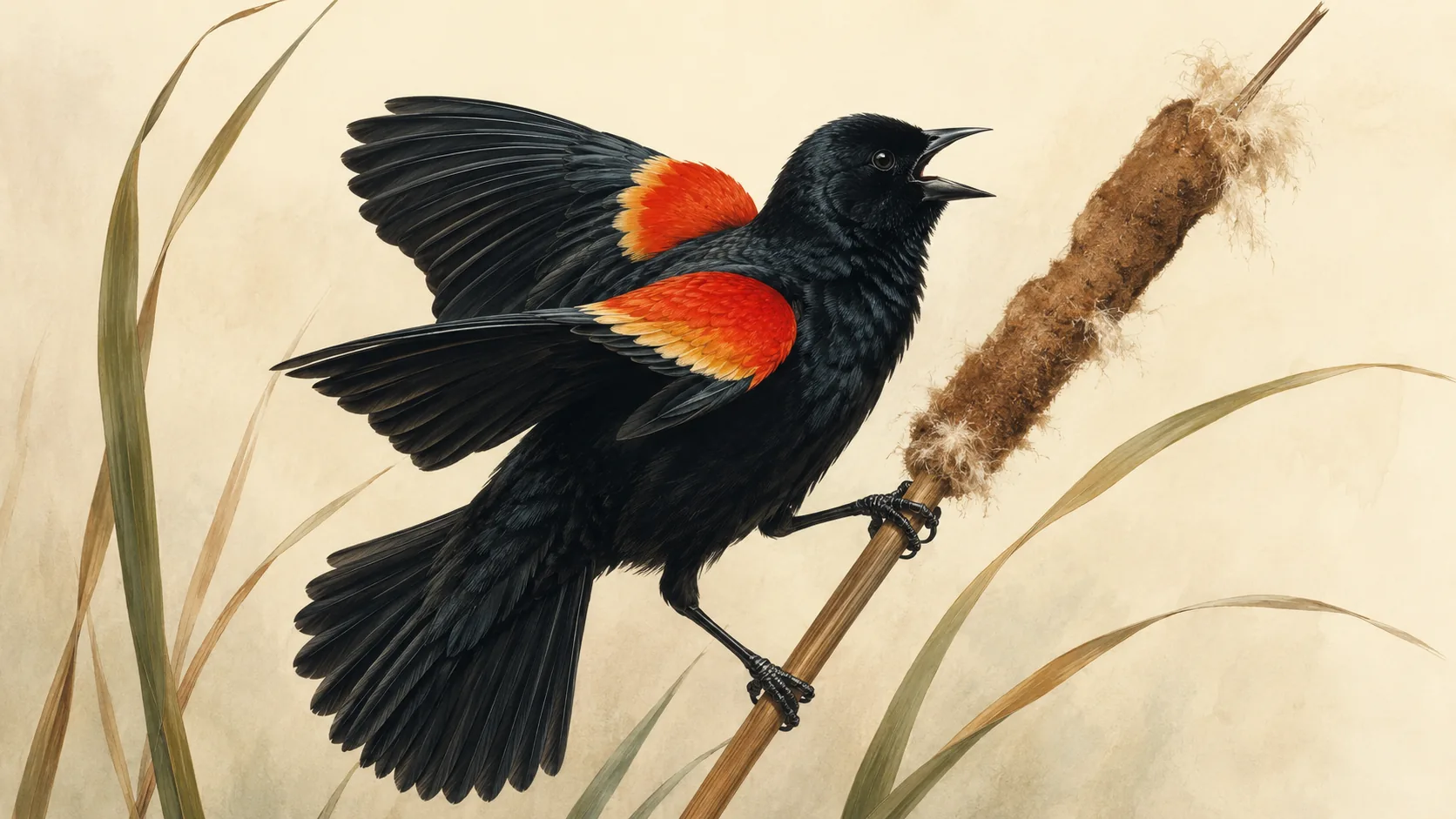
The red-winged blackbird shares the Icteridae family and also nests in open agricultural land, but it nests earlier, often in cattail marsh rather than open hay, and it is not in decline. The Bobolink’s particular vulnerability is that it cannot simply shift its timing to match the mowers. Ground-nesting grassland birds are trapped in their own phenology.
On the wintering grounds in Argentina, the bird faces pressure of a different order. Bobolinks - called ricebirds in the agricultural zones of the Pampas - feed heavily on rice crops during migration and in winter, and they have been shot and trapped in large numbers by rice farmers for over a century. The Smithsonian Migratory Bird Center notes that some birds were historically sold into the pet trade. The IUCN currently lists the species as Least Concern (LC), but the population trend is flagged as decreasing, and the North American Breeding Bird Survey data do not support complacency.
Diet
Through the breeding season the Bobolink is primarily insectivorous. Beetles, grasshoppers, caterpillars, wasps, and ants make up most of what the adults eat and nearly all of what they feed the nestlings. The Audubon field guide notes that this insect-heavy diet shifts to seeds and grain as autumn approaches. By the time the bird is crossing the Caribbean it is fueling the flight largely on carbohydrate, and in South America it feeds extensively on rice and cultivated grains alongside wild grass seeds. The species name oryzivorus - “rice-eating” - reflects the wintering diet and the long history of conflict with South American rice agriculture.
Breeding
Bobolinks arrive on the breeding grounds in May, the males first. They are loosely polygynous - a single male may hold pair bonds with two, occasionally more, females nesting within his territory - though the system is not as rigidly harem-structured as the red-winged blackbird’s. The nest is built by the female alone, a shallow open cup of grass and weed stems pressed into a natural depression on the ground and well hidden in the surrounding vegetation. The Audubon field guide records clutch size at five to six eggs, pale greenish or buff-brown, marked with heavy reddish-brown blotching. Incubation takes 11 to 13 days. The chicks are fed almost entirely on insects and fledge in around 10 to 14 days, though they remain dependent on the parents for some weeks. One brood per year.
The compressed timeline matters enormously for the hayfield problem. From egg to independent young takes six weeks at minimum. If the first cut falls in early June, there is no time to renest before the second cut comes. The bird’s annual investment in reproduction fails twice.
What the Bobolink teaches, if we are willing to learn it, is that a species can be abundant enough to seem secure while losing ground fast enough to be in real trouble - and that the mechanism of loss can be completely ordinary, nothing more dramatic than a farmer’s tractor running on schedule through a June morning. The reversed tuxedo, the bubbling electronic song, the magnetite compass pointing south across 10,000 kilometres of ocean and grassland: none of it is proof against a mowing date that moved three weeks earlier in half a century.