Field Guide
Bristle-thighed Curlew
The coral beach of a Northwestern Hawaiian atoll, late autumn. A Numenius tahitiensis - the Bristle-thighed Curlew - stands at the edge of an albatross colony. In its bill it holds a fragment of coral, not for balance and not by accident. It has selected the piece, carried it a short distance, and is about to use it. The target is an unattended egg in the abandoned nest nearby, its shell too thick for direct puncture. The bird swings its head and strikes.
This is not improvisation. It is behavior that Marks and Hall documented in 1992 in The Condor - five observed instances of curlews using coral fragments or small stones as percussion tools to crack albatross eggs, an extension of the species’ typical “slamming” technique in which the bird drives prey against a hard surface directly. Tool use in birds is uncommon. Among shorebirds, it is unique to this species.
The Bristle-thighed Curlew owns a series of firsts that are difficult to arrange in order of improbability. It is the only shorebird known to become flightless during molt. It is the only migratory shorebird that winters exclusively on oceanic islands. It makes nonstop ocean crossings exceeding 6,000 km. It breeds on two isolated tundra patches in western Alaska and turns up each winter from the Northwestern Hawaiian chain to French Polynesia, reaching atolls so remote that the birds can go weeks without encountering a mammalian predator at all. The flightlessness and the tool use and the islands are not three separate facts. They are the same ecological story.
What it looks like
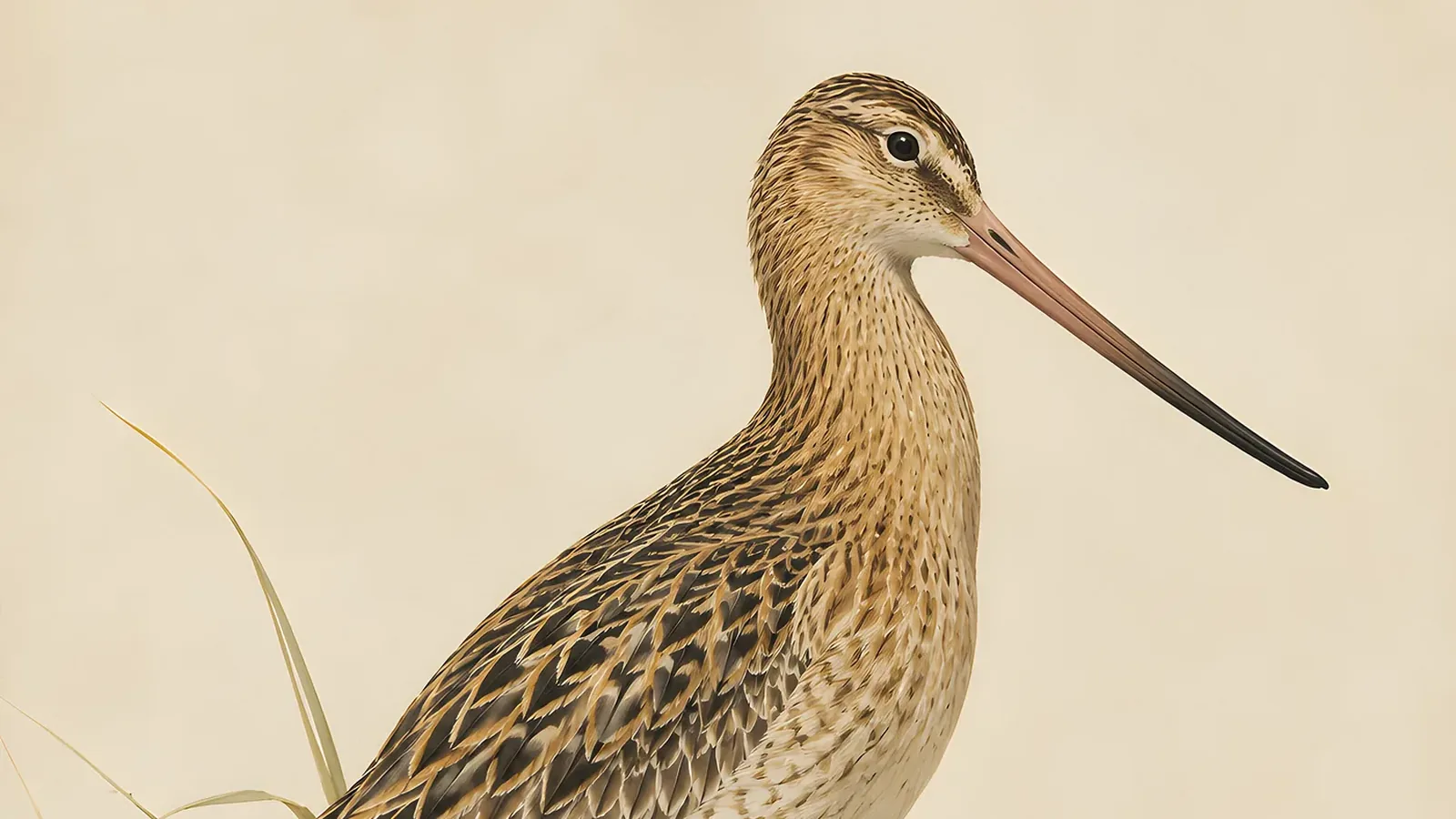
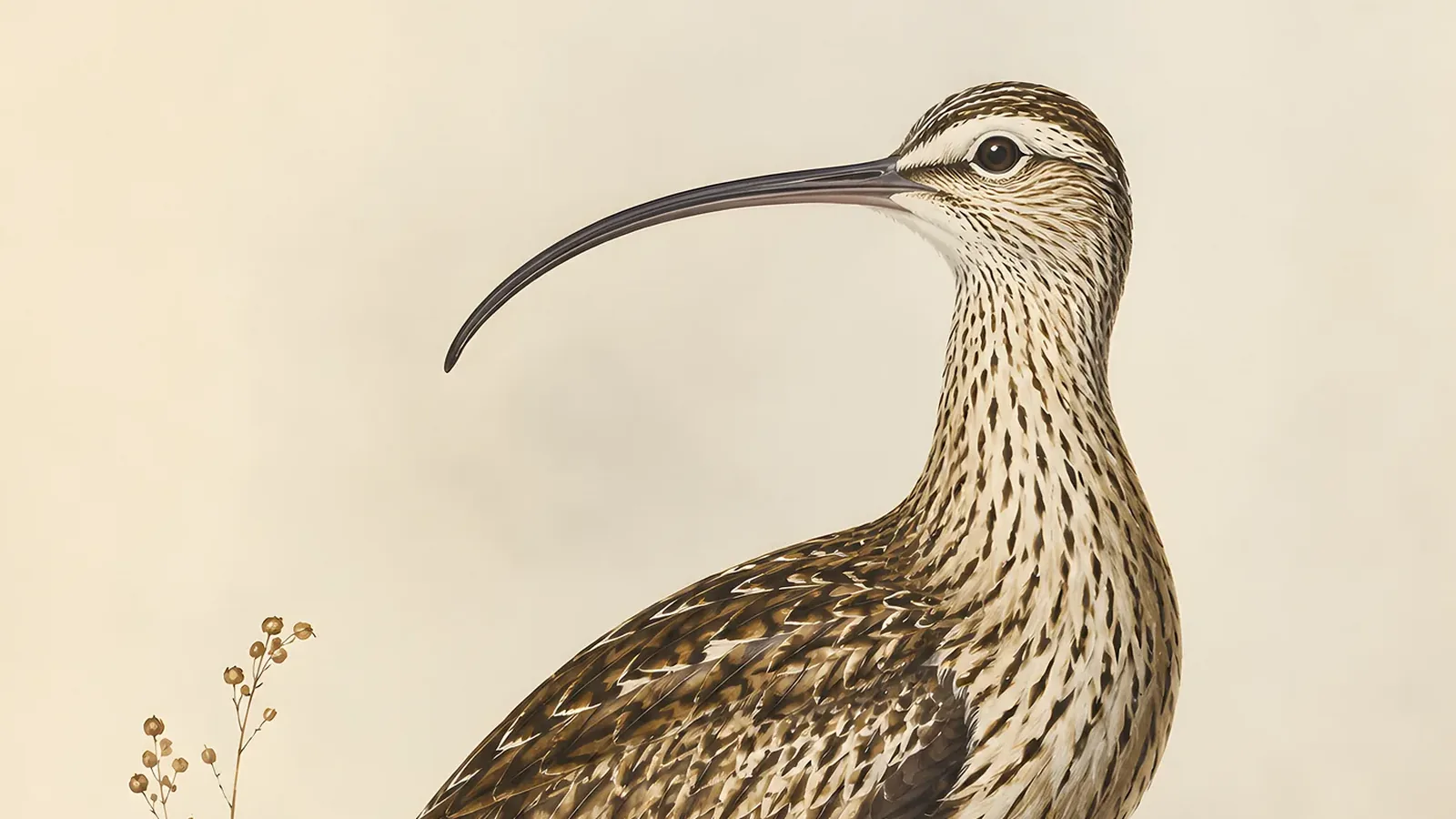
Numenius tahitiensis is a large, rangy shorebird in the curlew lineage, 40 to 44 cm from bill to tail, with a wingspan of 84 to 99 cm and a weight that fluctuates between 500 and 950 g depending on fat loading before migration. It holds the family shape well: long legs, upright posture, and above all the long decurved bill that arcs downward in a smooth, unbroken curve from the gape to the dark tip.
The plumage is rich by shorebird standards. The crown is dark brown with a buff central stripe. A strong pale supercilium broadens behind the eye and contrasts with a dark eye stripe below it. The upperparts are brown and buff-scaled, the feather edges warm orange-buff on fresh plumage. The neck and breast are heavily streaked brown on a pale buff ground. The underparts below the breast are clean buff to whitish. The tail and rump show prominent warm buff-and-brown barring that is visible in flight and useful at distance - it distinguishes this species from the larger Whimbrel (Numenius phaeopus), with which it can be confused.
The diagnostic field mark is the bristles. On the thighs and flanks, the feather shafts extend beyond the vanes as bare, stiff projections - straw-colored filaments that give the bird its name and serve no well-understood function. They are unusual enough to arrest attention in a good photograph.
| Measurement | Range |
|---|---|
| Length | 40 - 44 cm |
| Weight | 500 - 950 g |
| Wingspan | 84 - 99 cm |
| Longest recorded lifespan | 23 years 10 months (Marks et al., The Auk, 1990) |
| Annual adult survival | ~85% (Laysan Island study, 1988-1991) |
| Clutch size | 4 eggs |
The call is a drawn-out, rising whistle, described by the Audubon field guide as plaintive - a sound suited to an empty atoll, carrying across open water without rivals.
The flightless molt
Every autumn, after the breeding season concludes in Alaska and the adults have completed the crossing to their wintering islands, the Bristle-thighed Curlew does what no other shorebird does: it drops its flight feathers simultaneously and waits.
Most shorebirds molt their primaries in a gradual, staggered sequence. They lose a feather, grow it back, lose the next. Flight capability is impaired briefly at most. The Bristle-thighed Curlew loses primaries in a synchronized flush. The result is several weeks of flightlessness on the atoll - a vulnerability that would be untenable for nearly any other long-distance migrant.
Marks, Redmond, Hendricks, Clapp, and Gill documented this in their 1990 paper in The Auk, noting it as the only known instance of molt-induced flightlessness among extant shorebirds. Marks elaborated the timing and pattern in a 1993 Auk paper on molt in the Northwestern Hawaiian Islands. The explanation is the islands themselves. These atolls, remote from continental land masses, evolved in near-complete isolation. There are no native ground predators. No foxes, no weasels, no raccoons. The curlew can afford to be grounded precisely because the islands afford a predator regime unlike any the bird would encounter on a continental wintering ground.
“Molt-induced flightlessness in Bristle-thighed Curlews is the only example of this condition among extant shorebirds and reflects an adaptation possible only in the predator-reduced environment of oceanic islands.”
- Marks, Redmond, Hendricks, Clapp, and Gill, The Auk, vol. 107, 1990
The causal chain runs in only one direction. The island isolation made the flightless molt safe. The flightless molt may have reinforced the island dependence. The arrangement works until the predator equation changes - introduced rats on atolls, cats on larger islands, the slow colonization of previously sterile ground. On the wintering islands that have acquired introduced predators, the molting curlew is acutely exposed. Frédéric Jiguet, surveying French Polynesian atolls in 2021 and 2022 and publishing in Bird Conservation International in 2023, found Pacific rats (Rattus exulans) present on eight of nine surveyed atolls in the Tuamotu Archipelago. The flightless curlew and the island rat are not a stable pairing.
The tool user
Return to that atoll beach and the bird with the piece of coral. The behavior that Marks and Hall observed in 1992 extends the curlew’s existing foraging toolkit rather than diverging from it. Bristle-thighed Curlews feeding on eggs have two modes. In direct slamming, the bird grips the egg and drives it against a rock or hard substrate, using the egg itself as the instrument. In tool use, the bird reverses this: it holds the tool and strikes the egg with the tool. Five cases of the second pattern were documented, all involving fragments of coral or small stones.
What the behavior reveals is a facultative flexibility - the bird assesses the situation and selects the method appropriate to the resistance of the target. Thin-shelled or cracked eggs yield to direct pressure. Intact, thick-shelled albatross eggs require the harder contact that a stone or coral fragment can deliver. The cognitive step is modest by the standards of great apes or corvids, but in a shorebird it is a significant departure from what the lineage is credited with.
Diet on the wintering islands extends well beyond eggs. The curlew takes crustaceans, mollusks, small fish, and insects, working the beach wrack and coral rubble with the same long bill it uses on Alaskan tundra to extract beetles and caterpillars from the mat. The thematic continuity is the bill: probe, extract, or strike. The tool use is the striking behavior extended by one logical step.
Range and the ocean crossing
Two small populations in western Alaska hold the entire breeding stock of Numenius tahitiensis. Approximately 60 percent nest in the southern Nulato Hills on the Yukon Delta National Wildlife Refuge, and the remaining 40 percent occupy the north-central Seward Peninsula. The breeding terrain is hilly inland tundra, away from the coastal flats, at elevations from 50 to 500 m - steep enough to provide sight lines from the nest scrape, open enough to detect approaching threats. Both populations are small. Population estimates across the full global range have historically centered around 10,000 individuals, though Jiguet’s 2023 survey data from French Polynesia, showing a 49 to 58 percent decline in Tuamotu numbers since the late 1980s, suggest the global figure may need downward revision. The current IUCN Red List category is Vulnerable (VU).
After the breeding season, adults gather on the Yukon Delta to feed heavily - berries, insects, whatever the tundra offers in late summer - building the fat loads that will sustain the crossing. What happens next is the migration that frames the species’ entire ecology.
Marks and Redmond, publishing in The Condor in 1994, calculated estimated flight ranges from birds departing Laysan Island and found that curlews wintering south of the Northwestern Hawaiian chain - in the central and southern Pacific - must make nonstop crossings in excess of 6,000 km on each leg of migration. Even for curlews that winter in Hawaii, the initial crossing from western Alaska covers more than 4,000 km without a landing opportunity. Fat constituting 42 percent of body mass on departure, as Marks and Redmond documented, powers the crossing. The bar-tailed godwit holds the absolute record for nonstop overwater flight, but the curlew’s crossings belong in the same conversation - a shorebird of perhaps 600 g carrying itself across open ocean for days without the option of landing.
The system is tight and linear: small breeding ground, nonstop crossing, island wintering ground with no predators, flightless molt, another nonstop crossing back. Any disruption at any point - breeding habitat degraded, staging habitat lost, introduced predators on the islands, sea level inundation of low atolls - threatens the whole chain.
Diet
On the Alaskan breeding grounds, the curlew feeds on the insects and berries typical of western tundra in summer: beetles, caterpillars, crowberries, and whatever the hilly terrain offers during a brief season. The bill’s length serves it differently here than on the beach - it is used to probe the mat and surface vegetation rather than to strike or slam.
On the wintering islands the diet diversifies into whatever the coral atoll provides: crustaceans from the reef rubble, mollusks, small fish, insects on the vegetation, and seabird eggs when available. The eggs are opportunistic. Albatross breeding seasons create a temporary abundance that the curlew exploits with the two-mode egg-cracking strategy described above. The island diet reflects the curlew’s generalism - it is not a specialist like the oystercatcher, locked to a single prey type and a single tool. It reads the available surface and feeds accordingly.
Breeding
The breeding season in western Alaska is short and compressed. Nests are ground scrapes, usually positioned under or near low shrubs, lined with lichens, moss, and dry leaves. Four eggs, olive-buff and blotched with brown, are incubated by both parents for approximately 25 days. Males conduct aerial display flights over the territory and call persistently. Chicks are precocial and mobile within hours.
The known population centers - the Nulato Hills and the Seward Peninsula - are remote enough that the species remained poorly known to ornithology longer than its size and distinctiveness would seem to allow. Marks, Redmond, and their USGS colleagues, working these sites from the late 1980s through the 1990s, produced much of what is now the foundational literature on the species’ breeding biology, molt, migration, and longevity.
One female banded on Laysan Island in September 1967 was collected there in April 1991 at a confirmed age of at least 23 years and 10 months (Marks et al., The Auk, 1990). Annual adult survival in the Laysan wintering population averaged 85 percent in the late 1980s and early 1990s. In a population of perhaps 10,000 birds, a long individual lifespan matters. Each breeding adult represents an irreplaceable unit of the species’ total capacity to persist.
This is the argument the Bristle-thighed Curlew makes by existing: that the same evolutionary pressures that built the nonstop ocean-crossing machine also built the tool user and the flightless molter. Those traits did not arise in isolation. They cohered on the Pacific island, where the absence of ground predators turned an ordinary vulnerability into a viable strategy, and where the abundance of thick-shelled eggs turned a percussion behavior into something recognizable as craft. A curlew on an atoll with a piece of coral in its bill is not exhibiting a curiosity. It is exhibiting the full logic of its lineage, expressed on the only kind of landscape that could have produced it.