Field Guide
Snail Kite
A male Snail Kite hangs low over the marsh on broad, rounded wings. He drops, feet first, into the shallows. One second, two. Then he lifts out with a dark, dripping apple snail clenched in his talons. He banks to a weathered post at the marsh edge and lands. He holds the snail steady with one foot and lowers his head. The bill works quickly, finding the opening between the shell and the operculum - the tight plate the snail clamps down for protection. In a matter of seconds, the flesh pulls free. He swallows the snail body whole and drops the shell. It joins a small mound of others at the base of the post.
This is what the Snail Kite does, almost exclusively, every day of its life. It is a raptor that has staked everything on a single food source. That gamble shaped every feature of its body.
What It Looks Like
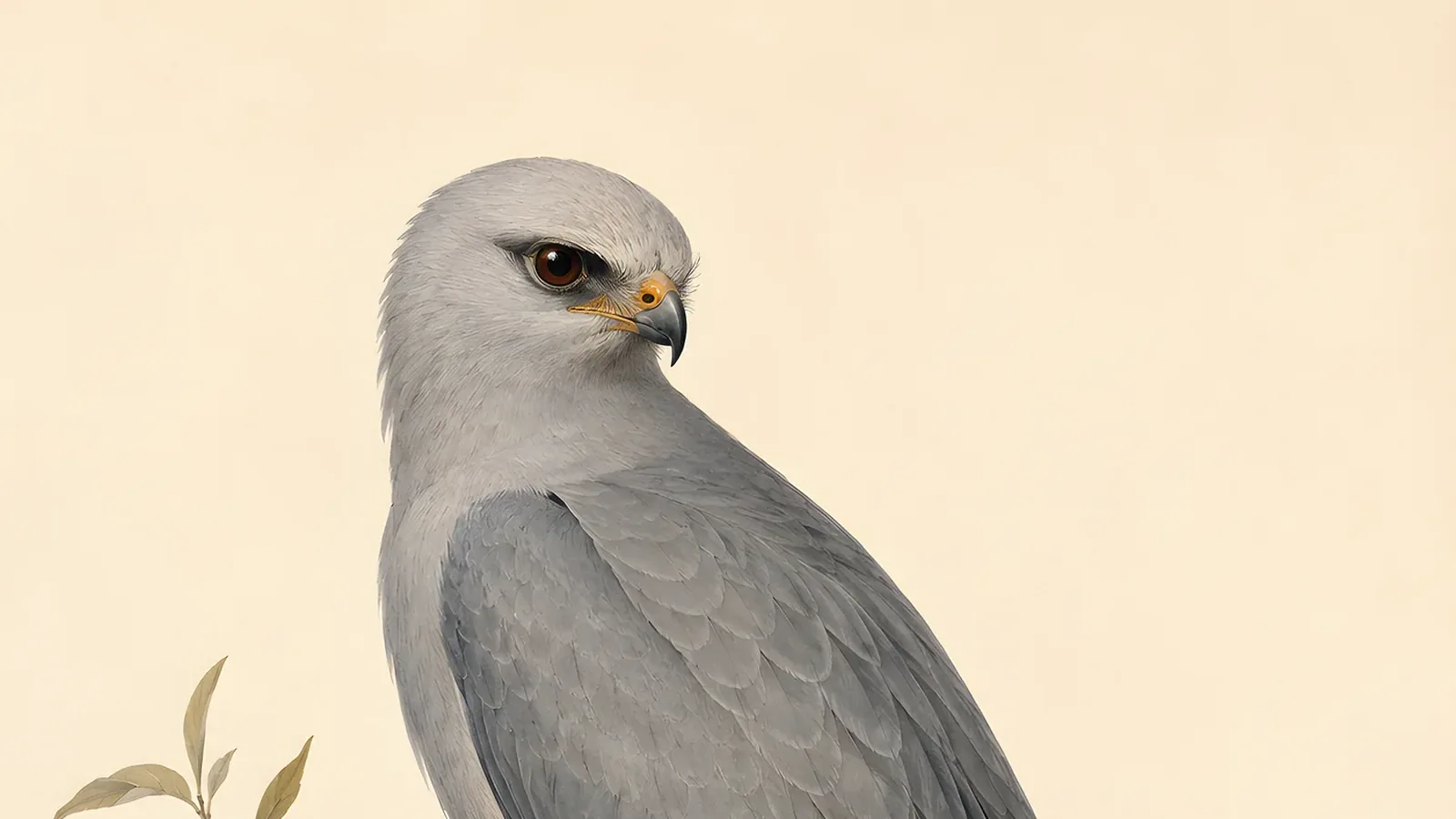
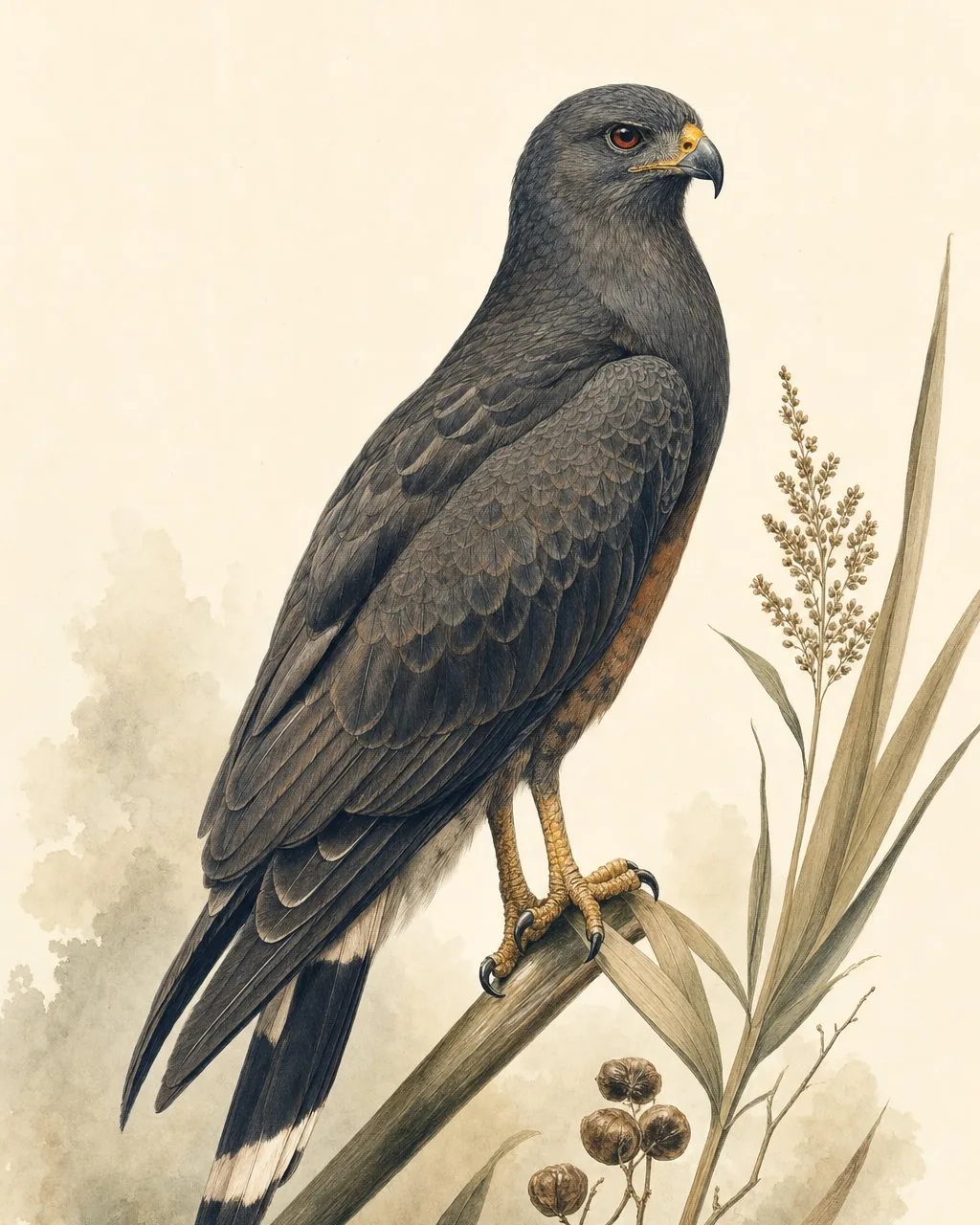
The adult male is slate gray across the back, wings, and underparts. The tail is white at the base, crossed by a broad black terminal band - a pattern visible in flight that separates him from most other raptors at a distance. The wingtips are black. His face sets him apart entirely: a vivid red-orange eye ring and red-orange bare skin at the base of the bill give him an almost theatrical look. The bill itself is the defining feature, a sharply hooked, laterally compressed structure that curves downward like a talon in miniature.
The female is brown above and heavily streaked below with dark brown on cream. Her facial skin and eye ring are orange-yellow rather than red. She can suggest a young Mississippi Kite in shape and pattern, but the bill - once you see it - is unmistakable on any age or sex.
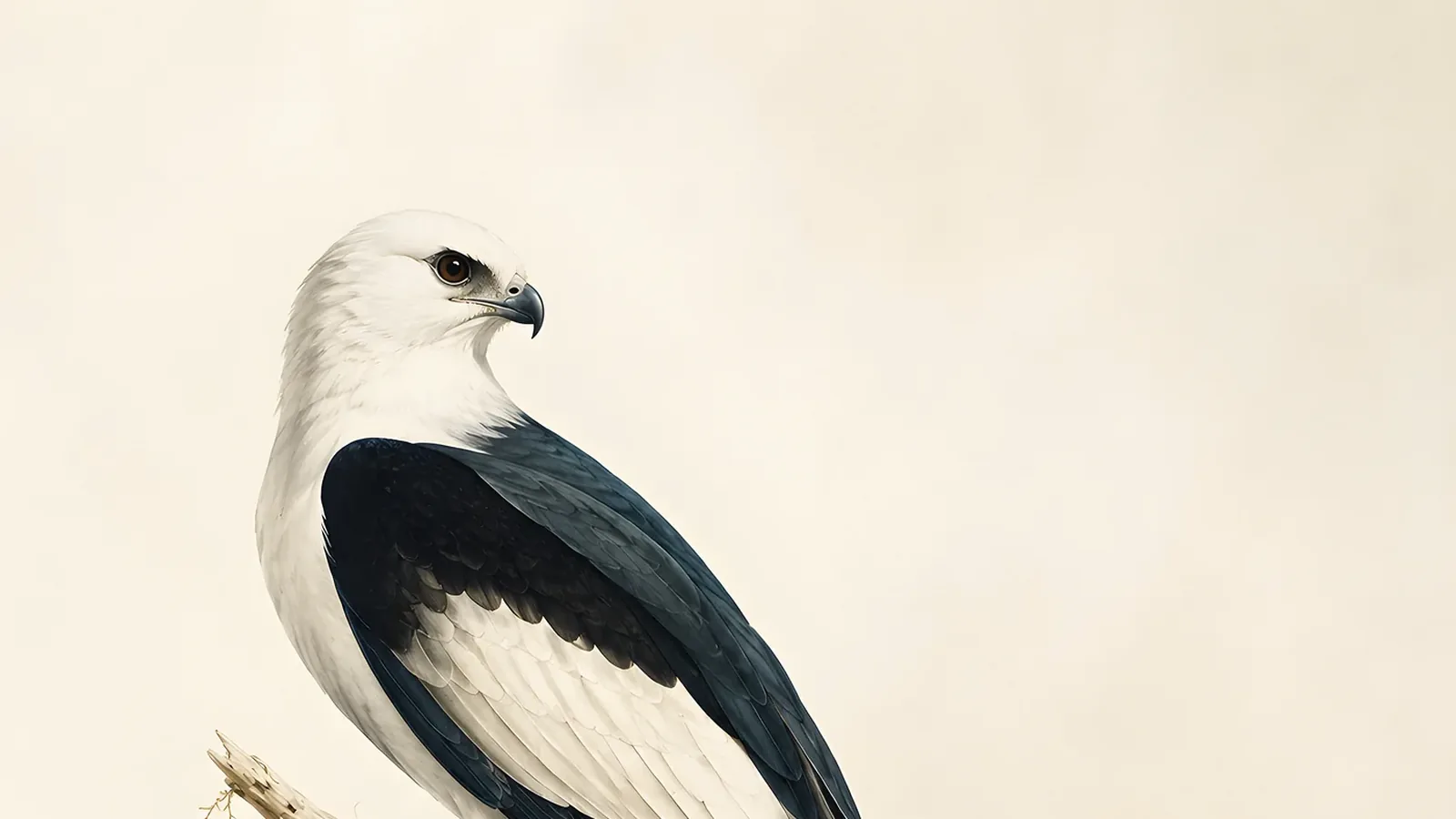
Immature birds resemble females but are more heavily streaked and have yellowish eyes that deepen to red as they age. In flight, all Snail Kites appear broad-winged and somewhat owl-like compared to the slender swallow-tailed kite. They fly slowly and low, almost buoyant, rocking side to side as they quarter the marsh surface.
Measurements
| Measurement | Range |
|---|---|
| Length | 39 - 43 cm |
| Weight | 320 - 570 g |
| Wingspan | 99 - 109 cm |
| Lifespan (wild) | 7 - 14 years |
“The Snail Kite’s bill is so perfectly specialised that ornithologists once used it as a textbook example of adaptive radiation - a single structure, honed over millions of years, for a single task.”
Voice and Song
The Snail Kite is not a vocal bird by raptor standards, but it is not silent. The most common call is a rapid, nasal cackling: ka-ka-ka-ka-ka, delivered mostly around the nest or when disturbed. Males produce a low, repeated cak note during interactions at feeding perches. The calls carry across open marsh but lack the piercing quality of other Florida raptors. In a landscape otherwise filled with herons, coots, and the constant churr of red-winged blackbirds, the kite’s voice is easy to miss if you are not already watching one.
Range and Habitat
In the United States, the Snail Kite is a Florida bird, and specifically a bird of certain parts of Florida. The core population occupies Lake Okeechobee, the Everglades, and the freshwater marshes of the Kissimmee River valley. Birds are largely resident year-round, moving within the state when water levels or snail populations shift. They do not migrate north. A few strays reach southern Georgia but do not establish.
Across Central and South America, the Snail Kite is a common bird of tropical freshwater wetlands from Mexico through Argentina. The Latin American population is stable and widespread. The Florida subspecies, Rostrhamus sociabilis plumbeus, is the one with a history of crisis.
The habitat requirement is strict: slow or still freshwater marsh, typically with emergent vegetation such as cattails, bulrush, and water hyacinth, and shallow enough for apple snails to be accessible at the surface. The kites do not use fast-moving rivers, brackish water, or dry grassland. Where freshwater marshes are drained or water levels managed into extremes, the kites disappear.
Diet: The Apple Snail Commitment
No North American raptor has narrowed its diet more completely than the Snail Kite. The vast majority of its diet - in Florida, historically over 95 percent - consists of apple snails in the genus Pomacea. When apple snails become scarce, kites do not simply switch to other prey. They move, searching for water where snails are still abundant. They wait. Breeding stops.
The bill anatomy is the clearest statement of this commitment. It is not merely hooked, as with other kites and hawks. It is laterally compressed, creating a thin, blade-like profile at the tip. It curves steeply and to a fine point. This structure allows the bird to slide the upper mandible between the snail’s body and the operculum - the calcified lid the snail uses to seal itself inside the shell. The kite does not crush the shell. It does not pick it apart. It inserts the bill like a key and extracts the soft body cleanly, leaving the shell largely intact.
The operation takes seconds, not minutes. Experienced adults are faster than younger birds. A kite with a productive snail population can eat many individuals in an hour. They carry snails in their talons rather than their bills, landing on a preferred perch - a post, a low branch, an emergent stem - where the extraction technique is repeated with the calm efficiency of long practice.
The kite occasionally takes other freshwater snails and has been recorded taking small turtles and crayfish under stress conditions. But these are exceptions. The bird is built for Pomacea, and Pomacea is what it seeks.
Breeding
Snail Kites nest colonially, often in loose groups of several to dozens of pairs in the same stand of marsh vegetation. The nest is a loose platform of sticks and aquatic plant stems built low over water in cattails, willows, or shrubs. Both parents incubate the two to four eggs. Both feed the chicks.
Breeding timing in Florida tracks water levels and snail availability more than calendar date. In a good year with stable water and abundant snails, a pair may attempt two or even three clutches. In a year of drought or flood, breeding may not begin at all. This flexibility is itself a survival mechanism - the kite does not waste energy on a breeding attempt the marsh cannot support.
Young birds from different parts of Florida move widely before settling. Florida’s kite population mixes enough that genetic diversity within the subspecies remains reasonable despite the population’s historical crashes.
Conservation: Found in an Unlikely Rescue
The Florida Snail Kite’s story is one of the more instructive in American conservation, and one of the stranger ones. By the mid-20th century, drainage of Everglades wetlands for agriculture and development had eliminated vast areas of apple snail habitat. The Florida subspecies fell to fewer than 500 birds by the 1960s and was listed as Endangered under federal law. Water management in the Kissimmee-Okeechobee-Everglades system continued to cause population swings: years of drought dropped water levels below snail reach; flood management events inundated nesting colonies.
Efforts to restore Everglades hydrology helped, but the population remained vulnerable. Then something unexpected happened.
Pomacea maculata, the island apple snail, arrived in Florida from South America - an aquarium trade escape that established in freshwater systems across the state. This snail is substantially larger than the native Florida apple snail, Pomacea paludosa. Wildlife managers initially feared the large invader would be too big for kites to handle. Instead, the kites adapted. They learned to extract flesh from the larger shells. The island apple snail colonized water bodies where native snails were thin on the ground. The kite’s food supply expanded.
By the early 2010s, the Florida population had climbed from fewer than 1,000 birds to more than 3,000. The U.S. Fish and Wildlife Service downlisted the subspecies from Endangered to Threatened in 2021 - a genuine recovery milestone, even if water management threats in the Everglades remain unresolved.
The kite’s recovery is not a simple conservation success. The invasive snail that helped it also outcompetes native Pomacea paludosa in some systems and has altered wetland plant communities. One problem solved became another problem introduced. The kite sits at the center of this, unchanged - pulling snails from the water with a bill shaped for exactly that purpose, adapting to whatever the marsh offers.
A species can be saved, it turns out, by the thing that was supposed to threaten it. That is not a lesson that generalizes neatly, but it is the Snail Kite’s lesson, written in a mound of empty shells at the base of a marsh post.