Field Guide
Scarlet Macaw
Every morning along the Tambopata River in Peru, dozens of Scarlet Macaws descend to the same exposed clay bank - loud, conspicuous, apparently reckless. They gather on eroded riverbanks where the canopy offers no cover. They cling, feed, shuffle, and argue for an hour before the heat drives them back into the forest. For a bird that can crack a Brazil nut and live five decades in the wild, it seems like an unnecessary risk.
It is not reckless. It is necessary. Ara macao lives in one of the most fruit-rich environments on earth, and it still cannot get enough sodium from its diet without eating dirt.
That is the thesis of this bird: spectacular appearance, extraordinary longevity, and a life governed by a nutritional shortfall that forces it into the open every day. The Scarlet Macaw is not just the brightest bird in the Western Hemisphere’s forests. It is one of the most ecologically constrained.
What the bird looks like
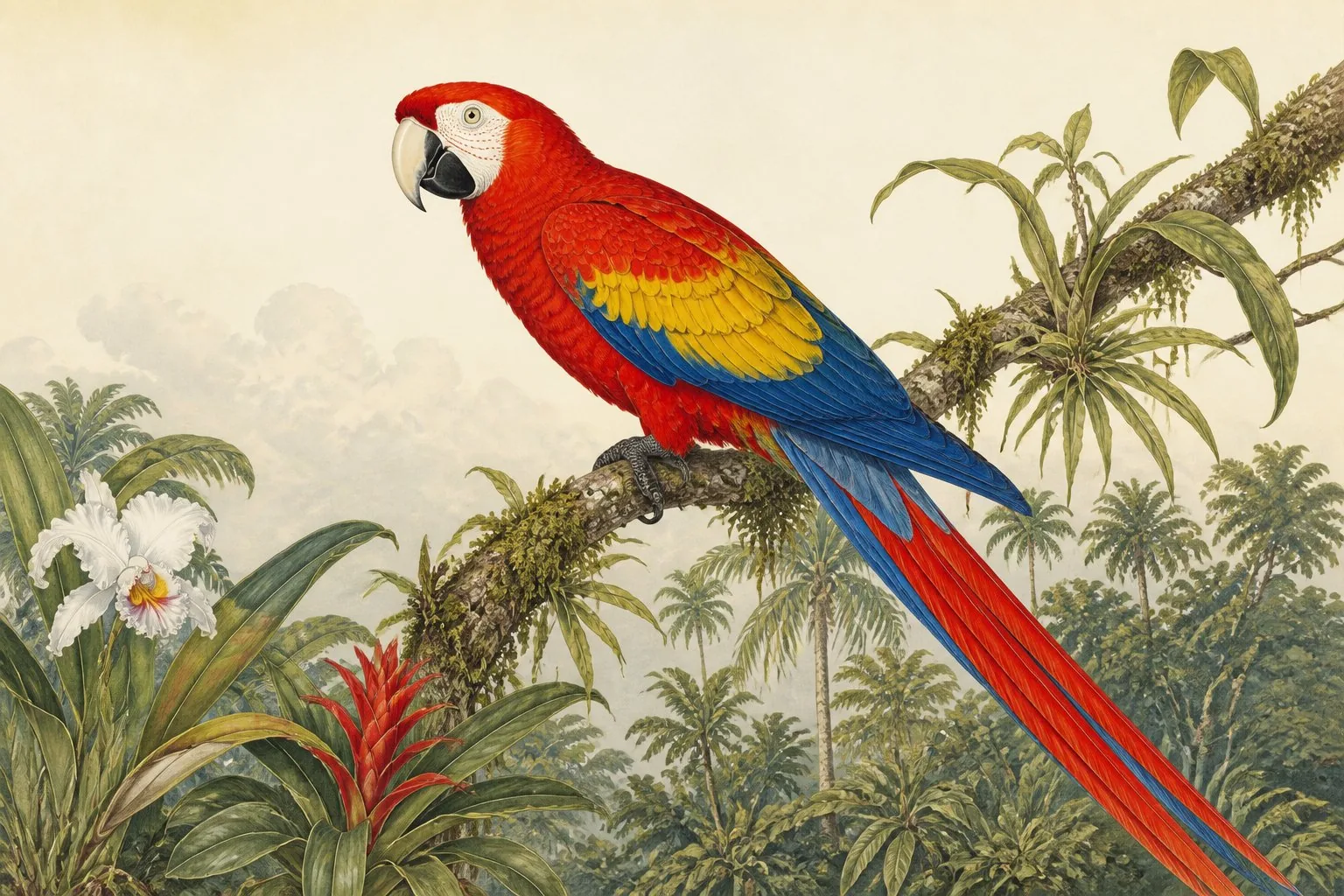
The Scarlet Macaw runs 84 to 89 centimetres from bill tip to tail tip - a length roughly equal to a child’s arm. The tail alone accounts for more than half that measurement. It weighs between 900 and 1,200 grams, and its wingspan reaches 100 to 120 centimetres. These are not subtle birds.
The plumage is primarily scarlet across the head, body, and most of the wing. The greater upper wing coverts are yellow. The flight feathers and a band between the yellow and red are bright blue, shading to light blue across the rump and tail-covert feathers. In full sunlight, the combination reads as three clean bands of primary colour laid over a scarlet ground - the kind of arrangement that looks designed but is simply the product of millions of years of mate selection in a visually complex forest environment.
The face is bare white skin with fine red feather streaks. The upper bill is pale, the lower bill dark. Males and females are identical to the eye. Two subspecies exist: the larger Ara macao cyanoptera of Mexico through Nicaragua, and the slightly smaller Ara macao macao from Costa Rica south through South America. The northern subspecies shows more blue among the yellow wing bands.
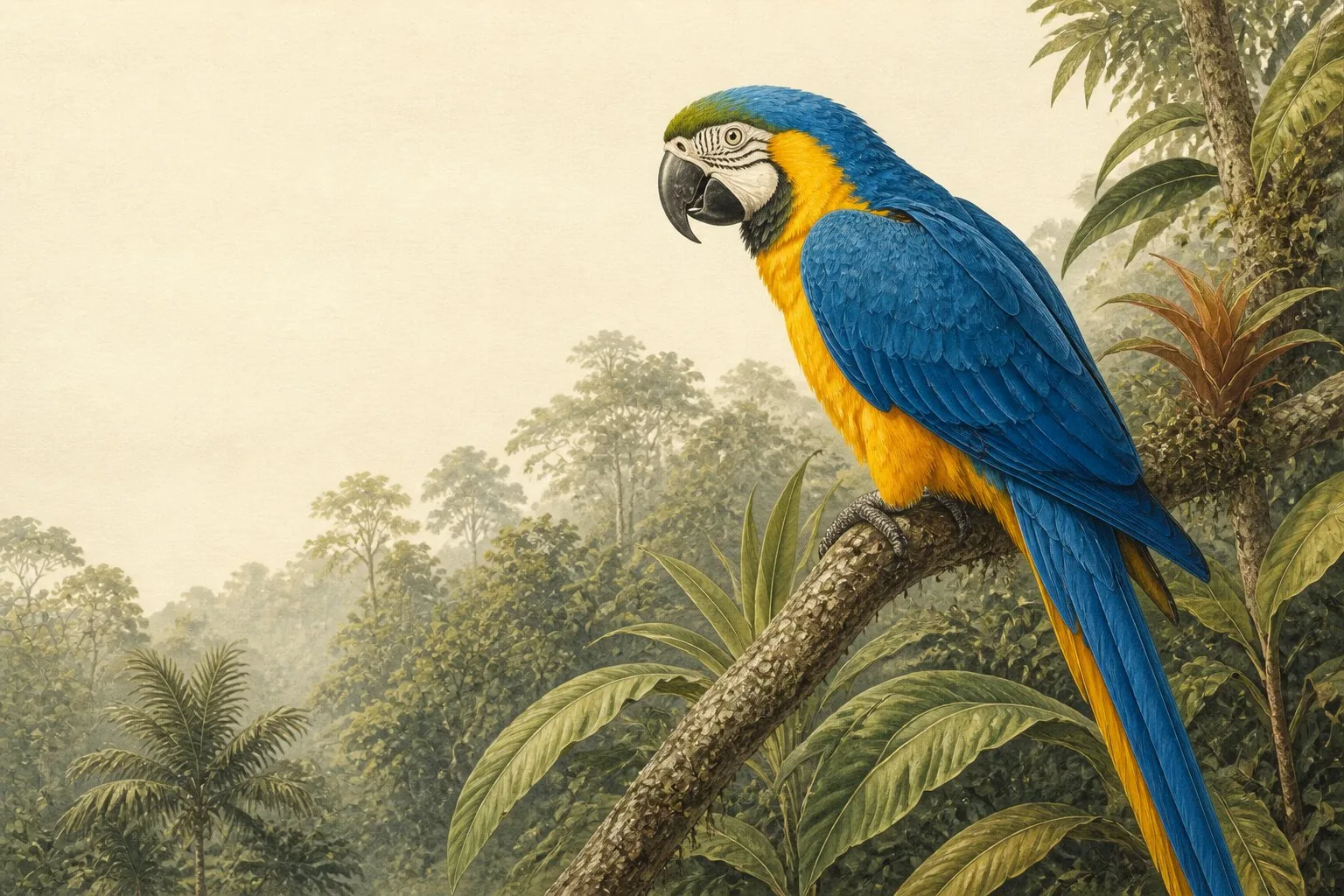
The only large macaw with a similar silhouette in overlapping range is the Blue-and-yellow Macaw (Ara ararauna), which lacks any red. A bird this size in scarlet is effectively unidentifiable as anything else.
Voice and sound
The Scarlet Macaw is heard before it is seen. Its calls are raucous, carrying - a series of harsh, grating squawks and screeches that travel well through closed-canopy forest. Pairs and family groups call constantly in flight, maintaining contact across distances where visual tracking through the canopy would be impossible. The calls vary between individuals and between social contexts: contact calls differ from alarm calls differ from the softer, lower exchanges that paired birds make when preening each other at close range.
Cornell’s Birds of the World notes the species is commonly observed flying in pairs or family groups, and the vocal constant of those flights is part of what makes a flock of macaws overhead so unmistakable - not just the colour, but the noise announcing them from 200 metres away.
Range and habitat
The species occupies a vast arc of tropical lowland forest from southeastern Mexico, through Belize, Guatemala, Honduras, Nicaragua, Costa Rica, and Panama, and south and east through Colombia, Venezuela, Ecuador, Peru, Bolivia, and Brazil, with a small presence on Trinidad. The Birds of the World account places it in tropical evergreen and riparian forest ecosystems from sea level up to around 1,000 metres.
Its core requirement is tall, old-growth forest with large-diameter trees that contain usable nest cavities. Secondary forest and forest edge are used for foraging but not nesting. Where logging or agriculture removes the largest trees, Scarlet Macaw nesting collapses quickly - the birds can find food in degraded habitat but cannot reproduce without the cavities that only old trees provide.
The northern subspecies is genuinely endangered within Mexico. Once ranging from Chiapas north to Tamaulipas, the Mexican population has contracted to a single stronghold in the Lacandon rainforest in extreme southern Chiapas. Around 1,000 individuals remain in the country.
Globally, the IUCN lists the species as Least Concern, reflecting the large South American population.
Diet
Scarlet Macaws are frugivores and seed predators, consuming fruit, seeds, pods, leaf shoots, flowers, and occasionally insects, across approximately 126 plant species from 25 families, according to the Birds of the World account. They are among a small group of animals that regularly eat unripe fruit - the hard seeds and high tannin content that deter most frugivores are no obstacle to a bill that can apply enough force to open a Brazil nut.
The clay lick is where the diet’s structural problem becomes visible. Western Amazonia receives less windblown ocean salt than the Atlantic coast, and the fruits and seeds that macaws eat are low in sodium. Clay licks - eroded riverbanks where mineral-rich subsoil is exposed - provide the sodium that the diet cannot. The leading scientific hypothesis, supported by studies of macaw clay-lick behaviour at sites like Tambopata in Peru, is that geophagy functions as sodium supplementation rather than toxin neutralization as earlier researchers proposed.
The practical consequence is that Scarlet Macaws tie themselves to specific riverbank locations every morning, regardless of what else is happening. They are predictable at the clay lick in a way they are not predictable anywhere else.
Breeding and nesting
The Scarlet Macaw forms monogamous pair bonds that persist for life. Pairs spend most of their time together year-round, maintaining the bond through mutual preening and close physical contact. Animal Diversity Web records that mates lick each other’s faces - behaviour more commonly associated with mammals than with birds.
Nesting takes place in natural cavities in large trees, typically high in the upper canopy where dense foliage provides concealment. The female lays two to three white eggs. Incubation runs approximately five weeks. Chicks fledge at around 90 days, but remain with the parents close to a year after leaving the nest. Sexual maturity comes at around three to five years of age, which is late for a bird - and sets up the life history arithmetic that makes long-lived species like this one so vulnerable to nest-site loss. A pair that loses a season produces no offspring. A pair that loses their nesting tree loses years of potential productivity.
The foot preference
Animal Diversity Web notes that Scarlet Macaws show a consistent left-foot preference when handling food - using the left foot to hold seeds and fruit against the bill in the same way a right-handed person picks up a tool. The preference is analogous to human handedness in that it is individually consistent and lateralized, and it appears across the Ara macaws as a group. It is the kind of detail that goes unnoticed in the field but carries significant weight in what it implies about the cognitive organisation of a bird most people think of as decorative.
What the lifespan means
A Scarlet Macaw in good conditions can live 40 to 50 years in the wild. In captivity, individuals have lived past 75 years. The figure is not incidental: it determines the conservation calculus for the species.
A bird with a 40-year reproductive lifespan but a first breeding age of four or five years, and a clutch of two to three eggs per season, produces offspring slowly by bird standards. The population’s capacity to recover from hunting pressure, habitat loss, or the illegal pet trade is far lower than the large, colourful bird would suggest. Each individual killed or taken from the wild represents, conservatively, decades of future reproduction removed from the population.
The IUCN’s Least Concern classification reflects current population size across a large range. It does not mean the species is under no pressure. In Mexico, the trajectory from historical range to a single Chiapas stronghold is a warning carried in the data of a bird alive today that was flying over Tamaulipas when the people currently watching it were not yet born.
The clay lick in the morning is not theatre. It is a necessity in an incomplete forest, performed by an animal old enough to remember when the forest was larger.