Field Guide
Mississippi Kite
Over a golf course in Lubbock on a July afternoon, a pale grey form tilts against the blue and vanishes into a long, banking arc. It reappears ten metres lower, snatches something mid-air, and brings the prey to its bill without once breaking the glide. The insect - a cicada, most likely - is gone in two bites. The bird curves back up into the thermals without having touched a branch, a wire, or the ground.
That is Ictinia mississippiensis, the Mississippi Kite, as close to its essential self as you will see it. And if you linger too long under the elm at the edge of the twelfth fairway, you may find out that the bird has an opinion about you too.
The IUCN lists the Mississippi Kite as Least Concern. Its population stands at roughly 700,000 individuals and is increasing, a fact made plausible by this kite’s unusual talent for turning the human-altered landscape - the shelterbelt, the golf course, the shade tree on a Kansas Main Street - into territory it can use and defend.
What it looks like
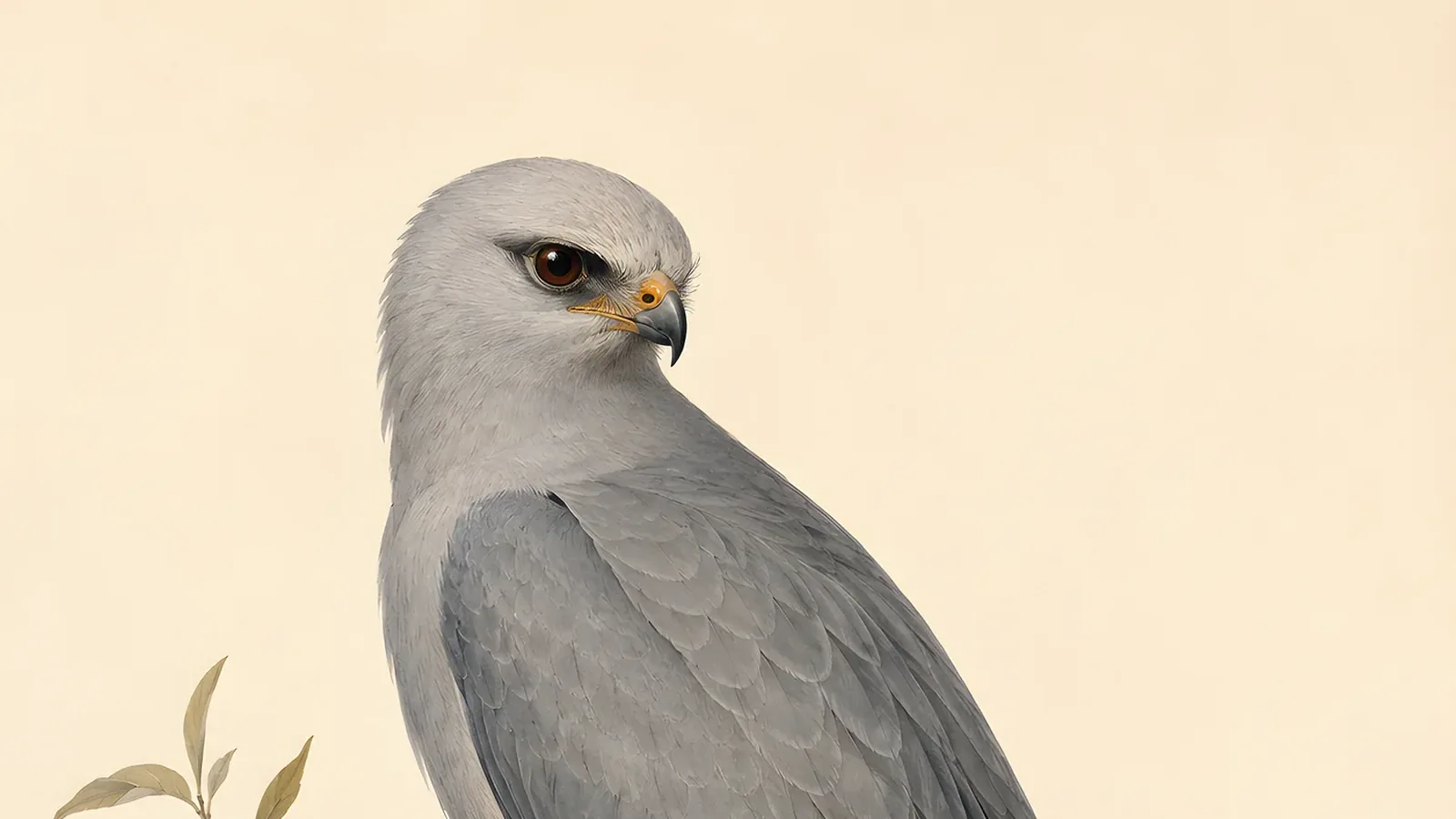
The adult Mississippi Kite is a small, trim raptor. Body length runs 34 to 37 centimetres, weight ranges from 214 grams in a light male to 388 grams in a large female, and wingspan averages 79 centimetres across a range of 75 to 83 centimetres (Animal Diversity Web, University of Michigan). Females are slightly larger, but the sexes are otherwise nearly identical in the field.
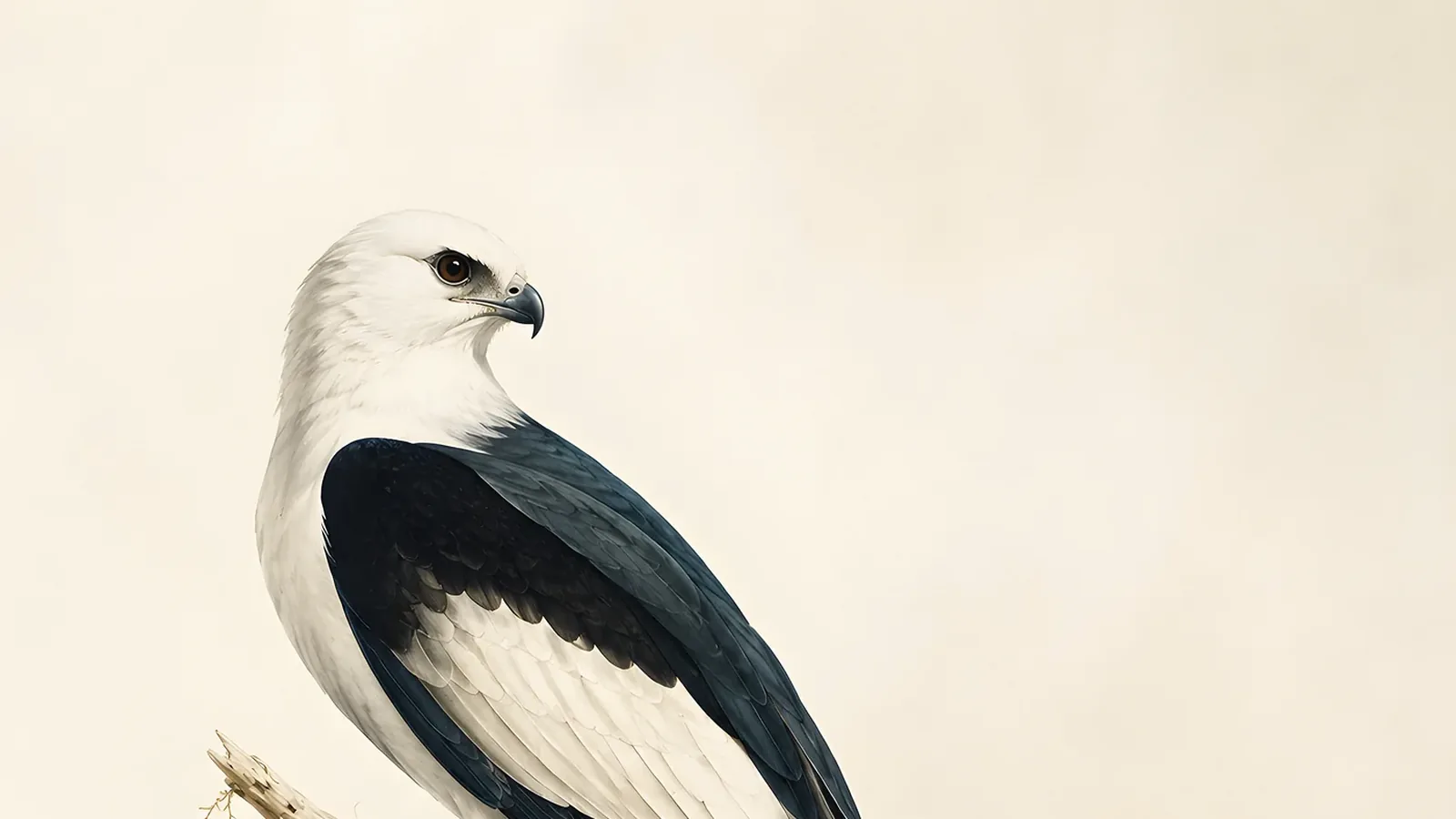
The head is whitish to pale grey, noticeably lighter than the body. The back and wings are medium grey with darker, near-blackish flight feathers that give a banking bird a two-toned quality. The tail is solid black, square-cut and long. In flight the wings narrow to near-blade tips - the profile of an insect-hawker rather than a soarer. A whitish patch on the upper inner wing, visible when the bird banks, is a useful field mark. The eye in the adult is deep red.
Juvenile birds are dark brown above, heavily streaked buff below, with narrow pale bars on the tail - the trap for beginners. By the third year the pale head and uniform grey body are in place.
Hunting on the wing
The Mississippi Kite eats insects - not as a supplement to a broader diet but as the diet, with everything else an occasional footnote. Cicadas, grasshoppers, dragonflies, beetles, and katydids make up the bulk, and most of it is caught and consumed while the bird is still flying.
The kite rises on a thermal, tilts into a long glide, drops into a sudden angled pursuit, and transfers prey directly from foot to bill. It never needs to land to eat. Bolen and Flores (1993) documented that cicadas become the dominant prey during emergence events - whole colonies converging on a woodland where a brood has surfaced, hawking in lazy arcs until they are too heavy to climb. Hunting range extends roughly 400 metres from the nest (Parker, 1999, in Animal Diversity Web, University of Michigan). In towns, where insects concentrate along tree-lined streets above mowed lawns, this range compresses further.
| Measurement | Value |
|---|---|
| Body length | 34 - 37 cm |
| Weight | 214 - 388 g |
| Wingspan | 75 - 83 cm (avg. 79 cm) |
| Clutch size | 1 - 2 eggs |
| Incubation period | 29 - 32 days |
| Fledging age | 25 - 34 days |
| Longevity (wild record) | 12 years |
The town-tree colonies
This is where the Mississippi Kite becomes interesting to anyone who thinks raptors belong in wilderness.
In the southern Great Plains, the kite nests not in remote bottomlands but in the shade trees of streets and parks, in golf course elms, in churchyard pecans, in cemetery oaks. Garden City, Kansas. Lubbock, Texas. Dodge City. Medium-sized cities in the Kansas and Oklahoma wheat belt where the tree cover is a hundred years old and cicadas are loud in summer. The birds nest in loose colonies - typically two to ten pairs within earshot of each other, occasionally more - and show strong site fidelity from year to year.
The nest itself is a flimsy stick platform, sparse enough to see through from below, lined with a few green leaves and occasionally Spanish moss where available. It sits 20 to 35 feet above ground in a branch fork and looks, by the standards of most raptors, underdeveloped. The birds compensate for structural indifference with vigilance. Nesting kites will mob any intruder that approaches the tree, and they will specifically target the head of a passing human - stooping silently from above, breaking off close, circling back, and repeating. Injuries are documented. Golfers have been struck. Some towns post warning signs beneath nest trees in summer. The Audubon Society’s field notes describe nesting adults as “highly aggressive” to perceived threats near eggs or chicks (Audubon Field Guide, Mississippi Kite). This aggression is not random - it is precisely calibrated to the distance from the nest and stops the moment you clear the territory boundary.
Parker and Ogden (1979) documented that the western breeding range expanded by more than 700 kilometres during the 20th century, from the core in Texas and northeastern Kansas outward to Arizona and New Mexico. More recently the expansion has pressed north and east: first nesting in Ohio was recorded in 2007, and breeding in New Hampshire and Connecticut followed in 2008 (American Bird Conservancy). The species has also reached Mississippi, its nominal home state, in greater numbers than historical records suggest it ever held. The shade tree, planted everywhere humans settled the treeless plains, seems to have unlocked a colonisation process that is still underway.
What it sounds like
The Mississippi Kite is not a vocal bird. The call - heard most often near the nest or when a colony member arrives at a roost - is a thin, two-note whistle, rendered variously as phee-phew or pee-teer, the first note short and rising, the second longer and falling. It carries well over open ground but has nothing of the weight or drama of a hawk’s scream. Alarm calls near the nest are sharper, more insistent. Away from the colony, the bird is largely silent. You will often see it long before you hear it, and you will frequently leave without having heard it at all.
Range and migration
The Mississippi Kite breeds across a broad southern arc of the United States, from the western Carolinas and Georgia west through the Gulf states, north through the Great Plains to Kansas, Missouri, and now scattered records well beyond. The stronghold is the southern Great Plains, where the combination of open country and planted shelter trees creates near-ideal conditions.
In late summer the birds gather into pre-migratory flocks. By September most have departed. They travel south through Central America in mixed flocks, sometimes alongside swallow-tailed kites and other long-distance migrants, and winter in southern subtropical South America - primarily northern Argentina, southern Brazil, and Paraguay. A documented concentration of approximately 10,000 individuals passing Fuerte Esperanza in Argentina gives some sense of the scale of the migration (Peregrine Fund). They are back on their Great Plains nesting territories by late April or May.
The route is almost entirely overland, through Central America and Colombia. A bird that eats while flying needs flying insects at every stage, and the tropical corridor provides them.
Breeding
Pairs arrive on territory together or form on arrival. Nest construction begins in May - small dead twigs assembled loosely over a week or two. The clutch is most often two eggs. Both parents incubate for 29 to 32 days and both provision the chicks after hatching. Young fledge in 25 to 34 days, then spend another 35 to 40 days near the adults before dispersing. Sexual maturity comes at two years. A bird banded in Kansas in 1984 was recovered in Texas 11 years and two months later. Longevity records compiled by the USGS Bird Banding Laboratory place the maximum at 12 years (Cornell Lab, All About Birds).
Nesting success in town colonies tends to be higher than in rural woodlands. Predators are present but a defended urban colony is harder to raid than an isolated nest in the trees. The kite, like the red-tailed hawk, has done the maths on human-altered landscapes and come out ahead.
The Mississippi Kite did not adapt to towns out of desperation. It found in the planted shade trees and mowed fairways of the southern plains something structurally identical to what it always wanted, and it moved in.
What holds this bird in the mind is that combination: the effortless aerial style, the cicada snatched without a wingbeat’s interruption, the silent stoop at the golfer’s hat. Grace and precision, expressed as a single kite-shaped curve across a July sky. Whether the bird is over a wilderness bottomland or the thirteenth hole, it looks like the same thing: a raptor that found exactly the right altitude and never came down.