Field Guide
Ruby-throated Hummingbird
A Ruby-throated Hummingbird weighs about 3 grams. That is less than a US nickel, less than a tea bag, less than two paperclips. In late April every year, a population of roughly 36 million of them flies north from Central America toward summer breeding grounds that stretch from southern Texas to Nova Scotia.
The middle leg of that journey is a non-stop crossing of the Gulf of Mexico, roughly 800 kilometres of open water, completed in 18 to 22 hours of continuous flight by birds who have doubled their body weight in pre-migration fat. Some of them, on a bad year with the wrong wind, do not make it. Most do. The ones who do then fly another two to three thousand kilometres to find your hanging basket of bee balm.
Of all the things to admire in North American birding, the Ruby-throat’s annual return to your kitchen window is near the top.
Plumage and identification
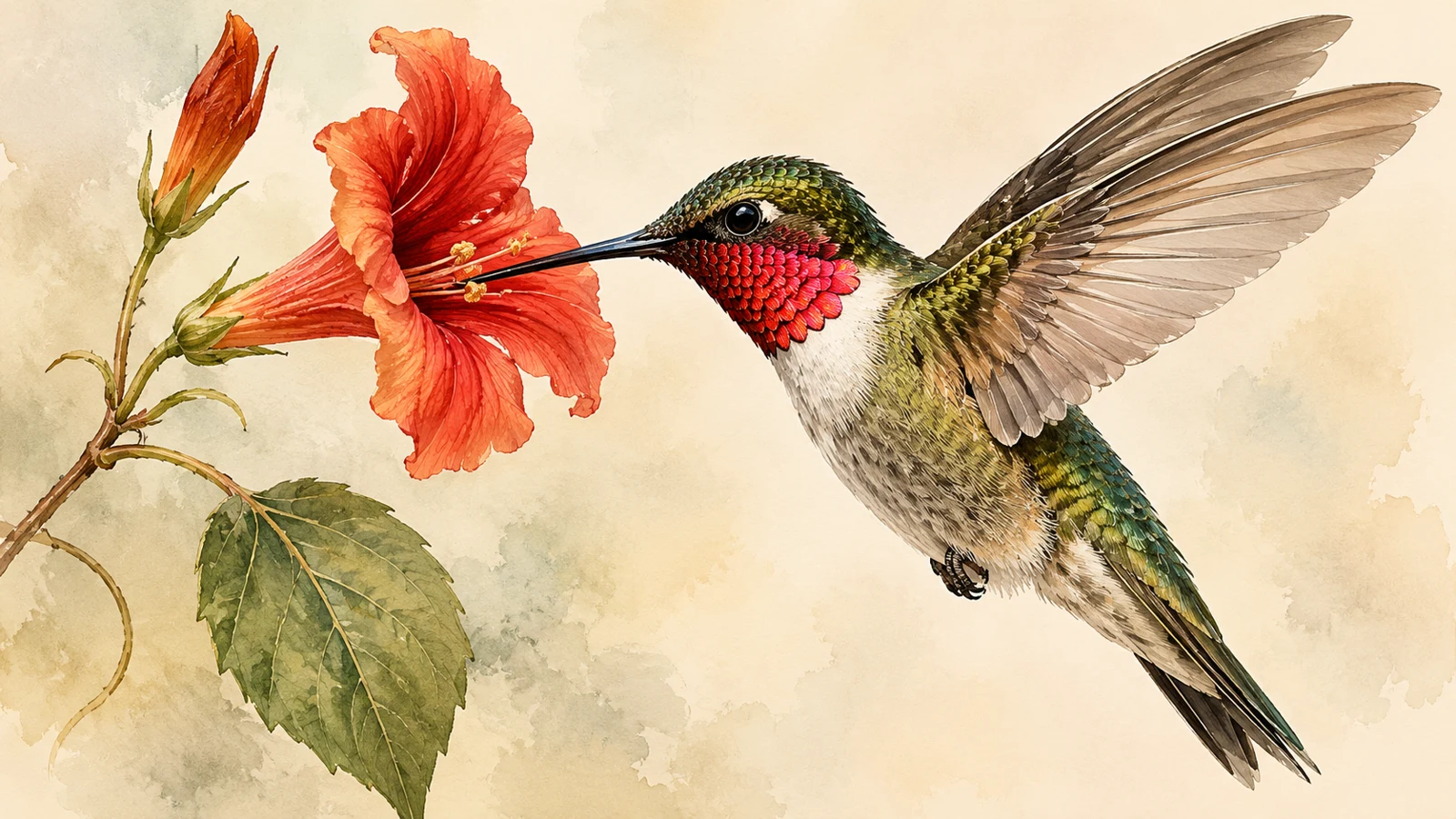
The gorget is the giveaway, when the light is right. When light hits a male’s throat head-on, the iridescent ruby-red explodes into one of the most saturated colours in North American nature. Tilt the angle 30 degrees and it goes flat black. The colour is structural, not pigmented - microscopic platelets in the feather barbs interfere with light to produce the red, the same physics that makes a Morpho butterfly blue.
| Feature | Adult male | Adult female | Juvenile |
|---|---|---|---|
| Back | Iridescent emerald green | Iridescent green | Green with buff edges |
| Throat (gorget) | Iridescent ruby-red (black at the wrong angle) | White, occasionally with a few dark streaks | Plain white or lightly streaked |
| Belly | Pale grey-white | White with greenish flanks | White |
| Tail | Notched, all dark | Rounded, white tips on outer feathers | White tips |
| Bill | Long, slim, slightly decurved | Same | Same |
Common confusions: Black-chinned Hummingbird where ranges overlap in central Texas; Rufous Hummingbird as an autumn vagrant; clearwing moths (Hemaris species) that hover at the same flowers and confuse new birders consistently. See Birds that look like hummingbirds.
Voice and flight
Hummingbirds do not sing.
- Call. A dry ticking tchew tchew tchew, faster when irritated. Used at feeders to warn off rivals.
- Wing hum. Roughly 53 wingbeats per second, the lower end of hummingbird wingbeat rates. The pitch lifts when the bird accelerates.
- Display dive. The male’s courtship dive ends in a sharp zik produced by air rushing through his outer tail feathers as he pulls out of the dive. Not voice. Aerodynamics.
The wingbeat is the most-cited number. At 53 beats per second the figure-eight motion of each wing produces lift on both the upstroke and the downstroke, which is rare in birds and shared mostly with insects. The hovering hummingbird is functionally a small jet doing low-altitude precision work.
The Gulf crossing
This is the part of the species’ biology worth dwelling on.
A Ruby-throat preparing to migrate south in late August roughly doubles his body weight. A 3-gram bird becomes a 6-gram bird, the extra mass entirely fat. The fat is stored in the body cavity and along the flanks. The bird now has enough metabolic fuel for somewhere between 20 and 26 hours of continuous flight.
The southward crossing of the Gulf of Mexico starts in the late afternoon on the US Gulf Coast, runs through the night and the following morning, and ends - if the wind cooperates - on the Yucatan peninsula. The bird burns through nearly all of his fat reserves in the process and arrives at his Central American wintering grounds weighing roughly what he weighed before migration began.
The northern crossing in April is the same flight in reverse. Birds arriving on the Texas coast in late March can be three grams - the weight of a thin piece of paper - because they have burned everything they had crossing open water.
Some birds skip the Gulf and take the longer coastal route around it. Banding studies suggest about a third of the population goes around. The other two-thirds go across.
Range and arrival
| Month | Where the bird is |
|---|---|
| February | Beginning to leave Central American wintering grounds |
| March | Arriving on US Gulf Coast, moving north along the eastern seaboard |
| April | Reaching the Carolinas, Tennessee, Kentucky |
| May | Reaching the Great Lakes and southern Canada |
| June to July | Breeding |
| August | Pre-migration fat accumulation, peak feeder use |
| September | Southbound migration begins |
| October | Last birds leaving the US east coast |
If you want to know when the bird will arrive in your yard, the eBird community tracks weekly progress at species level on its website. The leading edge each spring is highly predictable to within a few days.
Diet
A hummingbird’s metabolism is the highest of any vertebrate by mass. He needs to feed roughly every 10 minutes during waking hours and goes into torpor overnight to survive.
- Nectar. From red, orange and pink tubular flowers - trumpet creeper, bee balm, cardinal flower, salvia, jewelweed, columbine. Wild nectar runs 20 to 25 per cent sugar.
- Small insects and spiders. Mosquitoes, gnats, aphids, fruit flies. Insects supply the protein nectar cannot. Females especially take large amounts of insect protein during nesting.
- Feeder sugar water. 4 parts water to 1 part white table sugar, boiled briefly and cooled. No red dye, no honey, no organic sugar, no brown sugar. Change every 2 to 3 days in hot weather, weekly otherwise.
The 4:1 ratio is not arbitrary. It matches wild nectar concentration closely enough that the bird’s digestive physiology recognises it as food. Stronger ratios can cause kidney problems. Weaker ratios are not energetically worth the bird’s time.
Full feeder strategy: How to attract hummingbirds, Where to hang a hummingbird feeder, Cleaning hummingbird feeders with vinegar.
Nesting
The nest is the size of a walnut shell and is one of the most refined structures in nature.
| Feature | Detail |
|---|---|
| Site | Top of a downward-sloping branch, 3 to 12 m up. Often oak, hornbeam, beech. |
| Builder | Female only. The male provides no parental care. |
| Materials | Plant down (cattail, dandelion, thistle) bound with spider silk |
| Camouflage | Outer surface decorated with lichen flakes, indistinguishable from bark |
| Clutch | 2 white eggs, each the size of a coffee bean |
| Incubation | 12 to 14 days |
| Fledging | 18 to 22 days |
| Broods per year | 1 to 2 |
The spider silk is the architectural feature. The silk’s elasticity lets the nest stretch as the chicks grow without splitting, an engineering trick most nest-building birds do not have.
The male contributes sperm and nothing else. Hummingbird mating systems are polygynous: a single male may father chicks at three or four nests in his territory, and he leaves all parental care to the females.
Territorial behaviour
A male Ruby-throat is one of the most aggressively territorial small birds in North America. He will defend a feeder against everything that comes near it: other hummingbirds, large insects, sometimes warblers and chickadees.
The fix for the feeder bottleneck is to hang multiple feeders out of sight of each other. Two feeders 20 metres apart, with vegetation between them, can support a small flock. Two feeders 2 metres apart will produce one bird and a permanent fight.
Torpor
On cold autumn nights a Ruby-throat can drop his body temperature from 40 C to as low as 18 C, slow his heart rate from 1,200 beats per minute to 50, and pause breathing for short intervals. He wakes at dawn, shivers his way back to operating temperature in about 20 minutes, and starts feeding before he has finished warming up.
The torpor is not hibernation. It is daily metabolic management at the edge of viability for a 3-gram body in a temperate climate. Without it, the bird could not survive his own life.
Folklore
In Aztec mythology hummingbirds were the souls of warriors fallen in battle and the god Huitzilopochtli was depicted with a hummingbird’s head. In Caribbean folklore the bird carries messages between the living and the dead. In modern Western culture the bird has become a near-universal symbol of resilience, joy and the present moment - a symbolic load that is, frankly, more weight than a 3-gram body should have to carry.
See Hummingbird symbolism and spiritual meaning for the longer reading.
Print available
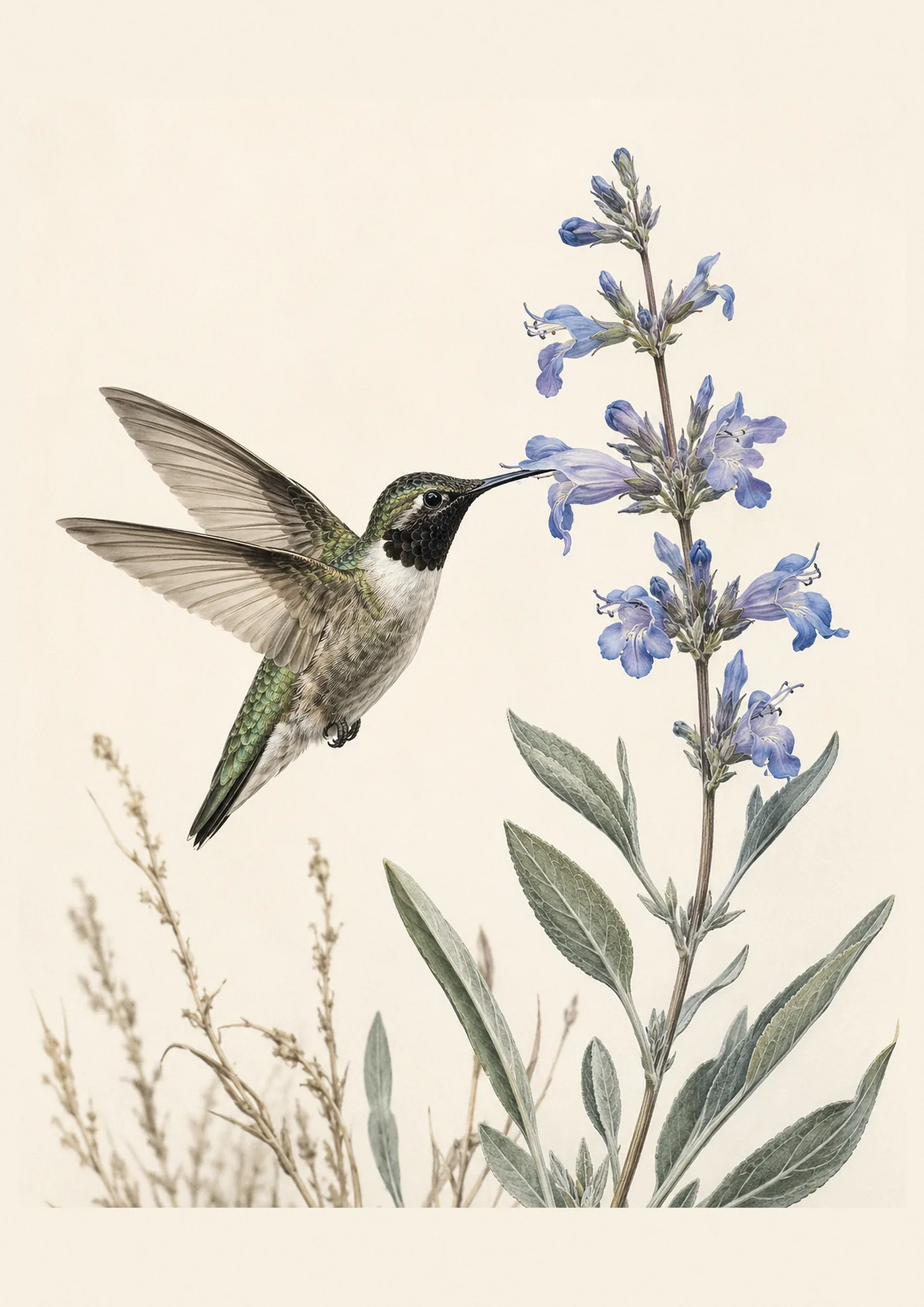
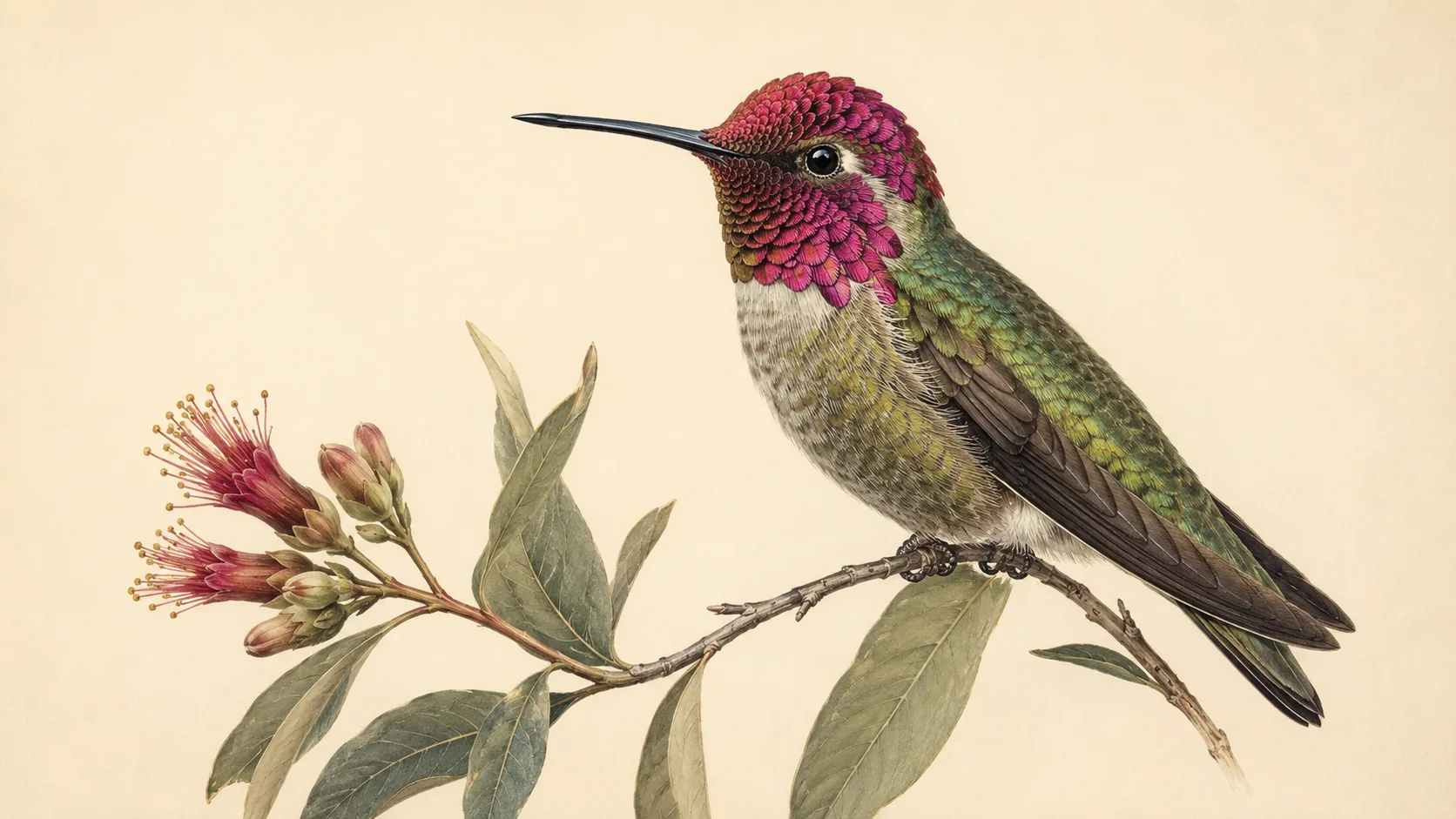
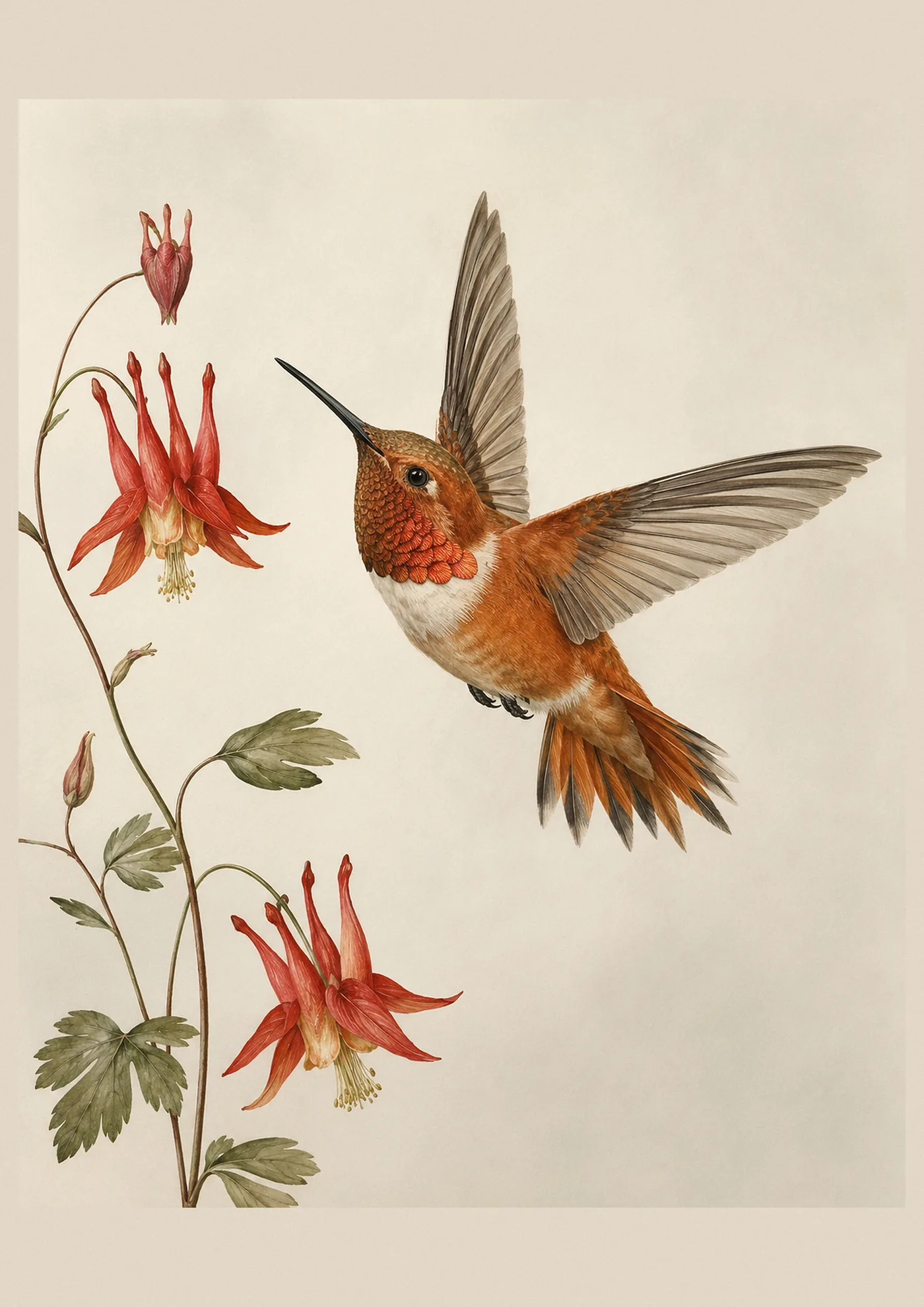
A study of a male Ruby-throat hovering at a trumpet creeper bloom is available as the Ruby-throated Hummingbird Print, and the bird appears in the Hummingbird Trio Print collection.