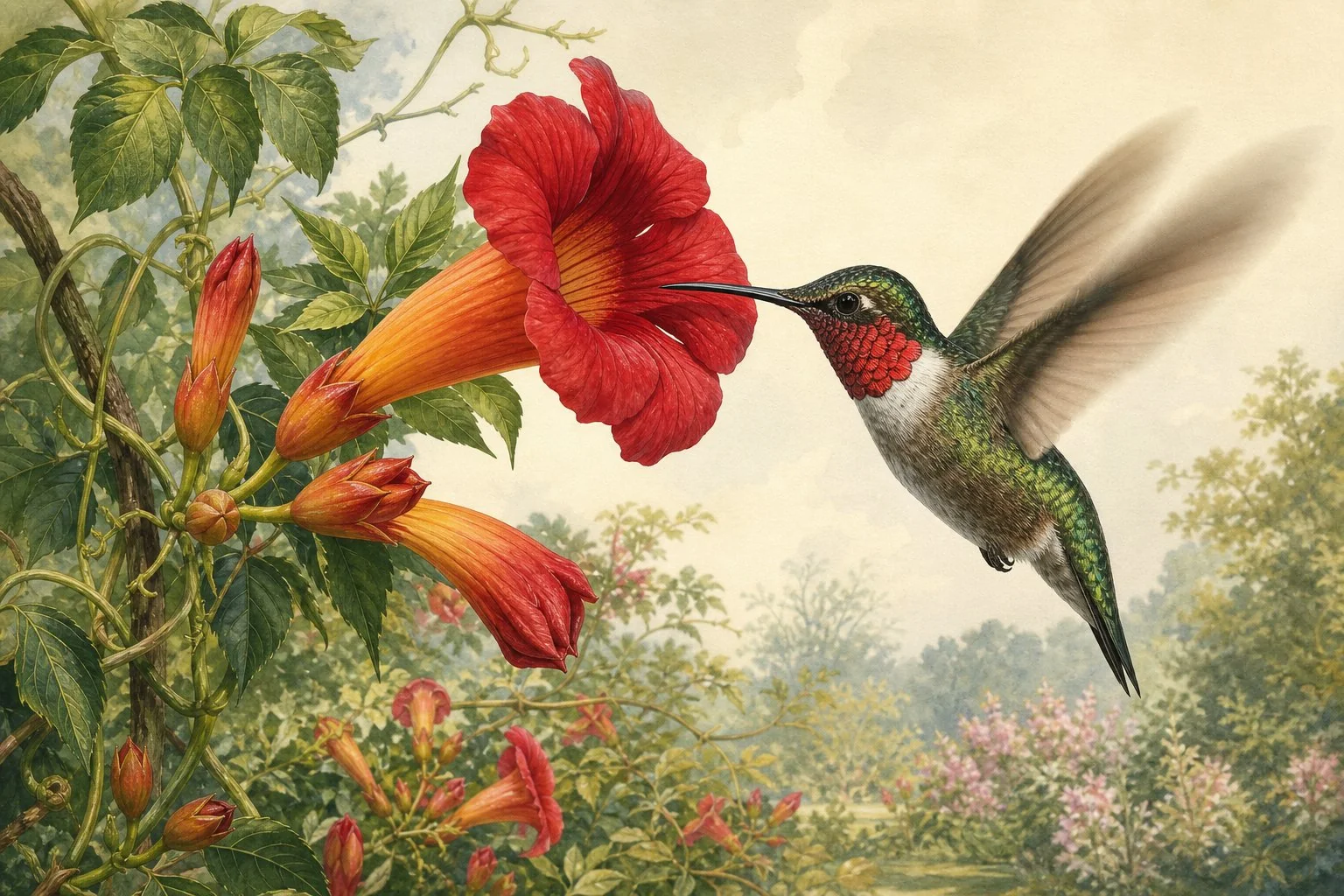
Symbolism
The Hummingbird Was a War God Before It Was a Grief Symbol
The “hummingbird after death” belief has no documented origin before the early 2000s.
This is the thing the grief blogs do not say, because they are not in the business of saying it. Hundreds of websites assure the newly bereaved that a hummingbird at the window is a message from their loved one, that this is an ancient tradition, that “many Native American cultures” hold this belief. None of them name a specific culture. None of them cite a source. The belief as it circulates today is modern internet folklore, assembled from pieces of genuine traditions that it has substantially distorted.
The genuine traditions are more specific, more interesting, and structurally different from what gets passed around online.
The Aztec Source: A War God, Not a Comfort Symbol
The best-documented pre-Columbian hummingbird symbolism belongs to the Nahua people of central Mexico, who built Tenochtitlan where Mexico City now stands.
Their supreme war god was Huitzilopochtli. The name is Nahuatl: “huitzilin” (hummingbird) plus “opochtli” (left, or south). “Hummingbird of the South” is the more precise translation, though “Left-handed Hummingbird” appears in scholarship. Left-handedness in Aztec thought carried associations of trickery and danger. This was not a gentle deity.
The birth myth is recorded in the Florentine Codex, compiled 1577 to 1579 by Franciscan friar Bernardino de Sahagun with indigenous collaborators. The goddess Coatlicue, “She of the Serpent Skirt,” was sweeping on Coatepec mountain during a ritual when a ball of white feathers drifted down from the sky. She tucked it against her body. It impregnated her. Her existing children, the daughter Coyolxauhqui (“She of the Golden Bells”) and 400 sons called the Centzonhuitznahua, were furious at the apparent dishonor. They plotted to kill her.
At the moment they attacked, Huitzilopochtli was born fully grown and armed for war. He seized his xiuhcoatl, the lightning serpent weapon, dismembered Coyolxauhqui, and routed the 400 sons before they could reach his mother.
A god born from a ball of feathers is already a feathered being before the cosmological battle begins.
The Warrior Reincarnation Belief
Here is the tradition that grief culture has borrowed and softened into something unrecognizable.
Aztec warriors who died in battle were believed to accompany Huitzilopochtli on his journey across the sky - specifically the morning half, from sunrise to noon. After four years as solar companions, they descended to earth reincarnated as hummingbirds and butterflies. Women who died in childbirth received the same honor: they accompanied the sun on the afternoon journey.
The Dumbarton Oaks online exhibit, maintained by the Smithsonian-affiliated research institute in Washington, states it directly: “The hummingbird was one of the most sacred animals for the Nahuas, as it symbolized the patron god Huitzilopochtli. Those who perished in battle or as sacrificial victims were honored by being allowed to accompany the sun in its travels, and after four years, these glorified souls were resurrected as hummingbirds or butterflies.”
The four-year transition is not incidental. The warriors first serve as sun-companions, a position of elevation and honor, and only then return as hummingbirds. The number four had cosmological weight in Aztec calendar reckoning. This is a structured process, not a spontaneous visitation.
The modern grief belief strips out the warfare, the sacrifice, the solar cosmology, the four-year calendar, and the restriction to warriors. It keeps only the husk of “death to life transformation” and applies it to any recently deceased individual, regardless of how they died or what culture they belonged to. The bird sacred to the Aztec god of war now decorates sympathy cards.
The Featherworkers of Tenochtitlan
The amanteca, the featherworkers, occupied their own social class in Tenochtitlan and lived in a district called Amantla. The Florentine Codex documents their craft in detail, including illustrations. They worked hummingbird feathers alongside quetzal, macaw, and cotinga to create mosaics of extraordinary precision - cloaks, shields, headdresses, and fans. Feathers in Aztec culture were as valuable as jade and turquoise.
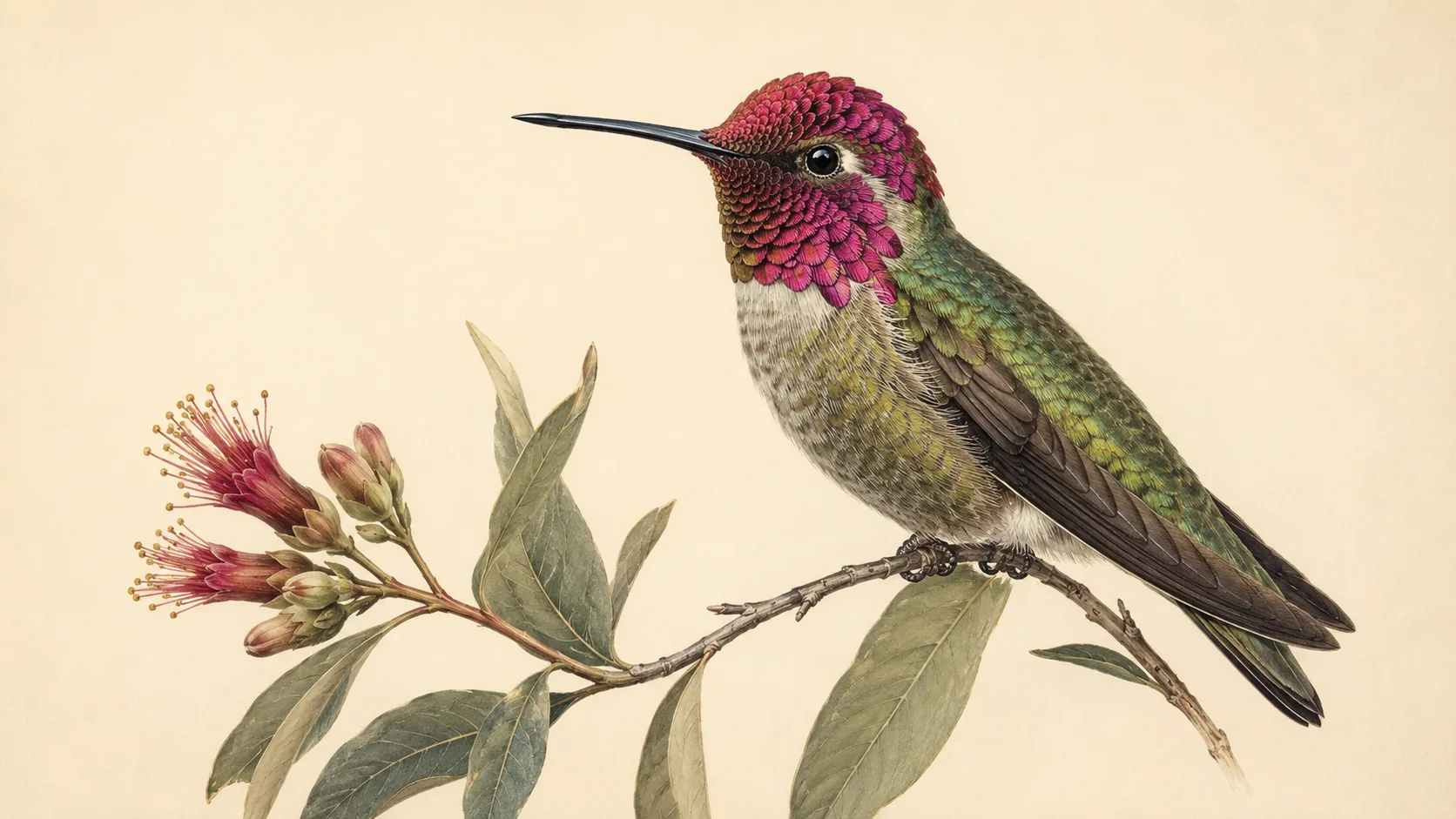
The optical property of hummingbird feathers was not lost on them. The gorget of a ruby-throated hummingbird is not pigmented red in the conventional sense. The color is structural. Stacks of hollow, flattened melanin granules in the feather barbules create interference between light waves: at one angle, waves reinforce each other and the feather blazes scarlet. At ten degrees difference, waves cancel and the feather looks black. The amanteca were working with a live material. Featherwork mosaics would have looked different in torchlight, in sunlight, from across the room. Static pigment cannot do that.
After the Spanish conquest of 1521, this craft merged with Catholic iconography. Indigenous craftsmen in Michoacan made feather-mosaic images of Christ and the Mass of St. Gregory using the same techniques and some of the same bird species. The three major surviving Aztec featherwork pieces are in the Vienna Museum of Ethnology. The syncretism was rapid and forced, but the craft that carried it was ancient.
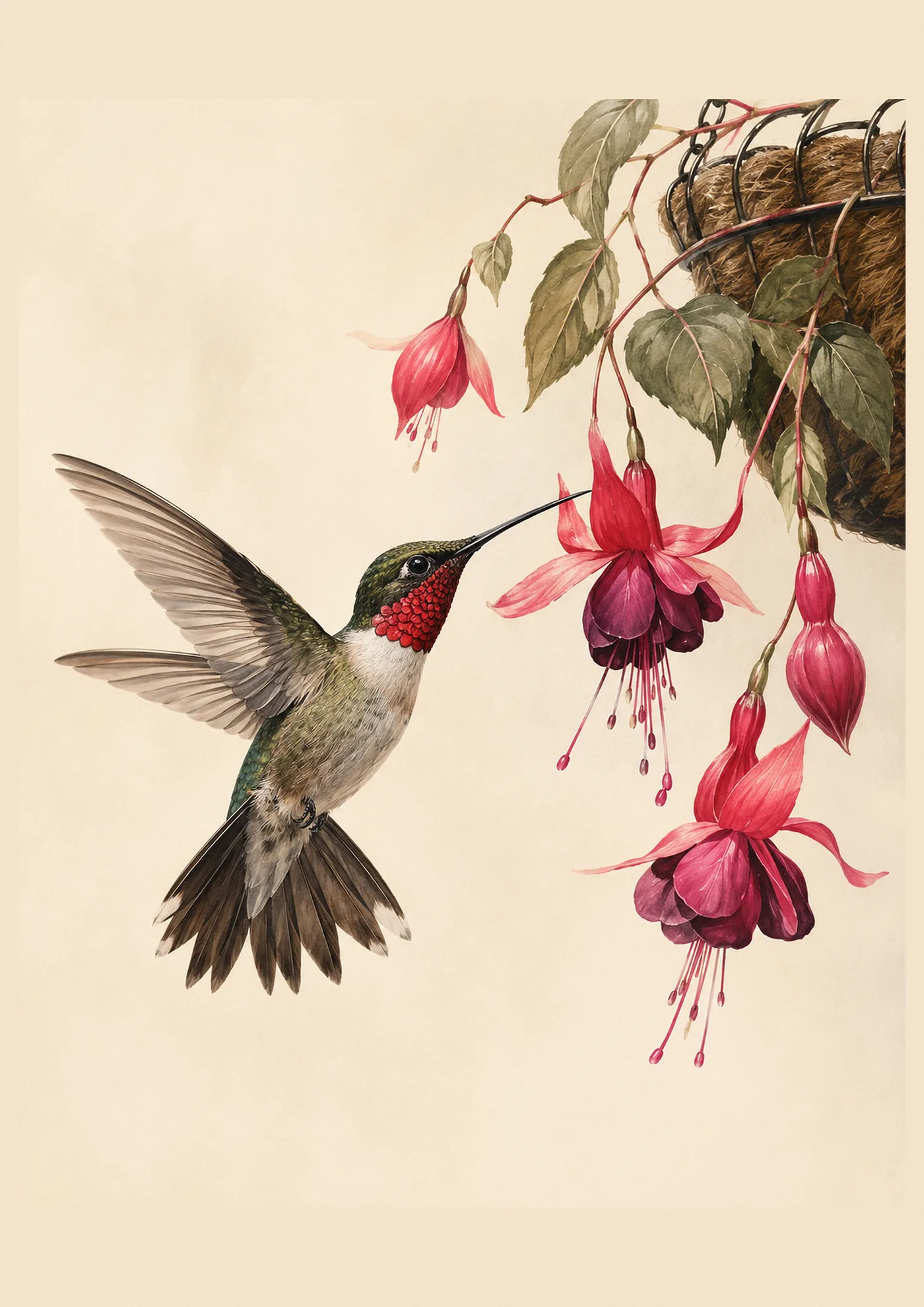
The Cherokee Tobacco Story
The Cherokee tradition comes from documented fieldwork, not internet aggregation. James Mooney recorded it for the Bureau of American Ethnology in “Myths of the Cherokee,” published in 1900.
In the beginning, there was one tobacco plant, guarded by the Dagul’ku geese in the far south. The people depended on tobacco, and an old woman was dying without it. Various animals tried to retrieve the plant. All were killed by the geese, who could see them coming. The hummingbird volunteered. The others dismissed it as too small. The hummingbird flew south, and because it was so small and flew so fast, the Dagul’ku could not see it. It seized the top of the tobacco plant - the leaves and seeds - and was gone before the geese understood what had happened.
The old woman had fainted by the time it returned. They thought she was dead. The hummingbird blew tobacco smoke into her nostrils and she opened her eyes, crying out “Tsa’la!” - Tobacco.
The structural elements: the bird succeeds where larger creatures fail because of its smallness and speed. The woman who appears dead is revived. This is a resurrection-adjacent structure, but the subject is tobacco and communal survival, not personal grief. The revived woman does not receive a visitation from a deceased loved one. She receives medicine.
The Hopi Hummingbird Kachina
The Hu kachina, the hummingbird figure in Hopi ceremonial tradition, is depicted with a green mask and green moccasins, carved from cottonwood root. The academic treatment is in Polly Schaafsma’s “Kachinas in the Pueblo World.”
In Hopi belief, the hummingbird interceded with the gods on behalf of the Hopi people to bring rain. The subject is agricultural abundance, not individual loss. The hummingbird here functions as a specific kind of intermediary: it moves between the human world and the spirit world, and the spirit world is associated with flowers, rain, and growth. The “flower world” in Hopi cosmology is real and documented.
That is a specific role with a specific subject matter. It is not interchangeable with grief visitation.
The Mayan Sun Disguised
A peer-reviewed paper in the journal Ancient Mesoamerica, published by Cambridge University Press, documents a distinct Mayan pattern: the hummingbird as the sun temporarily in a small and vulnerable form.
In Kekchi Mayan tradition, the ancestral hero Xbalanque transforms into a hummingbird to woo the daughter of an Earth God while she is weaving. In Tz’utujil Mayan tradition, a weaver named YaSar finds a hummingbird - identified as the Sun - lying on the floor and places it between her breasts. Her son from this union is a solar deity. The hummingbird here is the sun in a moment of weakness and smallness, capable of intimacy and concealment in that form.
This rhymes with a biological fact that pre-scientific observers would have witnessed directly.
The Biology of a Near-Death
A hummingbird in torpor hangs upside down on a branch, bill tilted upward, feathers fluffed, completely motionless. It does not respond to touch or sound. Its body temperature is near ambient air temperature. In cold mountain environments it would feel cold to the touch. By every observable standard it would appear dead.
Its heart rate during torpor: 40 to 50 beats per minute. In active flight: more than 1,200 beats per minute. The range from 40 to 1,200 in a single creature is without equivalent in warm-blooded animals.
At sunrise, it begins to shiver. It warms itself using its own flight muscles as a furnace, approximately one degree per minute. Within an hour it is feeding.
In November 2020, researchers from the University of New Mexico published a paper documenting that a black metaltail hummingbird in the Peruvian Andes entered torpor at 3.26 degrees Celsius. That is the lowest body temperature ever recorded in a bird or non-hibernating mammal. The bird was, by any physiological standard, nearly dead. Then it was not.
Father Juan Eusebio Nieremberg, a Spanish Jesuit natural historian working in the 17th century, wrote of the hummingbird: “It is a small bird, but through an amazing providence it dies to live again. It thinks it will die happy on the wood from which it will rise again.” He explicitly equated torpor with the Resurrection of Christ. This is the earliest documented European theological reading. Nieremberg was a natural historian trying to fit American fauna into a Christian cosmological framework. He was not being sentimental. He was doing comparative theology.
Whether specific pre-Columbian traditions explicitly theorized about torpor as resurrection is not documented in sources found. What is documented: the Aztec warrior-reincarnation belief, the Andean association of the hummingbird with resurrection, and the Mayan sun-in-hummingbird-form myth are all structurally compatible with a torpor observation. The bird that dies every night and rises at dawn is a natural resurrection symbol in any culture that watches it closely enough.
In a culture that worshipped a sun god and believed warriors accompanied the sun across the sky, a small bird that appeared to die at sunset and revive at sunrise would carry obvious resonance.
What the Bird Actually Is
Some biological facts that anchor everything above.
Hummingbirds cannot walk. Their legs evolved for perching and hovering. They lack functional knees for ground movement. On the ground a hummingbird can shuffle sideways on a perch. It exists in two states: flying or perched. There is no in-between, no gradual transition, no contact with the earth in motion. A creature that never walks is a natural symbol of between-states, of sustained suspension.
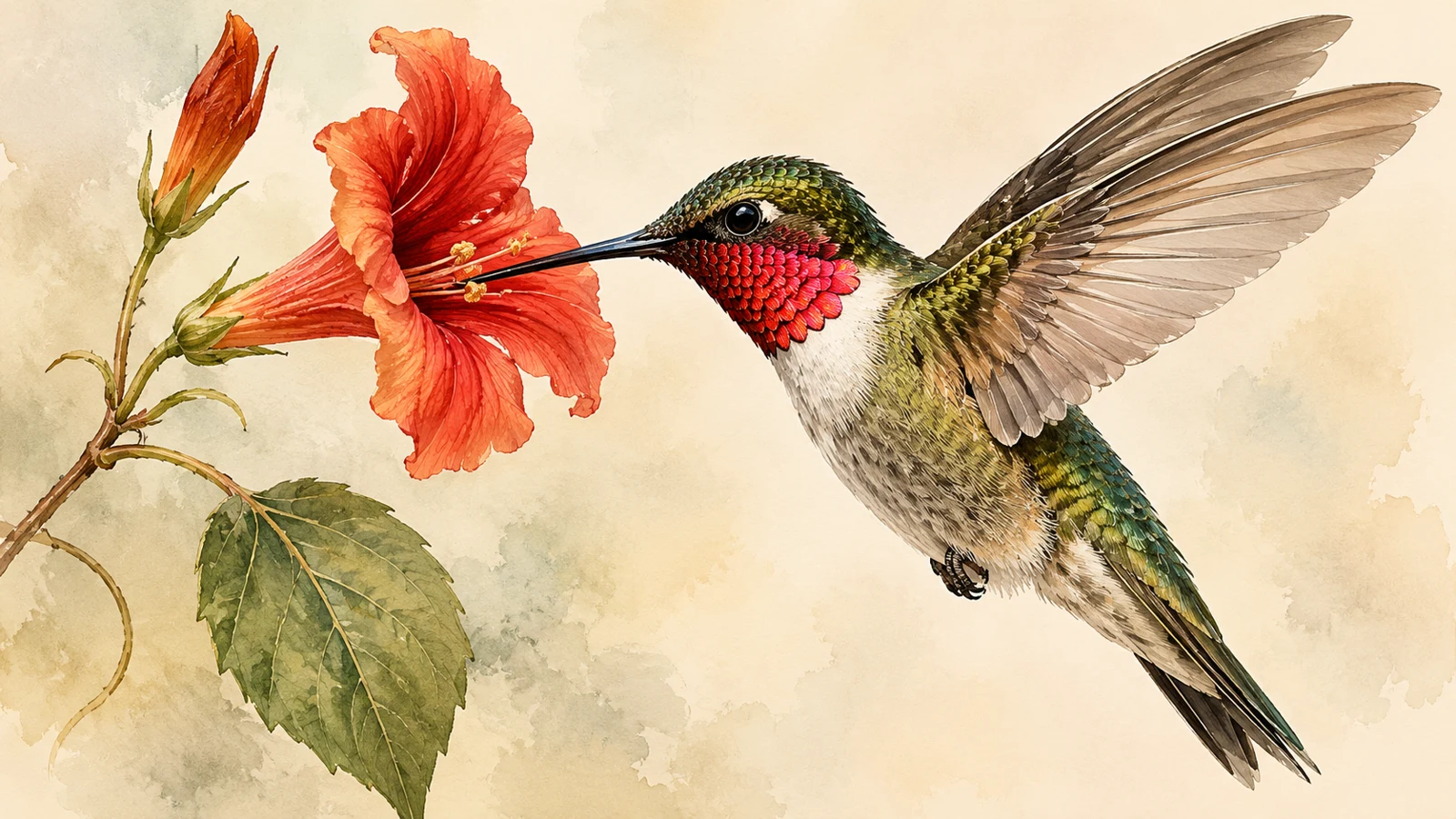
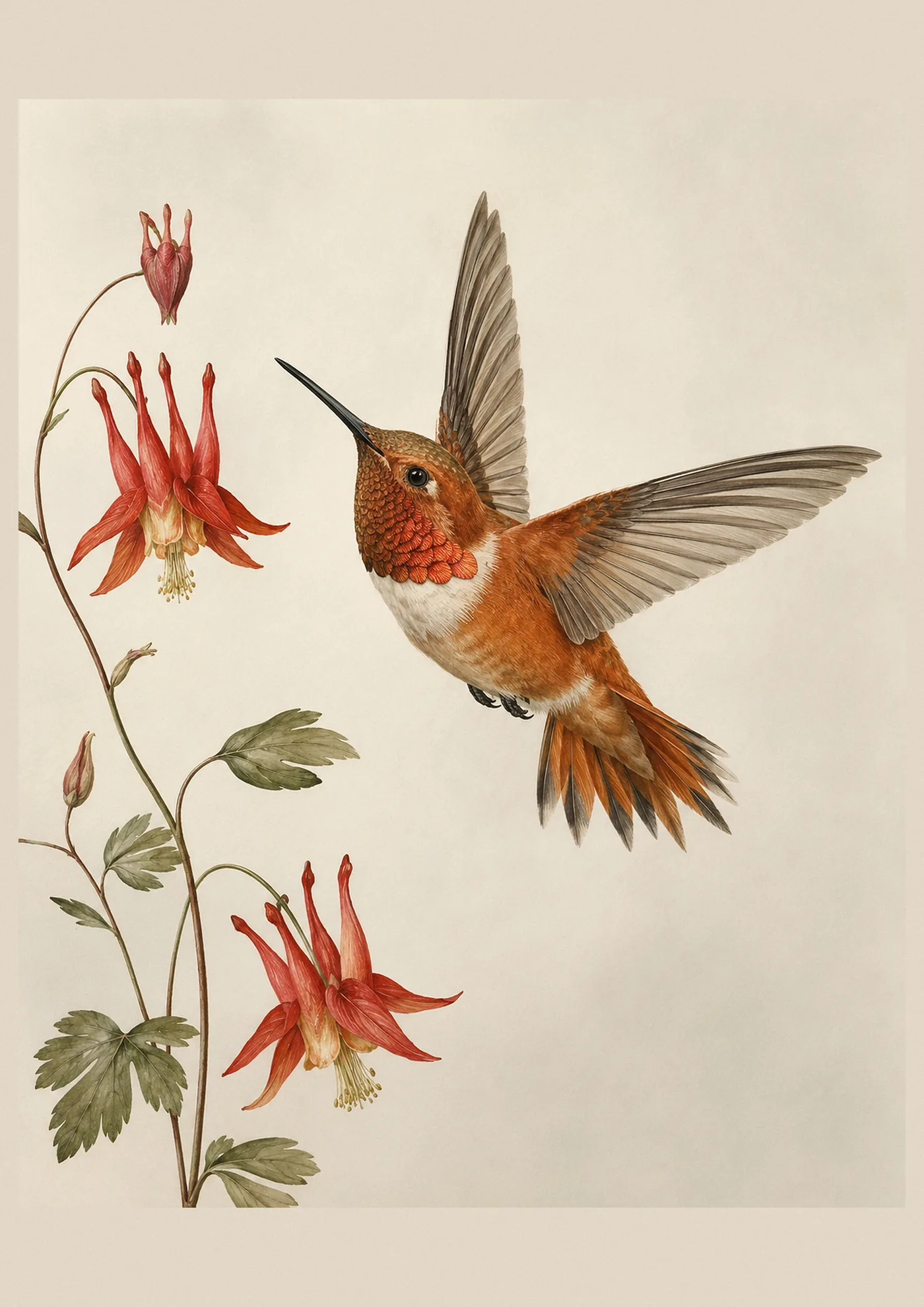
The rufous hummingbird weighs 3 to 4 grams and migrates nearly 4,000 miles, from wintering grounds in southern Mexico to breeding grounds in Alaska and Canada. This is one of the longest migrations relative to body size of any bird. The ruby-throated hummingbird crosses the Gulf of Mexico non-stop, 18 to 20 hours over open water, approximately 500 miles. The wings beat 70 times per second in direct flight, more than 200 per second while diving. The humming sound that names the bird in English is that frequency.
Hummingbirds cannot smell flowers. They navigate by color, strongly preferring red. Their relationship to flowers is purely visual and caloric. There is no scent, no poetry, just extraction at 1,200 heartbeats per minute. The sweetness and joy that people project onto them is entirely human projection.
All 328 living hummingbird species are native to the Americas. There are no hummingbirds in Europe, Asia, Africa, or Australia. The fossil genus Eurotrochilus existed in Germany, France, and Poland 28 to 34 million years ago but went extinct during Oligocene cooling, long before human beings arrived in Europe. No European, Asian, African, or Oceanian culture has any indigenous hummingbird symbolism. Every tradition involving the hummingbird is American.
The European Encounter
When Spanish explorers reached the Americas, the hummingbird created a category problem.
Their names for it reveal the failure: “pajaro-musca” (bird-fly), “pajaro-mosquito” (little bird-fly), “joyas voladoras” (flying jewels). The last name is the one that stuck aesthetically. The English name is behavioral. Every name is a separate attempt to classify something that fit nothing.
Early observers questioned whether hummingbirds were birds at all. Something smaller than any European bird, hovering like a bee, feeding on flowers like an insect, displaying colors that shifted from brilliant to black depending on the angle - their conceptual frameworks simply did not accommodate it.
Jean de Lery, a French sailor, was among the first Europeans to describe a hummingbird in writing, in a journal of his 1556 to 1557 travels on the Brazilian coast. Within decades, Aztec featherwork objects entered European collections, and the syncretism was underway: indigenous Michoacan craftsmen making feather-mosaic images of Christ, hummingbird feathers in Catholic reliquaries, the war-god’s bird now decorating devotional objects for the conquerors’ religion.
Nieremberg’s resurrection reading, written a century later, is the endpoint of that process: a Jesuit natural historian converting a biological observation into a theological argument, using American fauna to illustrate Christian doctrine. The grief-hummingbird association circulating online now is structurally his idea, secularized and sentimentalized over four more centuries.
The Honest Accounting
The “hummingbird appears after death as a message” belief is real as a contemporary folk practice. It provides genuine comfort to bereaved people. That is not nothing.
But it is not ancient. Its claim to indigenous authority is borrowed from traditions it has substantially changed. The Aztec warriors who reincarnated as hummingbirds were not sending personal messages to surviving family members: they were serving a four-year cosmological function as solar companions of a war god before returning to earth in a new form. The Cherokee hummingbird revived a dying woman with tobacco smoke, not with reassurance. The Hopi hummingbird petitioned for rain.
The grief belief keeps the bird and removes everything that makes the actual traditions worth knowing.
There is something worth sitting with in the actual biology. A creature that drops to 3 degrees above freezing every night and climbs back to full metabolic fire by dawn, every day of its life, is enacting something that every culture that watched it closely enough found worth making sense of. The Aztec featherworkers knew the gorget’s light changed depending on where you stood. The Jesuit natural historian knew the bird appeared to die and return. The Andean traditions knew the same thing.
Those observations are documented. They point to something real about the bird.
What the bird is not: a messenger dispatched by recently deceased individuals to the living. That is a modern comfort, not an ancient one, and the difference matters for reasons beyond pedantry. The actual traditions are stranger, older, and built on closer attention to what the bird physically does.
A creature that cannot walk, migrates 4,000 miles on wings the size of a thumbnail, dies every night, and is born again at sunrise was always going to mean something. The meaning got there by observation. Not by grief, and not by algorithm.