Field Guide
Rufous Hummingbird
Small enough to sit in the palm of a hand. Bold enough to chase off birds many times its size.
The Rufous Hummingbird is little more than a few grams of muscle and temper. It weighs about as much as a coin. And yet it crosses thousands of miles each year, glowing like a struck match the whole way.
How to know it
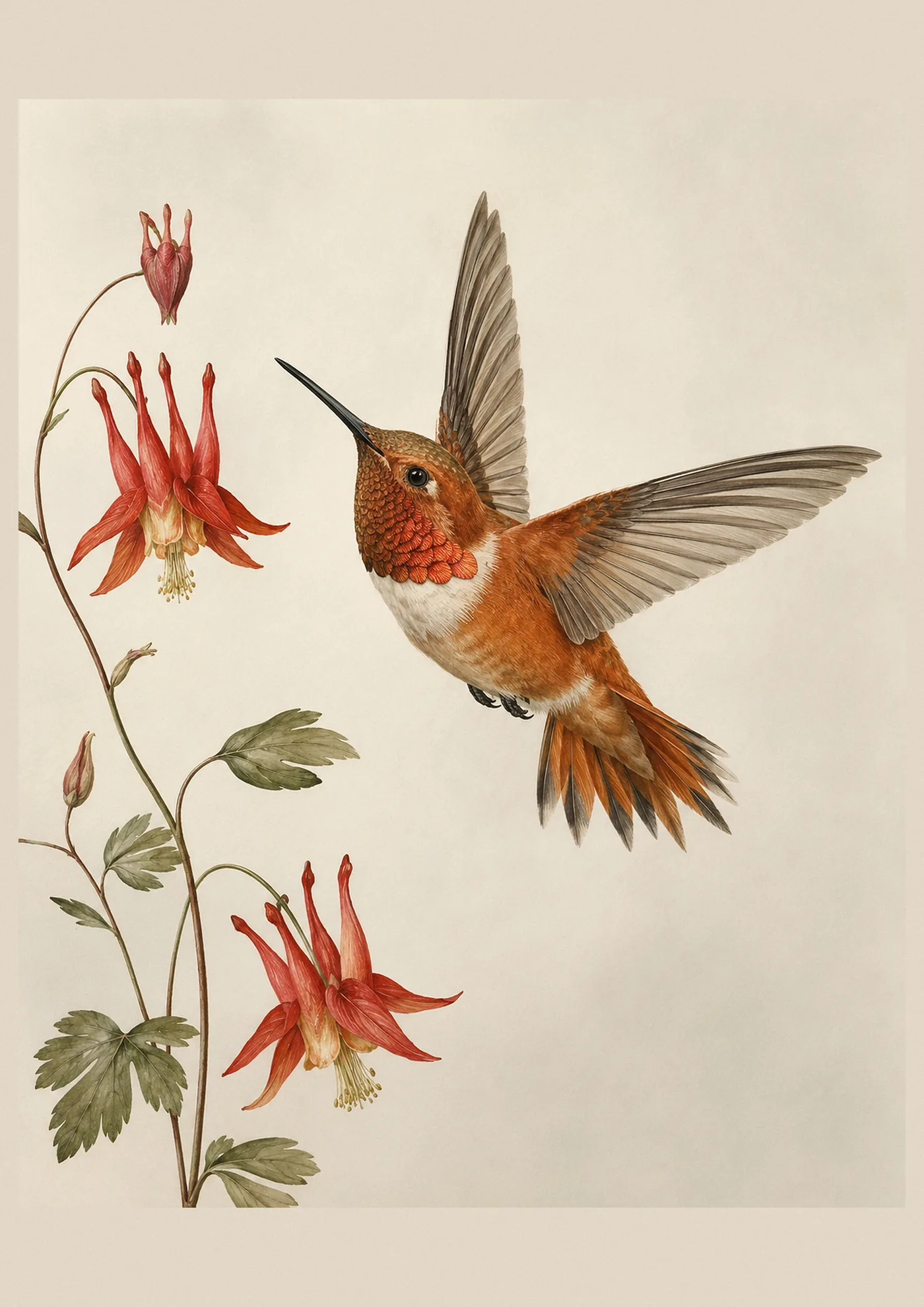
The adult male is the giveaway. A warm copper-orange across the back, flanks and tail, with a white breast and a throat that burns from scarlet to molten gold as the light shifts. That throat patch is called a gorget, and on this bird it is one of the most striking in North America.
Females and young birds are quieter. Green above, with a flush of rufous on the flanks and tail, white-tipped tail feathers, and often a small spot of orange at the throat.
It is one of the smallest birds you will ever see well. Roughly 7 to 9 centimetres, with a wingspan a touch over 11. The body is compact, the bill straight and needle-fine, the whole thing humming in the air.
Range and habitat
Few birds travel like this one.
The Rufous breeds further north than any other hummingbird, reaching well into Alaska and across the Pacific Northwest and western Canada. It favours open woodland, forest edges, meadows and mountain clearings where flowers run thick.
Then it turns around. Come autumn it loops south through the western mountains to winter in Mexico, a round trip that can run to thousands of miles. For its size, it is one of the longest migrations of any bird on Earth.
It is a regular visitor to garden feeders right along that route.
Behaviour
Fierce is the only word.
The Rufous is famously territorial. A single bird will guard a patch of flowers or a feeder with real aggression, diving at rivals, larger hummingbirds and sometimes anything that wanders too close. It backs the temper with speed and a tight, darting flight.
It feeds on nectar, working flower after flower, and takes small insects and spiders for protein. Like all hummingbirds it can hover, rise, drop and fly backwards, the wings a blur that barely seems to move.
A note of concern sits behind the bright feathers. The species was uplisted to Near Threatened in 2018, with declines linked to habitat loss and the wider fall in insect numbers it depends on.
Voice
Not a singer. The Rufous talks in sharp, ticking chip notes and dry, buzzy chatter, often delivered in a quick scolding run when another bird intrudes.
The deeper sound is the wings. In a steep courtship dive the male’s feathers produce a distinctive whine and pop, a small mechanical music made by flight rather than throat.
Stillness, from a bird that almost never holds still.
Print of this bird: /shop/rufous-hummingbird-in-flight/