Field Guide
Black-chinned Hummingbird
A small bird that seems made of patience and speed at once. The Black-chinned Hummingbird is a familiar visitor across the dry West, easy to overlook until the light turns and its throat catches fire.
How to know it
Start with the size. This is a tiny bird, around 9 to 11 cm long, with a wingspan of just 12 to 14 cm and a weight measured in grams.
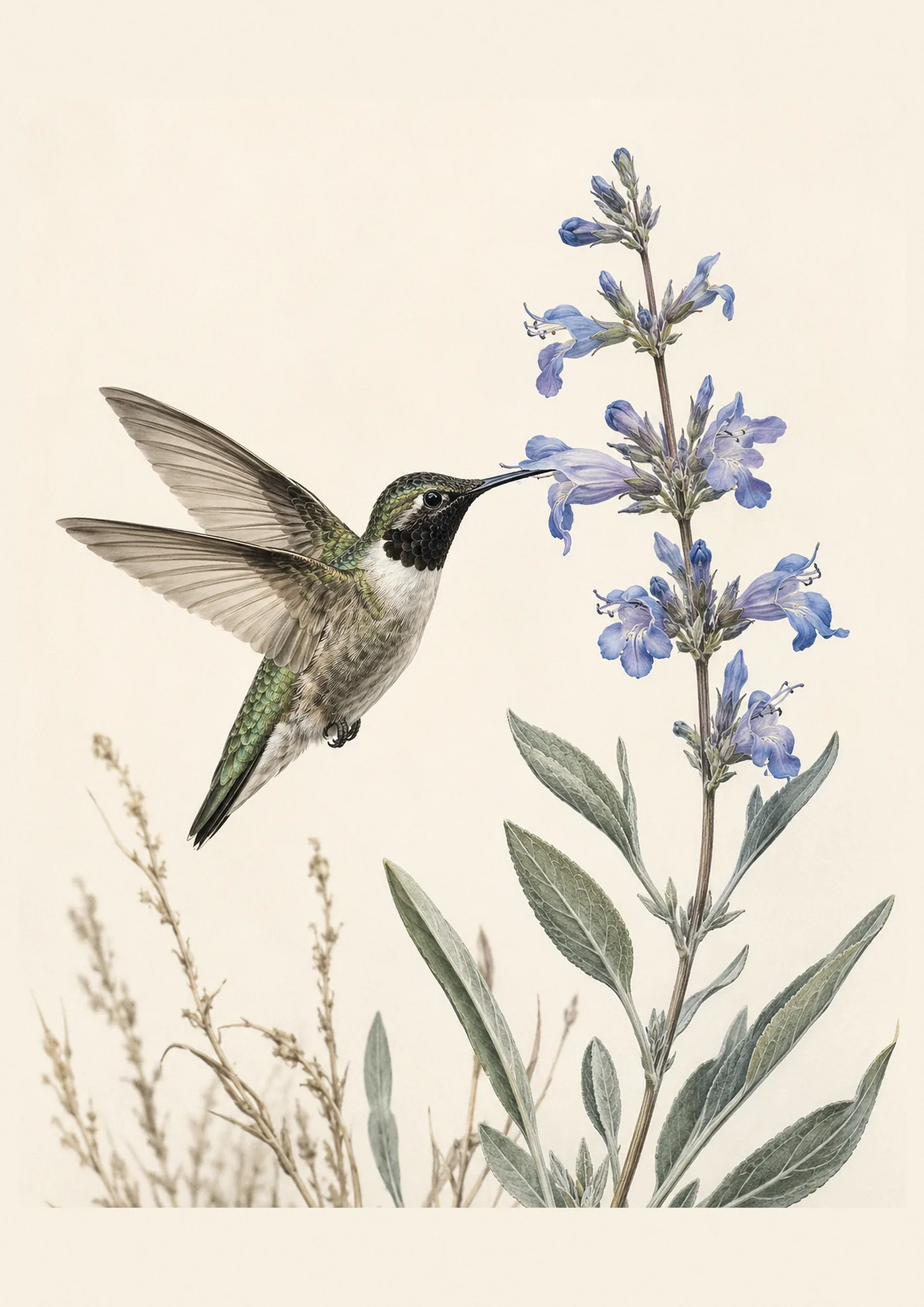
The back is a dull metallic green. The underparts are pale, washed grey and white. The bill is long, straight, and needle-thin.
The name points to the male’s throat. At rest it looks plain black. Tilt your head, or wait for the bird to turn, and a narrow band of iridescent violet flares along the lower edge. That violet is the giveaway.
Females and young birds lack the throat colour. They show a plain pale throat and a green back, and can be hard to separate from other small western hummingbirds.
Range and habitat
This is a bird of the American West. It breeds from southern British Columbia down through the western United States, into Oregon, Washington, California, Utah, Colorado, New Mexico, and Texas.
It favours dry, open country. Canyons, foothills, river groves, desert washes, and increasingly suburban gardens with feeders.
In winter most birds withdraw to the west coast of Mexico, though some now linger along the Gulf Coast in the cooler months.
Behaviour
Watch it feed and you watch it hover. The bird holds station in the air at a flower or a feeder, body still, wings a blur, then darts sideways or drops in an instant.
It takes nectar from tubular blooms and feeders, and snaps up small insects and spiders for protein.
The male displays with a steep pendulum flight, swinging back and forth in a wide arc to impress a watching female.
It is bold for its size. A Black-chinned Hummingbird will chase off rivals many times its weight from a favoured patch of flowers.
Voice
The voice is thin and soft, easy to miss. A quiet, dry chip note, often given from a high bare perch.
There is no rich song here. The real sound of this bird is mechanical. A low, dull hum from the wings, and in the male’s dive a faint papery whir at the bottom of the arc.
A bird best known by sight, by stillness, and by that one thin line of violet.