Field Guide
Anna's Hummingbird
In December, on the California coast, when the oaks are bare and most insect-eating birds have gone, the male Calypte anna is already singing. He perches on a bare twig at the top of a eucalyptus and produces a buzzy, scratchy song - long and oddly complex for a hummingbird, with notes that carry across a garden. He is claiming a territory. He is, by weeks, the earliest nesting hummingbird in North America. The egg is often in the nest before Christmas.
This is the thesis of Anna’s Hummingbird: he does not behave like a hummingbird is supposed to behave. He stays when others leave, breeds when others wait, sings when others are silent, and has expanded his range so aggressively over the past half-century that a bird once confined to coastal California now nests from British Columbia south to Baja and east across Arizona and southern Nevada. He is, quietly, one of the great avian range expansions in recent North American history.
What he looks like
He is a compact, broad-bodied hummingbird, 9.9 to 10.9 centimetres long and weighing between 2.8 and 5.7 grams - close to the weight of a US nickel. The wingspan runs around 12 centimetres.
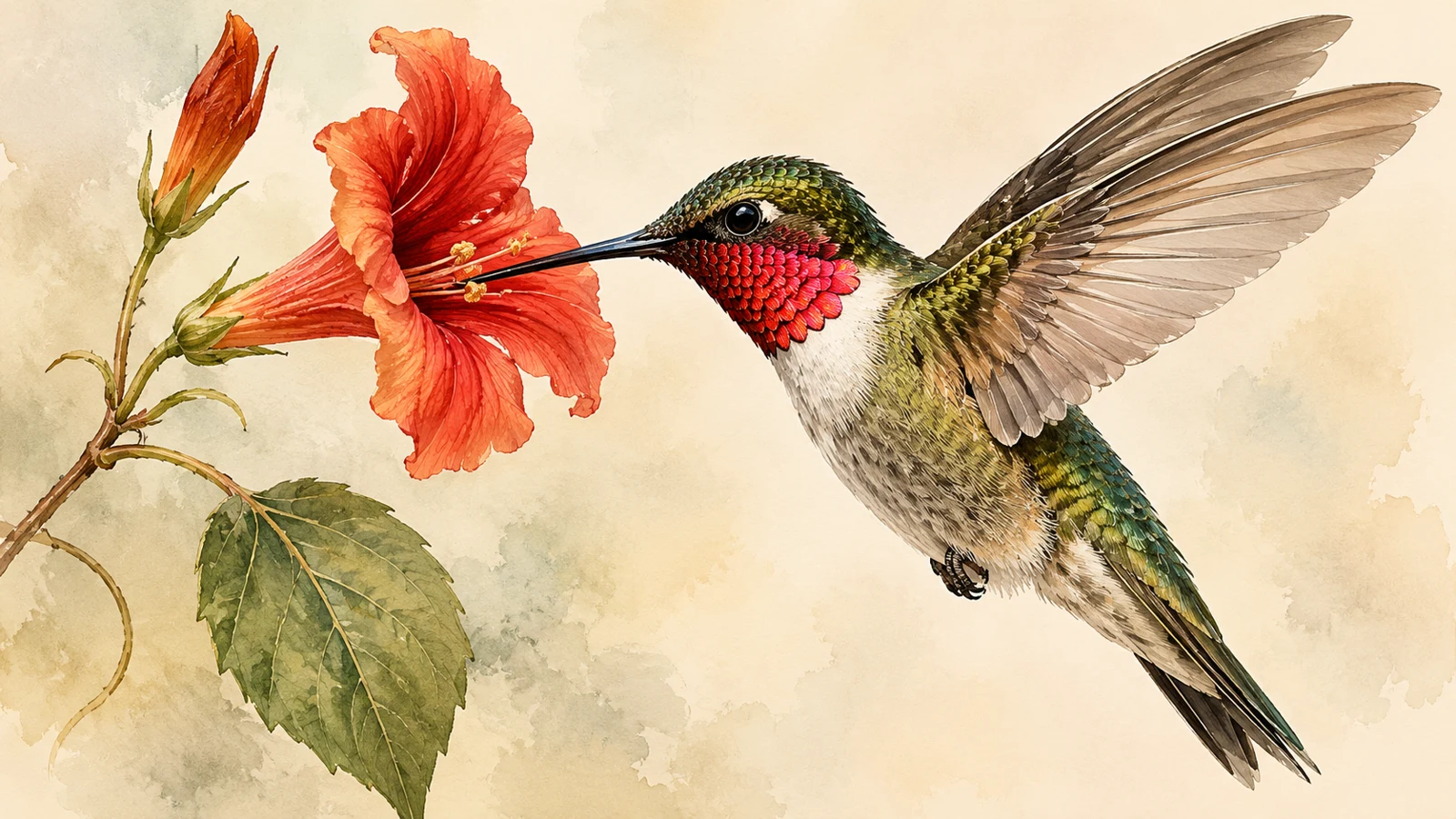
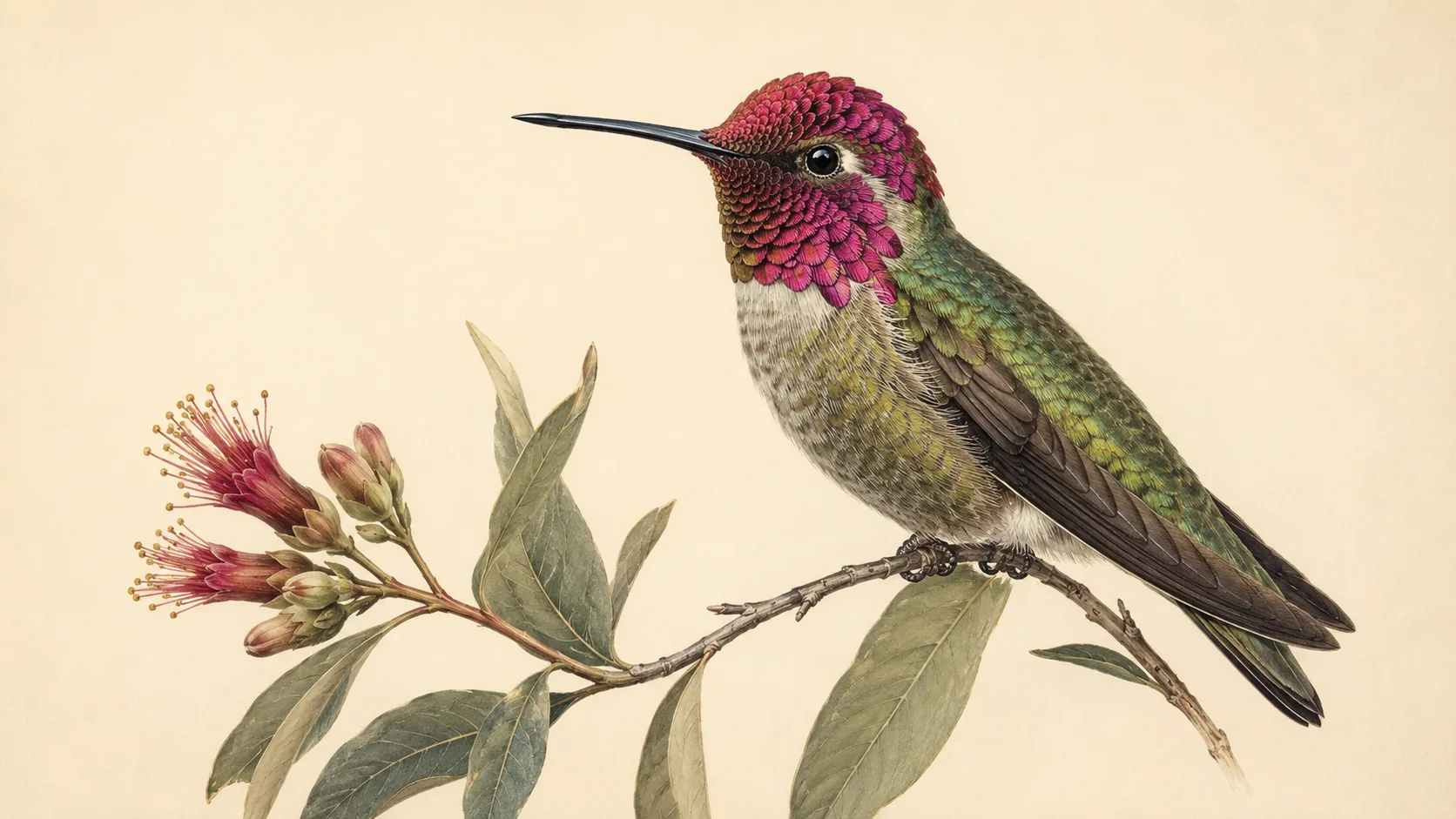
The male’s most immediate feature is the gorget, the iridescent throat patch that hummingbirds share as a family trait. In Anna’s, it is not the restricted bib of the Ruby-throated Hummingbird but a full helmet: gorget and crown both blaze rose-red to crimson, the exact shade shifting from magenta to flame depending on the angle of light. Face the bird directly in sun and he looks as though his whole head has been dipped in embers. Shift a few degrees and the colour vanishes entirely, leaving plain grey. This is structural colour - the same physics that makes a peacock’s feather shift from green to black.
His back and flanks are iridescent bronze-green. His underparts are pale grey, lightly washed with green on the flanks. The bill is straight, black, medium-length, suited to tubular flowers.
The female is greenish above with dingy grey-white underparts. She is distinguished from other small hummingbirds by a small but genuine red throat patch - not a smear or a single feather, but a cluster of gorget feathers, dull rose rather than blazing crimson. Cornell’s All About Birds notes this as one of the more reliable field marks separating her from the female Costa’s Hummingbird in overlapping desert-edge habitat: the Anna’s has a slightly heavier build and a longer bill.
What he sounds like
He is, by a considerable margin, the most vocal hummingbird in North America. The song - delivered from a perch, which itself is unusual for a hummingbird - is a long, squeaky, buzzy production that sounds more like a wren with laryngitis than anything in the hummingbird family. Audubon’s field guide describes the species as “more vocal than most hummingbirds,” which is a polite way of saying he is hard to shut up. He sings in defence of feeding territories, in advertisement for mates, and apparently for his own reasons in the middle of winter.
The courtship dive is the other acoustic event worth recording. The male climbs to roughly 40 metres, then folds his wings and drops in a near-vertical stoop toward the female. At the bottom of the dive he spreads his tail feathers abruptly, and the air passing through them produces a sharp, loud crack - described in field notes as an explosive “chirp” or “pop.” Cornell’s Birds of the World records the dive speed at approximately 27 metres per second: relative to body length, this is one of the fastest manoeuvres performed by any vertebrate under its own power.
Range and habitat across the year
The original breeding range was the chaparral and coastal sage scrub of southern and central California, north into the San Francisco Bay area. That range is now substantially larger. The species pushed steadily northward through the second half of the twentieth century, following the introduction of winter-flowering garden plants and the installation of hummingbird feeders. By the 1970s it was nesting regularly in Oregon. It now nests in British Columbia. The eastward expansion into Arizona, southern Nevada, and occasionally Texas parallels the spread of desert garden plantings.
The Audubon Society’s field guide describes it as a permanent resident along the Pacific Coast, with only partial, local movements rather than true migration. This sets it apart from every other hummingbird species in North America: the Anna’s is effectively sedentary where others are obligate migrants. The population recorded by the North American Breeding Bird Survey increased between 1966 and 2019, a period during which most insectivorous birds were declining.
Habitat includes chaparral, oak woodland, coastal sage scrub, riparian groves, urban parks, and suburban gardens. He is equally at home in Monterey cypress at the edge of the Pacific and in a garden in Portland.
Diet
Nectar is the fuel source. Anna’s visits flowering currant, gooseberry, manzanita, eucalyptus, and a wide range of ornamental plantings. A hummingbird’s metabolism requires visiting hundreds of flowers per day; a male defending a territory of productive flowers is defending not a singing post but a larder.
Insects and spiders are the protein source, taken by hawking flying midges in mid-air, gleaning aphids and whiteflies from leaves, and plucking invertebrates from spider webs. The distinction between nectar feeders and insect feeders is a false one for hummingbirds: they are both, necessarily, and a diet without insects produces birds that cannot build feathers or raise young. PBS Nature’s fact sheet records midges, whiteflies, and spiders among the documented prey items.
Breeding and nesting
The female begins nest construction in December in southern California, which makes Anna’s Hummingbird the earliest-nesting bird on the Pacific Coast by a substantial margin. She builds alone - no assistance from the male, who contributes only the genetic material and moves on to court other females. The nest is a round cup 3.8 to 5.1 centimetres in diameter, constructed from plant fibres and feathers bound with spider silk. The silk is load-bearing: it holds the structure together and allows it to expand as the chicks grow. The exterior is camouflaged with lichen. She lays two eggs.
The male’s role peaks during display. After mounting his dive, he follows with a “shuttle display,” swinging laterally back and forth in front of the perched female while producing a sustained buzzy vocalisation. The whole sequence - climb, stoop, crack, shuttle - is one of the more precisely orchestrated courtship performances in North American ornithology.
The behaviour worth noting
Anna’s Hummingbird holds its tail still while hovering. This sounds trivial until you have watched enough hummingbirds: most species pump or fan the tail as a counterbalance during sustained hover. The Anna’s does not. The stillness is conspicuous once you know to look for it, and it is one of the more useful in-field identification clues at a cluttered feeder where bill length and head colour are hard to judge.
The practical consequence of his year-round residency is that he enters winter with an established territory rather than arriving in spring to compete for one. The bird who stayed owns the flowering plants before the migrants return. His December song is not, in the end, bravado. It is a competitive strategy that has been working for long enough to push his range northward by several hundred kilometres in a human lifetime.
Anna’s Hummingbird is proof that the calendar is not a biological law - it is a default position, and some birds have found it profitable to ignore it entirely.