Field Guide
Roseate Tern
At the edge of the colony on Petit Manan Island, among the noise and movement of several thousand Common Terns, a smaller group of birds is distinguishable by their behavior before their appearance. They perch apart. They are quieter. They are longer-tailed and somehow lighter in the air when they rise, as if the extra length of those tail streamers makes them buoyant in a way the Commons are not. Then you see the color: a faint blush of pink on the white breast, visible in good light, present for only a few weeks in the breeding season. Roseate Terns.
Elegant is the word that recurs in descriptions of this bird, and it earns the use. The Roseate Tern is the most refined member of its genus in the North Atlantic - longer-tailed, more white, more delicate in flight than its congeners.
What it looks like
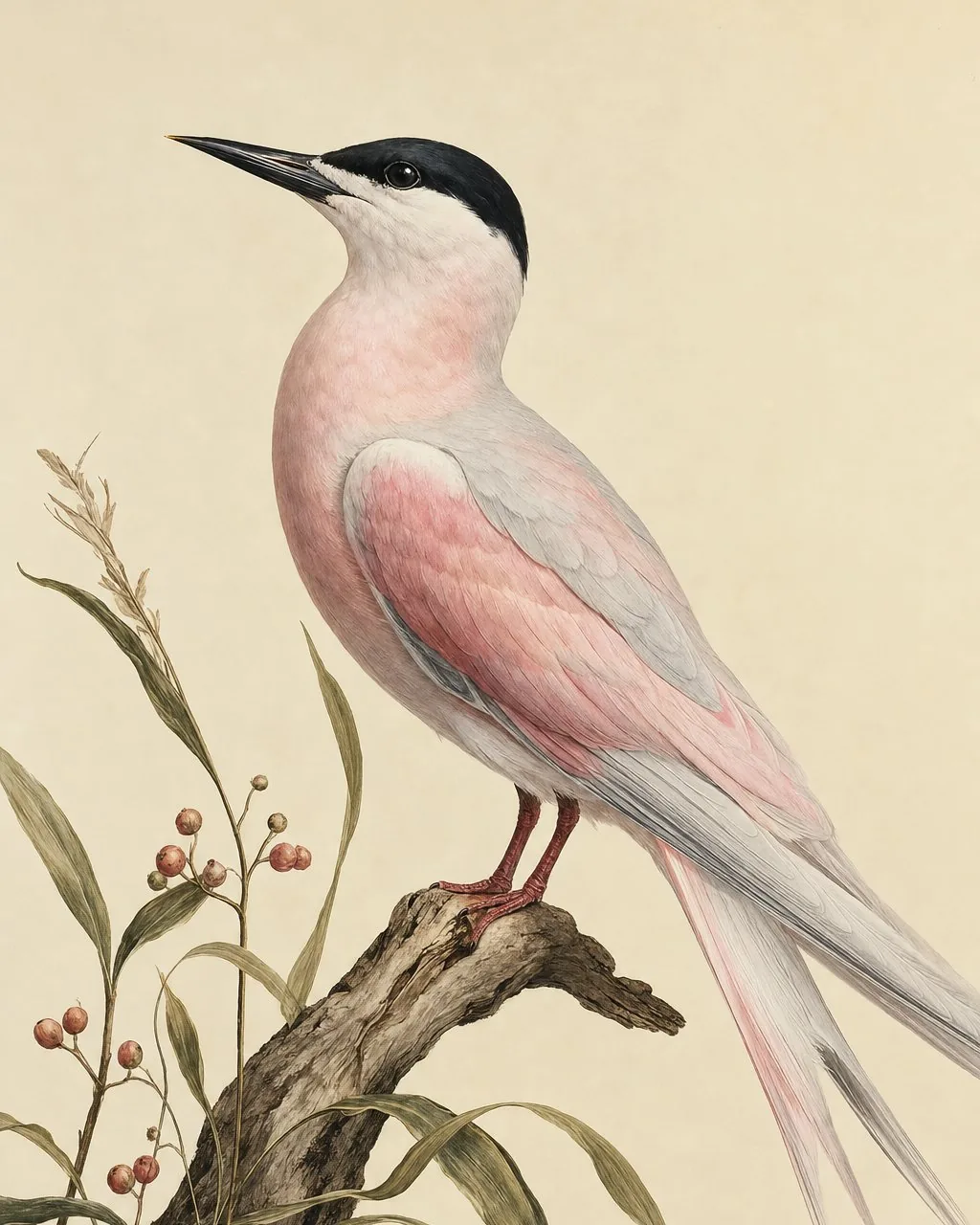
In breeding plumage, the Roseate Tern is very white above and below. The mantle is pale grey - paler than a Common Tern, approaching white in bright light. The underparts are white with a variable rose or pink suffusion on the breast that is more visible in some individuals and some lights than others. This pink is from which the species takes its name, and it can be genuinely striking when fresh, fading as the season progresses.
The bill is mostly black in breeding birds, with a red or orange base that varies by individual and season. The legs are red. The cap is black. The tail streamers - long, white, and deeply forked - are the most obvious field character in flight: they project noticeably beyond the wingtips when the bird is perched, and in flight they give a trailing, almost liquid quality to the silhouette.
Against a Common Tern on the same perch, the Roseate shows paler upperparts, an almost entirely dark bill (not orange-tipped), longer tail, and a more attenuated body profile. The flight style is also distinct: the wingbeat is faster and shallower, the dive more vertical. These differences are subtle to a beginner and obvious to an observer familiar with both species.
| Measurement | Range |
|---|---|
| Length | 33-36 cm |
| Weight | 95-130 g |
| Wingspan | 67-76 cm |
| Lifespan | 10-20 years |
Voice
A harsh, grating zreck or aak - quite different from the Common Tern’s more familiar kee-arr. The Roseate Tern’s calls are harder, shorter, and less musical. At a colony, once you learn the difference, the calls allow identification before the bird is found visually. The soft chiv-ik contact note is given frequently.
“On Falkner Island in July, I found the Roseates by ear before I found them by eye. The calls rose out of the colony noise like a different register - sharper, faster, harder - and when I tracked them to the birds, the long tails confirmed what the voice had already told me.” - field notes, Connecticut
Range and habitat
The Roseate Tern is a cosmopolitan species with breeding populations on multiple continents, but the North American population is the one under greatest conservation pressure. It breeds in the northeastern United States - primarily in Maine on the Seal Island and Petit Manan groups, and on a few sites in Massachusetts and New York - and in the Caribbean and off Nova Scotia.
The North American and Caribbean populations are listed as Endangered under the US Endangered Species Act. The combination of that listing with the species’ global Least Concern status reflects a real divide: while global numbers are not alarming, the northeastern US breeding population numbers only a few thousand pairs and is concentrated on very few sites. A single storm, oil spill, or Great Black-backed Gull pressure event at one of those sites can affect a significant fraction of the whole population.
The Least Tern is a useful comparison - another small, white tern with North American breeding populations under pressure, though the two species use quite different nest site types and have different primary threats.
Roseate Terns winter off the coast of South America, primarily around the coasts of Brazil and beyond. The migration routes cross the full length of the Atlantic.
Diet
Fish, taken by plunge-diving in shallow coastal water. Roseate Terns are efficient divers - the vertical entry is precise, and the bird submerges to a depth that Common Terns often do not reach. Sand lance (Ammodytes species) are the primary prey at most northeastern US breeding sites and form a critical link in the food chain from the open ocean to the breeding colony.
Sand lance availability fluctuates with oceanographic conditions. In years when sand lance are scarce, Roseate Terns raise fewer chicks. The connection between offshore ocean temperature and prey fish availability is a key driver of annual breeding success.
Breeding
Roseate Terns breed colonially, almost always with larger numbers of Common Terns or other tern species, never in pure single-species colonies of any size. Within the mixed colony, Roseate Terns tend to cluster together and favor specific microhabitats: denser vegetation, rocky crevices, or man-made nest boxes where these are provided.
One to two eggs, on a simple scrape. Both parents incubate for about three weeks. The chicks are mobile and hide in vegetation when threatened. Fledging takes about four weeks. Adults are fiercely defensive of the nest site.
The colonial nesting habit makes the Roseate Tern vulnerable to any disruption of the nesting colony as a whole. Great Black-backed Gulls, which have expanded greatly in the Northeast, are chronic predators on tern colonies and have forced the abandonment of several historic Roseate Tern breeding sites.
Decline and recovery
The history of the Roseate Tern in the northeastern US is a story of human impact in two phases. The first was market hunting in the late nineteenth century, when terns were slaughtered by the millions for the millinery trade, and the Roseate Tern was driven to near-local extinction. The birth of the conservation movement - Audubon’s earliest campaigns - was partly a response to what was happening on these tern islands.
Recovery was real and substantial through the twentieth century. Then a second wave of decline began in the 1980s, driven by different causes: gull expansion, habitat loss on wintering grounds in South America, and fisheries depletion of sand lance. The northeastern US population, which had recovered to perhaps 8,000 pairs by the early 1980s, fell to around 2,000-4,000 pairs by the 1990s.
Active management has stabilized numbers at some sites. Nest box installation, gull control, and warden presence during the breeding season have all contributed. The population is not recovering strongly, but it is not collapsing further.
Closing
Stand at the edge of a tern colony on a July morning off the coast of Maine and watch the birds arrive with fish. The Common Terns are everywhere, loud, orange-billed, orange-legged. The Roseates arrive on different terms: quieter, longer-tailed, somehow cleaner against the water light. They dive faster and deeper. They perch in the rockier spots, away from the main press of the colony. They have been here every summer for longer than the lighthouse behind you has stood. The question now is how many more summers they have left.