
Field Guide
Least Tern
A river sandbar in June. Flat light, pale gravel, the wide Missouri churning past. Something small breaks from the air above the shallows, holds itself impossibly still against the current, then drops. A coin-sized splash. Up again, a silver fish crosswise in the bill. It banks hard left, heading for the colony that, from this distance, looks like litter blowing across the sand. It is not litter. It is Sternula antillarum. The Least Tern.
Smallest of the North American terns. One of the smallest terns anywhere. It weighs between 39 and 52 grams, roughly the mass of a letter. What it lacks in size it makes up in velocity and nerve.
What it looks like
The Least Tern is compact even by tern standards. Length runs 22 to 24 centimetres. Wingspan reaches 41 to 51 centimetres. The tail is forked but short, giving the bird a stubby, front-heavy silhouette that distinguishes it from larger relatives at a glance.
In breeding plumage the cap is black and full, pulled down like a helmet to the eye. Below that, the forehead is white. This white patch is the field mark. No other small tern wears it so neatly. The bill is yellow with a fine black tip, vivid enough to read in poor light. The legs are yellow. The back and upperwings are pale grey. The underparts are white.
The eye is dark. In flight the wingtips show two or three dark outer primaries, a crisp contrast against the pale wing.
After the breeding season the black cap recedes to a black mask and a dark line back from the eye. The yellow bill dulls and darkens. First-year birds carry a dusky cap, dark shoulders and a black bill, an awkward in-between that sharpens into the clean adult pattern the following spring.
| Measurement | Range |
|---|---|
| Length | 22 - 24 cm |
| Weight | 39 - 52 g |
| Wingspan | 41 - 51 cm |
| Lifespan | 15 years typical; 24 years maximum recorded |
Fishing on the wing
The Least Tern hunts by sight from the air. It works the shallows, typically within six kilometres of the nesting colony, quartering low over sand-bottomed flats, river margins and coastal bays with shallow, rapid wingbeats that are among the quickest of any tern.
When it locates prey, it hovers. The hover is the bird’s signature act. The wings beat fast and shallow. The head drops forward, the whole posture angled down like a pointer reading the water. The body tilts into the wind. Hold this long enough and it looks as if the bird is painted onto the air.
Then it drops. Straight, or near-straight, bill-first. The splash is brief and small. It plunges for anchovies, silversides, killifish, small shrimp and the occasional crustacean - whatever fits a bill that is itself only a few centimetres long. Kenn Kaufman, in his 1996 Lives of North American Birds, describes the diet as predominantly small fish supplemented by crustaceans and insects, varying by season and location.
The fish is carried crosswise, repositioned on the wing and swallowed head-first before the bird reaches the nest. When a male is courting, he flies instead toward a female and presents the fish directly to her - a gift, a credential, a negotiation.
The scrape on bare sand
No cup. No weave. No materials at all.
The Least Tern nest is a scrape - a shallow depression in open sand or gravel, nothing added, nothing built. Two or three eggs, pale buff or olive, blotched and spotted with dark brown so they read as stones. Incubation lasts 19 to 25 days, shared by both parents. Chicks hatch covered in cryptic down and leave the scrape within hours, crouching flat and motionless when a shadow crosses them.
The colony is open to the sky by design. Terns rely on vigilance, communal alarm, and mob defence against predators. What they cannot defend against is the human who does not look down.
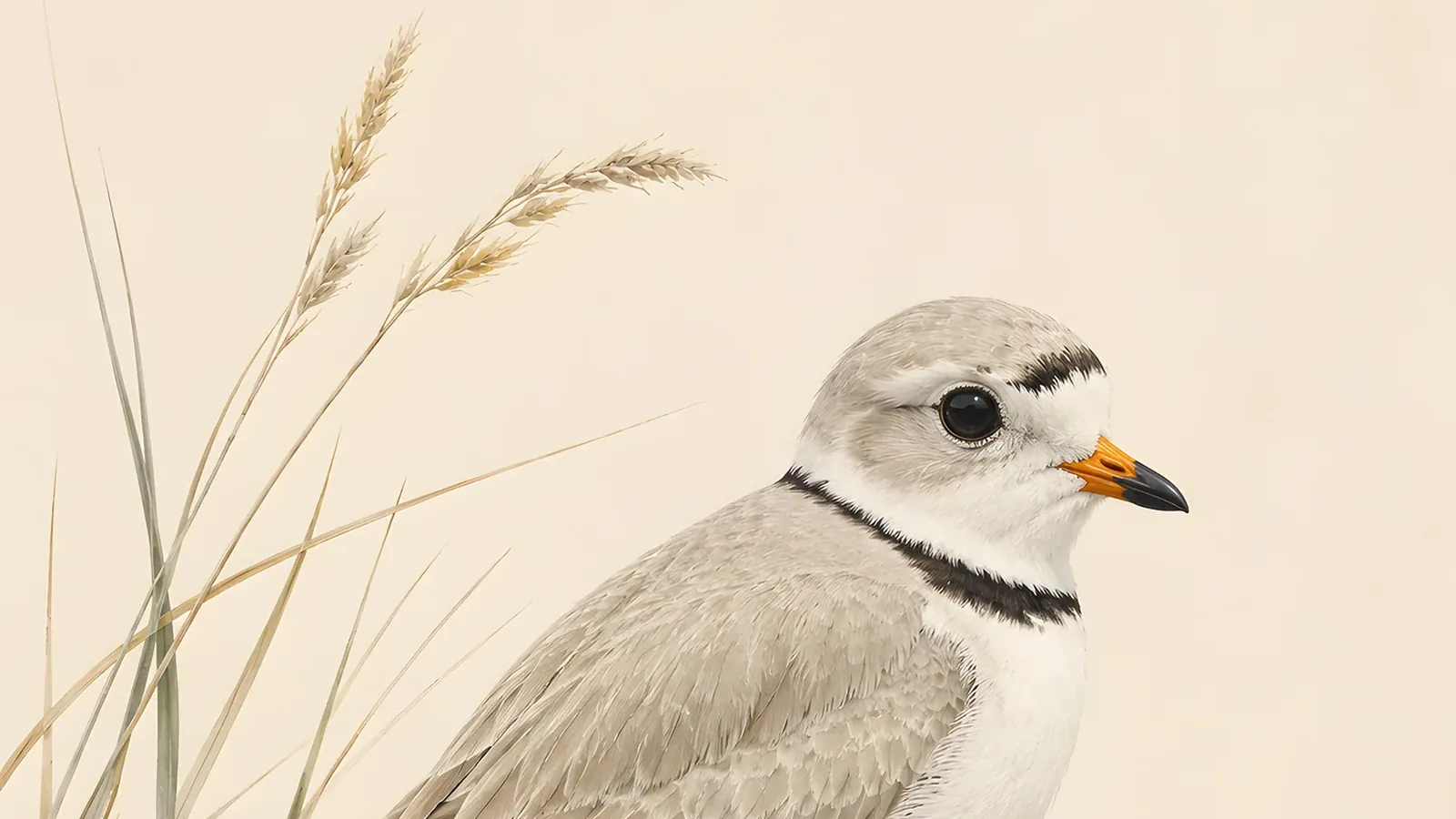
Beach disturbance is the central threat to coastal nesting populations. Off-road vehicles cross scrapes. Unleashed dogs scatter incubating adults long enough for eggs to overheat or chill. A single pass through a colony at the wrong moment can kill an entire cohort of eggs. The piping plover faces the same pressure on the same beaches, and the two species share nesting habitat along the Atlantic coast and Gulf, where management protections for one generally benefit the other.
Where natural sites are gone or too disturbed, Least Terns have learned to use flat gravel rooftops. The Florida Shorebird Alliance documents colonies that have used the same commercial rooftops for decades. A study published in Avian Conservation and Ecology (2024) followed 168 rooftop-nesting chicks in the Tampa Bay region over eight years, banding fallen birds and returning them to the roof surface, and found meaningful fledgling survival in managed rooftop colonies. This adaptation is real conservation. It is also a sign of how much ground the species has already conceded.
Range and the recovery
The Least Tern breeds across three broad populations: coastal Atlantic from Maine to Texas, coastal Pacific in California and Baja California, and inland across the Great Plains and Mississippi Valley. It winters on tropical coasts from Mexico south to Brazil, a migration of thousands of kilometres for a bird the weight of a letter.
The coastal populations have always been under pressure. The Interior population - the birds of the river sandbars, breeding along the Mississippi and Missouri systems and their tributaries in Mississippi and across 18 states - came within sight of extinction.
In 1985, when the U.S. Fish and Wildlife Service listed the Interior Least Tern as Endangered under the Endangered Species Act, fewer than 2,000 adult birds remained at a few dozen scattered colonies. The cause was not mystery. The U.S. Army Corps of Engineers had spent decades channelizing and straightening the great interior rivers. Secondary channels closed. Sandbars were drowned, stabilized or removed. The birds needed bare, bare ground: shifting, unvegetated gravel exposed by seasonal high water. The engineers had traded that complexity for a navigable channel, and the terns vanished with the habitat.
Recovery took 35 years and required changing the rivers back. The Corps notched hundreds of dikes along the Lower Mississippi, redirecting flow to rebuild secondary channels. It constructed new sandbars from dredged sand. Biologists documented that terns arrived to nest on fresh artificial bars within days of their creation. The Audubon Society, citing USFWS data, reports that by the time of delisting the Interior population had grown to approximately 18,000 birds at more than 480 nesting sites. On February 12, 2021, the U.S. Fish and Wildlife Service published the final rule removing the Interior Least Tern from the federal Endangered list. The rule cited a tenfold increase in population, recovery across 18 states, and the durability of management practices now embedded in river operations.
“What had been lost in the river ever since they started managing it was habitat and depth diversity.” - Paul Hartfield, USFWS Interior Least Tern recovery biologist, as quoted by Audubon
The Interior Least Tern’s story is a precise case study in what recovery requires: specific habitat, targeted intervention, a named threat addressed at its source. It is not a parable about nature’s resilience. It is a record of what the Army Corps of Engineers agreed to do differently, and the birds that came back because of it.
The California subspecies (Sternula antillarum browni) remains federally listed as Endangered. Globally, BirdLife International and IUCN classify the species as Least Concern, the overall population being large enough to absorb regional losses. That global designation can obscure how locally precarious the species remains wherever beaches are managed for human use rather than for nesting birds.
What it sounds like
The Least Tern colony is loud for such a small bird.
The alarm call is a sharp kip or kip-kip-kip, rapid and insistent, the sound rising when a predator - or a person - enters the colony zone. A more elaborate version runs kip-kip-kip-kiddeek, the final syllable rising. Audubon’s field guide, drawing on Kaufman (1996), describes the general call as a raucous killick. At distance the colony sounds like static. Up close it is directed and precise, different calls for different threats.
The male’s courtship flight includes calling while carrying a fish, advertising both himself and the meal.
Breeding
The breeding season opens in April in southern latitudes and May in the north. Males begin courtship with aerial displays and fish presentations. Pairs that bond typically share incubation across the full 19-to-25 day period, the eggs otherwise invisible against the gravel. Clutch size is one to three eggs, most often two.
Chicks are precocial. They walk from the scrape within hours. They can swim short distances if necessary. Both parents feed them, continuing for several weeks after fledging. Adults remain bonded through the season and may re-pair in subsequent years.
The species is monogamous within each breeding season. Some individuals have been tracked as old as 24 years, the oldest banded individual on record, found in New Jersey in 1981 and first banded in Massachusetts in 1957. Long-lived birds carry knowledge of site, of partners, of the particular behavior of a colony. When a sandbar disappears under rising water or a rooftop loses its gravel to plastic membrane, that accumulated knowledge goes with it.
What the Interior Least Tern teaches is that the knowledge can return, if there is something left to return to. The sandbars came back. The birds found them. The scrapes were made again in the gravel, the eggs invisible against the stone. It is the smallest tern on the continent, nesting on the least possible ground. What it asks for is not much. What happened when we took even that was nearly permanent.
The delisting is not an ending. It is a record of what a correct intervention looks like. The bird is still here. The scrape is still bare. The hover above the shallows is still worth stopping to watch.