Field Guide
American Oystercatcher
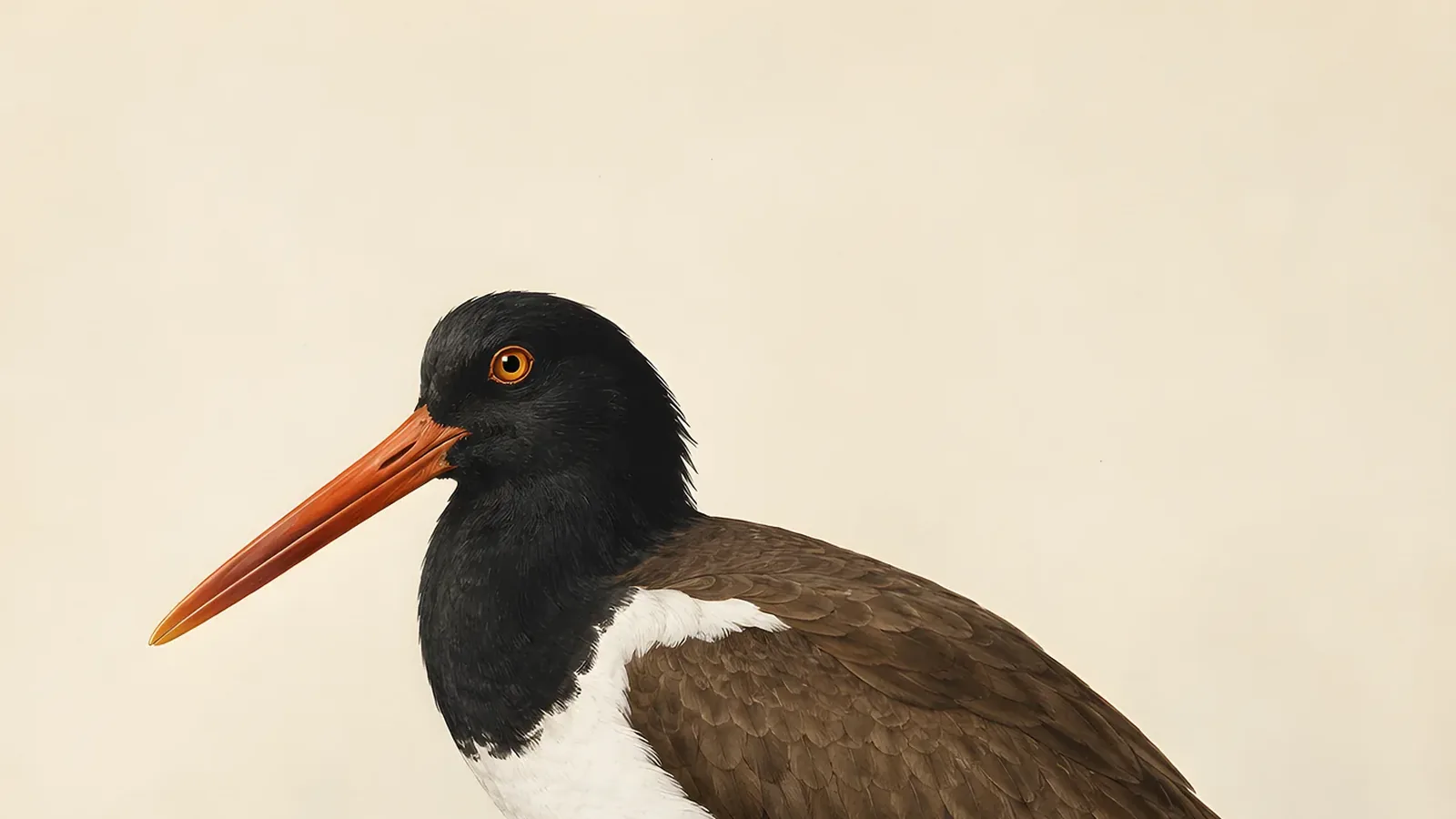
Low tide on a New Jersey barrier flat. The water has pulled back fifty meters, exposing a dark pavement of blue mussels packed so dense the whole bed seems to breathe. A single bird walks it slowly, head tilted, bill angled toward the shells. The bird is large. Its plumage is blunt and bold: black hood, dark brown back, white underparts cleanly divided. But nothing draws the eye like the bill. It is long, straight, laterally compressed to a thin blade, and the color of a road flare. The bird stops. It has found a mussel with its valves fractionally ajar. In one quick motion the bill goes in, the adductor muscle is severed, and the shell falls open. The bird feeds. The whole transaction lasts three seconds.
Haematopus palliatus, the American Oystercatcher, is one of the most immediately recognizable shorebirds on the Atlantic coast. There is nothing subtle about it. It is designed for a single task and the design is total.
What it looks like
At 42 to 50 cm in length and 400 to 700 grams, H. palliatus is substantially bigger than a Dunlin or a Willet. It sits in the visual weight class of a small gull, though it carries itself nothing like one.
The head and neck are a deep, matte black. The back and wings are dark brown. The underparts and a broad wing stripe (visible in flight) are white. The legs are thick and flesh-pink. The eye is bright yellow with a conspicuous red orbital ring. In the field, at any distance, none of that matters as much as the bill. It is 7 to 10 cm long, bright orange-red, and flat-sided, compressed into a blade that is noticeably taller at the base than at the tip. In good light it seems to glow against the dark plumage like an ember.
Juveniles show a dark tip on the bill and brownish scaling on their upperparts. They acquire the full adult pattern by their second or third year, but they will not breed until they are three to four years old.
| Measurement | Range |
|---|---|
| Length | 42 - 50 cm |
| Weight | 400 - 700 g |
| Wingspan | 76 - 89 cm |
| Bill length | 7.5 - 10 cm |
| First breeding | 3 - 4 years |
| Max recorded age | 23 years, 10 months |
The bill and the two techniques
The bill is the thesis of this bird. It is not simply a long beak. It is a purpose-built prying tool, laterally compressed so that its edges can slip between bivalve valves where a rounder bill could not follow. The tip, viewed head-on, is almost knife-thin.
There are two methods of using it, and this is where the biology becomes genuinely surprising.
Some individuals are stabbers. When they find a mussel or oyster with its shell slightly open, they quickly insert the bill into the gap and - with several short, sharp thrusts - sever the adductor chain, the tough muscle holding the valves shut. The shell falls open. The bird eats without breaking anything.
Others are hammerers. They pull a mussel free from a clump, carry it clear of the water, orient it with the umbo (the hinge) facing down, and pound repeatedly at the point on the shell where the adductor muscle lies beneath. Once the shell cracks, they lever it open and cut the muscle in the same fashion.
The two populations are real and persistent. The American Oystercatcher Working Group documents both techniques across the Atlantic range, with stabbers tending to work submerged beds of live bivalves and hammerers more often found working above the tide line. Juveniles do not invent their own method. They follow their parents and, over an apprenticeship that Safriel et al. (1996, The Oystercatcher: From Individuals to Populations) document as lasting up to 26 weeks in mussel-specialist families, they adopt the technique they have watched. The chick’s bill is not strong enough to tackle bivalves independently for the first 60 days of life, so this is not merely social learning but a developmental necessity - the parent keeps feeding the young bird while the technique is absorbed through observation and practice.
The specialization may be cultural in the deepest sense. Norton-Griffiths first described the stabber-hammerer dichotomy in European Oystercatchers in 1967 (Ibis 109: 412-424), and subsequent work confirmed the pattern holds in H. palliatus as well. A parent that hammers, breeds a chick that hammers. The bill shape is genetic. The method of using it is not.
“When a bivalve with open valves is located, the oystercatcher employs a technique known as stabbing, whereby it quickly inserts its knife-like bill into the open valves, and with several quick thrusts severs the adductor chain.”
- American Oystercatcher Working Group, Food Habits documentation
What it sounds like
The American Oystercatcher is not shy about announcing itself. The primary call is a loud, piercing kleep - a sharp, carrying note that cuts across beach noise, breaking waves and wind with equal ease. A second call, described by the Audubon Society Field Guide as a plover-like cle-ar, carries a slightly more musical quality.
When alarmed or in courtship, pairs produce a piping duet, both birds calling in close parallel, sometimes running side by side along the beach with bills pointed downward in the characteristic “piping display.” These displays function in pair bonding and in territorial advertisement. A pair that has held territory for several seasons will perform the display with a rehearsed quality, as though the movements have been worn smooth by repetition.
Range and habitat
H. palliatus is a strictly coastal bird. It does not wander inland. Its range on the Atlantic coast of North America runs from coastal Massachusetts south through Florida, then west along the entire Gulf coast. A separate Pacific population runs from Baja California south through Central America and down into western South America. Caribbean populations occupy islands throughout the region.
The barrier islands of North Carolina represent one of the species’ core nesting concentrations. The Outer Banks, Core Banks, and Shackleford Banks hold substantial breeding populations, and the flat, shell-strewn overwash areas these islands offer are close to ideal oystercatcher habitat. Virginia and South Carolina barrier systems function similarly.
By season: breeding birds favor open sand beaches, shell beaches and dredge-spoil islands, often at or near the wrack line. Outside the breeding season and in migration, the same birds move to oyster reefs, mussel beds, tidal mudflats and salt-marsh edges wherever bivalves are accessible at low tide. Northern populations, roughly those breeding above the Carolinas, move south in fall and return in March. Southern and Caribbean populations are generally year-round residents.
Breeding on the beach
The nest is nothing more than a scrape. A shallow depression on bare sand or shell, sometimes edged with small pebbles or broken shell fragments, set back from the tide line but rarely far from it. Both parents incubate the one to four eggs, which are cryptically colored in buff and brown speckle. Incubation runs 25 to 28 days.
The chicks hatch active and alert, and can run within 24 hours. But their bills are not yet hardened enough to tackle a bivalve, so parents feed them for the first 60 days - a long investment by shorebird standards. The young bird is watching throughout this period, attending the foraging parent, absorbing the method. Fledging comes around 35 days, but the family unit often stays together through the post-breeding dispersal and into early migration.
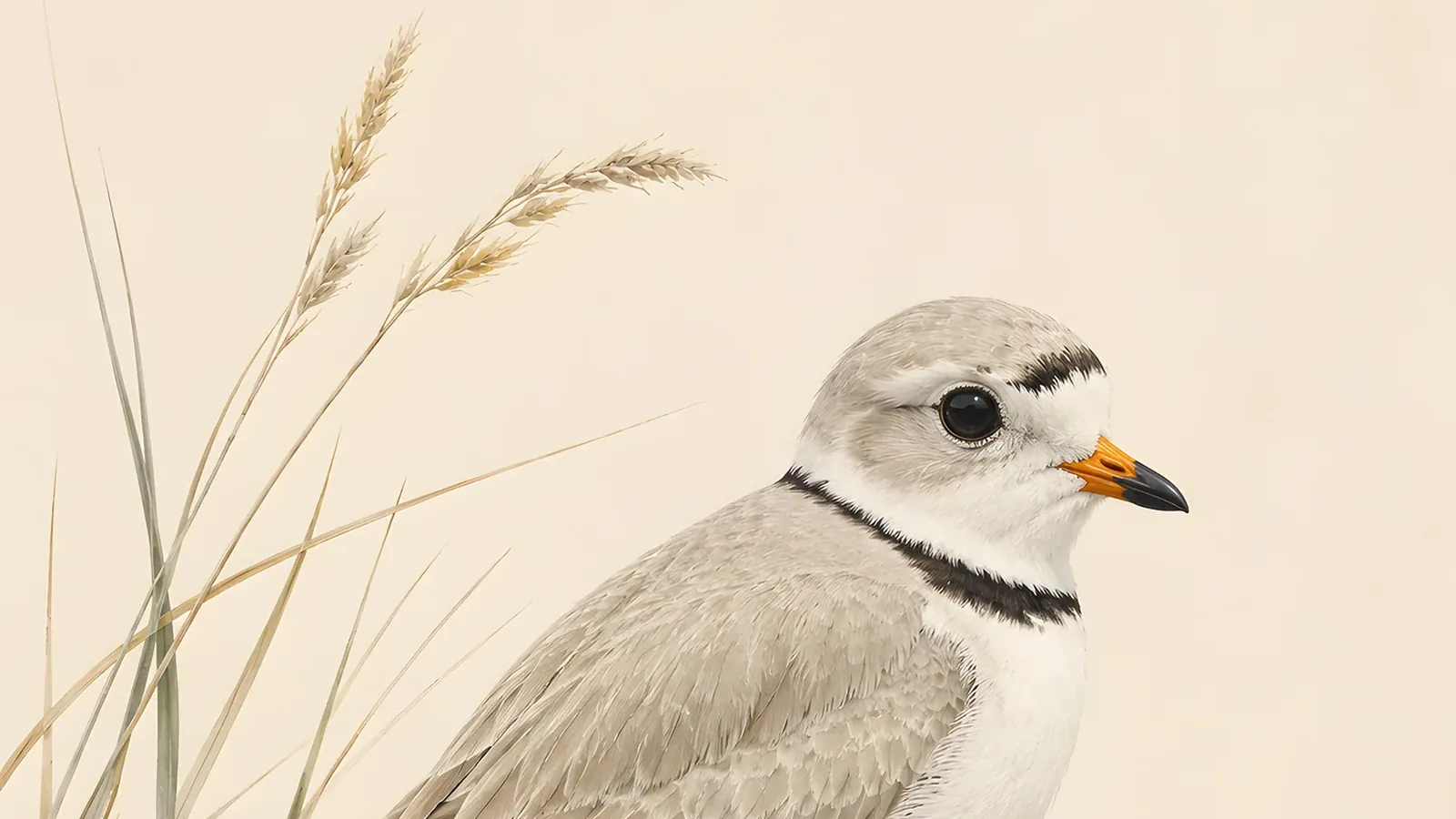
The beach is also the vulnerability. Nests sit at human eye level on the sand. A dog off a lead, a person walking the tide line, a ghost crab investigating at dawn - any of these can end a clutch. The same coastal strand that holds the bivalve beds is the same strand that holds the beach umbrella and the volleyball net. The piping plover faces identical threats on the same beaches, and the two species nest in loose proximity across much of the mid-Atlantic range, their fortunes rising and falling on the same conservation decisions.
Diet
Bivalves are the core: blue mussels, ribbed mussels, oysters, clams, razor clams. On southern ranges oysters and hard clams dominate. The bill is designed for these animals above all others.
But the species is not rigid. Marine worms (polychaetes), mole crabs, sand crabs, sea urchins, starfish, barnacles, limpets, and occasionally jellyfish all appear in documented diet studies. In areas where bivalves are seasonally unavailable or depleted, oystercatchers shift to softer prey. The hammering specialists can sometimes be seen on hard substrate pounding what amounts to a closed market - working shellfish that would defeat a stabber.
A success built on coordination
Clay, Lesterhuis, Schulte, Brown, Reynolds and Simons (2014, International Wader Studies) assessed the global status of H. palliatus and identified approximately 43,000 birds across all subspecies, with the nominate Atlantic race accounting for roughly 20,000 individuals. At that count, the species earned an IUCN rating of Least Concern, but the number was low enough and the habitat specific enough that Shiloh Schulte of Manomet Conservation Sciences and the American Oystercatcher Working Group pushed for active management rather than passive monitoring.
That management worked. By 2023, the Atlantic and Gulf population alone was counted at approximately 14,735 birds - a 45 percent increase from 2008. The recovery, documented by the American Oystercatcher Recovery Campaign, resulted from a coordinated effort across approximately 40 partner organizations: beach access restrictions during nesting season, volunteer nest-monitoring networks, oyster reef restoration, predator management, and transmitter studies on chick survival. It is one of the cleaner shorebird recovery stories of the past two decades, set against a backdrop noted in Ornithological Applications where 26 of 28 other U.S. shorebird species showed declines between 1980 and 2019.
The oystercatcher’s lesson is simple to state and difficult to replicate. It requires nothing except that the coastal system that produces the bivalves is left intact, that people do not walk on the nests, and that someone is watching and counting and willing to close a section of beach for ten weeks each spring. These are not heroic requirements. They are, as recoveries go, almost ordinary. That they produced a 45 percent increase in 15 years says something pointed about what modest, consistent effort can accomplish when the habitat still exists to receive it.
H. palliatus has held this coast since before there was a name for it. It holds a bivalve open with a blade-shaped bill and a learned technique passed from one generation to the next, culture accumulating in the family group as steadily as sediment at a river mouth. The beach that protects that continuity is the same beach that needs protecting.