Field Guide
Northern Gannet
It folds at about thirty metres. One moment it is gliding, scanning, white and unhurried against a grey Atlantic sky. Then it tips forward, draws its wings back against its flanks, and drops. By the time it hits the water it is moving at nearly 100 kilometres per hour, bill first, an arrow that crosses the boundary between air and sea without a splash that could warn anything below. The whole sequence - spot, commit, fold, hit - takes under three seconds. Then it is gone, chasing down through green water, and the North Atlantic closes over it as if nothing happened.
Morus bassanus, the Northern Gannet, is the largest seabird native to the North Atlantic. It has built its entire existence around that dive.
What it looks like
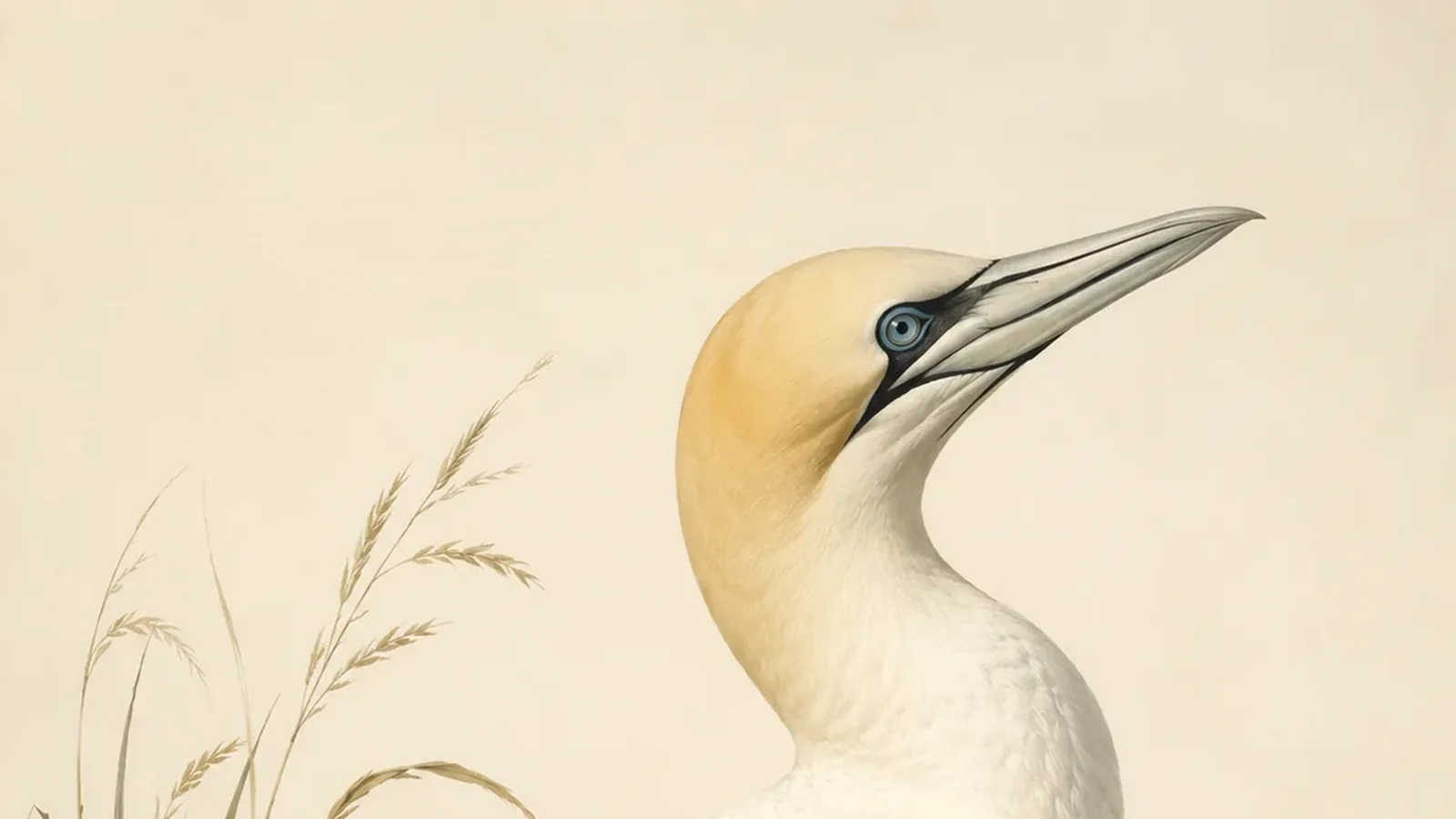
An adult gannet is impossible to misidentify. The body is brilliant white: 87 to 100 centimetres of streamlined torso, 170 to 200 centimetres of pointed wing-span. The wingtips are black, precise and clean, as though the bird were dipped in ink. The head carries a wash of warm buff-yellow, and around each eye sits a ring of pale bare skin with a faint blue-grey cast. The bill is long, heavy, and blue-grey. The tail comes to a point.
Weight runs 2,470 to 3,610 grams. That range matters because a bird heavy enough to punch through water at speed needs to be light enough to fly efficiently over open ocean - gannets routinely forage 60 to 200 kilometres from their nesting colonies (Hamer et al., 2001, Marine Ecology Progress Series). The body resolves both problems with nothing to spare.
Juveniles are dark. A first-year bird is almost entirely grey-brown with fine white speckling, and it takes four to five years of successive moults to work through intermediate patchy plumages to the full adult white. A gannet in its second or third year looks like a different species. Once you know this, a grey-brown bird the size and shape of an adult gannet makes immediate sense: it is a young one, still in the long apprenticeship before breeding age.
| Measurement | Range |
|---|---|
| Body length | 87 - 100 cm |
| Weight | 2,470 - 3,610 g |
| Wingspan | 170 - 200 cm |
| Max recorded lifespan | 21 years |
| First breeding age | 5 - 6 years |
The dive
The dive is not a fall. That distinction matters.
A gannet locates its prey visually from height, adjusts its angle of approach during the descent, and enters the water at a chosen point with purpose. Bennison et al. (2023, Biology Letters) equipped 51 gannets with accelerometers at two colonies and recorded 2,133 dives, finding that the birds are highly lateralised in their entry roll - 51 percent consistently tilting left, 43 percent right, with the preference highly repeatable across time in each individual (repeatability R = 0.878). That consistency, the researchers noted, represents the first documented case of lateralisation during prey capture in a foraging seabird. The brain asymmetry helps the bird simultaneously locate, pursue, and strike a moving target while managing its own trajectory through the air.
Below the surface, momentum alone does not sustain the pursuit. The same accelerometer data show that gannets never reach deeper than about 11 metres on dive inertia alone. They flap their wings underwater to push further down, reaching maximum recorded depths of around 15 metres and staying submerged for five to seven seconds. The dive is a beginning, not the whole act.
Built to hit the water
The impact forces involved in plunge-diving at 100 km/h would destroy a less purpose-built animal. The gannet’s skull is reinforced. The bill is sealed to prevent water forcing its way in. But the most important adaptation is structural and invisible from the outside: a system of subcutaneous air sacs under the skin of the face and along the chest and sides that compress on impact and cushion the blow the way packaging foam cushions a fragile object. These same sacs play a secondary role in buoyancy control once the bird is submerged.
The eye position is equally deliberate. Both eyes face slightly forward, giving the gannet genuine binocular overlap in its forward field of vision - unusual in a bird, and essential for gauging the distance and trajectory of a fish from 30 metres above it while falling fast. In Maine and along the Massachusetts coast, birders watching gannet flocks offshore in late summer sometimes see a dozen birds fold and drop simultaneously from the same flock, the water going white as they hit, each one having independently locked onto the same concentrated school.
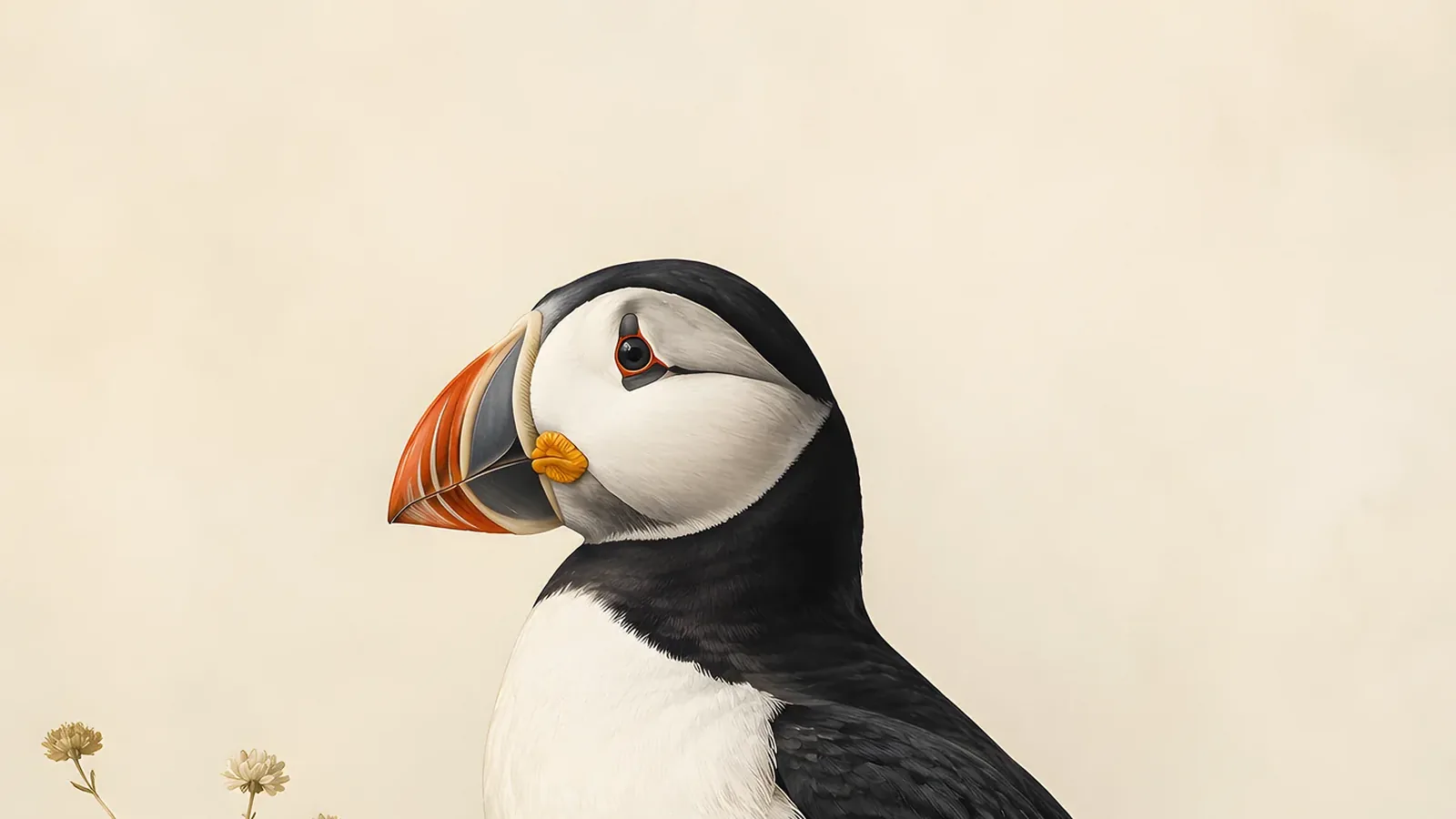
The Atlantic puffin, the gannet’s cliff-nesting neighbour at many North Atlantic colonies, hunts by diving too, but from the surface rather than the air - a completely different technique, controlled by wing-stroke rather than gravity, that reaches similar depths by different physics.
The colonies
The argument this page wants to make is simple: no other seabird in the North Atlantic represents the colonial instinct at the same scale. When gannets choose to nest, they choose to nest in tens of thousands.
Bass Rock, a volcanic plug in the Firth of Forth off the east coast of Scotland, held over 75,000 apparently occupied sites (AOS) as of 2014, when it was confirmed as the world’s largest gannet colony. The noise at Bass Rock during the breeding season is continuous. The smell carries on the wind from several kilometres. The white of the birds covers the entire surface of the rock in breeding season until the dark stone beneath is essentially invisible from a distance.
Ile Bonaventure in the Gulf of St Lawrence, Quebec, is the largest gannet colony in North America and holds roughly 104,000 breeding birds, representing approximately 50 percent of Canada’s total gannet population. A bird that breeds in dense proximity - nests spaced at roughly 80 centimetres centre to centre, packed tight enough that any walking requires stepping carefully around territories - is a bird that evolved in the absence of terrestrial predators. Island and sea-cliff nesting is not preference. It is the only viable option for a species with no defensive behaviour against foxes or rats.
“The sound is deep and somewhat like that of a Raven but unlike a Raven the ‘beat’ goes on and on: urrah, urrah, urrah.”
That description holds for any major gannet colony. The call - a guttural arrha-arrha on arrival at the nest, shortened to a clipped rah-rah during flight - is the background noise of every gannet breeding site from Newfoundland to Iceland to the Faroe Islands. At a colony of 75,000 pairs, the sound is not background. It is the whole atmosphere.
Range and the flu
The Northern Gannet’s global range is the North Atlantic. In summer, breeding colonies occupy sea cliffs and rocky islands from the Gulf of St Lawrence, through Newfoundland, to Iceland, the Faroe Islands, Norway, the British Isles, and a handful of sites in France and the Channel Islands. Scotland alone holds approximately 60 percent of Europe’s breeding gannets. In winter the population disperses south - adults into the eastern Atlantic toward West Africa, immatures ranging further toward the Caribbean and the Gulf of Mexico.
The IUCN lists the species as Least Concern, with an estimated population of between 1.5 and 1.8 million mature individuals as of recent assessments. That classification reflects a genuinely large and historically recovering population. It does not reflect what happened in 2021 and 2022.
The H5N1 highly pathogenic avian influenza outbreak that swept the North Atlantic during those years hit gannets harder than almost any other species. Lane et al. (2024, Ibis) documented unusually high mortality at 40 gannet colonies - representing 75 percent of all known global colonies - with the first significant deaths recorded in Iceland in April 2022 and outbreaks spreading in what appeared to be a clockwise pattern around UK and Irish colonies through late summer. At Bass Rock, testing of carcasses on June 4, 2022, confirmed H5N1 clade 2.3.4.4b. Drone surveys from June 30 identified 5,035 dead birds in the colony. Subsequent annual counts showed the Bass Rock population had fallen to 51,844 AOS by 2023 (a 31 percent reduction from the 2014 peak) and 46,045 AOS by 2024, with no signs of major recovery through 2025.
At Ile Bonaventure, the first confirmed mortality was recorded on May 24, 2022. Dramatic mortality and reproductive failure followed. The Quebec population, which had been in long-term decline since the 1980s, fell an additional 52 percent between 1984 and 2019 before the flu arrived.
The Least Concern designation remains accurate at the species level. The North Atlantic gannet population is not on a trajectory toward extinction. But 75 percent of all colonies showing unusual mortality in a single year is not a detail the global status category captures.
Breeding
Gannets are long-lived and slow-reproducing. First breeding comes at five to six years of age, after which most birds return to the colony where they hatched. The return fidelity is tight: Hamer et al. (2001) note that 94 percent of males and 88 percent of females return to the same nest site in successive years. A single egg is laid between April and mid-June. Both parents incubate for 42 to 46 days using an unusual mechanism - gannets lack a brood patch, so they wrap their webbed feet around the egg to transfer warmth directly from the highly vascularised foot skin. The chick hatches naked, grows rapidly under continuous brooding, and reaches or exceeds adult weight by ten weeks before losing mass again as it prepares for fledging at roughly 90 days.
Young birds fledge into the Atlantic in September without any parental guidance on migration. They disperse south, making their own way toward West Africa or the Gulf of Mexico, and do not return to the colony until their second or third year as sub-adults. The long apprenticeship before first breeding - five to six years of wandering, practising, and maturing before claiming a nest site - is the cost of a body plan that takes that long to work properly.
A gannet that survives to breeding age and establishes a territory may occupy the same patch of cliff for fifteen to twenty years. The maximum recorded wild lifespan is 21 years. The dive that looks instantaneous - three seconds from fold to impact - is the expression of a bird that has been practising it, in one form or another, since the Miocene. The North Atlantic is wide. The fish are fast. The gannet folds anyway, every time.