Field Guide
Prairie Falcon
The lark did not see it coming. The falcon had been flying low across the sage - not the towering aerial stoop of a Peregrine Falcon but a flat, hugging pursuit barely above the grass, using the terrain as cover. Then the burst of speed, the strike, and the meadow was quiet again. A Prairie Falcon had eaten.
This is a bird of the open West: wide basins, shrubsteppe, shortgrass prairie, and the rimrock cliffs that rise above them. It does not need height to be lethal. It needs speed and cover and grass to hunt across.
What it looks like
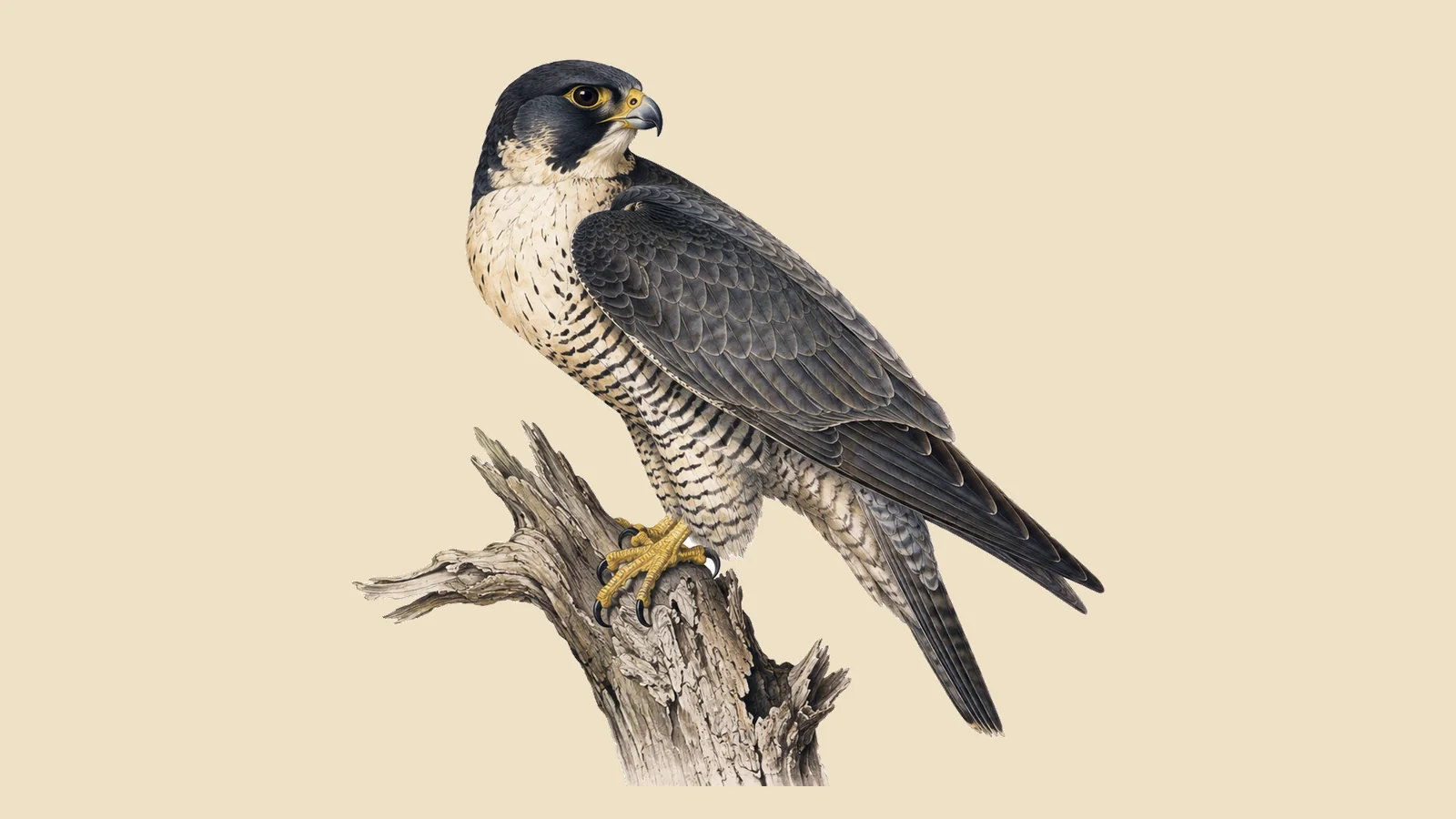
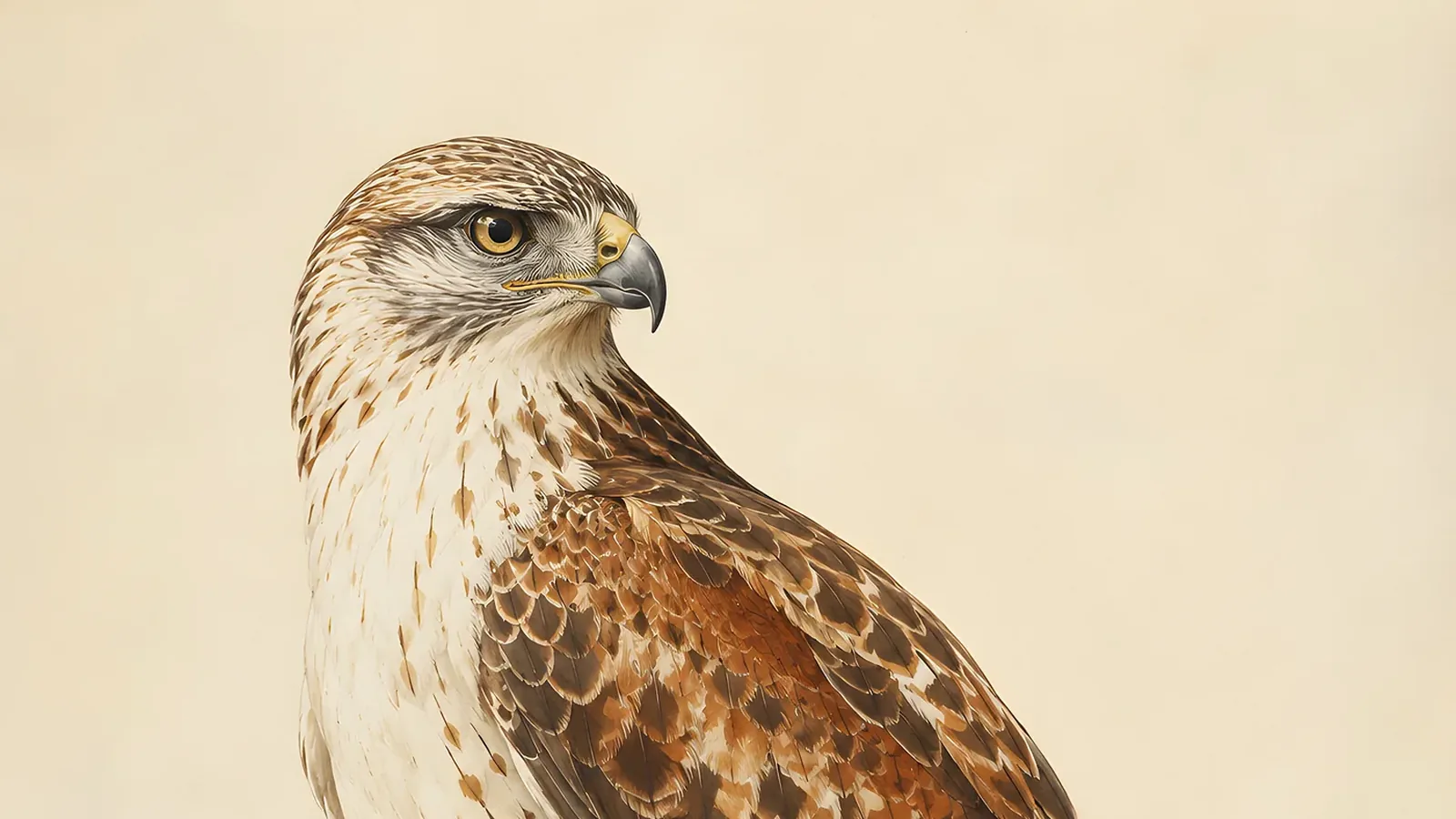
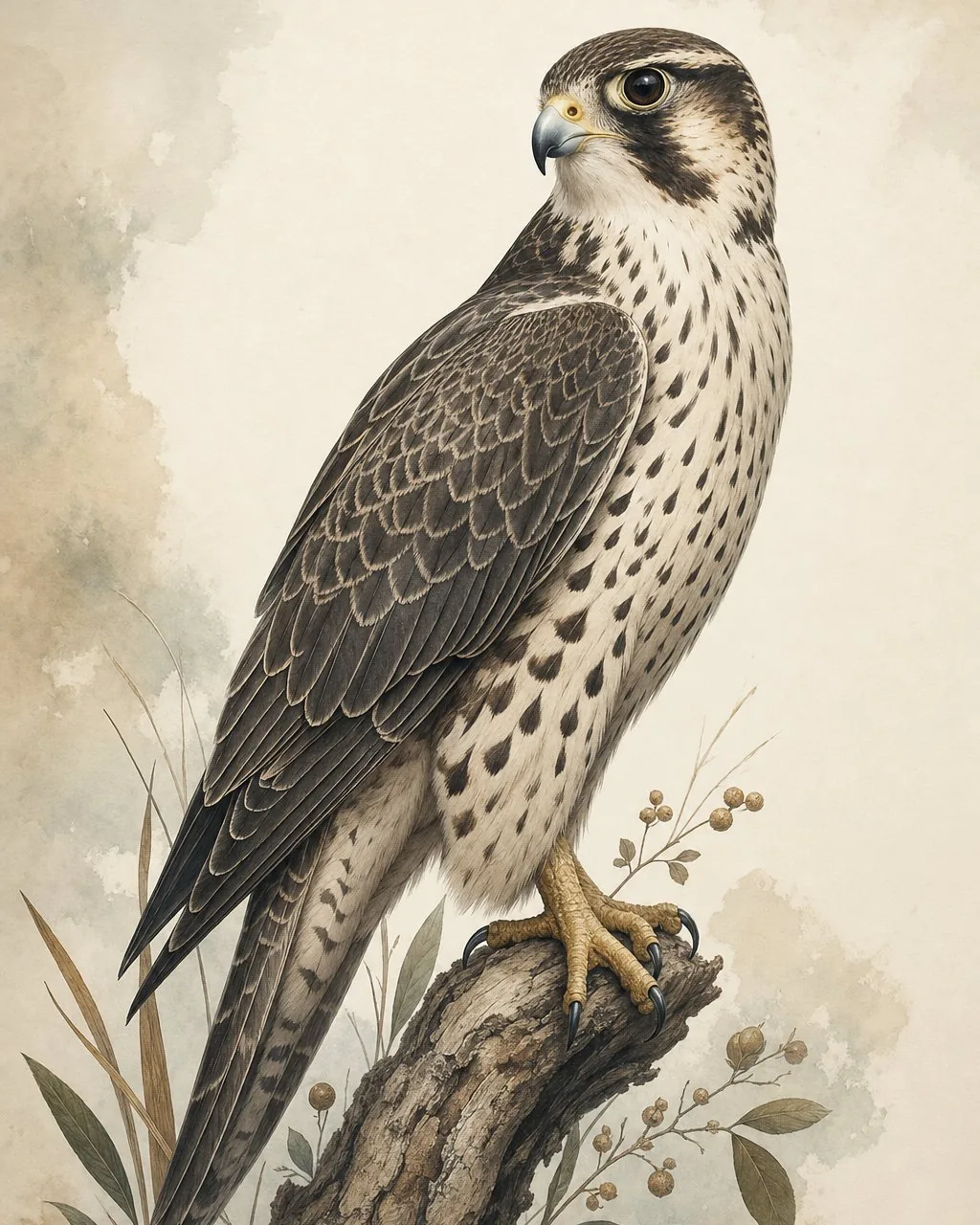
Pale. That is the first word, and it separates this falcon from most confusion species at a distance. The upperparts are sandy brown - the colour of dry Wyoming grassland in late summer - rather than the slate-blue or dark grey of a Peregrine. Below, the bird is whitish to pale buff, streaked or spotted brown. The moustache mark is present, as in all falcons, but narrow and pale compared to the Peregrine’s heavy black helmet.
The underwing is the field mark to look for in a flying bird: a dark axillar patch at the base of the wing, forming a distinctive dark comma or triangle where wing meets body. No other large falcon of the West shows this cleanly.
The eye is dark brown. The cere and orbital ring are yellow. The tail is long. The wings are proportionally broad-based and pointed. Females are noticeably larger than males - as is typical in raptors - and may weigh nearly twice as much.
| Measurement | Range |
|---|---|
| Length | 37-47 cm |
| Weight | 420-720 g |
| Wingspan | 89-113 cm |
| Lifespan | 5-13 years |
Voice
A harsh, repetitive kik-kik-kik-kik, much like the alarm calls of other falcons. Loud and insistent near the nest. Otherwise the Prairie Falcon is a quiet bird - it relies on stealth and speed for hunting, not on vocal communication. At the eyrie, adults and young are vocal through the breeding season, and a nest site on a cliff face can be identified from a distance by the noise before the bird is spotted.
“On the rimrock above the Bighorn Basin, the falcon pair had been screaming for ten minutes before we found the ledge. The male was perched on a knob of sandstone, calling down to nothing visible. The nest was just below him, invisible from our angle, full of sound.” - field notes, Wyoming
Range and habitat
Wyoming and Montana hold strong Prairie Falcon populations, and the Great Basin and interior West more broadly are the heart of the species’ range. It breeds from southern British Columbia and Alberta south through the Great Plains and Rocky Mountain states into Mexico, and winters through much of the same area, with some movement into the lowland deserts of the Southwest.
Habitat is open country with hunting ground and a cliff for nesting. The cliff can be a shallow ledge on a river canyon wall, a rocky outcrop on an otherwise flat plain, or a dirt bank with enough overhang to keep eggs from direct sun. The hunting ground below must be open: this is not a woodland bird.
In winter, Prairie Falcons shift toward agricultural lands and desert basins where prey is available and visible. Some individuals become site-faithful to a particular winter hunting territory.
Diet
Horned Larks are the most frequently documented prey item across most of the range, but the Prairie Falcon is an opportunist. Ground squirrels form a substantial part of the summer diet, particularly around colonies where hunting efficiency is high. Meadowlarks, sparrows, other small birds, large insects, and lizards are all taken when available.
The hunting style varies by prey. Against birds in open air, the falcon uses a low, fast approach at near-ground level, or a shallow stoop from moderate height. Against ground squirrels, it may hover briefly, or approach and then walk after a squirrel that dives for cover rather than running. Against large colonies, multiple strikes in rapid succession have been documented.
Breeding
Prairie Falcons do not build nests. They use cliff ledges, shallow caves, or recesses - sometimes occupying an old raven or raven nest, sometimes nothing more than a gravel scrape on bare rock. The same cliff sites are reused for years, sometimes decades, by successive pairs.
Egg-laying begins in March or April at most sites. The clutch is three to five eggs, buff to pinkish and heavily blotched. Incubation is about a month, shared by both sexes but dominated by the female. The male hunts to feed her through incubation.
Young falcons fledge at about five weeks but remain near the cliff for several more weeks as they develop hunting skills. Adults continue to feed them through this period. The family typically disperses in late summer.
Built for the basin
What the Prairie Falcon does differently from the Peregrine is worth understanding. The Peregrine is a speed machine optimized for the long aerial stoop - it closes from above at extraordinary velocity, and that speed is the whole strategy. The Prairie Falcon is a pursuit machine optimized for low-level, terrain-aided attack.
It flies flat, using ridges, brush, and terrain contours to conceal its approach. The target - a lark, a sparrow, a ground squirrel - does not detect the falcon until the last seconds. Then the bird must choose: flee into open air (where the falcon has speed) or dive into cover (where the falcon may lose it). This is the arms race that has shaped both the falcon and its prey species over millions of years.
In open basin country, with no forest cover for prey to reach, the Prairie Falcon’s low-altitude surprise attack is devastatingly effective. In autumn, when Horned Larks form enormous flocks over agricultural fields, a single falcon may make dozens of sorties in a morning.
The species is not currently threatened, and its attachment to open country rather than woodland has insulated it from the worst habitat losses that have hurt some other raptors. Maintaining open shrubsteppe and avoiding disturbance at cliff nest sites through the breeding season are the most useful conservation actions available.
Closing
Watch for it over any wide flat basin in the West in winter: a pale, falcon-shaped bird cruising low over stubble fields, unhurried in appearance and extremely fast in practice. It will not circle like a hawk. It will not hover like a kestrel. It will cross the field at speed, drop below a hedgerow, and reappear two hundred metres on. If you lose it, wait. It will come back. The hunting ground is good, and the Prairie Falcon is not finished with it.