Field Guide
Ferruginous Hawk
In the shortgrass flats of Wyoming, the hawk appears first as a pale smear against the blue - wide, white, and larger than you expect. It drops lower, banking over a prairie dog town, and the light catches the fox-red of its back and the deep rust leggings that run all the way to the toes. The prairie dogs bark. Every animal in that colony goes rigid and vertical. The hawk tips a wing, slides sideways on the wind, and keeps watching.
Buteo regalis - the regal hawk - is the largest buteo in North America, and nothing in its profile is understated. It was named for its colouring. Ferruginous means iron-rust, and it fits: the back, the shoulders, and those extraordinary feathered legs glow a deep auburn in strong light. John James Audubon painted it. George Newbold Lawrence formally described the species in 1854. It has been correctly understood as a grassland specialist for as long as ornithology has had a name for it.
What it looks like
The numbers mark the bird’s scale at once. Length runs 51 to 69 centimetres, wingspan 122 to 152 centimetres, weight 977 to 2,100 grams - the upper end of that range, in large northern females, exceeds anything the red-tailed hawk will typically produce. The sexual size difference is pronounced: females in the northern breeding range in Alberta and Saskatchewan average around 1,776 grams, males around 1,163 grams (Schmutz et al., Journal of Wildlife Management, 2008).
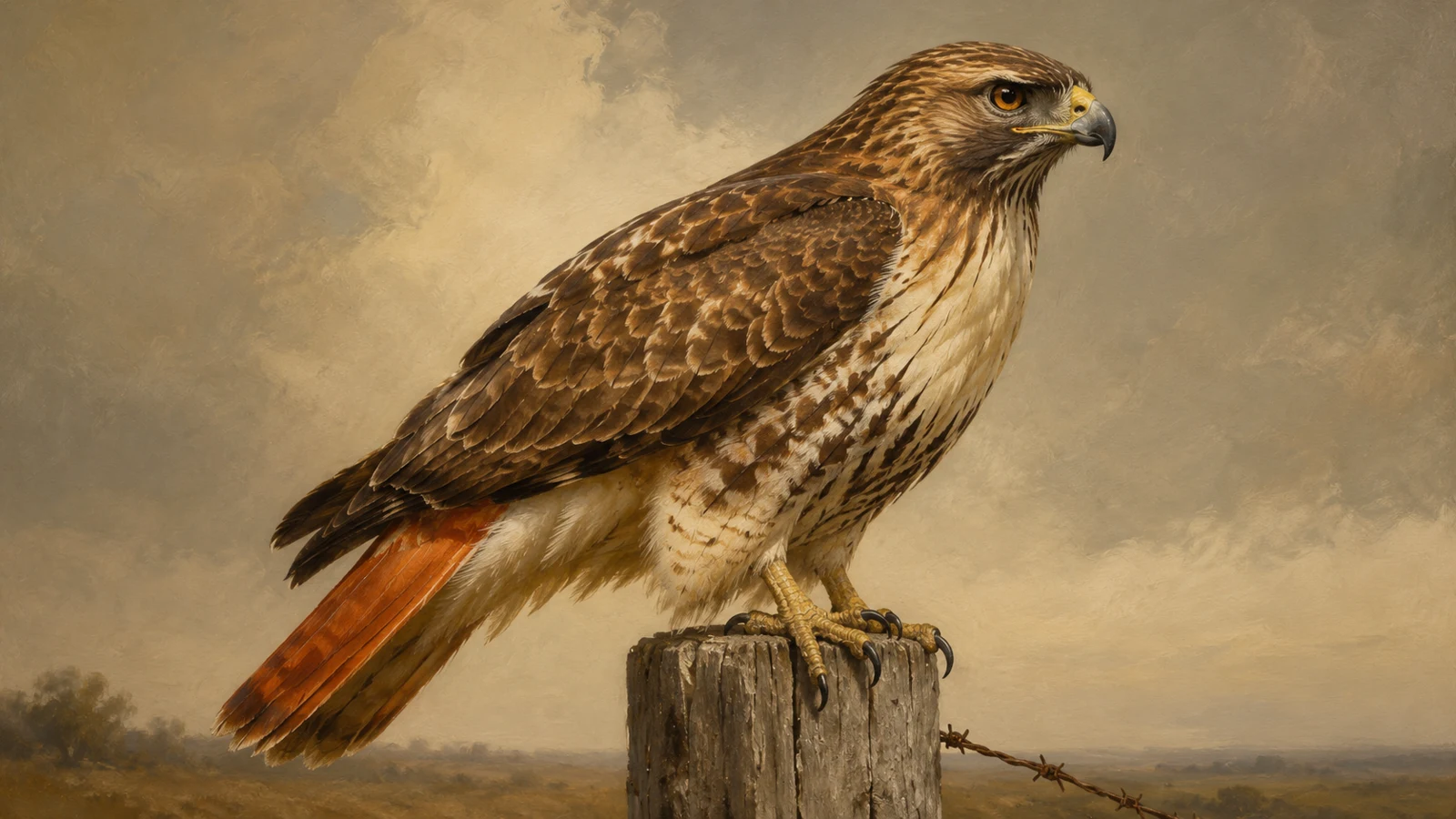
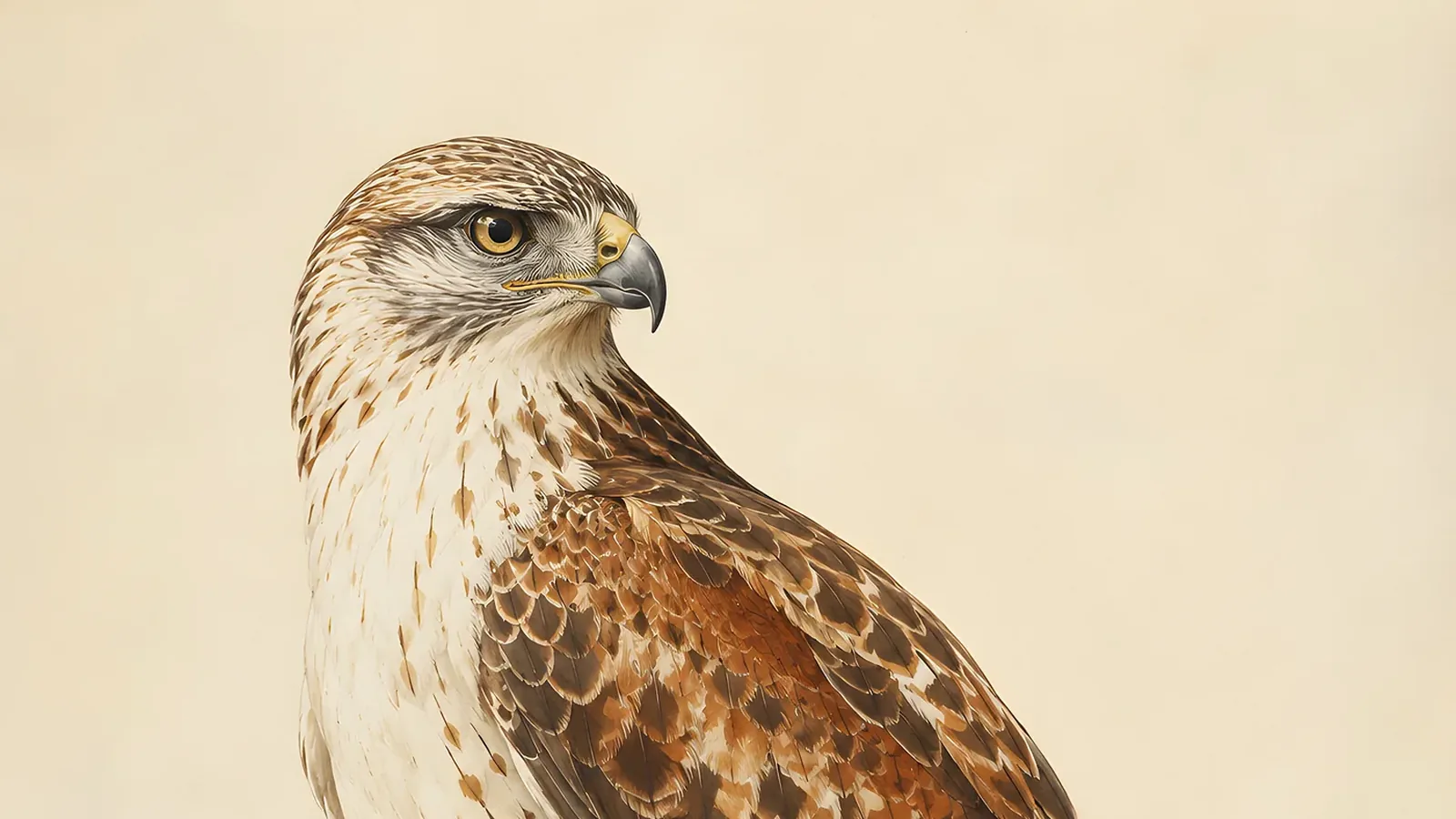
In the common light morph, the adult is pale below, with a whitish breast and belly interrupted only by a V-shaped marking where the rufous leg feathers meet at the front of the bird in flight. This V is diagnostic. No other North American buteo shows rufous feathering running continuously from the shoulder down through the legs to the feet. Those feathered tarsi are an eagle-like trait, shared within North America only with the golden eagle, and they mark the Ferruginous Hawk as something outside the ordinary buteo template.
The upper surface is rust-brown on the back and wing coverts, fading to pale grey at the base of the tail. The flight feathers below are silver-white, contrasting sharply with the rufous shoulder patches visible from above. The tail washes pale rust near the tip. The bill is substantial, the gape a vivid yellow extending well behind the eye - a feature visible at surprisingly long range.
A dark morph exists. Dark-morph birds run chocolate-brown throughout, with the pale flight feathers still contrasting sharply from below. Dark morphs are uncommon but regularly encountered across the Great Plains. Juveniles of both morphs lack the rufous leg feathering of adults and carry streaked underparts.
| Measurement | Range |
|---|---|
| Length | 51 - 69 cm |
| Wingspan | 122 - 152 cm |
| Weight | 977 - 2,100 g |
| Incubation | 28 - 36 days |
| Fledging | 38 - 50 days |
| Max. longevity | ~20 years |
The prairie dog hawk
The species is a prey specialist in a way few North American raptors manage. Prairie dogs (Cynomys spp.) and Richardson’s ground squirrels (Urocitellus richardsonii) dominate the diet wherever the two species overlap. In western Canadian breeding populations studied by Schmutz, Flockhart, Houston, and McLoughlin (Journal of Wildlife Management, 2008), Richardson’s ground squirrels comprised approximately 95 per cent of prey items. The same study tracked nesting density across Alberta and Saskatchewan from 1972 to 2003 and found a dramatic collapse - from 14.0 pairs per 100 square kilometres down to 3.1 pairs per 100 square kilometres, a 4.5-fold decline - and concluded that falling ground squirrel populations better explained the trend than adult survival rates alone.
In winter, the connection to prairie dog colonies becomes even more explicit. Ferruginous Hawks aggregate wherever prairie dogs remain numerous, sometimes roosting communally in numbers up to 100 birds near active colonies. These same towns also draw golden eagles and occasional prairie falcons, making a large, intact prairie dog town one of the richest raptor-watching sites on the winter plains.
The hunting style is versatile but purposeful. The bird quarters low at speed, stoops from height, hovers in strong updrafts, or sits on a fence post or low knoll until something moves below. Every method depends on open sight-lines.
Jackrabbits (Lepus spp.) figure heavily where prairie dogs are absent. In Utah, black-tailed jackrabbits comprised over 95 per cent of prey biomass at some breeding sites (Woffinden and Murphy, 1989), and hawk numbers there tracked jackrabbit cycles directly. When the mammals crash, so do nesting attempts.
What it sounds like
The call is a quavering, falling scream - kreeeeer or a harsh key-ahh - louder than most buteo calls, carrying well across open country. It is most often given near the nest, during display, or when a human approaches too closely. Perched birds hunting over open ground rarely call at all.
Range and habitat
The breeding range runs from southern British Columbia and Alberta east through Saskatchewan, south through Washington, Idaho, and Montana, and down through the Great Basin and High Plains into Utah, Colorado, Wyoming, the Dakotas, and northern Texas. Wintering birds push into northern Mexico.
Habitat is defined by openness. Shortgrass prairie, sagebrush steppe, and arid desert shrubland all hold breeding pairs. The consistent requirement is unobstructed sight-lines - the bird cannot hunt in dense vegetation. It follows the open land wherever it goes, from the prairie dog towns of the Dakotas to the greasewood flats of the Great Basin. Breeding birds arrive in March and April, when ground squirrels are emerging from hibernation. Northern birds move south into the US by October.
The nest
The nest is large, obvious, and historically loaded. A pair builds a substantial stick platform and returns across years, adding material annually until some structures reach nearly a metre in diameter. On the treeless high plains of the 19th century, nests went onto low buttes, rocky outcrops, and occasionally the flat ground itself.
What sets the old nests apart is the material. Before American bison were extirpated from the Great Plains in the 1870s and 1880s, Ferruginous Hawk nests on the northern plains were built in part from bleached bison ribs and other bison bones, with bison wool used as lining material. This is documented from 19th-century collections from North Dakota. The bones were not incidental - they were structural. The hawk was using the bones of the great ungulate that sustained the grassland to build a nest on that same grassland. That correspondence no longer exists. Modern nests on the plains sometimes incorporate cow bones and dried cattle dung as a functional substitute, but the bison are gone.
Clutch size runs two to four eggs, rarely six. Incubation takes 28 to 36 days, shared by both adults. Males fledge at roughly 38 to 40 days, females approximately 10 days later (Palmer, Handbook of North American Birds, 1988). Pairs are site-faithful and often mate for life.
Breeding and decline
The Ferruginous Hawk is listed as Least Concern by the IUCN, with a global population estimated by Partners in Flight at around 110,000 individuals. That headline figure conceals a more complex reality. Regional populations have declined sharply, and the bird remains on state threatened lists in Washington and several other states at the edge of its range.
The threats are familiar to anyone who follows grassland ecology. Conversion of native prairie to intensive agriculture removes both nesting habitat and the prey colonies the hawks depend on. Black-tailed prairie dog populations were reduced by an estimated 98 per cent across their original range through poisoning campaigns, habitat loss, and introduced sylvatic plague during the 20th century. Ferruginous Hawk numbers followed. Electrocution from powerlines kills birds moving between perches in otherwise pole-free terrain. Illegal shooting persists in parts of the range, though the bird has been protected under the Migratory Bird Treaty Act since 1918.
Disturbance at the nest is a specific vulnerability. Unlike some raptors that will tolerate human presence within reasonable distance during incubation, the Ferruginous Hawk is prone to nest abandonment when disturbed during the early breeding period. Vehicle activity, livestock movement through nest sites, and recreational intrusion during April and May represent real risks to reproductive success.
The bird that built its nest from bison bones on the open plains is now an index species for the health of an ecosystem that has been reduced to fragments.
The Ferruginous Hawk is the visible edge of a much larger problem. Prairie dogs are not a pest to be managed but a keystone species whose colonies sustain raptors, ferrets, and burrowing owls across the short-grass plains. Restore the dogs, and the regal hawk has something to come back to. Eliminate them, and no nest platform will reverse what was lost. The hawk is patient enough to wait at the rim of any colony that remains - but the colonies themselves are running out of places to be.