Field Guide
Red-tailed Hawk
Somewhere on the interstates of middle America, a Red-tailed Hawk is sitting on a highway sign right now. Not hunting, exactly - watching. It has been doing this since the interstate highway system went up and gave it a continent-spanning network of elevated perches, open roadside verges, and an endless conveyor of small mammals flattened or startled into the open by traffic. The bird adapted faster than most species manage in a thousand years of geological pressure. It did it in a generation.
Buteo jamaicensis is the most numerous large hawk in North America. Cornell’s Birds of the World puts the global population at two million or more, stable or slightly increasing. The IUCN lists it as Least Concern. These are the numbers of a bird that figured out how to live alongside humans and largely did.
That adaptability is the thesis here. The Red-tailed Hawk is not a wilderness specialist. It is the most successful raptor on a continent of 330 million people, and it succeeded not by avoiding us but by reading us accurately.
What the bird looks like
The adult female stands 50 to 65 centimetres long and weighs up to around 1.4 kilograms. The male is smaller - 45 to 56 centimetres and typically under 1.3 kilograms, a significant size difference that holds true across most raptor families. Wingspan runs 110 to 145 centimetres.
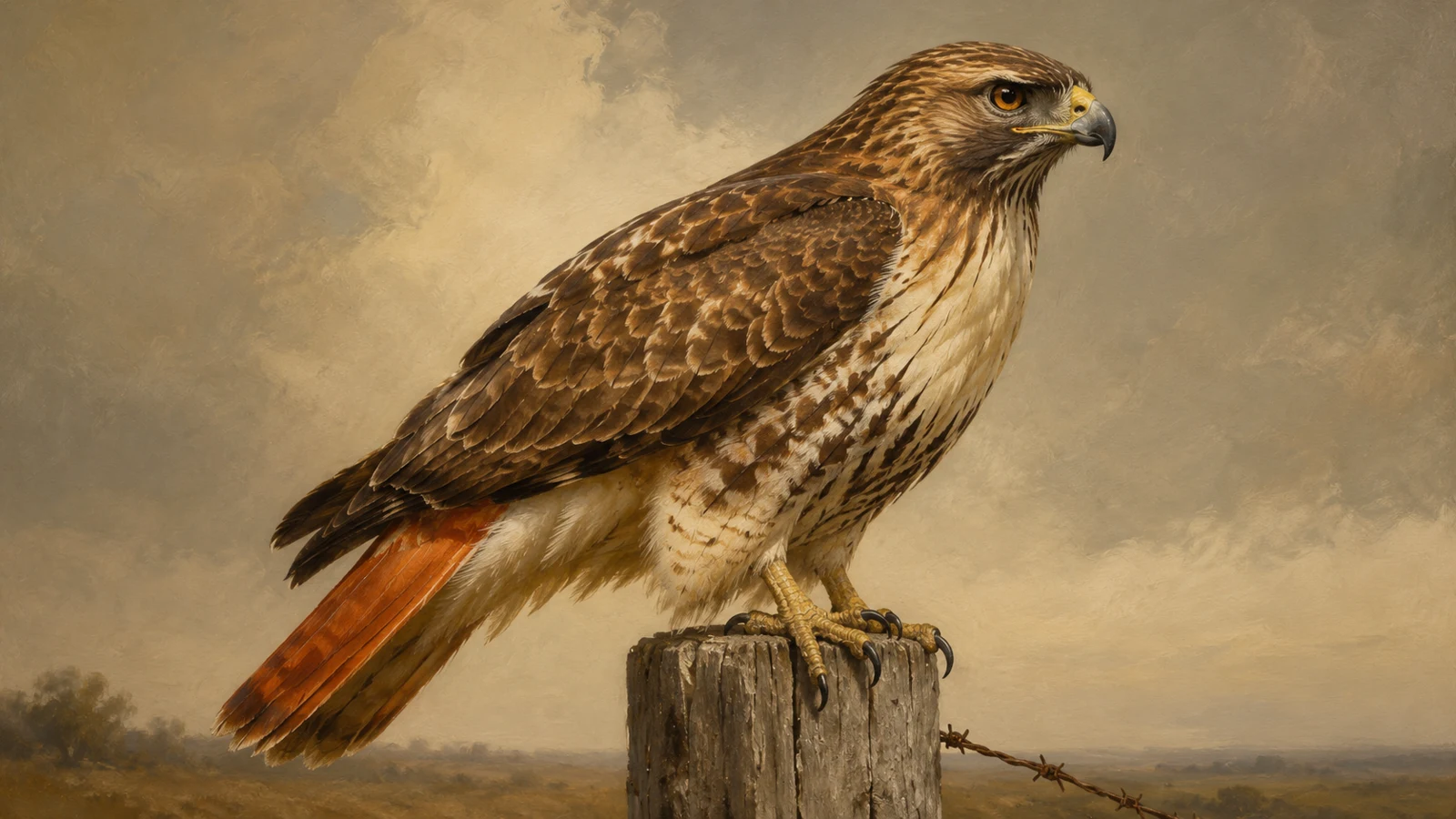
The field mark that names the bird is unambiguous on any perched adult: the upper tail is brick-red to rust-orange, banded with a single dark terminal bar. Below, it reads as pale pinkish-cinnamon. No other common hawk of similar size in North America shows this combination.
The underparts on the classic eastern bird - the subspecies calurus and borealis most North American birders encounter - are whitish with a dark streaked “belly band” across the lower abdomen that functions as a useful identification marker in flight. The back is dark brown. The face is pale.
That clean description covers perhaps half of the individuals you will actually meet. The Red-tailed Hawk runs more colour variation than almost any other American raptor. Pale morphs wash the belly almost white. Dark morphs run chocolate-brown throughout, with the red tail still holding. The Harlan’s Hawk of the northwest, long treated as a separate species, is now considered a subspecies and can be nearly black above with a mottled white or streaked tail that sometimes shows only traces of red. Western birds taken as a group are darker, more variable, and more frequently confusing than their eastern counterparts.
Juveniles complicate matters further. Young birds in their first year carry finely barred brown tails with no red at all, which is why many beginners in autumn look at a large brown hawk and call it something else. The belly band, where it shows, is the more reliable pointer in immature birds.
Voice
The call is one of the most recognised sounds in North American natural history, and almost always misattributed. A single, two- to three-second hoarse descending scream - the sound the public has learned to associate with any large bird of prey on screen. Film and television have used it for Bald Eagles for decades. The actual Bald Eagle produces a high thin chittering that sounds considerably less dramatic. The Red-tailed Hawk, by accident of pitch and character, became the default sound of aerial power in popular culture, and much of its symbolism of vision and focus flows from that same screaming presence.
The call carries effectively across open country and is most frequently given near the nest or during territorial display. Away from those contexts the bird is largely silent - HawkWatch International describes it as “generally silent away from the nesting territory.” Perched birds hunting along roadsides tend not to call at all.
Range and the year’s rhythm
The species breeds from the treeline in Alaska and northern Canada south through the continental United States to Panama and into the West Indies. The winter range contracts somewhat at the northern edge, with birds from the Yukon and northern Alberta moving south, but large numbers of resident birds remain across most of the lower 48 states throughout the year.
Migration through traditional hawk-watch ridges such as Hawk Mountain in Pennsylvania and Duluth’s Hawk Ridge in Minnesota produces consistent counts each autumn, with peak flights in October and November. Individual birds banded at Hawk Mountain have been recovered up to 2,200 kilometres from the banding site.
Habitat is open to semi-open across the range: grassland and prairie with scattered trees, agricultural land with woodlots, desert with saguaro and Joshua trees, forest edge, suburban parks with large mature trees, and those highway corridors. The bird requires two things: a structure from which to watch (tree, cliff, power pole, fence post, highway sign), and open ground below it. Given both, it will occupy almost any landscape.
Diet
Cornell’s Birds of the World describes the Red-tailed Hawk as primarily a sit-and-wait predator. It scans from an elevated perch, drops onto prey, and returns to the perch. On open prairie it will also hunt in flight, quartering low like a harrier. In some western habitats it kites in strong updraughts, holding station over a hillside while watching the grass below.
Rodents dominate the diet - meadow voles, deer mice, ground squirrels, gophers, and cottontail rabbits depending on region and season. Wikipedia’s summary of diet research gives rodents up to 85 per cent of foraging observations in many studies. Snakes figure heavily in some populations, particularly in the south and west. The occasional bird - pheasant, starling, pigeon - gets taken. Carrion is eaten opportunistically.
The belly band - that dark streaked bar across the lower abdomen - appears to function partly as disruptive coloration during the stoop, breaking up the bird’s silhouette as it drops into open grass. This remains a working hypothesis in raptor ecology rather than settled fact, but it is the most plausible explanation for a marking that appears consistently across otherwise variable plumage forms.
Breeding and nesting
Pairs bond for life, or as close to it as long-term tracking studies can confirm. Courtship aerial displays - the pair circling high on thermals, one bird diving and the other rolling to present talons in mid-air - are among the most visible raptor behaviours in North America, visible from the ground in clear spring weather over open farmland.
The nest is a substantial stick platform built in the tallest available tree, often reused across years and added to annually until it becomes a conspicuous structure. Nest height ranges from about four to 21 metres. Audubon’s field guide records clutch sizes of two to five eggs, typically two or three, with incubation running 28 to 35 days, both adults taking shifts. Young fledge at 42 to 46 days, according to Cornell’s Birds of the World, and remain in the parents’ territory for some weeks after first flight.
Territory size, Cornell notes, runs roughly 1.25 to more than 2.5 square kilometres, adjusted for habitat quality and prey density. A pair holding good agricultural land in Ohio may maintain a smaller territory than a pair over marginal shortgrass prairie in New Mexico.
The partnership with human infrastructure
This is the behaviour worth sitting with. The interstate highway system covers roughly 77,000 kilometres of the continental United States. Every kilometre of that road is a maintained clearing with mowed verges and elevated structures every few hundred metres. For a hawk that requires open ground and an elevated lookout, this is not a disrupted landscape. It is an engineered one that happens to suit the bird almost perfectly.
The same logic extends to suburban tree-lined streets, where the Red-tailed Hawk has established nesting territories in parks and large gardens in Boston, Chicago, and Los Angeles. The most famous example - a hawk known as Pale Male who nested on a luxury apartment building on Fifth Avenue in New York City beginning in 1991 and whose eviction in 2004 triggered a public campaign that forced the building management to restore the nest - demonstrated something about the bird’s read on human behaviour as much as about its adaptability to urban structure. Pale Male correctly identified a high south-facing ledge on a large building as equivalent to a cliff face, the surrounding city blocks as open territory, and Central Park below as a reliable hunting ground. He was right about all three.
The Red-tailed Hawk’s call carries in cinema because it has the right pitch and the right length for dramatic effect. The bird itself carries in the landscape for the same reason: it got the proportions right. It found the perch, found the clearing, found the territory it could hold. The highway was just the next version of a cliff.
The Red-tailed Hawk is the hawk North America built without meaning to - the one that read the new landscape accurately and moved in before anyone thought to ask.