Field Guide
Brown Pelican
In 1970, the entire California breeding population of the Brown Pelican produced exactly five chicks. Five. From thousands of nesting pairs, across all the rookery islands of the Southern California Bight, five juveniles survived. The culprit was DDT flowing from a Montrose Chemical plant near Los Angeles into the coastal waters, concentrating up the food chain - anchovies to pelicans - until the birds’ eggshells thinned to the point that an incubating adult crushed its own clutch simply by sitting.
Pelecanus occidentalis is the only pelican species in the world that feeds by plunge-diving. That foraging method made it uniquely vulnerable: fish-eating at a single trophic level, aggregating toxins with every meal. But the same singularity - a bird whose entire ecological identity is built around a particular trick - makes recovery, once the pressure is removed, equally decisive. DDT was banned in 1972. By the 1980s, breeding pairs were nesting successfully along the southeastern coast. In 2009, the species was removed from the Federal Endangered Species List. Audubon counts it among the most dramatic conservation recoveries of the twentieth century. The Brown Pelican did not return from extinction. It returned from near-functional sterility, which is, in some ways, more instructive.
What it looks like
An adult Brown Pelican runs 100 to 140 centimetres from bill tip to tail and weighs roughly 1,800 to 4,000 grams - a wide range that reflects genuine size variation between subspecies and between sexes. The wingspan reaches 180 to 200 centimetres. At rest on a dock piling, it is unmistakable: the grey-brown body, long flat bill, and pendulous throat pouch give it a silhouette that resembles nothing else on the Atlantic or Pacific coast.
Plumage varies by age and season. Non-breeding adults carry silver-grey upperparts, a white head, and a dark blackish-brown belly. Breeding adults shift dramatically: the back of the neck goes rich chestnut-brown, the eye patch turns greenish, and a yellow patch appears at the base of the throat. Immatures are largely grayish-brown above with a whitish belly, and they stay that way for roughly three years before acquiring full adult colouring. The sexes look alike at all ages.
The pouch is the defining structure. In a foraging adult, the gular pouch can expand to hold up to 11 litres of water - more than the stomach can hold, and functionally a scoop rather than a carrier. The bird drains the water by tilting its bill downward before swallowing, which is why a successful dive is followed by that characteristic chin-to-chest pause.
Voice and sound
The Brown Pelican is a largely silent bird away from its colonies. Nesting adults produce low grunts and hisses when disturbed, and chicks are considerably louder when competing for food from a parent’s throat pouch. The species communicates more through posture than through sound - the raised pouch, the lowered bill, the hunched wings all carry meaning in the tight social space of a colonial nest site. At sea, foraging birds are typically quiet.
Range and habitat across the year
The species is coastal year-round, with no true long-distance migration. Along the Atlantic, breeding populations concentrate from North Carolina through Florida and around the Gulf Coast. Pacific populations range from southern British Columbia through Mexico and down the Pacific coast of Central and South America. A small but growing inland presence appears around the Salton Sea in California, where human management of water levels has created viable foraging.
Brown Pelicans nest on islands - on the ground among low vegetation, or in mangroves or other shrubby coastal trees, depending on what the site offers. Island nesting is not a preference but a defence: mainland predators cannot reach eggs on low-lying barrier islands or rocky offshore outcrops as easily as they could on connected land. After the breeding season, non-breeding and juvenile birds can range considerably along the coast, appearing as far north as Washington State and Nova Scotia in late summer.
Habitat is straightforwardly marine: salt bays, estuaries, beach margins, and the immediate nearshore ocean. They do not move inland, and they do not forage in fresh water.
Diet
The diet is almost entirely fish. Anchovies dominate on the Pacific coast. Menhaden and mullet feature heavily on the Atlantic coast. Occasional crustaceans appear in stomach content analyses, but fish represents well over 90 per cent of foraging observations. Cornell’s Birds of the World notes that the Brown Pelican selects shallow-water schools visible from height - it does not follow fishing vessels or compete significantly with other species for subsurface prey.
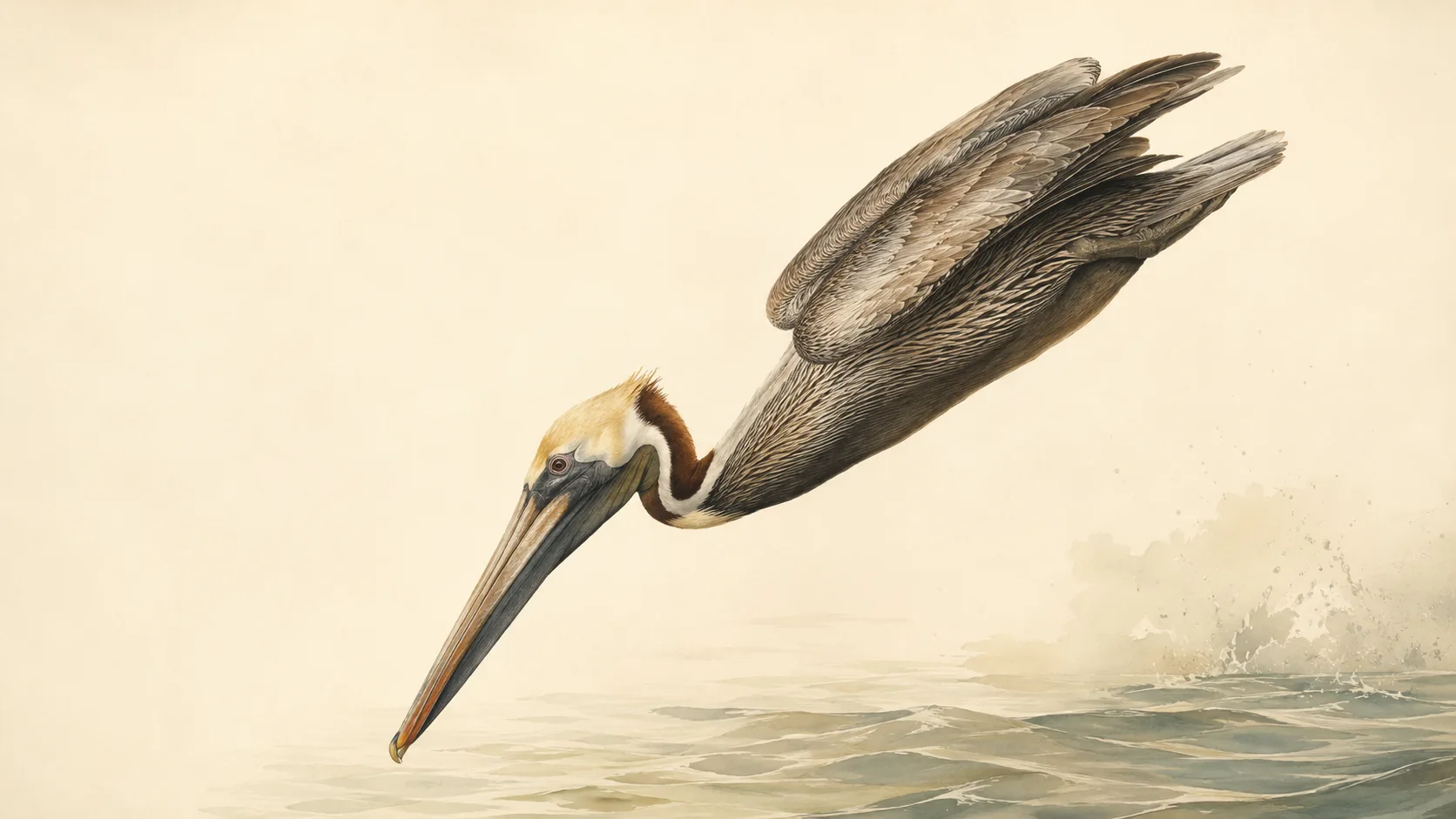
The plunge-dive itself is worth describing precisely, because it is different from the surface-dipping behaviour of the American White Pelican. A Brown Pelican spots a fish from as high as 20 metres above the water’s surface. It tucks its wings, rotates slightly to the left (protecting the trachea and oesophagus from impact), and hits the water bill-first. Air sacs under the skin cushion the blow. The pouch opens at the moment of impact, trapping fish and water together. The bird surfaces, drains the water, and swallows. Start to finish, the dive takes roughly two seconds.
Breeding and nesting
Brown Pelicans nest colonially, often in groups of hundreds to several thousand pairs. Nest construction varies by site: on the ground, it is a shallow scrape lined with grass and feathers; in trees, the adults build a stick platform that grows more substantial over successive breeding seasons as both partners add to it.
Clutch size is typically three eggs, incubated by both parents using the tops of their feet - the webbing wrapped over the eggs to transfer body heat - rather than a brood patch. Incubation lasts roughly 28 to 30 days. Chicks are altricial and hatch naked, developing a full coat of white down within a week. Cornell’s Birds of the World records that young pelicans fledge at 11 to 12 weeks, but the adults continue to feed them for some weeks after that. Sexual maturity comes at three to five years of age, which is slow for a bird of this size but consistent with the long potential lifespan: banding records cite the oldest individual on record at 43 years (Cornell Birds of the World), though 10 to 25 years represents a more typical wild range.
The left-rotation quirk
The leftward twist on entry is not ornamental. High-speed footage of diving Brown Pelicans has established that the bird consistently rotates its body clockwise (from the bird’s perspective, left to an observer watching from above) during the final phase of the dive. The specific orientation protects the oesophagus and trachea, which run down the right side of the neck, from the water impact force. It is a structural adaptation to a behaviour the species repeats thousands of times per lifetime. That the rotation is directionally consistent across the species - not random, not learned individually - suggests it is baked into the motor programme of the dive itself.
No other plunge-diving seabird uses this exact protective mechanism. The Brown Pelican solves the impact problem through rotation. Gannets, which hit the water at higher speeds, solve it through a reinforced skull and a sealed bill. Different physics, different birds, same solution category.
The IUCN lists the Brown Pelican as Least Concern, a designation that is technically accurate and quietly extraordinary: this is a species that held at five surviving chicks in California in 1970 and rebuilt from there.
The conservation status says nothing about how close the margin was, or how long it took, or what it cost in monitoring and nest-site protection and sustained political will to achieve. Least Concern is the correct current classification. It is also, if you know the history, one of the more hard-won two-word descriptions in North American ornithology.