Field Guide
Baird's Sparrow
It is July on the northern Great Plains, and the wind moves the grass in long, slow waves. Then, from somewhere inside that motion - not above it, not from any visible perch - comes a song. Three short clear notes, rising, and then a musical, descending trill that seems to belong to some smaller, more delicate bird than the prairie itself. Pause. The song again. A grass stem bends under the weight of a small brown sparrow, ochre-washed head barely clearing the seedheads, and the whole effect is of a bird designed to be heard but not quite seen.
This is Centronyx bairdii, Baird’s Sparrow. It was the last bird species described by John James Audubon. It has been declining for sixty years. And it may be the most perfect illustration available of what happens when a specialist meets a shrinking world.
What it looks like
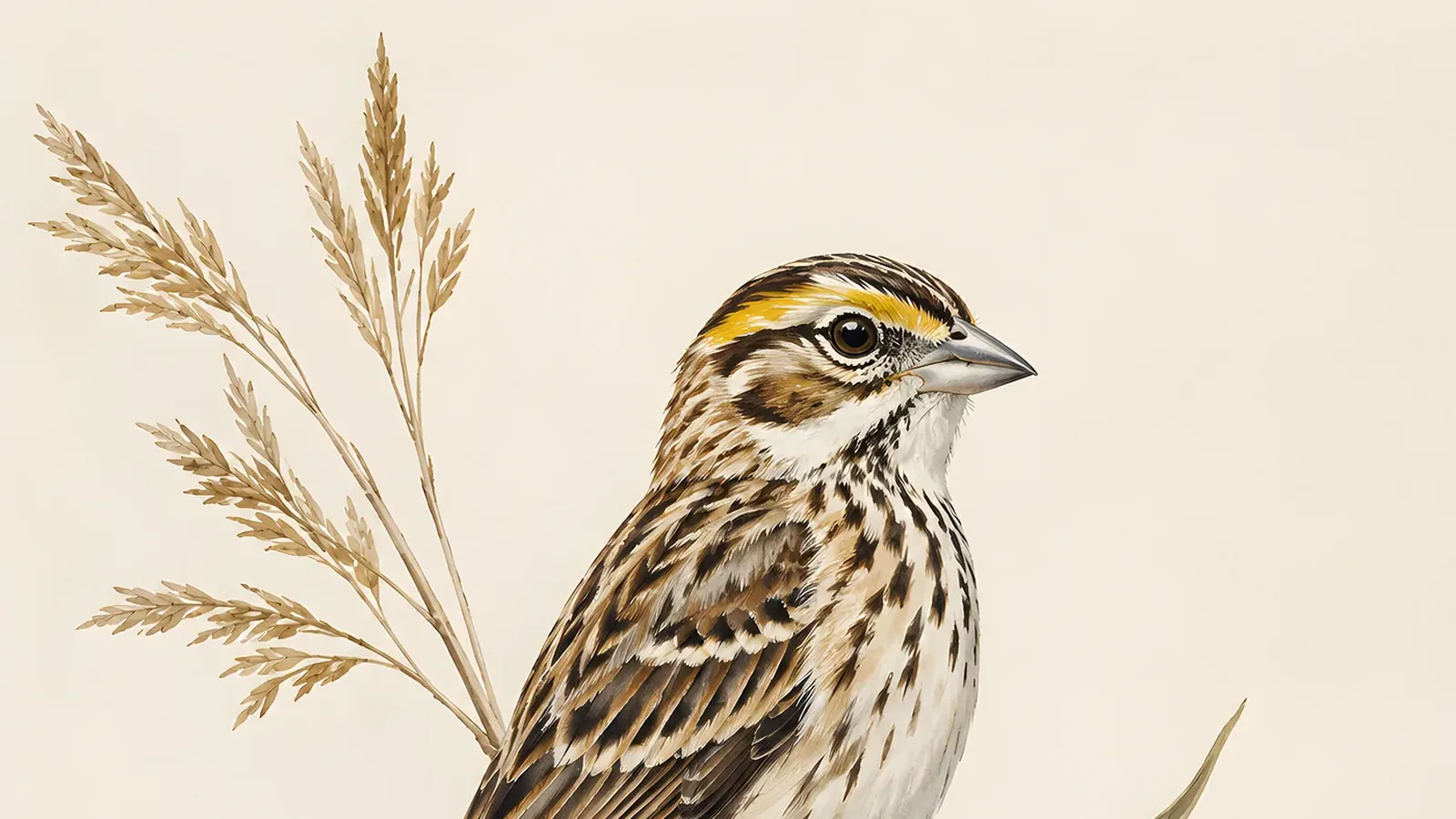
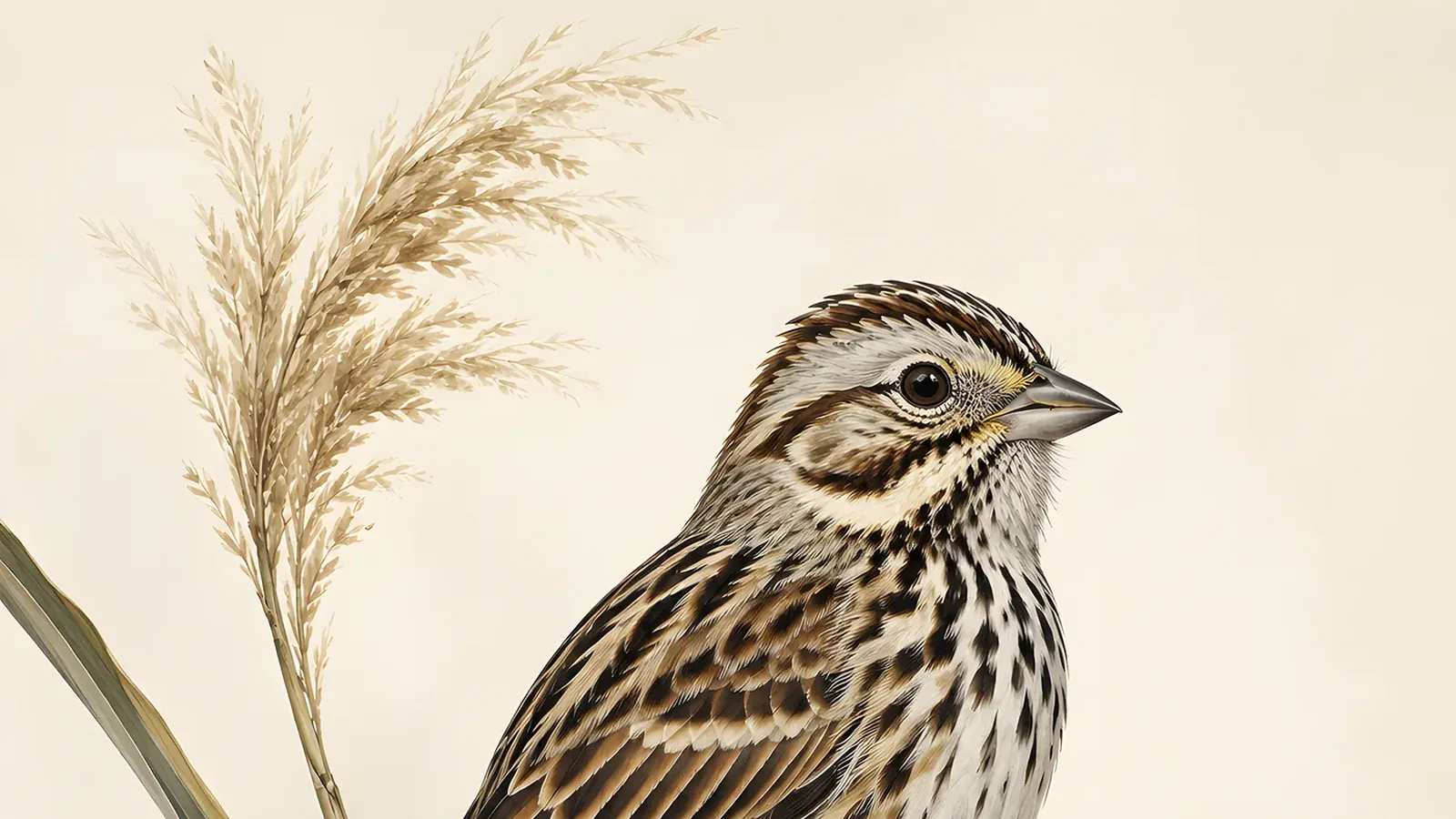
Baird’s Sparrow is a compact, short-tailed bird, 13 to 14 centimetres long and weighing 17 to 21 grams, with a wingspan of 22 to 23 centimetres. In the hand it is immediately distinctive. In the field, in tall grass, it disappears.
The head is the diagnostic feature. A broad, warm ochre median crown stripe runs from the bill to the nape, flanked by dark lateral stripes. The face is ochre-washed. A fine, well-defined necklace of dark streaks crosses the upper breast, distinct from the heavy, blurry streaking found on other prairie sparrows. Below that necklace, the underparts are clean white. The back is streaked brown and buff, the wings showing pale feather edges that give the folded wing a scaled appearance.
The bill is small and pale, suited to both seed and insect work. The tail is short and often cocked slightly upward when the bird is flushed.
What separates C. bairdii from its nearest confusion species - Henslow’s Sparrow above all - is the combination of that ochre head wash, the clean necklace rather than solid breast streaking, and the overall buffy warmth of the plumage. Henslow’s runs greener in the face and heavier through the breast. Le Conte’s Sparrow shares the ochre tones but is smaller, brighter, and shows strong facial striping rather than the subtle Baird’s pattern.
| Measurement | Range |
|---|---|
| Length | 13-14 cm |
| Weight | 17-21 g |
| Wingspan | 22-23 cm |
| Oldest banded individual | 4 years, 7 months |
The song
The male sings from an exposed grass stem or low shrub - brief, deliberate exposure before dropping back into the grass. Audubon’s field guide describes it as “three short notes followed by a musical trill on a lower pitch.” That is accurate, and it understates the quality of the sound. The three opening notes are clean and whistled. The trill that follows is tinkling, sweet, complex enough to arrest attention even on a wind-loud prairie. It carries further than the bird seems capable of projecting.
Singing is done with urgency during the breeding season, May through July. Males will sing through the midday heat when most songbirds have gone quiet. The song is also the surest way to locate the species - the bird itself will run through grass with a mouse-like ground speed that makes visual tracking almost impossible.
The call is a high, thin tsip, easy to miss against the larger sounds of open country.
Range and the native-prairie rule
C. bairdii breeds in a compact arc across the northern Great Plains - southwestern Manitoba, Saskatchewan, and Alberta in Canada, and south through Montana, western North Dakota, and the extreme northwest of South Dakota in the United States. Some breeding populations extend into the adjacent corners of Wyoming and Minnesota. Cornell’s All About Birds describes it as arriving on its wintering grounds in southeastern Arizona and northern Mexico during October and November, departing in April.
The species is almost never encountered east or west of this corridor. It is not a bird that wanders.
But the range description alone obscures what matters most about this species: C. bairdii is a native-prairie obligate. It does not breed successfully in cultivated fields, reclaimed pasture, introduced grass monocultures, or degraded prairie. Research cited by the Montana Field Guide and the North Dakota Game and Fish Department shows that the species requires relatively complex, structurally diverse grassland - needle-and-thread grass, grama, Junegrass, and native bluestem among the associated plants most strongly correlated with its presence. Nesting success is substantially higher in intact grassland patches of at least 63 hectares. Smaller, fragmented, or heavily grazed parcels produce fewer pairs and lower productivity.
This specificity is the central fact of its conservation story. The grass this bird needs has largely become something else.
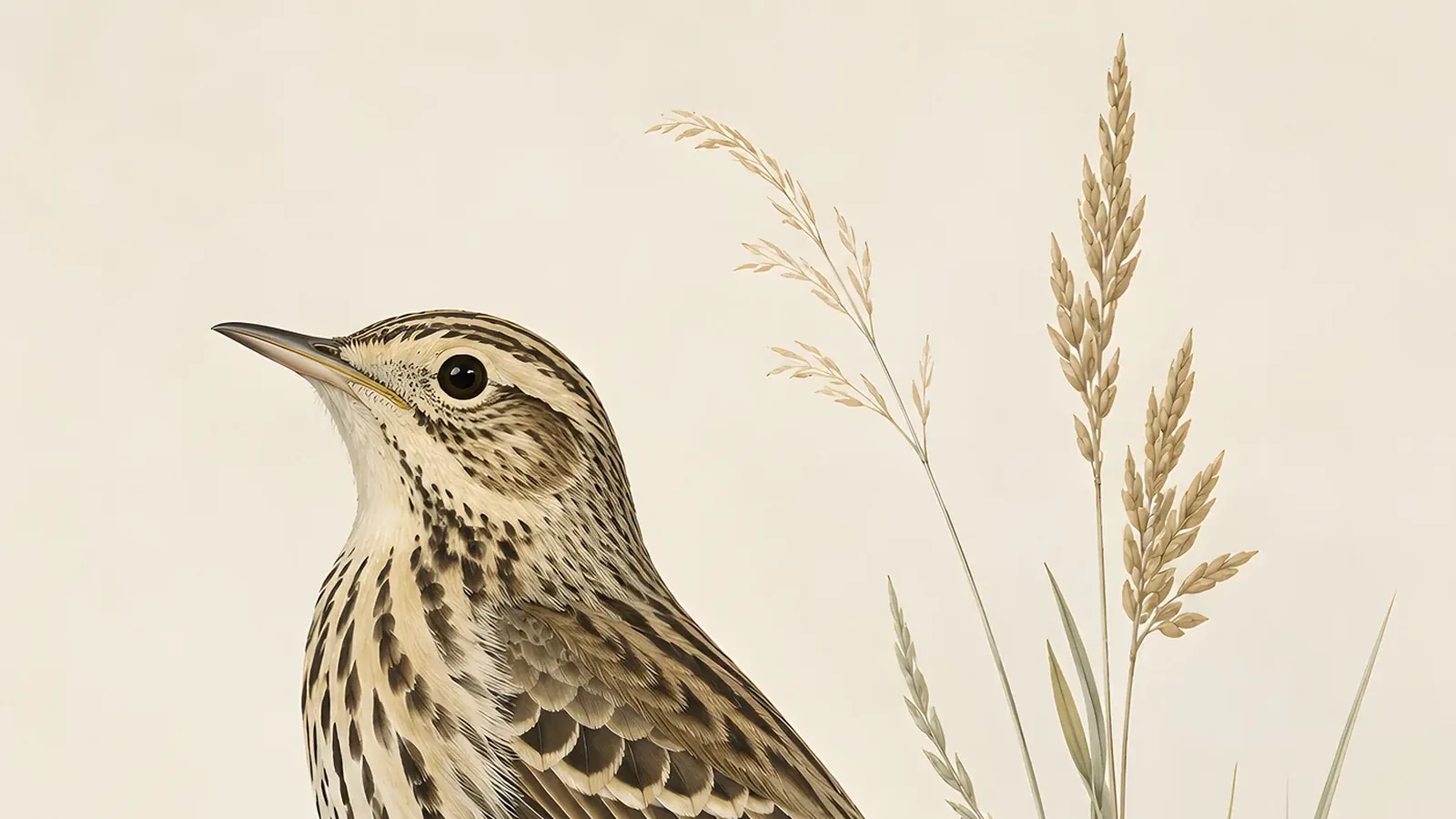
The Sprague’s pipit occupies overlapping breeding habitat and shares some of the same declines - together the two species are useful indicators of mixed-grass prairie quality.
Diet
During the breeding season, Baird’s Sparrow eats predominantly insects: grasshoppers, caterpillars, moths, beetles, and leafhoppers, plus spiders. Nestlings are fed almost exclusively grasshoppers and caterpillars - the protein density required for rapid development. Outside the breeding season, on the wintering grounds and during migration, the diet shifts to weed seeds and grass seeds gathered by foraging along the ground.
Foraging happens mostly on foot, the bird moving through the base of the grass with a deliberate, almost mouse-like pace. It rarely perches to feed. This ground orientation - combined with its preference for staying within the grass rather than above it - gives it the secretive quality that frustrates birders who hear the song but cannot locate the singer.
Breeding
Males arrive on the breeding grounds in May and immediately begin singing to establish territories. Territory sizes in North Dakota have been recorded between 0.8 and 2.25 hectares (Kantrud and Kologiski, 1982). The species may breed in loose, informal colonies where prairie quality is high, with several pairs occupying adjacent territories.
The nest is a cup of dry grass, woven into a slight depression at the base of a grass clump, often with an entrance partially concealed by overhanging blades. The female builds it. She incubates alone for 11 to 12 days.
Clutch size runs three to six eggs, with four or five typical. The eggs are greyish-white, heavily spotted with reddish brown. Young leave the nest at eight to ten days - before they can fly - and continue to receive parental care for one to two more weeks. The Montana Field Guide records that a second brood is possible in a season, though evidence for this in northern populations is limited.
Fisher and Davis (2024), writing in Ornithological Applications, found that daily nest survival for C. bairdii decreased significantly as precipitation between nest visits increased, and that high minimum temperatures also depressed nest success. Their study, conducted at three Saskatchewan sites from 1997 to 2008, found nest success ranging from 28.8 to 63.2 per cent depending on location - with weather accounting for up to 28.6 per cent of nest failures. Given that 75 per cent of the global breeding population occupies the northern range edge, this weather sensitivity is a compounding threat in a warming climate.
The name
Audubon collected two specimens of this bird in the summer of 1843, from the wet prairie margins near what is now Fort Union in Williams County, North Dakota. He was 58 years old, on his last major expedition, travelling up the Missouri River. The bird did not appear in scientific records again for nearly 30 years.
He named it for Spencer Fullerton Baird, then a young naturalist who had recently completed his degree at Dickinson College and had begun corresponding with Audubon and other leading figures in American natural history. Audubon gave Baird a significant portion of his collected specimens. The naming was a gift, and a recognition: Baird went on to become the second Secretary of the Smithsonian Institution and one of the most influential American scientists of the nineteenth century, with more species named for him than for almost any other person. But when Audubon wrote the name in 1843, Baird was 20 years old and not yet any of that.
The last bird Audubon named was given to a young man who would outlast his mentor by decades and reshape the institutions of American natural history. It is a small, warm detail at the edge of a large story.
“The vast majority of native grassland has disappeared due to agriculture, overgrazing, fire suppression, and invasive plants. Baird’s Sparrow is among the North American grassland-obligate songbirds whose populations have experienced significant annual declines.” - American Bird Conservancy
Rosenberg and colleagues (2019), writing in Science, calculated that grassland birds as a group have lost more than 700 million breeding individuals since 1970 - the largest proportional decline of any North American bird guild at 53 per cent. Baird’s Sparrow has lost roughly 65 per cent of its population since 1967, according to Cornell’s All About Birds, placing it in the category of species the Cornell Lab identifies as “Red Alert Tipping Point” birds.
The IUCN lists Centronyx bairdii as Least Concern. That designation reflects range size and current estimated population rather than trajectory. The trajectory is not reassuring.
There is a narrowness to this bird’s requirements that makes its future legible. It needs large, intact, structurally complex native prairie. That is all. There is very little left, and what remains continues to fragment. Baird’s Sparrow is not a species that will adapt to the altered version of its home. It has been singing from that grass stem for thousands of years, and it will sing there until the grass is gone.