Field Guide
Snowy Egret
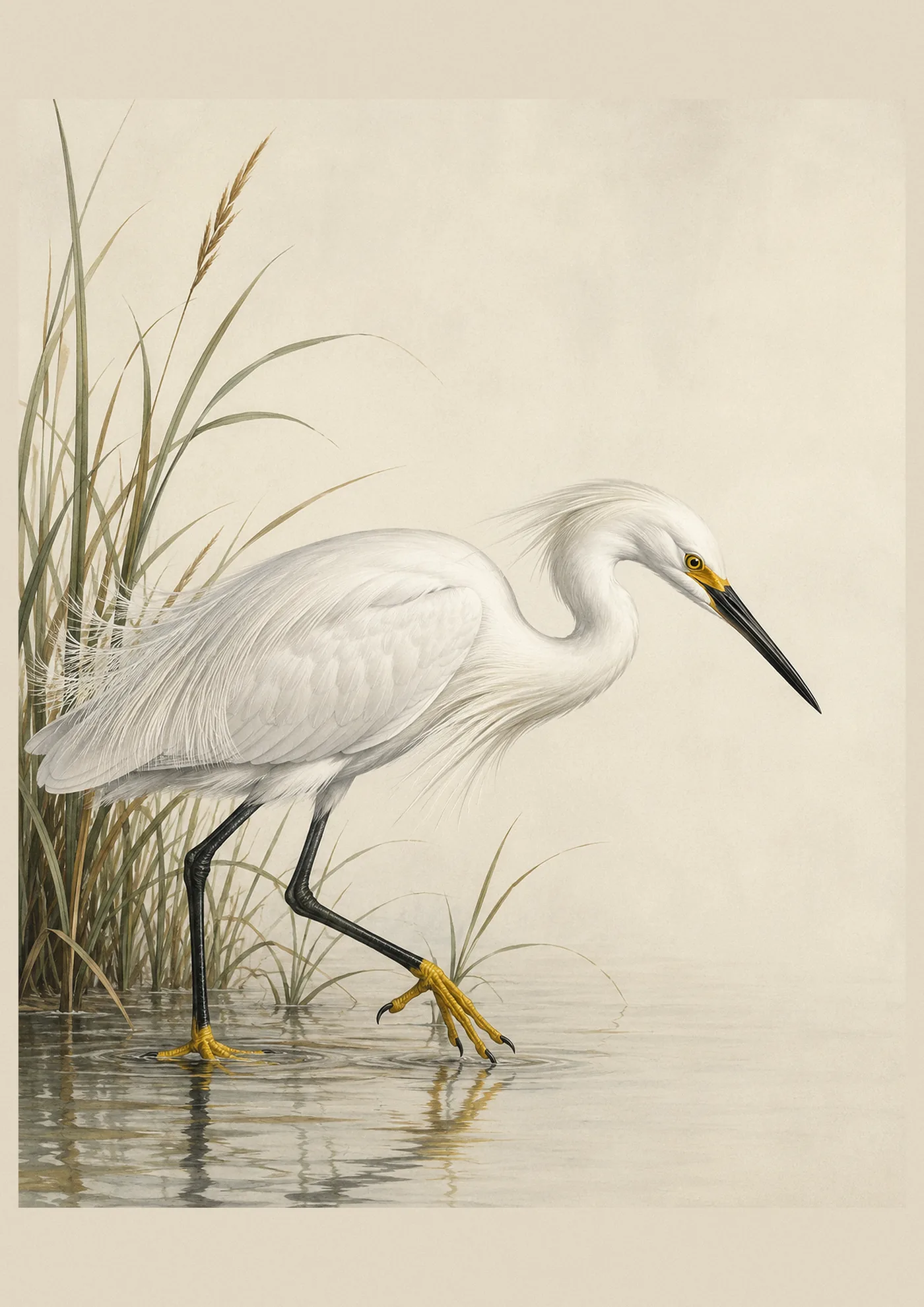
A white bird in the shallows. Black legs, and feet the colour of egg yolk. Watch it long enough and the feet do something strange. They shuffle. They flicker against the mud. This is the Snowy Egret, and the gold is not decoration. It is a tool.
How to know it
A small, slender heron, all white from bill to tail.
Look first at the bill. It is slim, sharp and black. The legs are black too, long and dark. Then look down to where the leg meets the water. The feet are a vivid yellow, almost orange in good light.
That single contrast, black legs and golden feet, settles the identification. The larger Great Egret has a yellow bill and black feet. The Snowy reverses it.
In the breeding season the bird grows long, lacy plumes off the back, chest and crown. These are the famous “aigrettes”. A patch of bare skin at the base of the bill flushes from yellow toward red at the peak of courtship.
Range and habitat
A bird of the Americas, edge to edge.
It breeds across the southern and coastal United States, through Central America and the Caribbean, and down into much of South America. Northern birds move south for the winter. Some wander far off course, which is how the odd one turns up well outside its usual map.
Look for it where land meets shallow water. Salt marshes, tidal flats, mangroves, freshwater ponds, the muddy margins of rivers and lakes. It nests in colonies, often shoulder to shoulder with other herons and egrets, in trees and low shrubs near water.
Behaviour
This is the egret that fidgets.
Where some herons stand frozen and wait, the Snowy is a restless, active hunter. It stalks. It runs. It hops. It flutters one wing to throw a shadow on the water.
And it uses those yellow feet. The bird stirs the bottom, vibrating a foot in the mud to startle fish, shrimp, crabs, frogs and insects into moving. Movement gives them away. Then the neck uncoils and the strike comes.
It feeds alone and in loose crowds, and will follow other feeding birds to snatch what they stir up.
Voice
A quiet bird, mostly. Away from the colony you may hear little at all.
At the nest it is another matter. A breeding colony is loud and quarrelsome, full of harsh, rasping calls and a low, raspy “wulla-wulla” as birds squabble over space and mates.
A bird worth saving
There is a reason this bird matters beyond the wetland.
In the late nineteenth century those delicate breeding plumes were worth more than gold by weight, ripped from the birds to decorate hats. Whole colonies were destroyed. The slaughter helped spark the early bird-protection movement and the first conservation laws.
The Snowy Egret survived it. Today the species is listed as Least Concern and stands across its old range once more. A small wild patience, recovered.