Field Guide
Allen's Hummingbird
In January, while most of North America’s hummingbirds are still in Mexico waiting on spring, a male Allen’s Hummingbird is back on the California coast and already showing off. He picks a perch in the coastal scrub, flashes a throat the colour of hot copper, and launches into a display that looks less like courtship than a dare. He swings in long pendulous arcs, back and forth, then climbs high and drops in a steep dive that ends with a thin metallic squeal torn from his tail feathers. He has been home for weeks before the competition arrives.
That early return is the key to the bird. Allen’s Hummingbird breeds along a coastal ribbon only a few miles wide, from southern Oregon down through California, one of the narrowest breeding ranges of any bird on the continent. It is small even by hummingbird standards and almost impossible to separate from the Rufous Hummingbird in the field. What it lacks in size and range it makes up for in nerve.
What it looks like
This is a compact, stocky little hummingbird, 7.6 to 8.9 centimetres long and weighing just 2 to 4 grams, with a wingspan Cornell Lab puts at 11 to 12 centimetres. It is, by their reckoning, one of the smallest hummingbirds in California, edged out only by the migrant Rufous and Calliope.
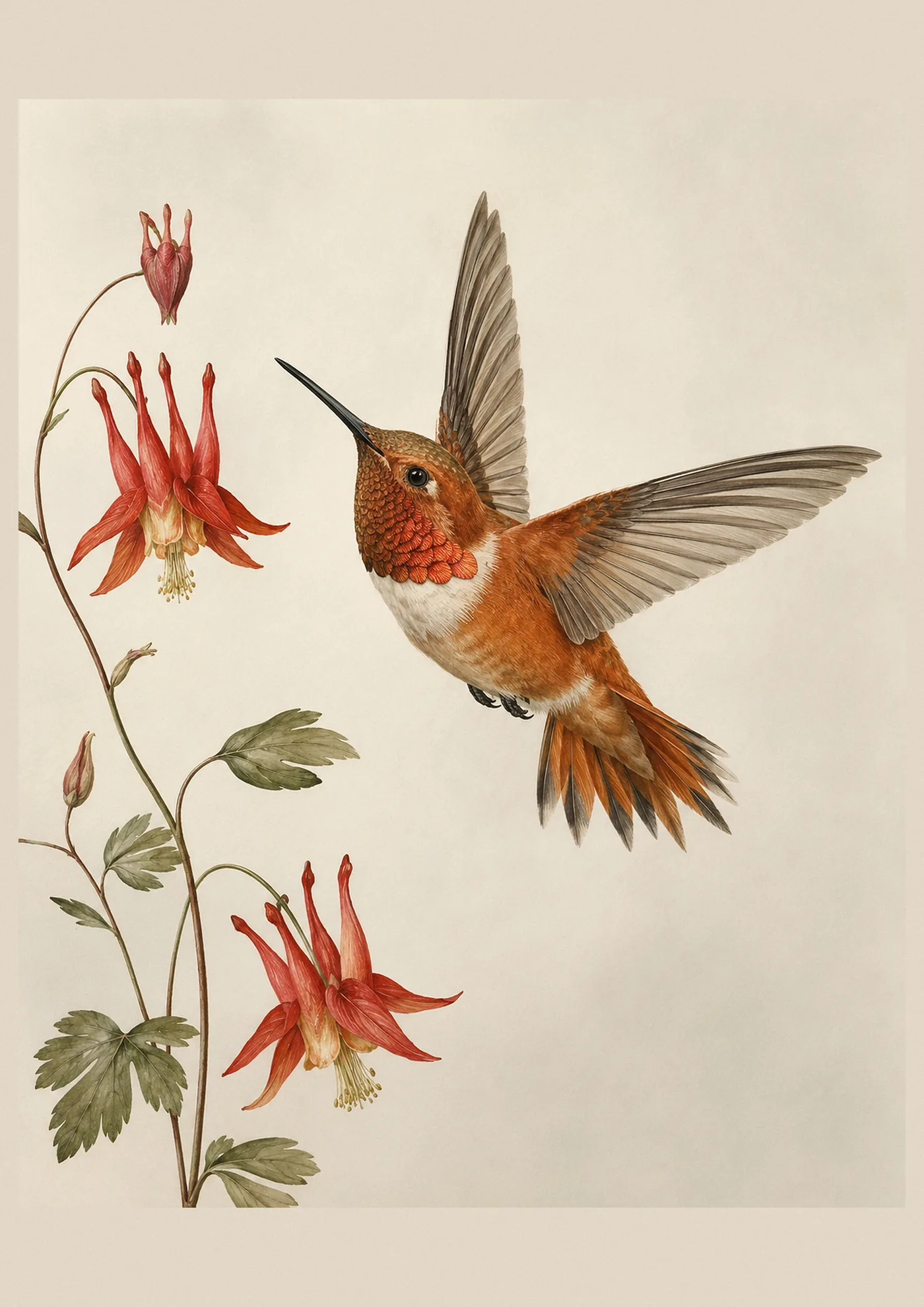
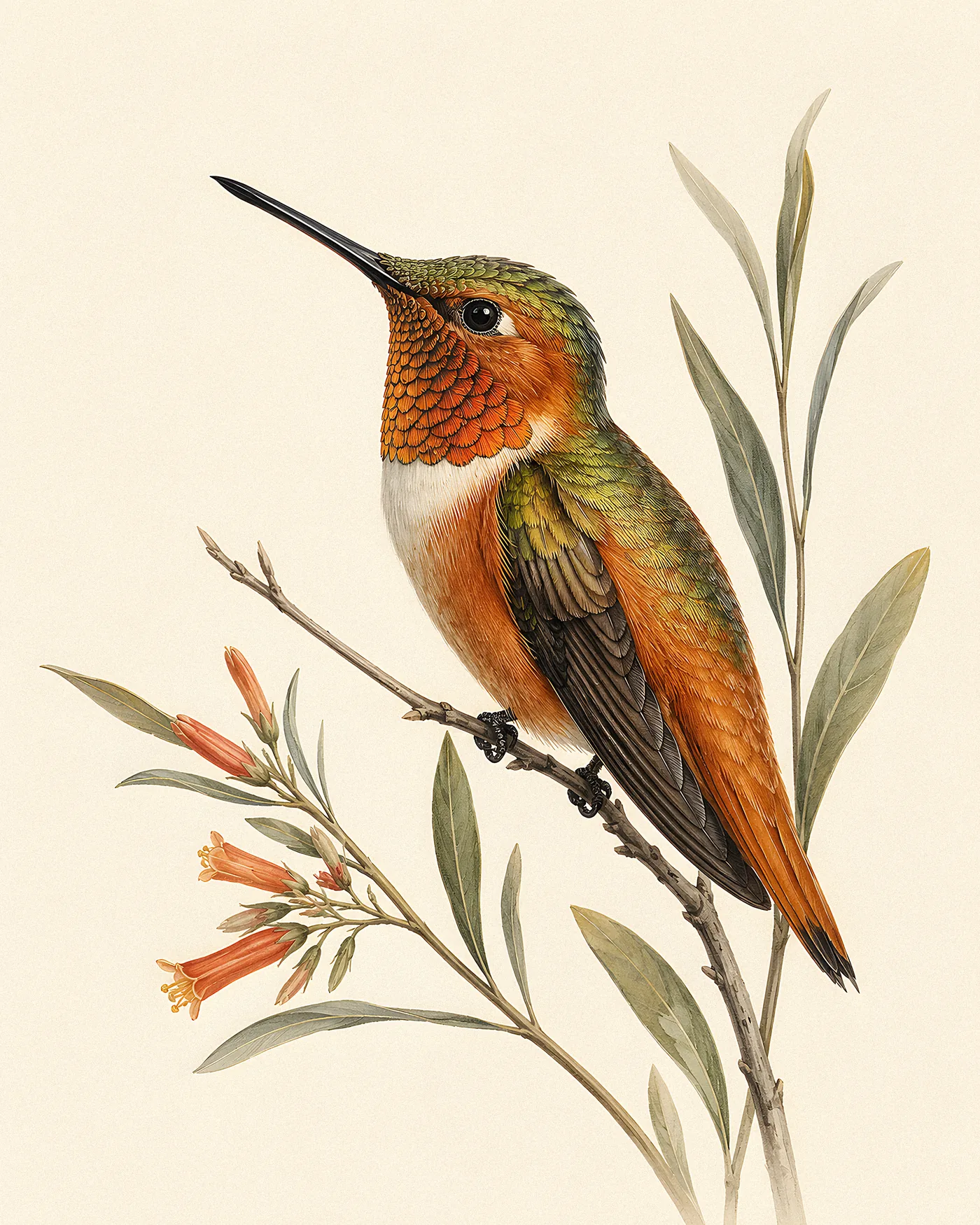
The adult male is the showpiece. His gorget, the iridescent throat patch the family wears, blazes coppery orange-red, shifting toward flame or gold as he turns his head. His back and crown are bright metallic green, his flanks and tail rich rufous, and his belly washed orange. Face him in full sun and the throat ignites; turn him a few degrees and the colour drops to dull bronze, the trick of structural colour that all gorgets play.
The female is the quieter bird and the harder identification. She is metallic green above with pale coppery flanks, a whitish throat sometimes flecked with a few bronze spots, and rufous in the tail with white tips. She reads almost exactly like a female Rufous Hummingbird, and even experienced observers often leave the two unresolved unless the bird is in the hand. The green back separates an adult male Allen’s from the typically rusty-backed Rufous, but the females and young defy a clean call.
What it sounds like
The voice is thin and buzzy, a string of high chip notes and dry buzzes delivered in chases and squabbles around a feeder or a flowering shrub. None of it carries far, and none of it is the sound that matters.
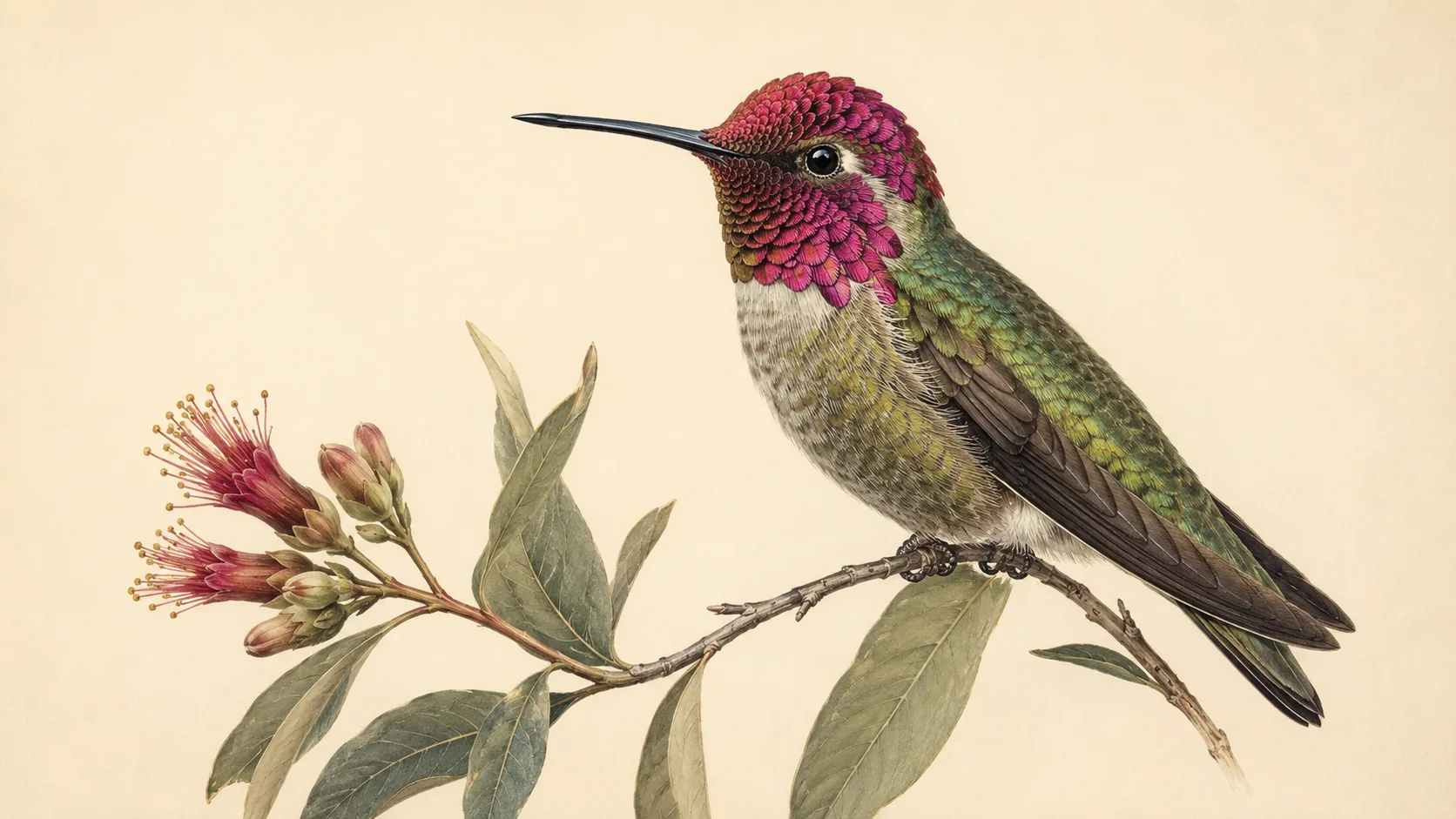
The sound that matters is mechanical, not vocal. At the bottom of the male’s display dive, air rushing through his spread tail feathers produces a sharp, high squeal, a sound made by feathers rather than voice. It is the acoustic signature of the dive, the same family trick the Anna’s Hummingbird turns with a louder crack. In a male Allen’s it is a thinner, more piercing note, the punctuation mark at the end of the pendulum-and-plunge routine he performs from January onward.
Range and habitat
Selasphorus sasin keeps to a thin coastal strip of scrub, chaparral, and forest edge from sea level up to around 300 metres, running from southern Oregon through coastal California. Males tend to hold the open, sunny territories thick with flowers, while females nest back in the cover of eucalyptus, redwood, and Douglas-fir.
The species splits into two ways of living. One subspecies migrates, wintering in central Mexico in oak-pine forest and scrubby flower-rich clearings, and these are the birds that pour back north so early in the year. The other, on the Channel Islands and across parts of greater Los Angeles, has stopped migrating altogether and stays put year-round, following the same path of garden plantings and feeders that let the Anna’s expand. The IUCN lists the species as Least Concern, though its narrow breeding range gives it less margin than most.
Diet
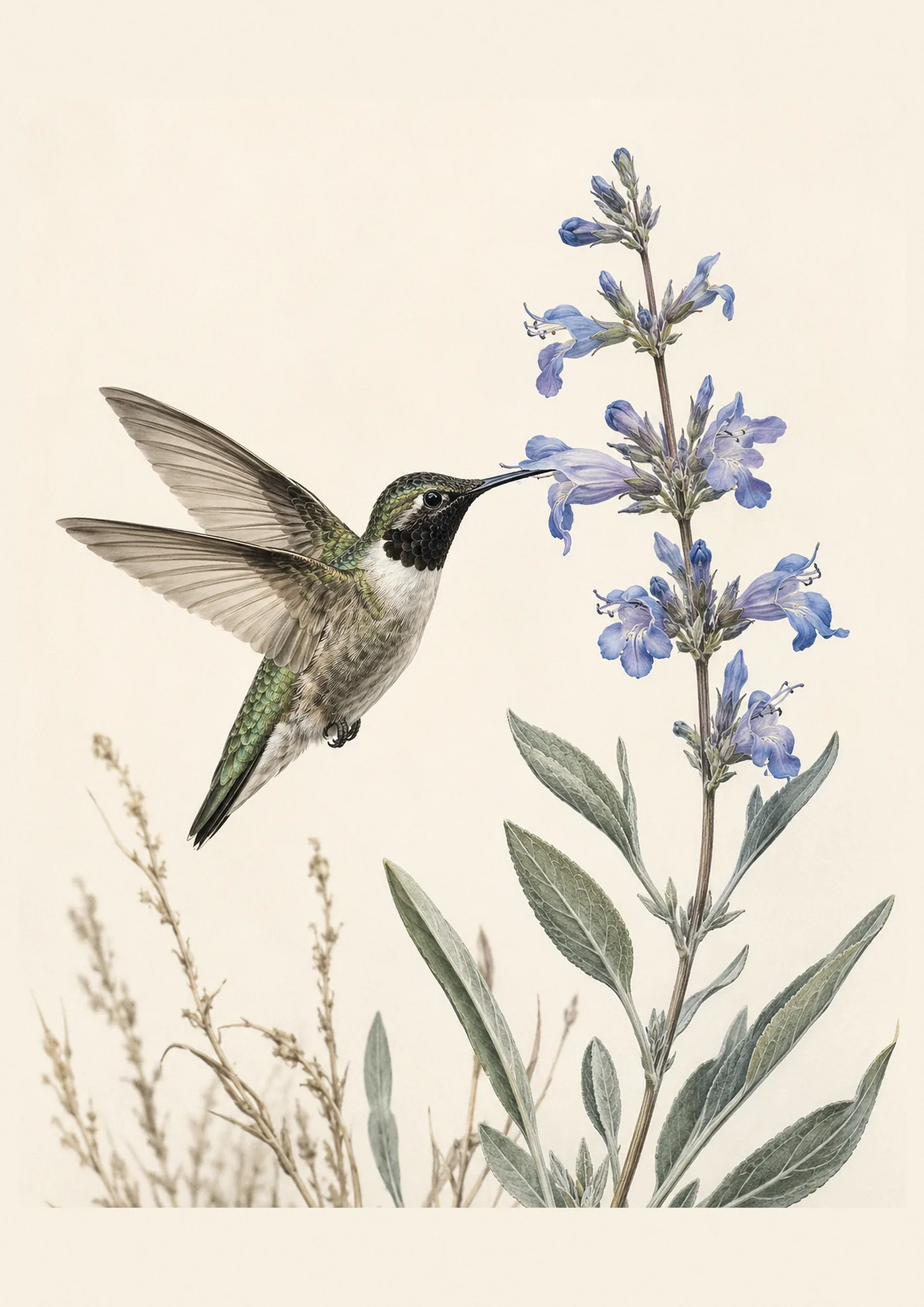
Nectar is the fuel. Allen’s works flowering currant, gooseberry, monkeyflower, manzanita, columbine, and the western lilies it helps pollinate, plus a long list of garden plants and any feeder within range of a defended territory. A hummingbird burns through hundreds of flower visits a day, so a male holding a patch of good blooms is guarding a pantry, not a stage.
Insects and spiders supply the protein, taken by hawking small flies, ants, beetles, and wasps from the air, gleaning them off leaves, and lifting them from spider webs. No hummingbird lives on sugar alone. The insects build the feathers and feed the young, and a diet without them produces a bird that cannot do either.
Breeding and nesting
The male’s contribution ends with the display. After the dives and the arcs, he mates and moves on to court the next female, taking no part in what follows. The female builds alone, a small cup of plant down and fibres bound with spider silk and shingled outside with lichen and moss, set on a branch in the shade of a tree.
She lays two white eggs, sometimes one, and incubates them by herself. Cornell Lab puts incubation at roughly 15 to 17 days, with the young fledging about three weeks after hatching, fed throughout by the female alone. It is the standard hummingbird arrangement: a brilliant, absent father and a plain, tireless mother who does every part of the work that produces the next generation.
The nerve worth watching
The thing to know about Allen’s Hummingbird is the size of its temper. For a bird that weighs less than a coin, it is astonishingly aggressive. Males defend their flowering territories against other hummingbirds without hesitation, but they do not stop at their own kind. Cornell Lab records male Allen’s driving off birds many times their size, including kestrels and hawks, harassing predators out of the airspace through sheer persistence.
A bird the weight of two paper clips will climb the sky to dive at a hawk, and the hawk usually leaves.
There is a smaller trick worth knowing too. In cold weather an Allen’s tucks its feet up into its belly feathers as it flies, conserving heat; in warm weather it lets them dangle to shed it, a living thermostat run on bare toes. So when the male turns up on the coast in January, copper throat flashing, arcing and diving weeks ahead of every rival, he is not just early. He is staking the best flowers, guarding them against all comers, and daring anything larger to try its luck.