Field Guide
Blue Jay
Every oak you can see east of the Rocky Mountains has a non-zero chance of being there because a Blue Jay forgot where he buried an acorn in 1958.
I do not mean this metaphorically. I mean it ecologically and demographically. The northward spread of oak forests after the last glacial maximum - from southern refugia in the Florida panhandle and the southern Appalachians, up to the Great Lakes and the southern margins of the boreal forest - happened at rates that simple gravity cannot account for. An oak tree produces about three thousand acorns a year. Without help, an acorn falls vertically and sprouts within a few metres of the parent tree, which moves the forest’s leading edge about a metre per generation. The post-glacial expansion happened at hundreds of metres per generation. Something moved the acorns. The leading candidate, in a 1989 paper by Johnson and Webb in the Journal of Biogeography, is the Blue Jay.
A single Blue Jay caches between three and five thousand acorns every autumn. He holds two or three at once in an expandable throat pouch and carries a fourth in his bill, flies anywhere from thirty metres to five kilometres from the source tree, and buries them one at a time in soft soil or leaf litter at the edge of a clearing or in a young forest opening. He marks each cache by spatial memory and visual landmark. He returns through the winter to dig them up. He remembers many of them.
He does not remember all of them. He gets killed, or distracted, or simply loses track. The forgotten acorns germinate the following spring. Wherever he chose to bury them is where a new oak seedling now stands.
This is the Blue Jay’s actual contribution to the planet and almost no one knows about it. He is the bird the suburban birder thinks of as a noisy disruptive raptor-mimicking troublemaker at the feeder, a bird best appreciated as a flash of blue and then ignored. He is also one of the most important seed-dispersal vectors in North American forest ecology, and the eastern hardwood biome that defines two-thirds of the United States east of the Mississippi exists, in some real sense, because of him.
You can keep that fact in mind for the rest of this field guide.
What he looks like and how to tell
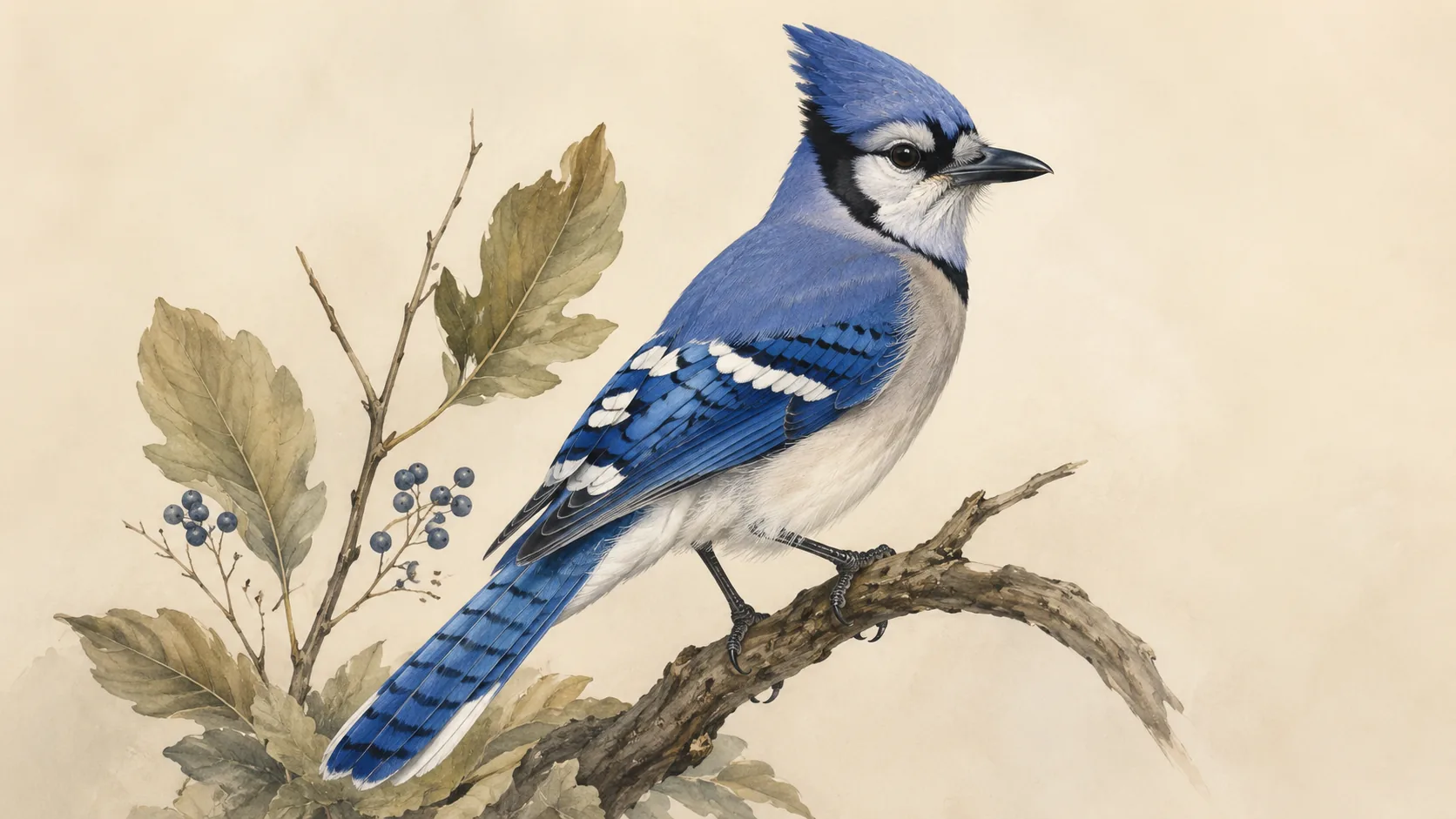
A Blue Jay is 25 to 30 centimetres long, weighs 70 to 100 grams, and is, despite the name, not blue. The blue in his plumage is structural. There is no blue pigment anywhere in his feathers. The colour is produced by the nanoscale arrangement of keratin and air pockets in each feather barb, which scatter light in the blue wavelengths and absorb the rest. A Blue Jay feather held in front of a candle backlit looks brown. This is the same physics that makes the sky blue, and the same that makes a Mountain Bluebird blue, and the same that makes the wings of a Morpho butterfly blue. Blue, in nature, is almost always structural.
The rest of him is high-contrast and unmistakable: tall blue crest, raised when alert and flattened when relaxed; powder-blue back with fine grey wash; long blue tail with black bands and white tips on the outer feathers; bright blue wings with bold black-and-white barring on the secondaries; white face crossed by a sharp black “necklace” curving around the throat; white underparts; stout black bill. Males and females look identical. Juveniles look like adults with softer markings.
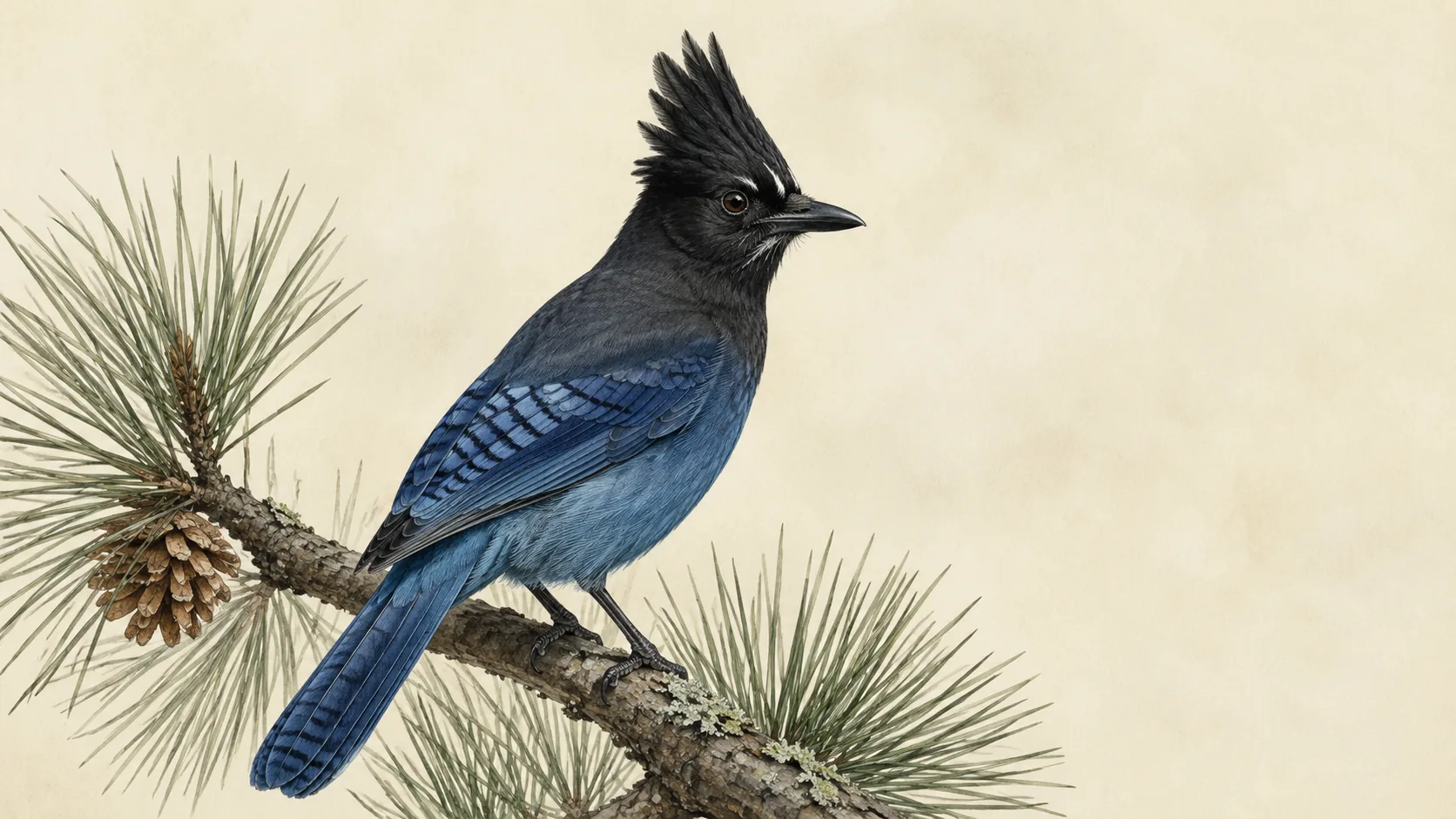
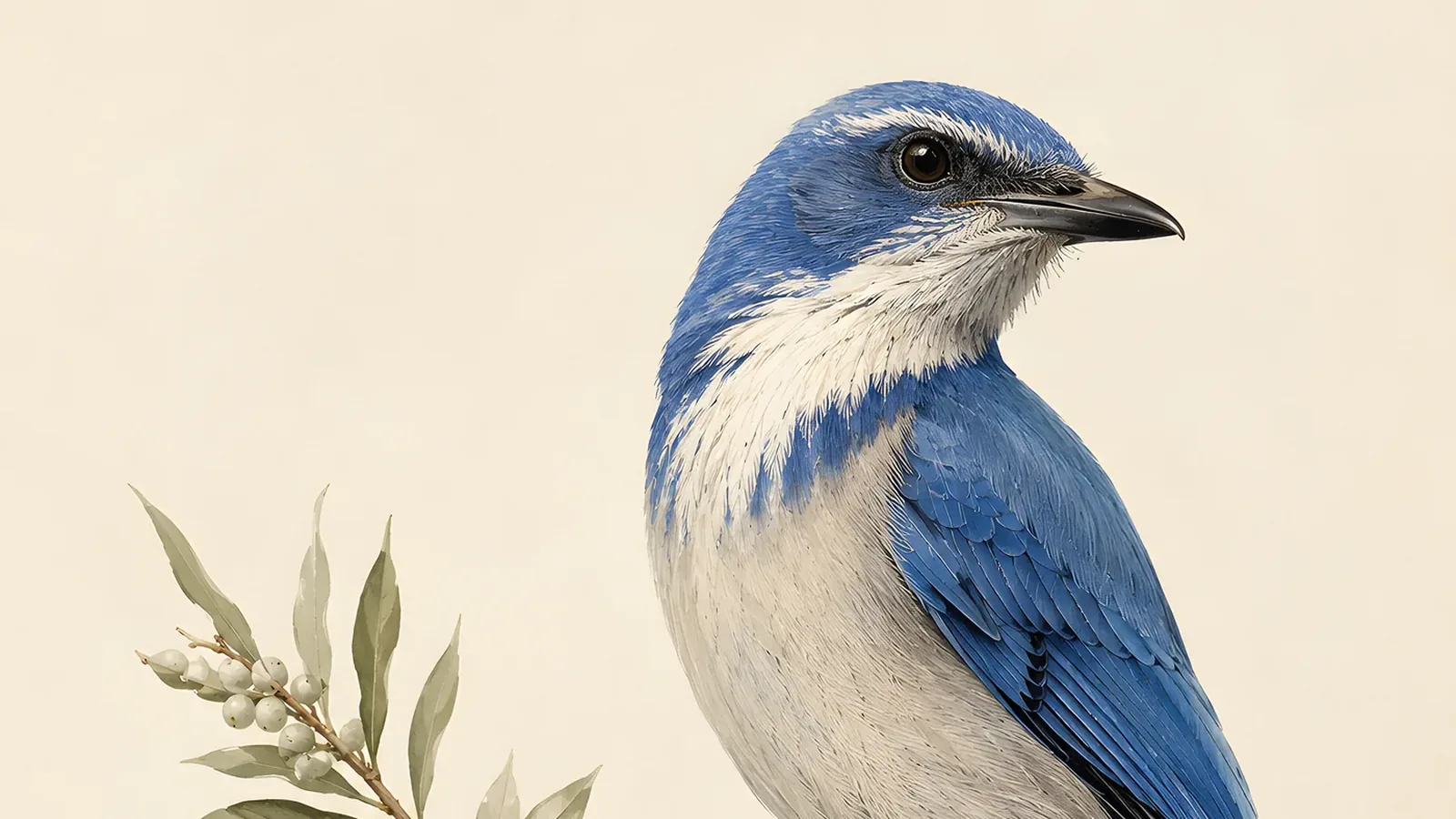
The species he can be confused with are limited. Steller’s Jay, the western counterpart, is dark all over with a black crest. Florida Scrub-Jay has no crest and lives only in Florida sand-scrub. Eastern Bluebird is half the size and has no crest. Most other “blue bird” sightings in eastern North America at this size are Blue Jay.
What he sounds like
He is one of the loudest and most verbally agile songbirds on the continent. The published call repertoire includes the famous jay-jay-jay alarm, soft whistles and gurgles between mates, a two-note rusty-pump call, a clear surprisingly sweet bell-call, and excellent mimicry of at least three local hawk species. The hawk mimicry is one of the more interesting behavioural puzzles in corvid research. Captive jays mimic hawks without prompting, which complicates any single-purpose explanation. The leading candidates are: clearing a feeder before landing, alerting a mate to a real raptor, or simple vocal play. The behaviour does multiple jobs, none of them well understood.
What is well understood is the alarm system. A Blue Jay’s jay-jay-jay carries about 500 metres in still woodland and is the most reliable predator-warning call in an eastern hardwood forest. Squirrels respond to it. Other songbirds respond to it. So do humans walking trails with their eyes open. The jay is the early warning system the woods has installed for itself.
How he lives the year
He is a year-round resident across most of the eastern half of North America. Some populations make partial seasonal movements south. The range is slowly expanding westward along the Great Plains, following human-planted shelterbelts and farm woodlots. He is found in oak, beech, hickory and other mast-producing hardwoods; mixed oak-pine forest; suburban gardens with mature trees; riparian woodland and woodland edge.
His diet is omnivorous but the defining staple is mast - acorns, beechnuts, hickory nuts, pine seeds. He takes insects in nesting season, fruit in late summer, and feeder sunflower and peanuts opportunistically. Yes, he sometimes eats other birds’ eggs and nestlings, as do most corvids; the actual fraction of diet from vertebrate prey is well under 1 per cent of foraging observations, despite the disproportionate reputation. The acorns are the headline.
He pairs for life, or close to it. The bond appears to persist year-round. Studies of marked pairs show a high rate of multi-year mate fidelity, which is unusual for a corvid. Nesting takes place in tree forks 3 to 10 metres up, in cup nests built jointly by both adults from twigs and rootlets. Two to seven eggs. Both parents incubate, which is also unusual in songbirds and a behaviour that aligns him more with crows and ravens than with the songbird norm.
The autumn
The autumn is where the year’s serious work happens. From late September through November he caches obsessively. A Blue Jay in autumn flying over an open clearing with an acorn in his bill is one of the most consequential animals in the eastern North American landscape, and he is also one of the easiest to overlook because the flight is brief and the acorn is small.
Lab and field work since the 1960s, much of it by Carter Johnson and Curtis Adkisson at South Dakota and Virginia Tech, has been steadily filling in the picture. Blue Jays move acorns at scales that exceed what gravity, wind or squirrels can achieve. They prefer to cache in clearings or at forest edges, exactly the kind of habitat where oak seedlings can establish themselves successfully. They cache in numbers far higher than they retrieve. The leftover acorns become oaks. The oaks become forest. The forest, decades on, supports more jays, who cache more acorns, who plant more oaks. The relationship is mutually constitutive.
A single Blue Jay’s career involves the planting of, by reasonable estimates, several thousand oak trees. Most of them die in their first year, eaten by deer or shaded out. A few survive. A jay who lives ten years may, conservatively, be responsible for the existence of fifty mature oaks who would not be there without him.
Multiply that by all the Blue Jays on the continent. Then multiply it by the 18,000 years since the last glacial maximum. That is how the eastern hardwood forest got from its southern refugia to its current northern extent.
What he means for a person at a feeder
He is the bird people complain about. The hawk impressions clear the feeder of cardinals and chickadees. He is bossy. He is loud. He takes whole peanuts and flies away with them in one motion.
What he is, less obviously, is the keystone seed disperser whose work has shaped the landscape your house was built in. The oaks at the edge of your garden, the acorns crunching underfoot in October, the dappled shade your patio gets in summer - all of these are downstream of his great-grandfather, his grandfather, and possibly him.
A Blue Jay at your feeder is not interrupting your view of the cardinals. He is the bird who built the forest the cardinals live in. He carries an acorn the way a librarian carries a book. He does not know what he is for. He just does it.