Field Guide
Canada Jay
It is February in Minnesota, minus eighteen, and a small grey bird has just landed on your outstretched hand. It does not flinch at your movement. It weighs what a deck of cards weighs. It takes the piece of cracker between its bill and is gone before your fingers register the cold.
Perisoreus canadensis - the Canada Jay, long called the Gray Jay, and before that the whiskey jack - has been doing this for as long as people have moved through the boreal forest. The tameness is not confusion or hunger. It is a very old strategy.
The jay’s relationship with people in the forest began with the Cree, who called it Wisakedjak (wee-sah-KAY-jak), a shape-shifting trickster figure associated with generosity and mischief. Anglicised through the fur-trade era into “whiskey jack,” the name carried through centuries of trappers’ camps and hunting blinds, describing the same behaviour - the bird appears at your fire, takes what you offer, and disappears into the spruce. The name “camp robber” followed on the same logic. Every generation of people working in the boreal has named this bird after what it does to their provisions.
But the Canada Jay is not stealing from you. It is doing what it does to every beetle, every berry, every fragment of mushroom it encounters from late summer onward. It is caching.
What it looks like
The Canada Jay is a medium corvid: 28 to 33 centimetres long, 62 to 100 grams, wingspan 43 to 46 centimetres. By the scale of the boreal forest it shares with ravens, it reads as small. By the personality it projects, it does not.
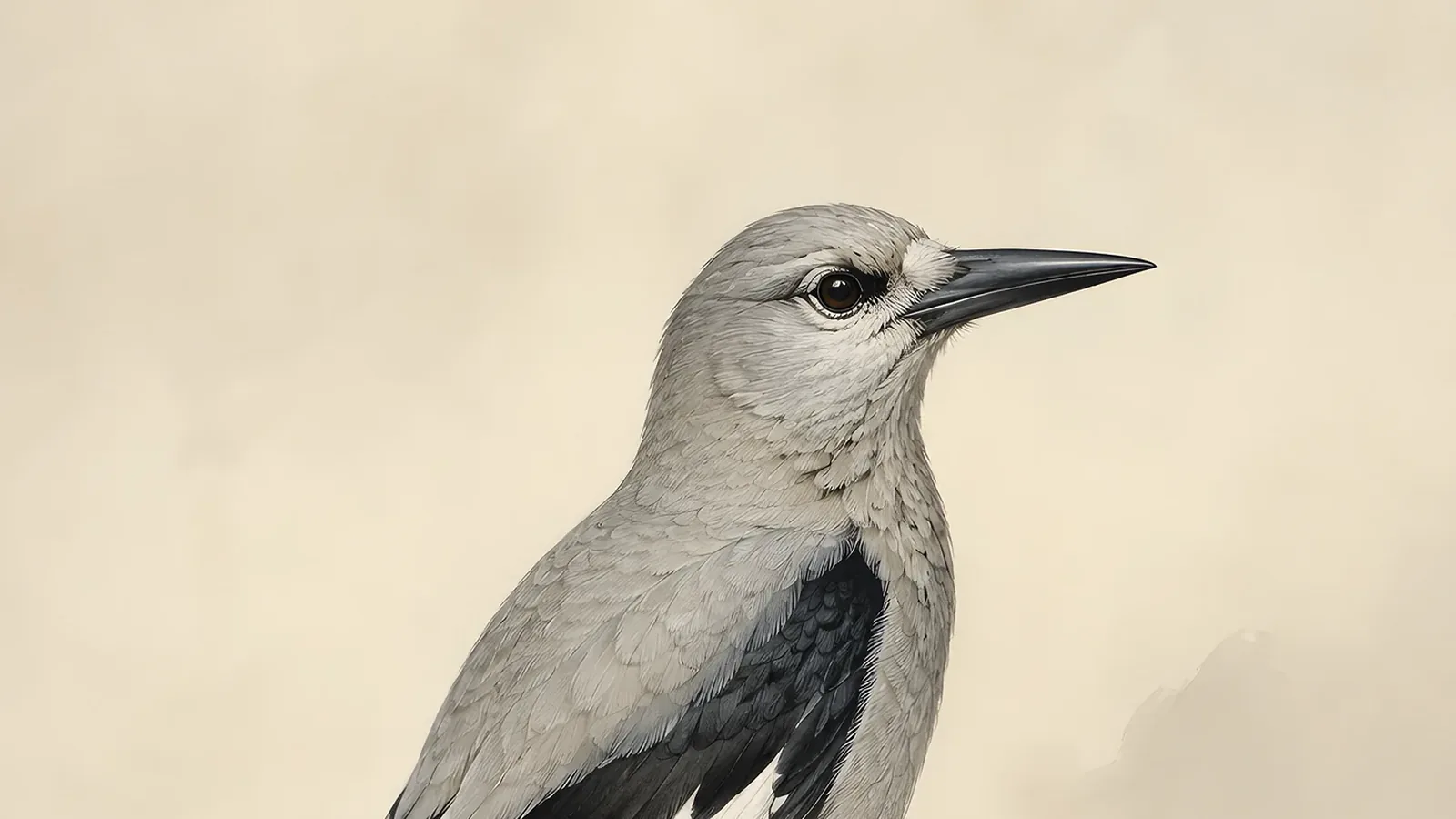
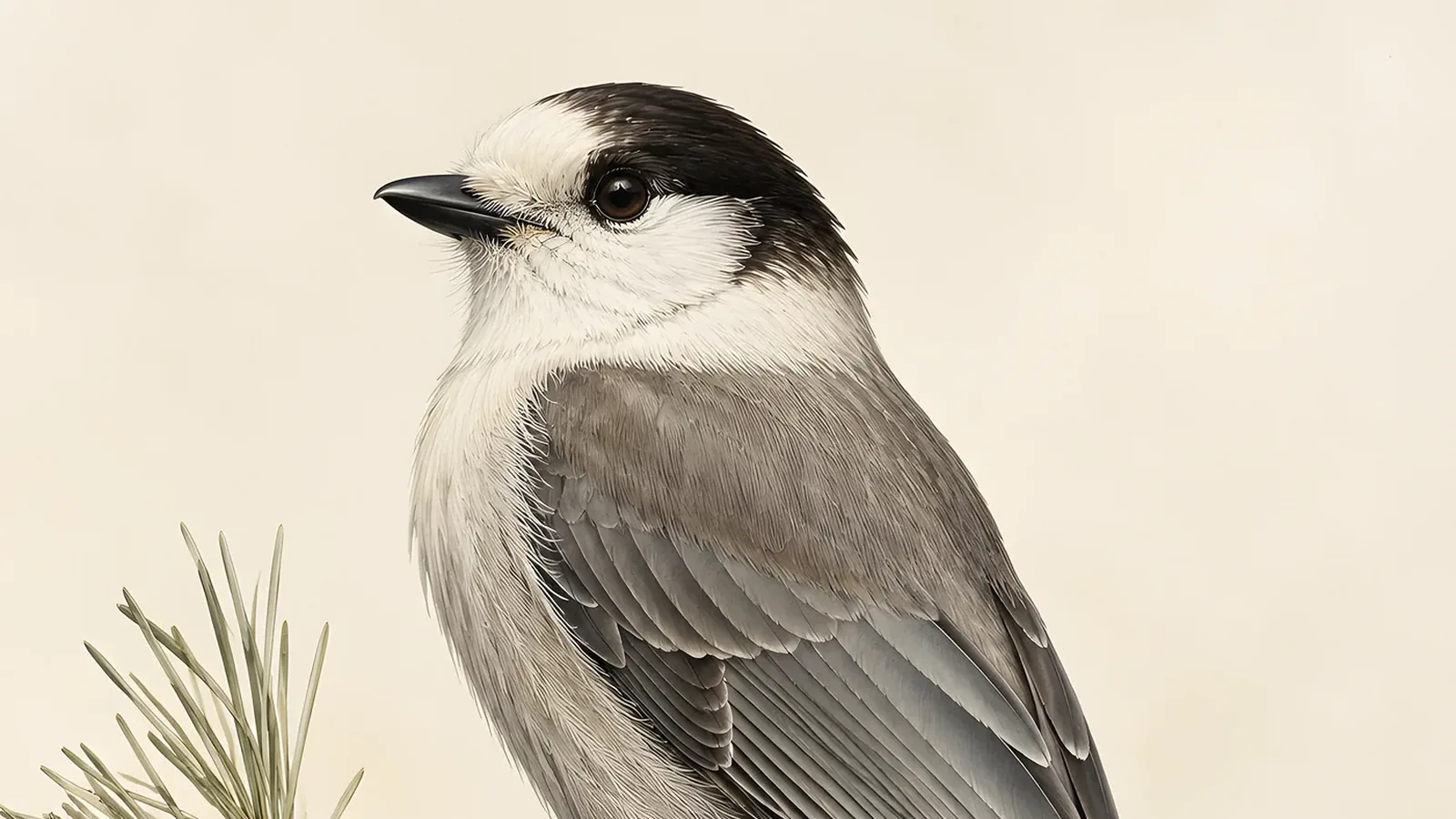
The plumage is soft grey throughout - a pale ash grey on the underparts, medium grey on the back, darker grey on the wings and tail. The head is the field mark. A dark, sooty-black patch sits on the nape and crown, framing a white face and white forehead from behind. There is no crest, no blue, no iridescence. This is a purposefully muted bird. In the snow-filtered light of a spruce forest in January, it is almost invisible until it moves.
The feathers are notably thick and fluffy for a corvid - close to the insulating architecture of a ptarmigan rather than the sleek plumage of a crow. This is not incidental. It is the same solution to the same problem: a bird that will spend the night in the open at minus thirty degrees needs a different feather structure than one that roosts in Virginia in June.
Juvenile Canada Jays are dramatically darker - a uniform sooty chocolate-grey all over - until their first full moult in midsummer, when they emerge in adult plumage.
The glued caches
The Canada Jay’s biology is organised around a single architectural fact: in the boreal forest, nothing is available in winter except what you stored in autumn. The jay’s answer to this constraint is one of the more precisely engineered behaviours in North American ornithology.
Through late summer and autumn, a Canada Jay devotes most of its day to caching food. Not piling. Not burying. Caching individually, one item per location, using its bill to press each piece into a crevice under bark or into a cluster of lichen on a branch and fasten it there with sticky saliva from its enlarged salivary glands - glands that are measurably larger than those of related corvids that do not cache. A single bird may complete more than 1,000 individual caches in a single day. Over a season, the total runs into tens of thousands.
Each cache site is essentially a refrigerated larder. The items are stored well above the eventual snow level - tucked into bark fissures in the upper canopy, not the ground - so the snow doesn’t bury them. The sub-zero temperatures of a boreal winter act as a preservative, keeping the cached insects, berries, meat scraps, and seeds stable for months.
The jay retrieves these items through winter by spatial memory, navigating a territory it knows to a resolution that has no analogy in human navigation. Research published in PLoS One by Sutton, Strickland, Freeman, Hanner, Norris, and colleagues in 2024 used fecal DNA metabarcoding to confirm what field observation had suggested for decades: among winter-surveyed birds, 39% of identifiable food items were classified as “likely cached” rather than fresh-caught. For nestlings fed in late winter, 28% of their diet items fell into the same category. The stored hoard is not a supplement. It is the food supply.
| Measurement | Value |
|---|---|
| Body length | 28 - 33 cm |
| Weight | 62 - 100 g |
| Wingspan | 43 - 46 cm |
| Typical adult lifespan | around 8 years |
| Maximum recorded lifespan | 19.2 years |
| Clutch size | 2 - 4 eggs |
| Incubation | 18 - 19 days |
| Eggs per year | 1 clutch |
Nesting in the snow
Here is the position worth defending: the Canada Jay nests in February and March not despite the cold but because of it.
The logic runs backward from the cache system. The jay’s chicks need food in March and April. The food supply that can reliably deliver it - the frozen cache built the previous autumn - is at its most intact and accessible precisely when temperatures are still below freezing. To wait until spring would be to nest when the cache is partially depleted and the stored items are beginning to thaw and spoil. The jay that nests earliest has the most intact pantry.
So pairs begin construction while snow still lies deep. The nest is a cup of twigs and bark strips lined with animal hair and feathers, placed in the sheltered angle of a dense conifer branch - often a spruce, chosen for the windbreak its needles provide. The female incubates alone for 18 to 19 days, on eggs that can see ambient temperatures of minus 30 degrees Celsius, while the male brings food from the cache to sustain her. The nest’s insulating materials and the female’s own thick plumage are the only technology deployed against the cold.
The Canada Jay’s early nesting schedule is only rational if the food cache it depends on is still frozen. Breed in February when the stores are solid. Wait until April and the pantry is soft.
Whelan, Strickland, Morand-Ferron, and Norris (2017), writing in Ecology and Evolution, documented an inverse relationship between warm incubation conditions and brood size in late-breeding pairs - the warm conditions associated with later nesting correlated with smaller, weaker broods. The early nest, despite its brutal setting, is the productive one.
What it sounds like
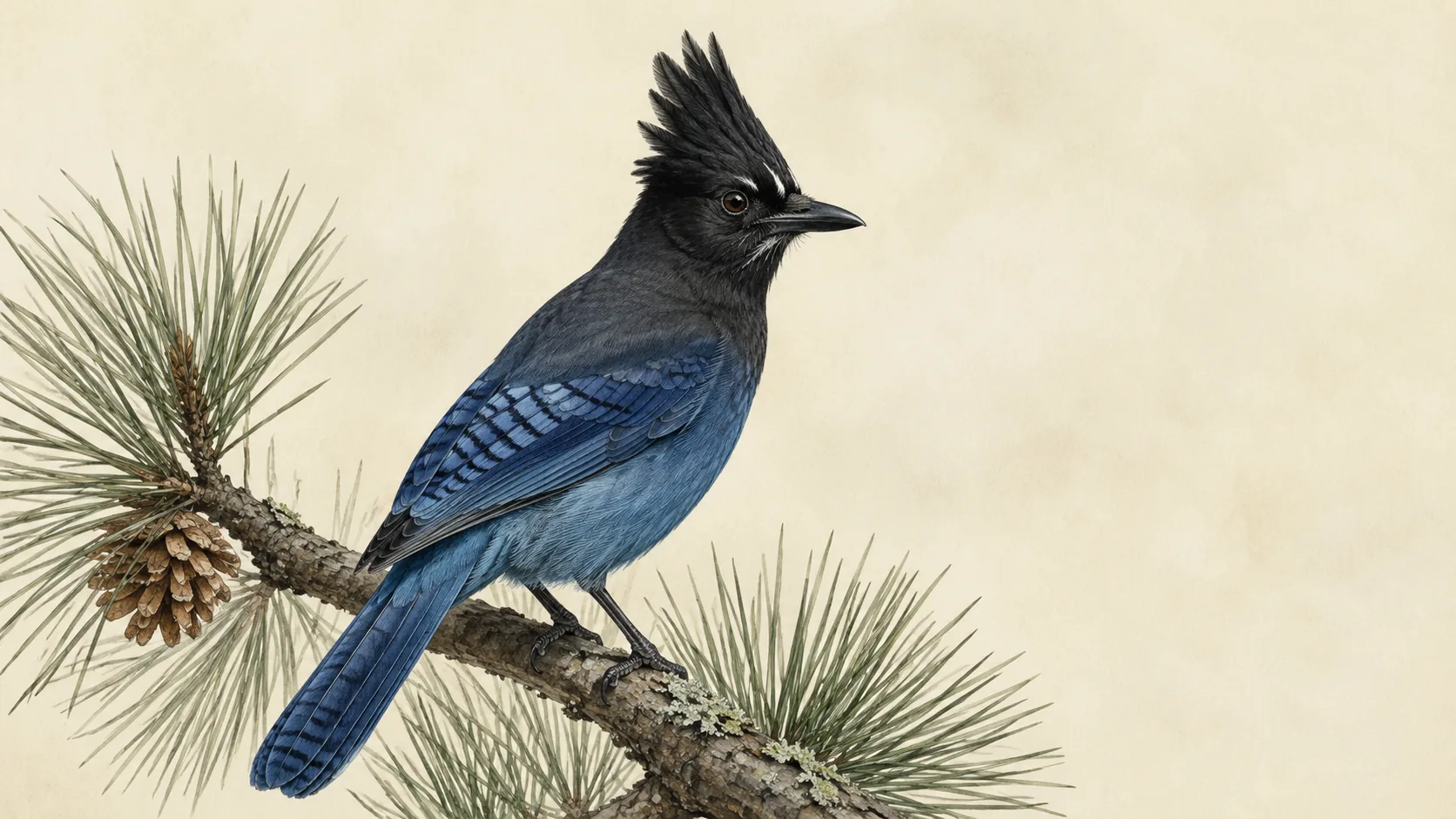
The Canada Jay is a quieter corvid than its relatives. The Steller’s Jay broadcasts its presence across an entire ridge. The Canada Jay generally does not.
Its contact calls are soft - a low whuit or twirk between paired birds, easy to miss in a wind. In alarm it produces a rattling chatter. In territorial assertion it can deliver harsh, carrying notes across the canopy. Between mated pairs, observers have described a whisper song: a sustained, low medley of clicks and melodic phrases quite unlike anything the bird produces in other contexts.
It also mimics, selectively and without the systematic range of a mockingbird - snatches of hawk calls, other corvid sounds, the occasional human whistle answered back through the trees.
Range and habitat
The Canada Jay is a boreal specialist. Its range runs from Newfoundland to Alaska in a broad northern band, south through the Rockies into isolated high-elevation pockets in the western United States, and down into the mountains of New Hampshire, northern New England, and the Great Lakes region at the southern margins. It does not migrate. A pair that holds a territory in October holds the same territory in February.
The preferred habitat is mature spruce-fir forest: black spruce bogs in the eastern boreal, Engelmann spruce in the Rocky Mountain subalpine, Sitka spruce and Douglas fir on the Pacific slope. The consistent element is the conifer - specifically the dense, bark-furrowed upper limbs where food items can be pressed and held by saliva. The jay is caching into the tree architecture. The habitat that provides the right caching substrate and the right windbreak for a February nest is the same habitat: old conifer canopy.
A warming threat
The Canada Jay’s cache system, for all its engineering, has one vulnerability: temperature. The stored items are food only as long as they stay cold. A freeze-thaw cycle in October - temperatures above zero for a day, then below again - does to a cached insect larva roughly what it does to meat moved in and out of a freezer. The proteins denature. Microbial activity accelerates during the warm window. The item is physically degraded before it refreezes.
Dan Strickland, who has monitored the Algonquin Park population since the 1970s - the longest continuous Canada Jay study on record - first proposed this mechanism in 2006. Sutton, Strickland, Freeman, Newman, and Norris (2019), in a 40-year dataset of 1,263 Algonquin nestlings published in Royal Society Open Science, confirmed it quantitatively. Years with more autumn freeze-thaw events correlated directly with smaller clutches, lower hatch rates, and weaker nestlings the following spring. The population at Algonquin has declined by more than half since the 1980s.
The mechanism is precise: it is not winter cold that breaks the Canada Jay’s food system, it is autumn warmth. A colder winter the jay can manage. It evolved for that. A warmer autumn corrupts the stores before they freeze solid, and the February nestlings pay the price.
This is why the Canada Jay, a bird that has outlasted ice ages and survived winters that kill wolves, is now a species to watch. Its vulnerability is not cold. It is a world in which October is too warm to keep food frozen.
The IUCN lists Perisoreus canadensis as Least Concern globally - the range is vast and most populations are stable. But the Algonquin data shows what a locally warmer autumn can do to a bird whose entire biology is built around a frozen cache. The jay landing on your hand in February has stored thousands of meals against exactly this moment. What it cannot store against is a season that arrives wrong.