Field Guide
Clark's Nutcracker
Late August, at eleven thousand feet. A bird drops onto a whitebark pine cone, drives its bill between scales, and levers. In under a minute it has packed seeds into the soft pouch under its tongue, flown two hundred metres downslope, pressed each seed individually into the soil. It does not eat. Then it returns to the tree.
This is Nucifraga columbiana, Clark’s Nutcracker - the corvid that has pushed the family’s famous intelligence toward a single purpose: remembering, through a winter that buries the mountains in metres of snow, the locations of thousands of small holes it dug in the ground six months earlier.
What it looks like
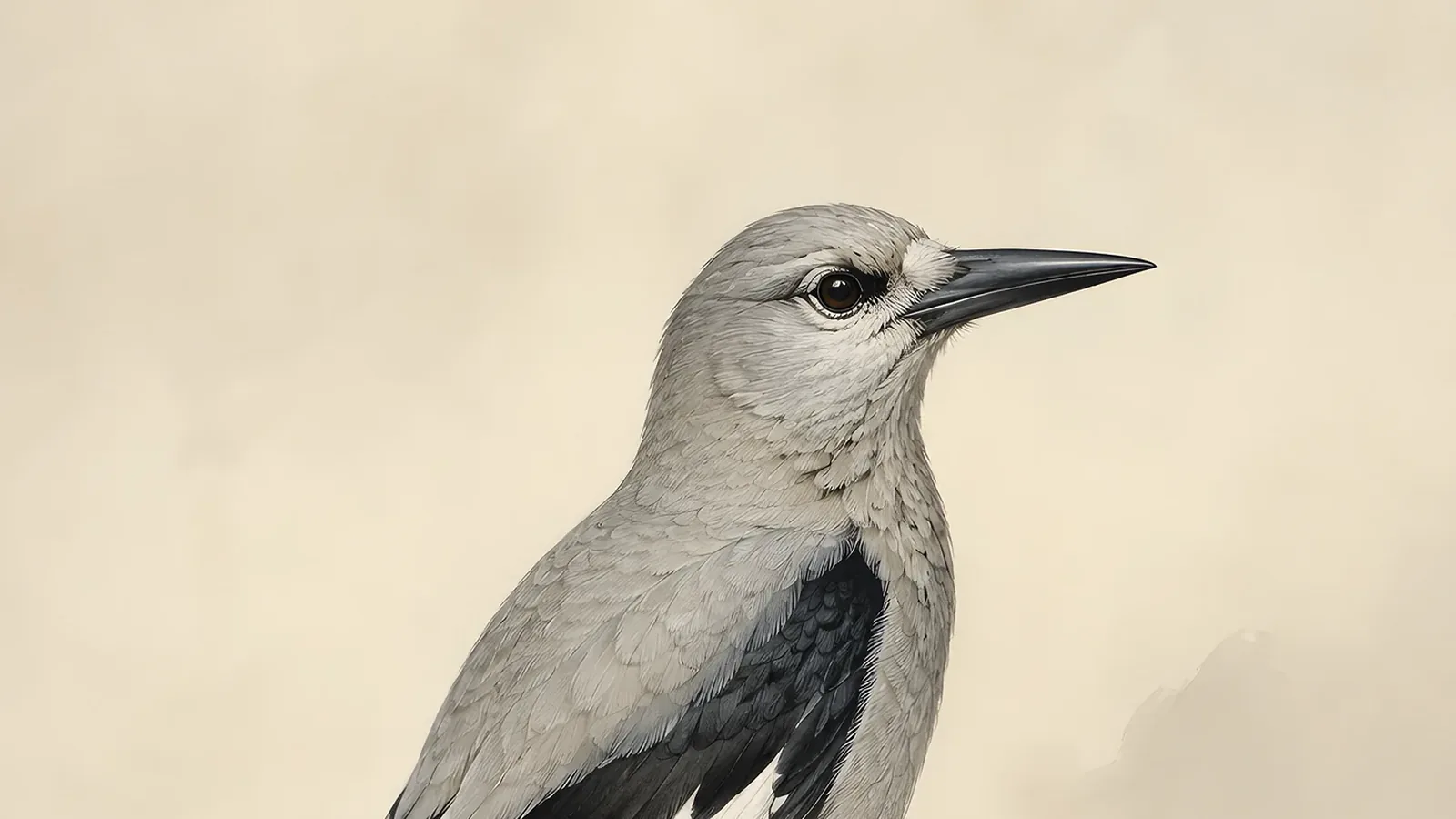
The body is a plain pale grey - cool, powdery ash-grey that reads at a distance as neutral, unremarkable. Look again. The wings and central tail feathers are flat glossy black, edged in flight by large white patches that flash hard against alpine light. The outer tail feathers are white. The bill is long, straight, and sharply pointed - a spike-billed probe suited to splitting pine cones and spearing seeds in frozen soil.
No crest. No red cap, no yellow eye-ring. The bird is designed to get things done.
| Measurement | Range |
|---|---|
| Body length | 28 - 35 cm |
| Weight | 100 - 160 g |
| Wingspan | 55 - 62 cm |
| Maximum recorded age | 17 years |
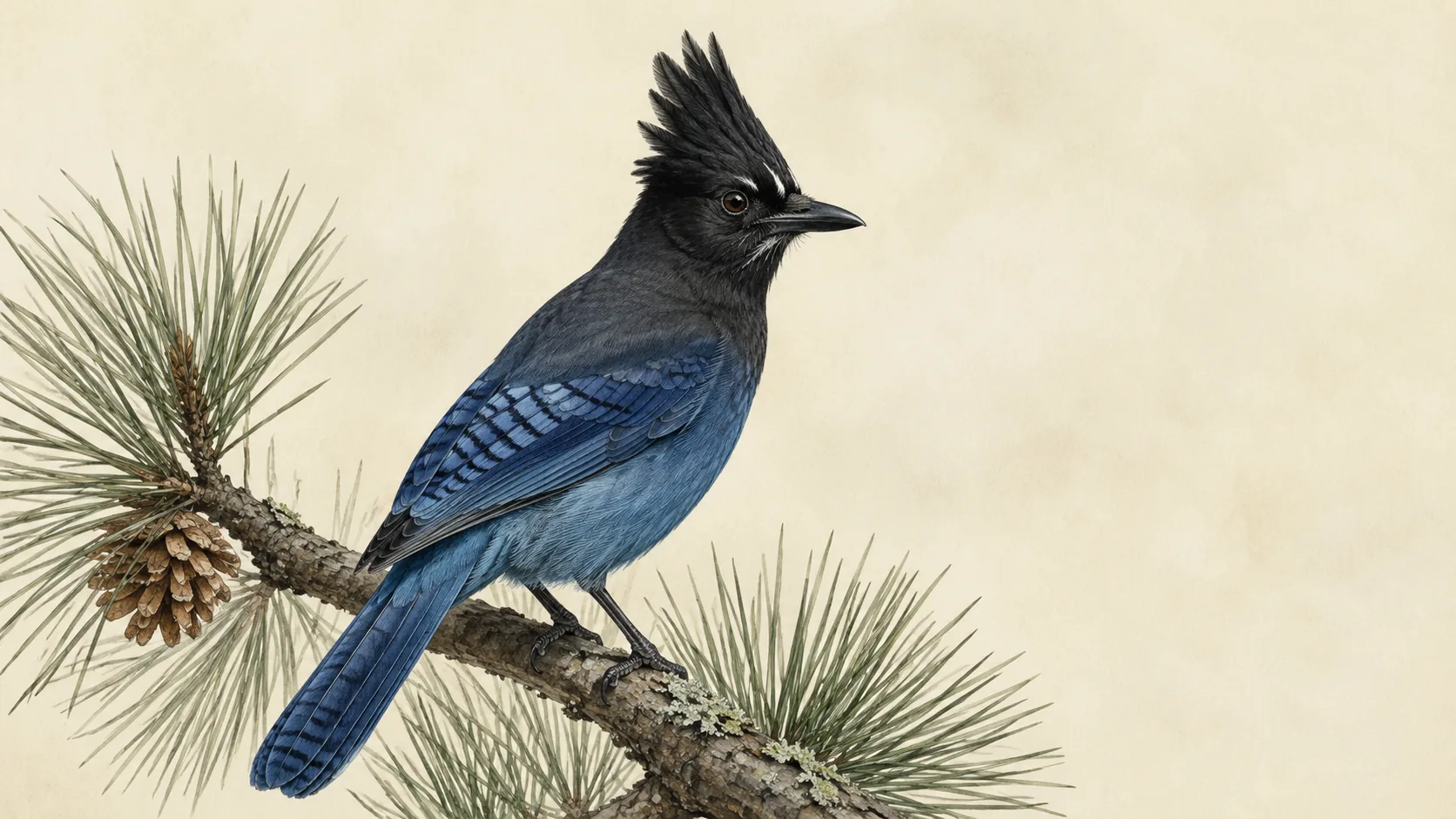
Males and females wear identical plumage - both sexes cache seeds through autumn and both rely on those caches through winter, so the cognitive demands fall equally on both. The bird is measurably heavier than a Steller’s Jay, built more compactly, with a shorter tail and broader chest. In flight the silhouette is crow-like but smaller, those white patches signalling the species to anyone who has learned to watch the treeline.
The memory
A Clark’s Nutcracker in Montana during a good whitebark pine year will, in the weeks between late July and early October, cache between 22,000 and 33,000 seeds in more than 7,000 individual sites across a territory that may span several square kilometres (Vander Wall and Balda, Ecological Monographs, 1977). Each cache holds between one and fourteen seeds, pressed 2 to 3 centimetres into the soil or under a flat stone. The bird returns to these sites across the following nine months - winter, spring, the tail end of the next summer - recovering what it needs and, critically, failing to recover some, which germinate.
The question the caching raises is obvious. How does it find them?
Not by smell. Controlled experiments place cached seeds beneath clean substrate with no olfactory cues available, and nutcrackers still locate their sites at rates far above chance (Tomback, The Condor, 1980). Not by random probing. In laboratory radial-maze tests and in field trials, Clark’s Nutcrackers significantly outperformed scrub-jays and Mexican jays - species that also cache but with smaller stores and shorter retrieval windows - in spatial memory tasks specifically designed to separate genuine memory from systematic search strategies (Balda and Kamil, Animal Behaviour, 1992).
The mechanism is landmark-based. The nutcracker encodes each cache position relative to large, stable features - boulders, ridge lines, standing dead snags - and takes simultaneous directional fixes from several landmarks to triangulate the site. Cache locations were accurately recalled after 285 days in controlled studies (Balda and Kamil, Animal Behaviour, 1992), and in the field nutcrackers have been documented recovering caches for at least nine months after burial.
“Each fall, Clark’s nutcrackers each cache tens of thousands of conifer seeds, relying on their highly accurate spatial memory to aid cache retrieval.” - McLaren et al., Ecology and Evolution, 2023
The sublingual pouch - a soft bag in the floor of the mouth, behind the tongue - is what makes this economy possible. Vander Wall and Balda recorded individual birds carrying up to 95 pinon pine seeds per trip (mean: 55) during harvesting runs in 1977. For whitebark pine seeds, which are larger, the per-trip load is lower but the principle is identical: extract, pack, carry, cache. Return. The bird is not eating. It is investing.
The pine and the bird
Whitebark pine (Pinus albicaulis) grows at the highest elevations of the northern Rocky Mountains - where other conifers thin and treeline breaks. Its seeds have no wings. The cone stays on the tree rather than drop. The tree has outsourced its reproduction to Nucifraga columbiana so completely that ornithologists classify the bird as a keystone mutualist: remove it, and the cascade is disproportionate to the bird’s biomass.
McLaren and colleagues (2023, Ecology and Evolution) describe nutcrackers as “mobile links” connecting spatially separated whitebark populations. The tree cannot colonise new terrain, recover from fire, or advance upslope as climate shifts, without a nutcracker carrying its seeds and forgetting a few.
The complication is that whitebark pine is under severe pressure. White pine blister rust - a non-native fungal pathogen - has killed trees across much of the range, and mountain pine beetles have compounded the damage as winters warm. Ray and colleagues (2020, PLoS One) documented blister rust infection rising from 18 to 38 percent of whitebark trees in Mount Rainier National Park between 2004 and 2016. Nutcracker densities in that park declined concurrently to roughly one-tenth of levels in parks with healthy whitebark.
The nutcracker is listed as Least Concern (LC) on the IUCN Red List - it takes limber pine and pinyon pine when whitebark fails locally, which buffers the population. But the mutualism is the mechanism by which whitebark pine maintains genetic connectivity across the mountain landscape. Break it widely enough, and the tree loses its capacity to move, adapt, and recover.
What it sounds like
The call is harsh and nasal: a drawn-out kraaah or khraaaah, repeated in short series, raspy and descending. Loud. Between paired birds there are also shorter clicks, rattles, and churring notes - none of which are subtle.
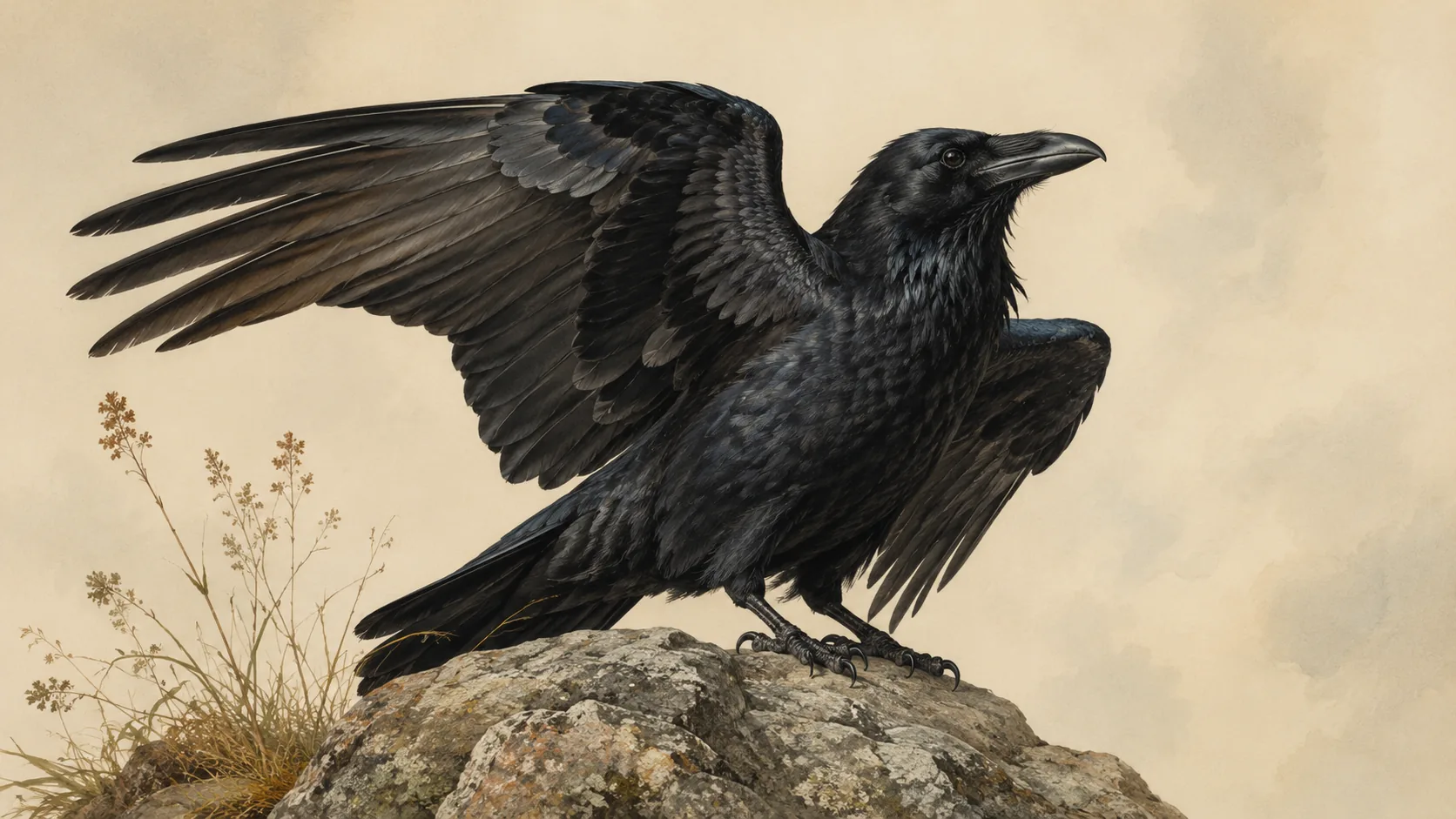
The call is recognisably corvid - the same hard, unmusical register shared by the common raven - but more insistently nasal. At treeline in September, when caching is underway and several birds work the same patch of whitebark, the sound is constant background.
Range and habitat
Clark’s Nutcracker ranges from the coastal ranges of British Columbia south through the North Cascades, Sierra Nevada, and the Rockies of Wyoming and Colorado, into the high pine zones of the Great Basin ranges. It is a permanent resident throughout but not rigidly attached to elevation. In years when the cone crop fails, nutcrackers descend in irruptive movements to lower pine forests, appearing at feeders and in foothills where they are otherwise unknown.
Core habitat is open or semi-open subalpine conifer forest: whitebark pine and limber pine above 2,000 metres, pinyon-juniper at lower elevations in productive seed years. The bird avoids closed canopy - it needs open ground for caching and visibility for landmark navigation.
Breeding in the cold
The nutcracker breeds earlier than almost any mountain bird. Nesting begins in February and early March, eggs laid while snow covers the ground and nighttime temperatures drop well below freezing. The timing is calibrated to the cache: young hatch in late March, fledge in April, and the adults feed them directly from winter stores before transitioning them to the spring seed harvest.
Both sexes incubate and both develop functional brood patches - males included, which is unusual in corvids. The nest is a deep cup of twigs and bark, 2 to 12 metres up in a conifer, often on the south-facing side to catch winter sun. Clutch size is two to four eggs, incubation 16 to 18 days, fledging at 18 to 21 days.
The argument for this bird, stated plainly, is this: Clark’s Nutcracker is a corvid that has turned its family’s famous intelligence toward a single long-term problem, and the solution it has arrived at happens to also be the primary mechanism by which an entire tree species regenerates across the highest forests on the continent. The nutcracker buries seeds to feed itself. It plants a forest as a side effect. What gets forgotten is not waste - it is succession, recovery, and the slow upward march of the treeline. The bird does not know this. But the forest does.