Field Guide
Northern Flicker
You flush a brown bird off a suburban lawn and it goes up in a low, bounding flight, and for a single second the underside of its wings is the wrong colour entirely. Lemon yellow in the east. Rose-salmon in the west. A flash of something that does not belong on a bird this drab, gone before you can be sure you saw it. Then a white rump patch over the retreating back, bright as a flag, and the bird is into a tree and the colour is hidden again.
That is the Northern Flicker. A woodpecker that mostly does not peck wood. It is on the grass because that is where the ants are, and ants are what it came for. Cornell Lab notes that the flicker probably eats ants more often than any other bird in North America. It is the only common woodpecker on the continent you are more likely to meet on the ground than on a trunk.
What he looks like
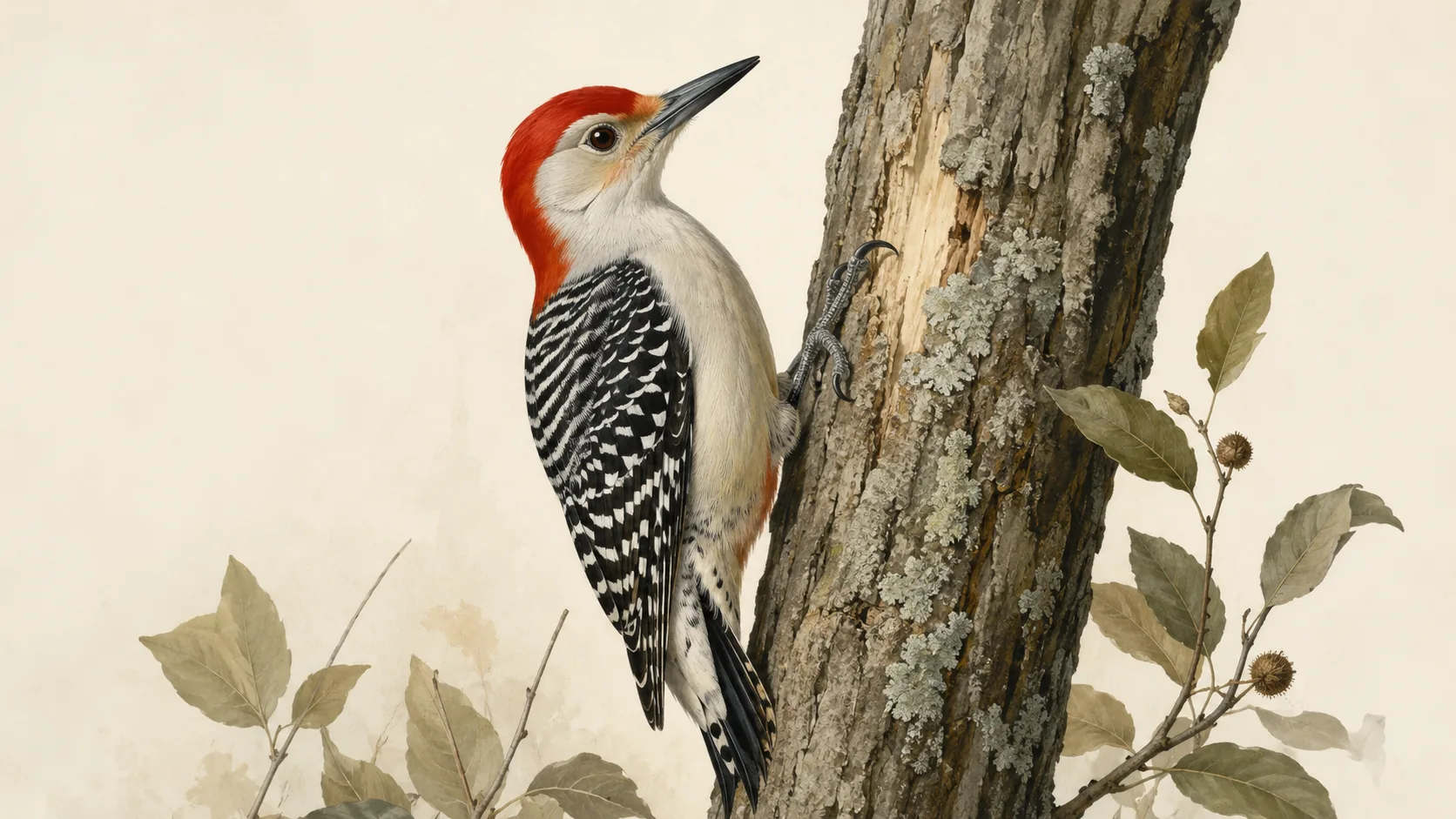
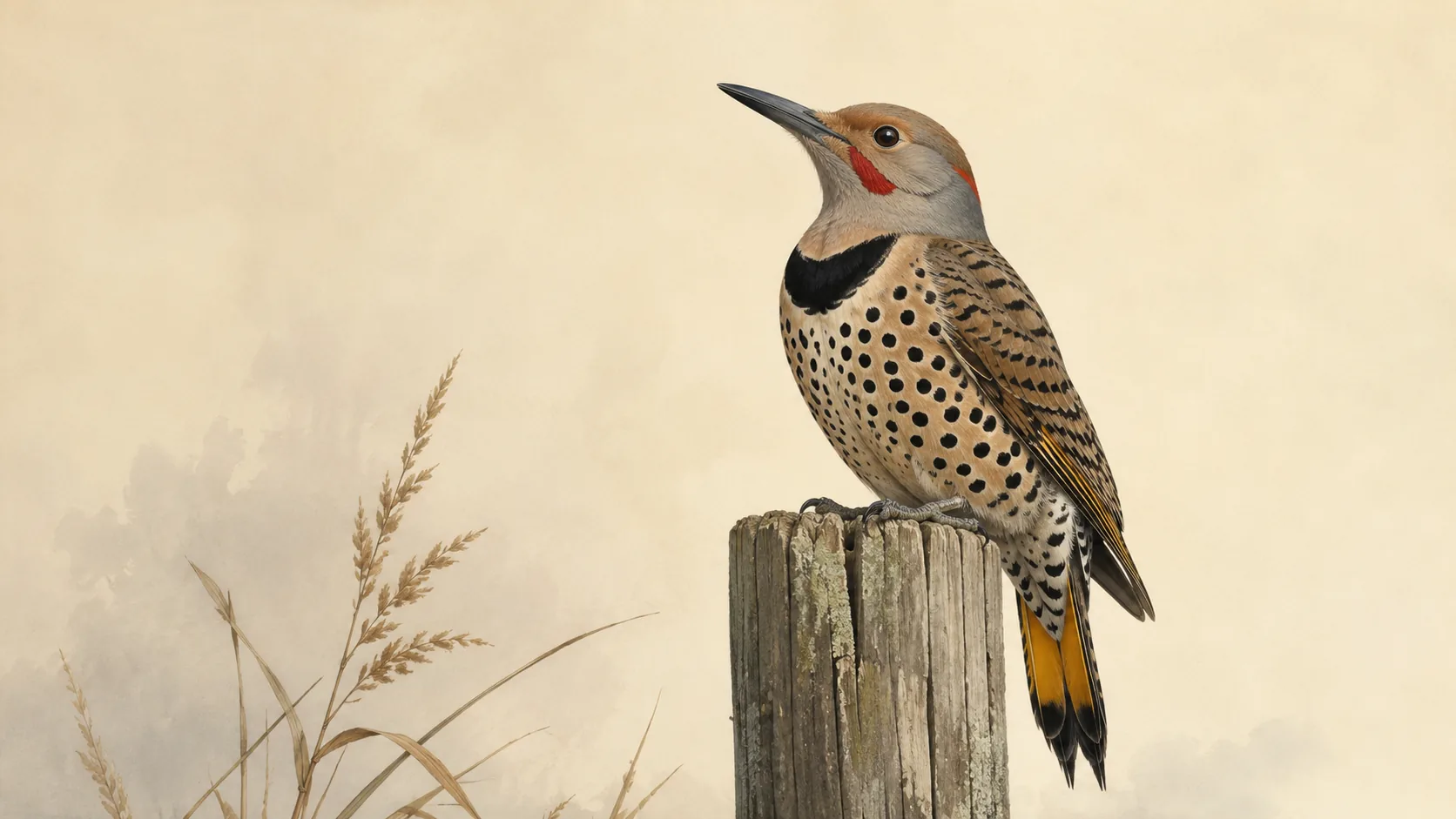
The flicker is a large woodpecker, brownish overall and built on a longer, slimmer frame than the pied woodpeckers most people picture. Audubon gives the length as 28 to 31 centimetres and the wingspan as 43 to 51, which puts it between a robin and a crow. The back is warm grey-brown, finely barred with black. The buff breast is dropped all over with round black spots, and across the upper chest sits a single bold black crescent, like a bib. In flight the white rump patch is unmistakable, and the underwings and undertail blaze with the colour of the feather shafts.
That shaft colour splits the species into two long-recognised forms. The Yellow-shafted flicker of the east and far north shows lemon-yellow shafts, a grey crown, a tan face, and a red crescent on the nape. The Red-shafted flicker of the west shows salmon-red shafts, a brown crown, a grey face, and no nape crescent. Where their ranges meet across the Great Plains the two interbreed freely, and Cornell Lab reports the two forms carry nearly identical DNA despite looking so different.
Sex is read off the moustache. In the Yellow-shafted male a black malar stripe runs back from the bill; in the Red-shafted male the same stripe is red. The female of either form simply lacks it. A flicker with a clean, unmarked face is a hen. It is one of the tidier field marks in the woodpecker family.
What he sounds like
The territorial song is a long, ringing, even-pitched wick-wick-wick-wick-wick, run on for several seconds and carrying well across open country. It is the sound of a flicker holding ground in spring, and once learned it is hard to mistake. There is also a sharp, descending kleer call given singly, often as the bird launches into flight, and a soft rolling wick-a-wick-a exchanged at close range between a pair.
And then there is the drumming, which is not voice but is unmistakably a flicker. In spring the male hammers a rapid, resonant roll to advertise himself, and he chooses his instrument for volume rather than nesting value. A dead branch will do. So will a metal gutter, a stovepipe cap, or the flashing on a chimney, which is why the bird that wakes a household at six in the morning with what sounds like a drumroll on the roof is, very often, a courting flicker. He is not damaging anything. He is showing off.
Range and habitat
Colaptes auratus ranges across nearly all of North America, from the treeline of Alaska and Canada south through the United States into Mexico and Central America. It is among the very few North American woodpeckers that genuinely migrate. Cornell Lab notes that birds breeding in the far north pull south for winter to escape frost and snow that seal away the ground and the ants beneath it, while birds breeding farther south tend to stay put year-round.
The habitat is edge, not deep forest. Flickers want open ground to feed on and scattered trees to nest and perch in: woodland margins, parks, orchards, large gardens, burned-over forest, river groves, and the seams where field meets wood. Open country with a few dead trees suits them better than unbroken timber, which is part of why a mown lawn beside a stand of oaks is such reliable flicker habitat.
Diet
Ants are the headline. The flicker digs into the soil and into anthills the way other woodpeckers drill into bark, hammering down to reach the colonies and the protein-rich larvae below. Its tongue is extraordinary: Cornell Lab records that it can dart more than two inches past the tip of the bill, barbed and sticky, to lap ants out of their galleries. Beetles and other ground insects fill out the warm-season diet.
In winter, when the ground hardens, the flicker shifts to fruit and seed: dogwood, sumac, wild cherry and grape, hackberry, bayberry and elderberry, with sunflower and thistle taken at feeders. It will come to suet and will occasionally work a trunk like an orthodox woodpecker, but the ground is its true office. A flicker probing a lawn, hopping and stabbing, is doing exactly what the species is built for.
Breeding and nesting
The flicker is a cavity nester. The pair excavates a fresh hole most years in a dead or diseased trunk or a stout limb, the entrance about three inches across, the chamber a deep shaft of 33 to 40 centimetres widening at the base for the eggs and the sitting adult. In the far north they favour trembling aspen, whose heartrot softens the wood for digging. They will also take to a large nest box packed with sawdust.
Audubon gives a clutch of five to eight glossy white eggs, occasionally as few as three or as many as twelve. Incubation runs about 11 to 16 days and is shared, with the male taking the night shift and part of the day, a division of labour more equal than in most songbirds. The young are altricial and slow to leave: they stay in the cavity roughly four weeks before fledging, then follow the adults to good feeding ground while they learn to dig for themselves. Most pairs raise a single brood a year.
The decline worth watching
For all its familiarity, the Northern Flicker is a bird in quiet trouble. It remains widespread and common, which is exactly what hides the problem. The North American Breeding Bird Survey, as reported by Cornell Lab, records a fall of roughly 1.2 per cent per year between 1966 and 2021, which compounds to a cumulative loss of around 49 per cent. Half the flickers are gone within a single human lifetime, and almost no one has noticed, because there are still flickers on the lawn.
The likely causes are the unglamorous ones. Flickers compete for nest holes with European Starlings, which take over excavated cavities. They depend on dead and dying trees, which tidy management removes. And they feed on ground insects in exactly the open, often chemically treated landscapes where insect numbers have fallen. None of this is dramatic. It is erosion, not collapse.
Half the Northern Flickers vanished inside one lifetime, and the reason almost no one noticed is that there are still flickers on the lawn.
That is the bird worth watching. Not because it is rare, but because it is the textbook case of a common species thinning out under everyone’s nose. Learn the yellow under the wing, the white rump, the spotted bib and the ringing wick-wick-wick, and you become one of the people keeping count. The flicker is widespread enough to take for granted. The numbers are the argument for not doing so.