Field Guide
Great Tit
In late April, in the oak woodlands of Wytham, a female Parus major lifts herself off her clutch of nine eggs and files out into a canopy that is, on a good year, thick with winter moth caterpillars. She has timed this precisely - or tried to. Whether she has timed it well enough is the central question of her year, and one of the most closely studied questions in British ornithology.
The Great Tit is not Britain’s most colourful bird, and it is certainly not its rarest. It is something more useful: a precise biological instrument whose breeding cycle has been tracked so carefully, over so many decades, that it has become a primary indicator of how temperate woodland is responding to a changing climate. The British Trust for Ornithology notes that average laying dates have shifted nine days earlier since 1968. Nine days in five decades is a signal, not noise. The bird is telling us something.
What it looks like
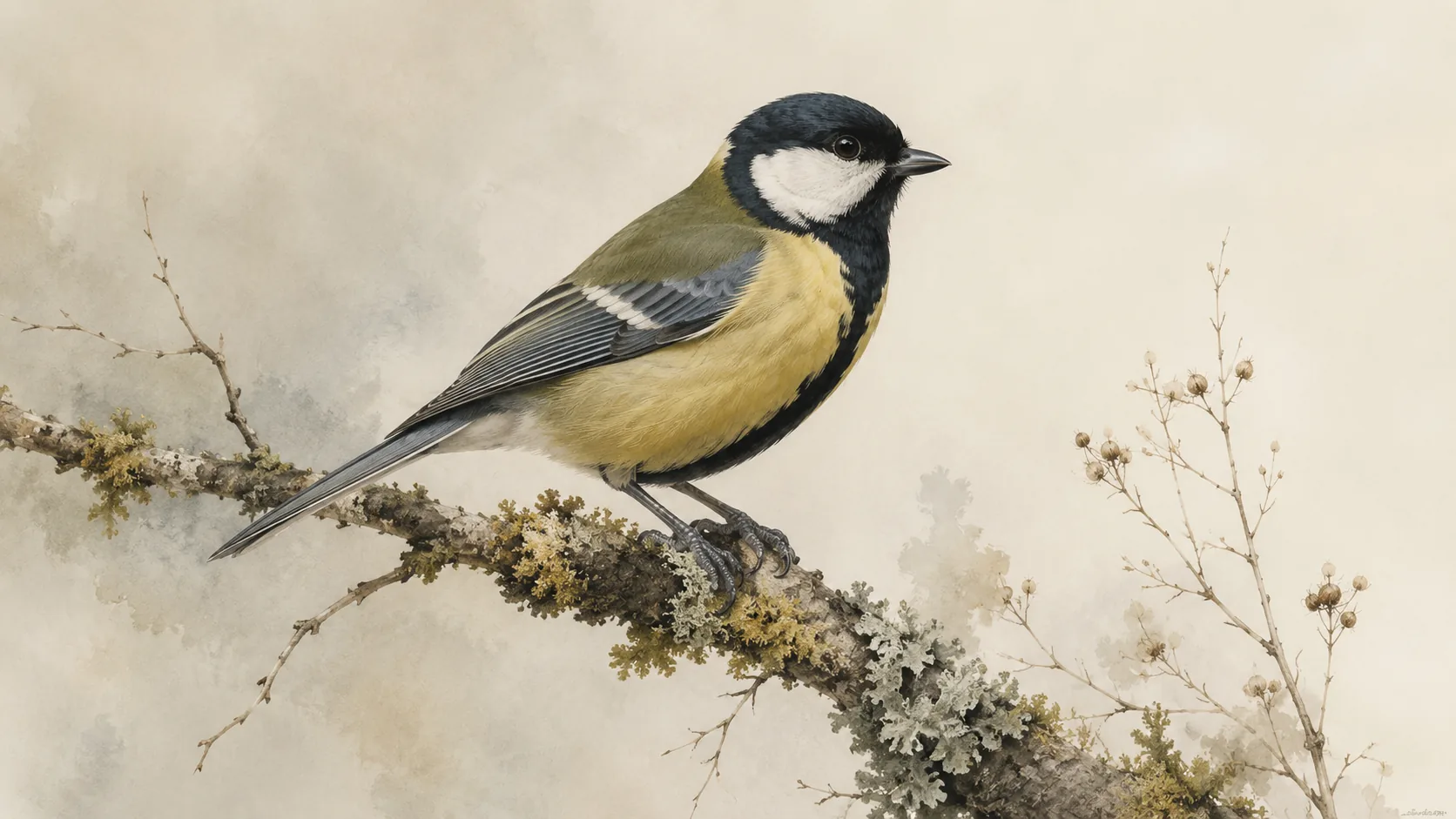
The Great Tit is 14 to 15 centimetres long and weighs between 16 and 22 grams - roughly the weight of three stacked pound coins - with a wingspan of 22 to 25 centimetres. It is the largest of the UK tits, noticeably bigger than the Blue Tit, and it carries itself accordingly: upright at a feeder, unhurried in the canopy, the first to arrive and the last to yield a good perch.
The plumage is high-contrast and unmistakable. A glossy black cap and bib frame white cheeks so clean they seem to glow against the dark head. The breast is yellow, divided cleanly by a black stripe running from chin to belly. In males that stripe is broad and bold; in females it narrows and sometimes breaks near the lower belly. The back is greenish-olive, the wings blue-grey with a single pale wingbar, the tail dark with white outer edges. There is nothing provisional or washed-out about any of this. The bird looks pressed and correct.
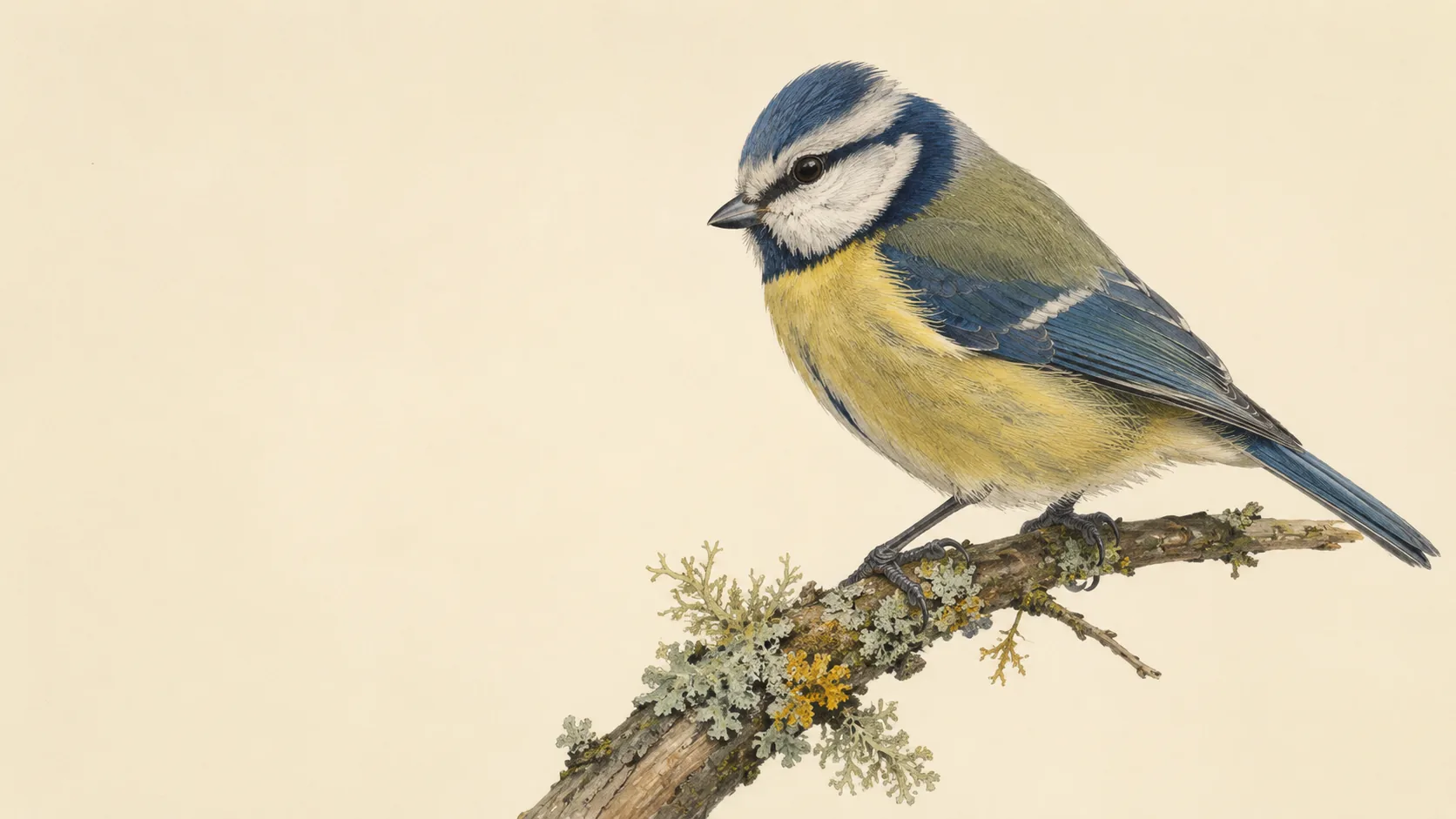
The only realistic confusion species in Britain is the Blue Tit, which is smaller, all-blue above, and lacks the bold black stripe. The Coal Tit shares the black cap but is sparrow-brown on the back and lacks yellow entirely.
Voice
The Great Tit’s song catalogue is large enough to be disorienting. The Woodland Trust logs the ‘teacher-teacher-teacher’ call as the signature - a ringing, insistent two-note phrase repeated up to a dozen times - but individual birds produce their own variations, and a single male may switch between calls in a way that leads an inexperienced listener to think the wood contains several different species. The BTO describes the range of songs and calls as exceptional for a British passerine. In February, when the calls begin in earnest, it is the first sustained evidence of a breeding season that is still weeks away.
Range and habitat
The Great Tit occurs in 90 per cent of 10-kilometre squares across Britain and Ireland, according to BTO survey data, with gaps only in the treeless moorlands of the Scottish Highlands, the Outer Hebrides, and the Northern Isles. It is a woodland bird at root - preferring deciduous and mixed woodland, scrub, parks, and well-treed gardens - but it has adapted so completely to human habitats that it is now a reliable fixture at garden feeders across the country from November to April.
In winter, it abandons its summer territories and joins roving mixed flocks with Blue Tits, Nuthatches, and Treecreepers. These flocks work systematically through garden shrubbery and woodland edge, turning leaves, probing bark, and visiting any feeders in range. The Great Tit is typically dominant at a feeding station, quick to displace smaller species and slow to yield its position. This dominance is a product of size, not aggression for its own sake. It simply outweighs the competition.
The BTO recorded a UK breeding population of 2.4 million territories in 2016, with populations 77 per cent higher than in 1967. The IUCN lists the global population at 127 to 205 million mature individuals and assigns Least Concern status.
Diet
Caterpillars are the keystone food, specifically during the three weeks that chicks are in the nest. The synchrony between peak caterpillar availability - largely the larvae of the winter moth and related species on oak - and the peak food demand of a brood of Great Tit chicks is one of the tightest timing relationships in British woodland ecology. Research at Wytham Woods in Oxford, much of it associated with the long-running great tit study begun by David Lack in the 1940s and continued through the work of Ben Sheldon and colleagues, has shown that as spring temperatures have warmed, caterpillar peak has advanced faster than great tit laying dates. The result is a narrowing window. Pairs that lay earliest - typically the most experienced females in the best territories - come closest to matching the peak. Those that miss it raise fewer chicks.
Outside the breeding season, the diet broadens substantially. Beech mast, seeds, berries, and invertebrates of all kinds are taken. At garden feeders, peanuts, sunflower hearts, and suet are preferred. The species will also forage on the ground, raking leaf litter with its bill in a way the smaller tits rarely do.
The Woodland Trust records one striking outlier behaviour in the diet: in Eastern Europe, Great Tits have been observed attacking and eating hibernating bats in caves. This is not typical British behaviour, but it is a reminder that the species’ opportunism extends further than the sunflower heart industry might suggest.
Breeding and nesting
The breeding season in Britain runs from April into May, with the female alone incubating a clutch of seven to nine eggs for around 13 to 14 days. The nest is built in a tree cavity, a natural hollow, or - with great readiness - a nest box. Both adults feed the chicks, which fledge after 18 to 21 days. The BTO records typically one brood per year, with a second brood exceptional rather than routine.
The nest box uptake is notable. The Great Tit was among the first species for which the nest box was demonstrated to be a genuine replacement for natural cavities, and much of what we know about nest success, territory quality, and individual fitness in British passerines has come from the marked nest box populations at Wytham and Bagley Wood.
The adaptation story
Research published in peer-reviewed journals and summarised in work from Oxford’s Edward Grey Institute has traced how individual great tits in Wytham respond to local temperature cues when setting their laying date. The birds are not reading a calendar. They are reading the spring - specifically, leaf-out phenology and invertebrate activity in their immediate territory. Birds in warmer microhabitats lay earlier. Year on year, the population’s average laying date drifts earlier as selection favours the birds whose internal cue-reading most closely tracks the shifting caterpillar calendar.
This is evolution working on a timescale a person can watch. The nine-day shift over five decades is a faster phenological response than most other woodland birds have managed. It is also, at present, not quite fast enough. The mismatch between caterpillar peak and chick peak is measurable, and the BTO’s long-term monitoring shows that it is widening in some sites in warmer years.
The Great Tit is, in this sense, not simply a common garden bird. It is the species through which British ecologists first clearly saw the biological consequences of a warming spring. The bird at your feeder in January, asserting its authority over the Coal Tits, has a lineage that runs through fifty years of careful watching - and a breeding season in which everything will depend, once again, on whether April arrives at the same pace as the caterpillars.
The Great Tit’s nine-day shift in laying date since 1968 is among the clearest biological signals of climate change recorded in any UK species - not a prediction, but a measured fact, from a bird that is watching the same spring you are.