Field Guide
American Redstart
A midge is resting on the underside of a red maple leaf along a Pennsylvania streambank in early June. The air is still. Then a small black shape drops into the canopy below the leaf, fans its tail in a half-second burst of orange fire, and the midge is airborne. The warbler is faster. It banks hard left, closes its bill on the insect, and is already searching the next stem before the leaf has stopped trembling.
That tail-fan is the whole game. Setophaga ruticilla - the American Redstart - is a warbler that does not wait for prey. It manufactures panic, and then it hunts the panic.
What it looks like
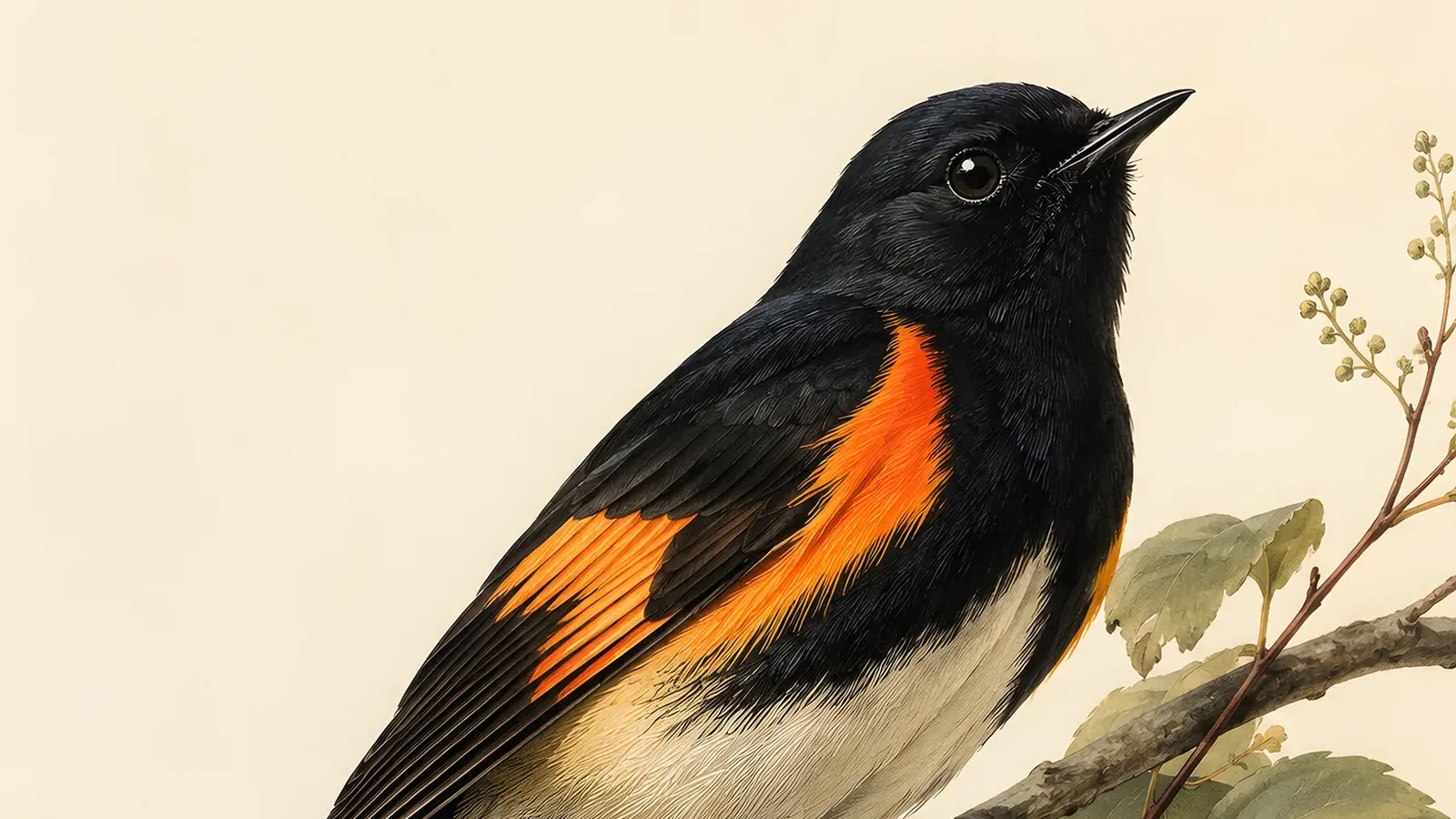
The male is striking and unambiguous. His upper parts, breast, and head are glossy black. Against this he carries three paired patches of deep red-orange: one on each side of the breast, one in each wing at the base of the flight feathers, and one across each half of the tail. At rest the patches read as bold accents. In motion, when he fans the tail and drops his wings simultaneously, they become a sudden flare of colour that fills a viewer’s eye - and apparently fills an insect’s eye too.
The female is a different bird in palette but identical in shape and behaviour. Her base colour is grey above and white below. Where the male shows orange, she shows clear yellow - on the wings, on the tail sides, and at the breast patches. The yellow is clean, not washed-out, and in good light it catches the sun sharply. Young males in their first spring resemble females but begin to show irregular black mottling on the face and back, making them look, briefly, patchy and unfinished.
Both sexes are small, 11 to 14 centimetres long and weighing between six and nine grams - lighter than a standard letter. The bill is flat and short, fringed with rictal bristles that help funnel flying insects into the gape. The tail is long relative to body size, which matters for the fanning display. Cornell Lab of Ornithology documents a wingspan of 16 to 23 centimetres and a confirmed longevity of up to ten years in banded individuals, though the average wild bird lives far less.
| Measurement | Range |
|---|---|
| Length | 11 - 14 cm |
| Weight | 6 - 9 g |
| Wingspan | 16 - 23 cm |
| Max recorded lifespan | 10 years |
Hunting by ambush of light
Most warblers are gleaners. They move through foliage, inspect surfaces, pick off resting insects. The American Redstart does some of this, but its defining technique is different, and it has a name in the ornithological literature: flush-pursuit.
The bird fans its tail and droops its wings simultaneously, flashing the high-contrast orange or yellow patches. The sudden visual stimulus - a burst of reflected light in an insect’s peripheral field - causes the insect to flee. The redstart was already watching. It sallies into open air, intercepts the flush, and takes the prey mid-flight. Cornell Lab records that redstarts take more flying prey than most other warbler species in North America. The prey list includes leafhoppers, planthoppers, midges, crane flies, moths and their caterpillars, wasps, beetles, and aphids.
The wing-droop and tail-fan are not silent. The bird is almost continuously in motion, turning, cocking, spinning on a branch, and the coloured patches wink in and out as it works a tangle of vegetation. The Cornell Lab notes that the same flash patterns serve a dual role - flushing prey and communicating social information among birds of different ages and sexes, where plumage brightness signals status.
Males tend to work higher in the canopy and make more aerial sallies. Females and first-year males forage lower and glean more from surfaces. This is not preference - it is a consequence of competition. Adult males hold the better territories with better foraging access, as Marra and colleagues documented in detail on the Jamaican wintering grounds.
What it sounds like
The song is high-pitched and variable, a quality that confuses birders who expect consistency. The standard rendition offers five or six thin notes ending with an upward or downward inflection - sometimes a rising zee-zee-zee-zee-ZWEET, sometimes the same phrase dropping at the end instead. Individual males often have several song types. The call is a sharp, crisp chip, useful for detecting the bird in dense vegetation. Both sexes call, and the call is common enough during migration to help locate redstarts moving through cover before first light.
In Michigan, where redstarts breed abundantly across the Lower Peninsula in second-growth forest and riparian corridors, the song rings out from willow thickets along rivers from late May through July - a thin, persistent high note that carries farther than the bird’s small size suggests it should.
Range and the tropical winter
The American Redstart breeds across a large swathe of North America, from southeastern Alaska and the Northwest Territories east to Newfoundland, and south through most of the eastern United States to the Appalachians and the Gulf states. It migrates at night, a long-haul journey to wintering grounds across Central America, the Caribbean, and northern South America.
The IUCN lists the species as Least Concern, with Partners in Flight estimating a global breeding population of roughly 42 million individuals. Numbers have declined modestly in the United States since the 1966 baseline of the North American Breeding Bird Survey - approximately 1.1 percent per year over the following five decades - but increases in Canada have kept the global trend close to stable.
The winter distribution has been one of the most studied aspects of the species. On Jamaica, the redstart’s primary Caribbean wintering ground, adult males hold territories in wet, food-rich mangrove and riparian forest. Females and first-year males - subordinate in the social hierarchy - are pushed into drier scrub habitat where insect availability is lower and more unpredictable. Peter Marra spent years on the island documenting what this partition means, and the answer turned out to matter far beyond Jamaica.
In a 1998 paper in Science, Marra, Hobson, and Holmes used stable carbon isotope signatures - absorbed from habitat-specific plant communities and preserved in bird tissue - to link individual birds to the type of habitat they had occupied the previous winter. The finding was crisp: birds that had wintered in high-quality wet habitat left Jamaica earlier in spring, arrived on North American breeding grounds earlier, and achieved greater reproductive success than birds from poor scrub habitat (Marra, Hobson, and Holmes, Science, 1998, vol. 282, pp. 1884-1886). The tropics were deciding the summer.
Norris, Marra, and colleagues extended this in 2004, demonstrating with a larger dataset that tropical winter habitat directly limited reproductive success on the temperate breeding grounds, not merely through arrival timing but through body condition carried north (Norris, Marra, Kyser, Sherry, and Ratcliffe, Proceedings of the Royal Society B, 2004, vol. 271, pp. 59-64). The phrase the field adopted for this is “carry-over effect.” A bird’s breeding season begins, in effect, in a Jamaican mangrove in November.
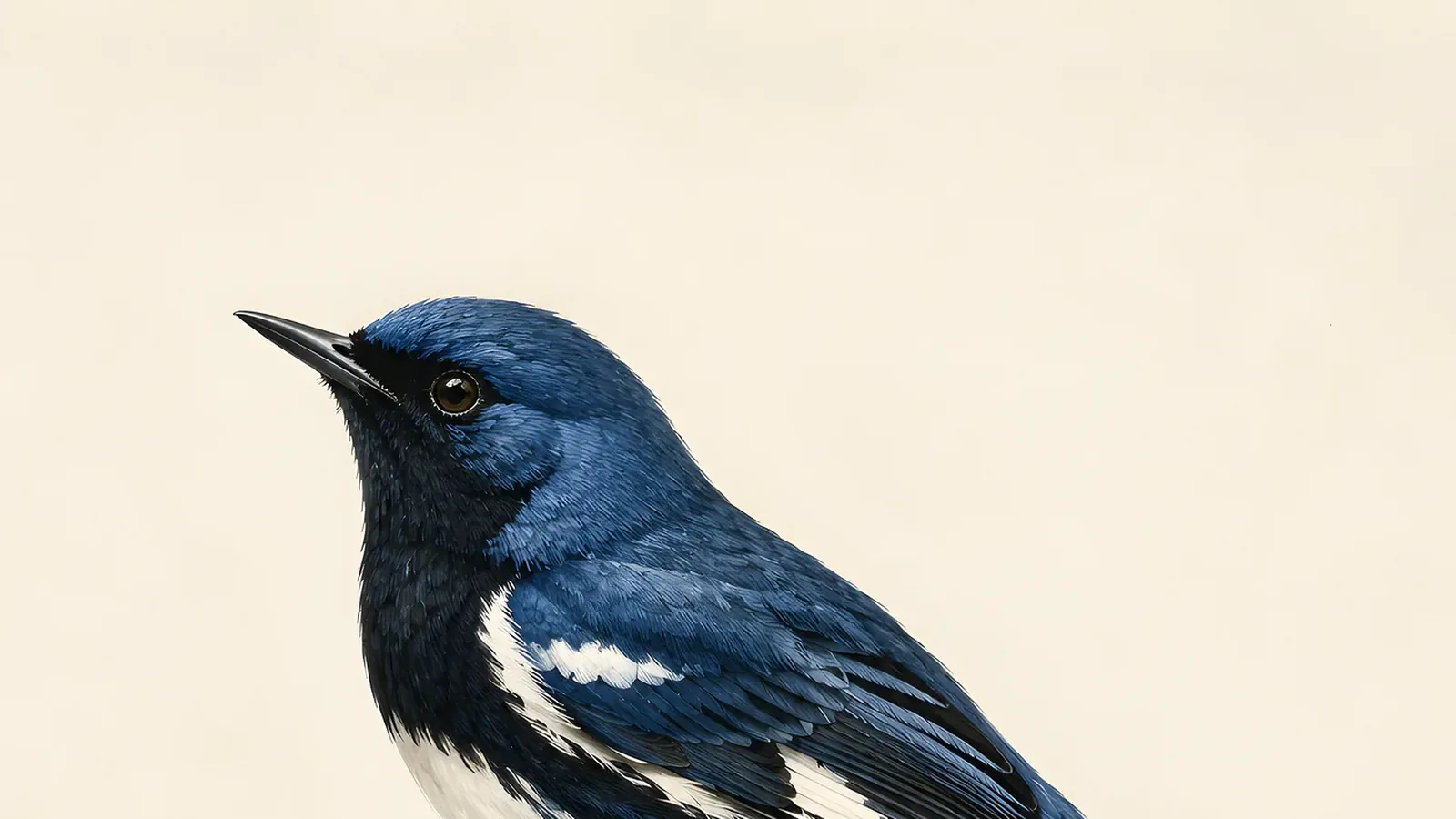
The implications run in both directions. Conservation effort focused only on breeding-ground habitat will be incomplete. The black-throated-blue warbler shows a similar pattern - a species where the winter range is not a holding pen but an active determinant of population health.
Breeding
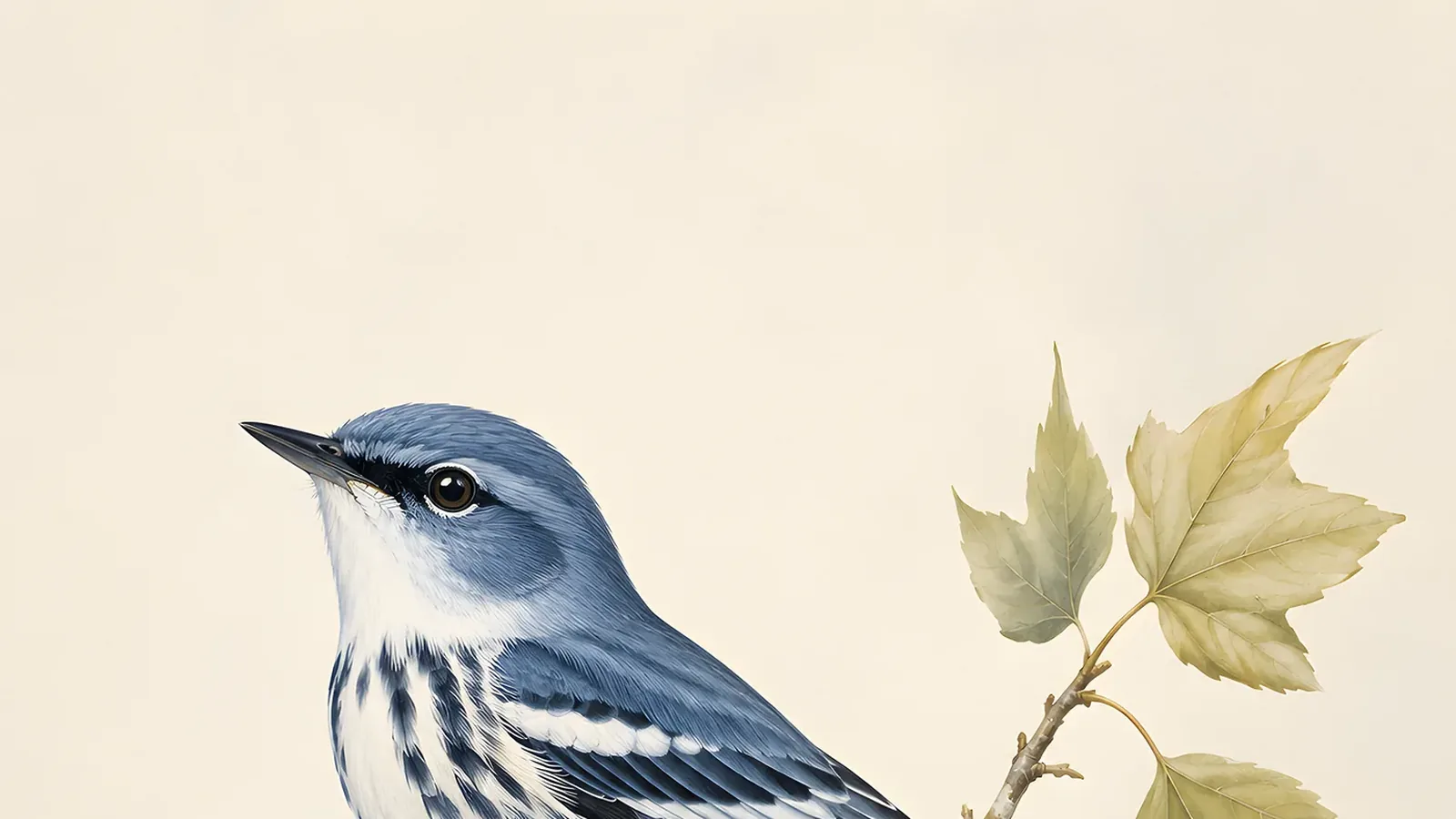
The American Redstart breeds in open deciduous and mixed-growth forest, with a preference for edges, second growth, and streamside woodland where the canopy is not fully closed. It is less tied to mature interior forest than species like the Cerulean Warbler and will use roadsides, shrubby field edges, and young regrowth stands - habitats that have expanded with forest fragmentation, which partly explains why its population has fared better than some of its warbler relatives.
The female builds the nest alone, a compact cup of plant fibres, rootlets, and spider silk, set in the fork of a shrub or small tree, typically two to ten metres off the ground. She lays three to four eggs, pale white to greenish with brown speckling, and incubates them alone for 12 to 14 days. Both parents feed the nestlings, which fledge at eight to nine days - unusually early for a passerine, and an adaptation that reduces predation risk during the most vulnerable period. The family remains together for several weeks after fledging while the young birds gain flight competence.
Males on good territories sometimes attract more than one female and will divide provisioning effort across two nests simultaneously. The early-arriving males from high-quality winter habitat, Marra’s research showed, hold better breeding territories and are more likely to maintain this multi-pairing arrangement.
Sit still beside a streamside thicket in early June and the redstart will work toward you. It cannot help itself. The need to flash, to flush, to chase, is stronger than its wariness of a motionless figure, and within a few minutes you will have it close enough to read every feather.
There is an idea lodged in this bird that is worth sitting with: that a creature weighing less than a letter, crossing a thousand miles of ocean twice a year, carries the quality of a Caribbean winter inside itself all the way to the breeding grounds of the Great Lakes. The summer success of a bird in a Michigan maple depends on whether a Jamaican mangrove is still standing. The two ecosystems are not separate. They are one system, and the redstart is the thread running through it.