Field Guide
Red-naped Sapsucker
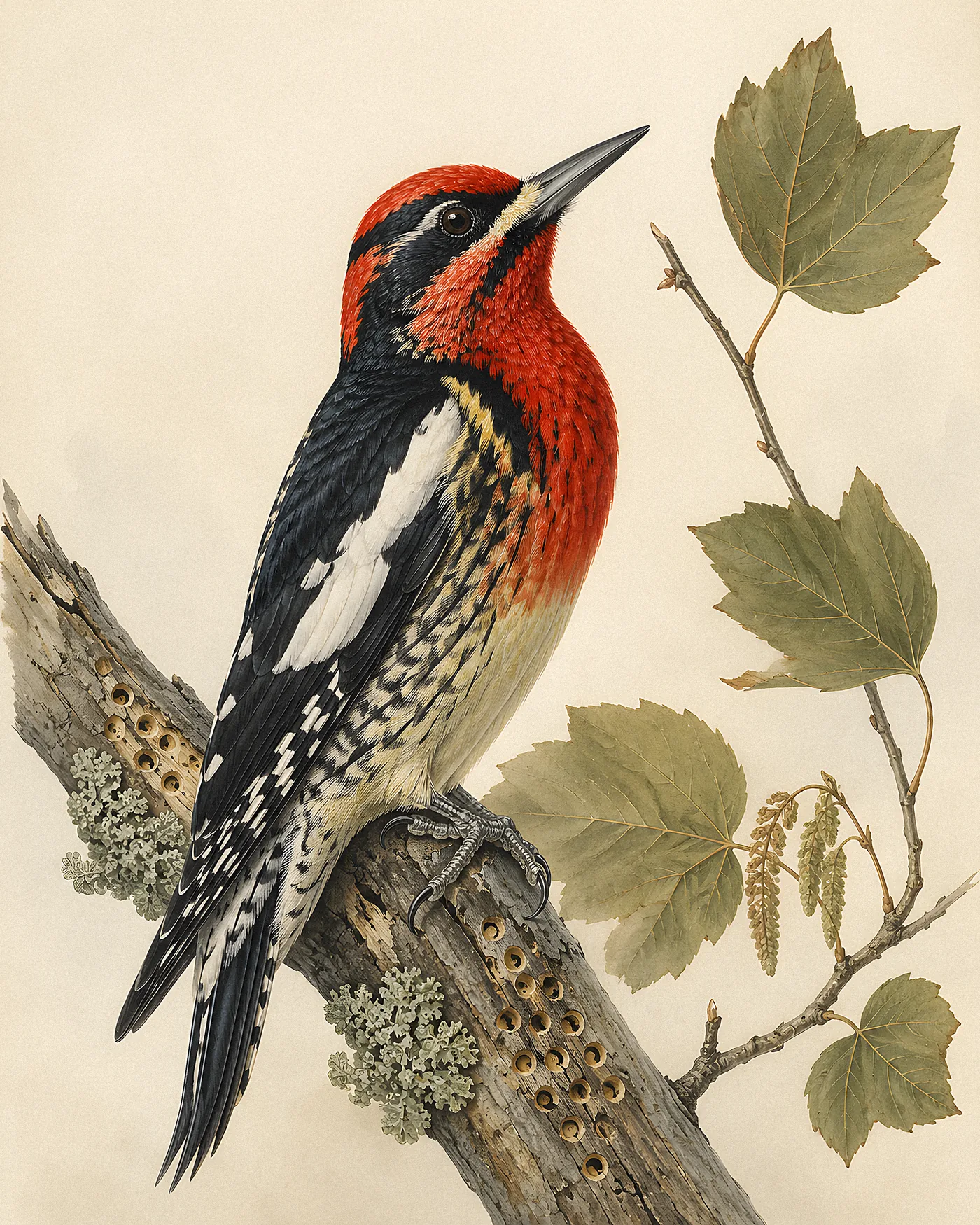
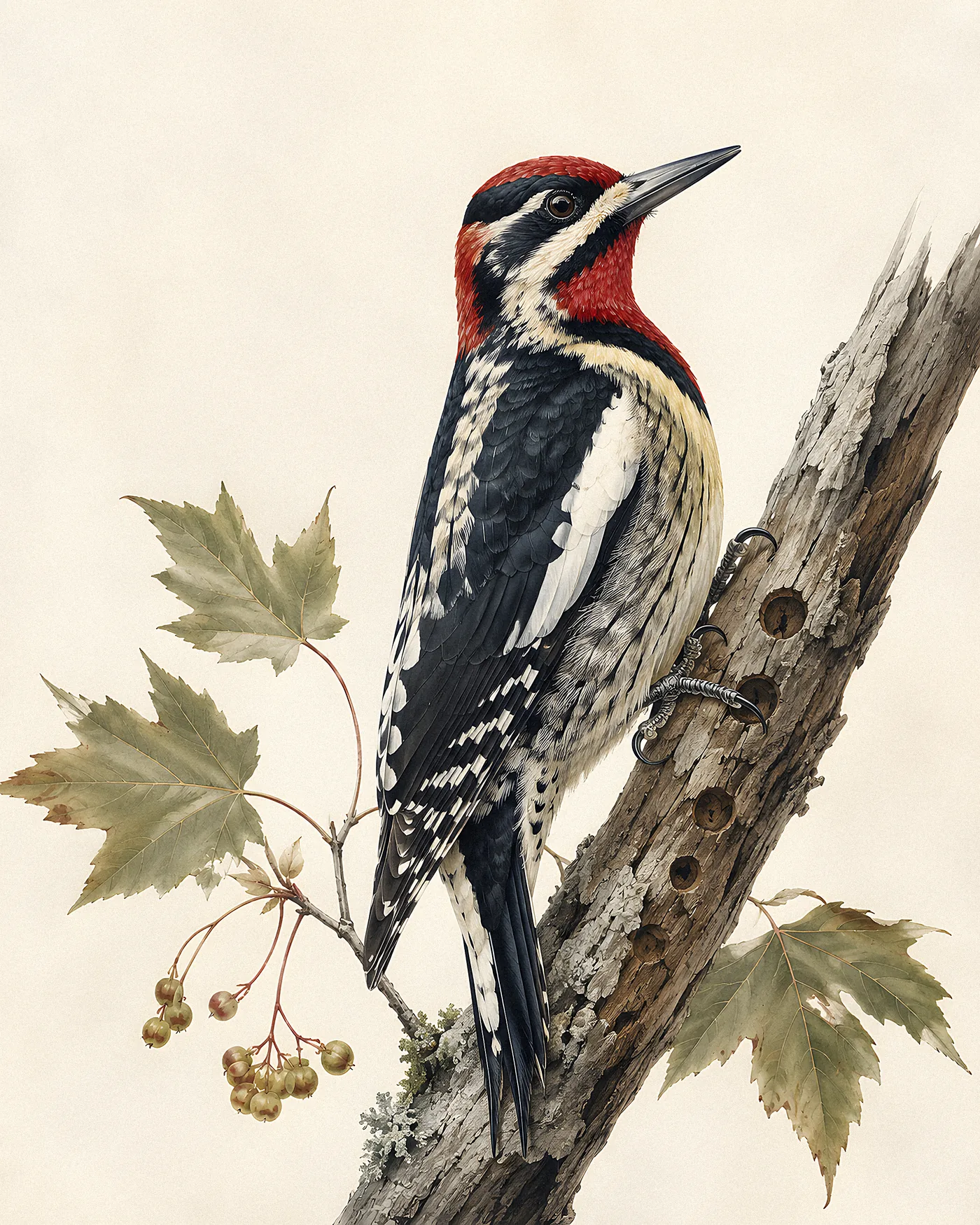
A grove of quaking aspen high in the Rocky Mountains, early summer, leaves rattling in the wind, and a black-and-white woodpecker is working a living trunk. It drills a neat row of wells, leans back, and shows the field mark that names it: a small patch of red on the back of the neck, where the black-and-white head meets the back. The crown is red, the throat is red, and that extra dab of crimson on the nape is the detail that separates this bird from its eastern twin.
The Red-naped Sapsucker is the Rocky Mountain and Great Basin member of the sapsucker family, a bird so close to the Yellow-bellied Sapsucker that the two were considered one species until 1983.
What it looks like
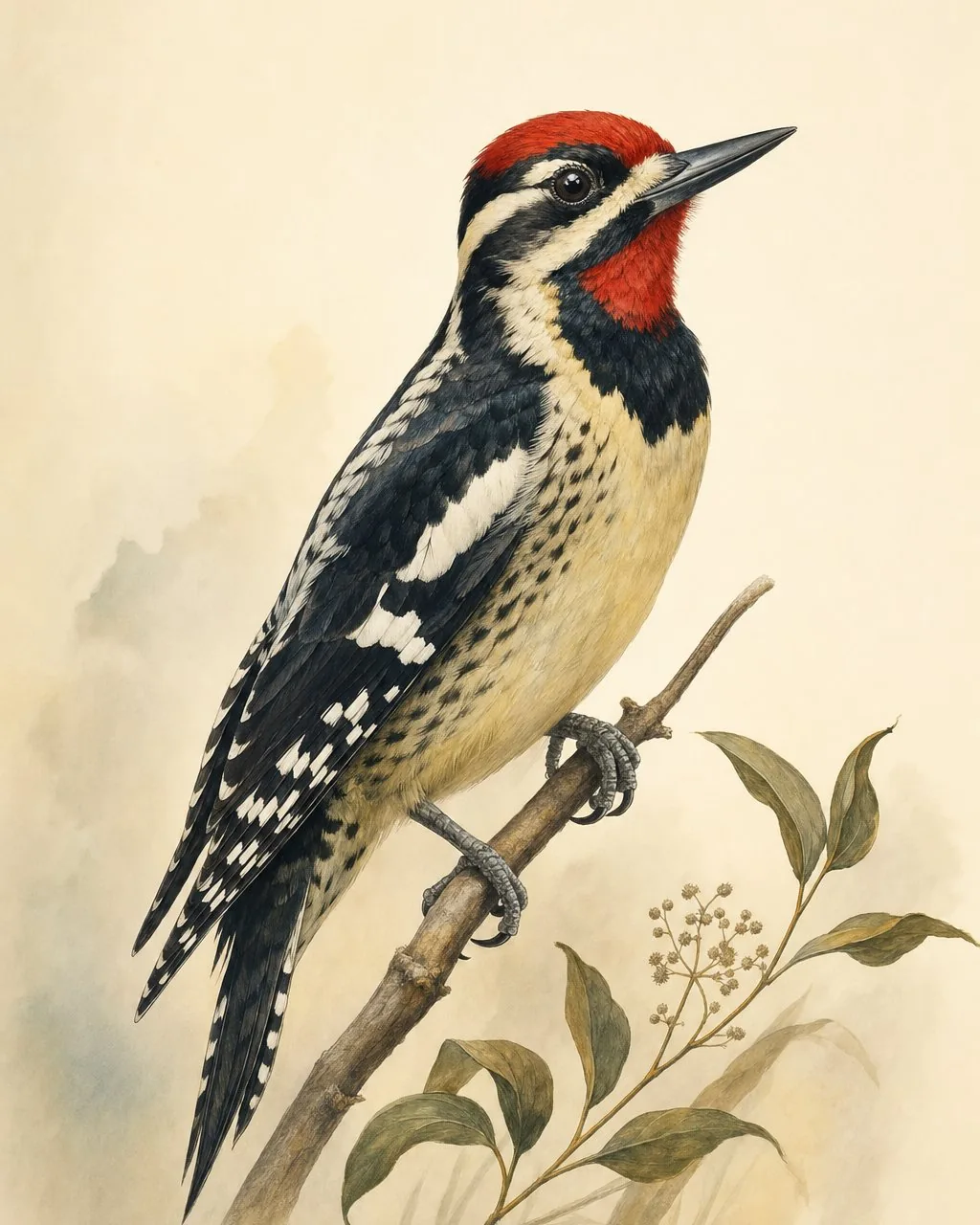
The pattern is classic sapsucker. Cornell Lab describes the bird as black and white overall, with a red crown, a long white stripe on the folded wing, a black stripe through the eye bordered above and below by white, and the pale yellowish wash on the belly the family shares. The mark that gives the bird its name is the small patch of red on the nape, the back of the neck - a feature the Yellow-bellied Sapsucker either lacks or shows only faintly.
This is one of the sapsuckers you can sex in the field. Cornell Lab notes that the male has an entirely red chin and throat, while the female shows a white patch on the chin, breaking the red. The nape patch can be red or white on the female. Juveniles are a washed-out brown version, with a brown cap and a brown wash over the head and belly, sorting themselves into the adult pattern over their first winter. Cornell Lab puts the bird at 19 to 21 centimetres long and 32 to 66 grams, with a wingspan around 41 to 43 centimetres.
What it sounds like
The voice is typical of the group - a nasal, cat-like, mewing call, querulous and falling, usually heard before the bird is seen. Around the nest it adds sharper notes and a churring scold.
The drumming is the better identification cue. Like the other sapsuckers, the Red-naped drums in a broken, stuttering rhythm rather than an even roll: a quick opening burst that trails off into slower, irregular taps, used in courtship and territorial display on resonant dead branches. That Morse-code cadence is the surest way to pick a sapsucker out of a forest of drumming woodpeckers.
Range and habitat
Sphyrapicus nuchalis is a western interior bird, common through the Rocky Mountains and the Great Basin. Cornell Lab records it breeding in mountain forests from British Columbia and Alberta south through the interior West, with a strong attachment to aspen. It nests in mixed stands of willow, aspen, birch, ponderosa pine, juniper and Douglas-fir, very often near water, and aspen groves are its heartland.
It is a short-distance migrant, withdrawing from the higher and colder parts of the breeding range in winter and moving south, with many birds wintering from the southern edge of the range into Mexico, where they use riverside trees and woodland. Where its range meets the coastal Red-breasted Sapsucker in the mountains of the interior Northwest, the two interbreed - another reminder of how thin the lines are between these look-alike sapsuckers. Cornell Lab and the IUCN list the species as Least Concern.
Diet
Sap and insects, in the now-familiar sapsucker arrangement. The bird drills and maintains rows of wells, tapping the sugary sap and lapping it with a brush-tipped tongue, returning to the same trunks through the day. Aspen and willow, which run sap freely, are favourite well trees.
Insects are the protein half. Cornell Lab notes that the sap draws ants and other small insects, which the sapsucker takes alongside the sap, and that adults feeding young forage especially for arthropods, ants above all, sometimes dipping the prey in a sap well before carrying it to the nest. The bird also catches insects in flight and eats seeds and berries when they are available.
Breeding and nesting
The Red-naped Sapsucker excavates a fresh nest cavity most years, with a strong preference for live aspen. Cornell Lab notes a particular habit: the birds favour aspens infected with a heart-rot fungus, aspen bracket, which softens the core of an otherwise living tree, so the bird gets a sound outer wall around a workable inner chamber. It is a neat piece of natural engineering.
The female lays three to seven white eggs onto a bed of wood chips. Both sexes incubate for about 10 to 13 days, the male taking the night shift, and both feed the nestlings, which stay in the cavity for around 25 to 29 days before fledging. As with the other sapsuckers, the parents go on feeding the young after they leave and lead them to the wells to teach them the trade.
The dab of red on the back of the neck is the whole story - the mark that names the bird and split it from the Yellow-bellied Sapsucker in 1983.
What to watch for
The identification challenge with this bird is its relatives. The Red-naped, Yellow-bellied and Red-breasted Sapsuckers were once tangled together as one or two species, and they still meet and hybridise at the edges of their ranges. The practical key is geography plus that nape. In the interior West, a black-and-white sapsucker with a red crown, a red throat and a small red patch on the back of the neck is almost certainly this one; the Yellow-bellied belongs to the East, the Red-breasted to the coast.
Better still, find its trees. An aspen grove ringed with tidy rows of sap wells is the Red-naped Sapsucker’s signature on the landscape, and those wells feed hummingbirds, warblers and other forest birds that follow the sapsucker from tree to tree. A red-naped male tending his rows on a white aspen trunk, leaves shivering around him, is a scene the tradition of Audubon would have set down with care.