Field Guide
Sulphur-crested Cockatoo
In a Sydney suburb in 2021, ornithologist Richard Major at the Australian Museum Research Institute documented something that had not been formally recorded before: Cacatua galerita prying open a wheeled rubbish bin by wedging its beak under the rim, walking sideways along the lip, and flipping the lid. The behaviour then spread - not through trial and error repeated independently across suburbs, but through social learning, bird watching bird, repeating what it saw. By the time a follow-up study by Barbara Klump at the Max Planck Institute of Animal Behavior appeared in Current Biology in 2022, residents were responding with bricks, locks, and weighted straps. Both species were innovating. The ‘arms race’ framing in that paper was not hyperbole. It was an accurate description of what was happening between a large white parrot and the cities it has colonised.
The Sulphur-crested Cockatoo is the most cognitively visible large parrot in the world. This is the argument the species makes by simply existing in a city.
What it looks like
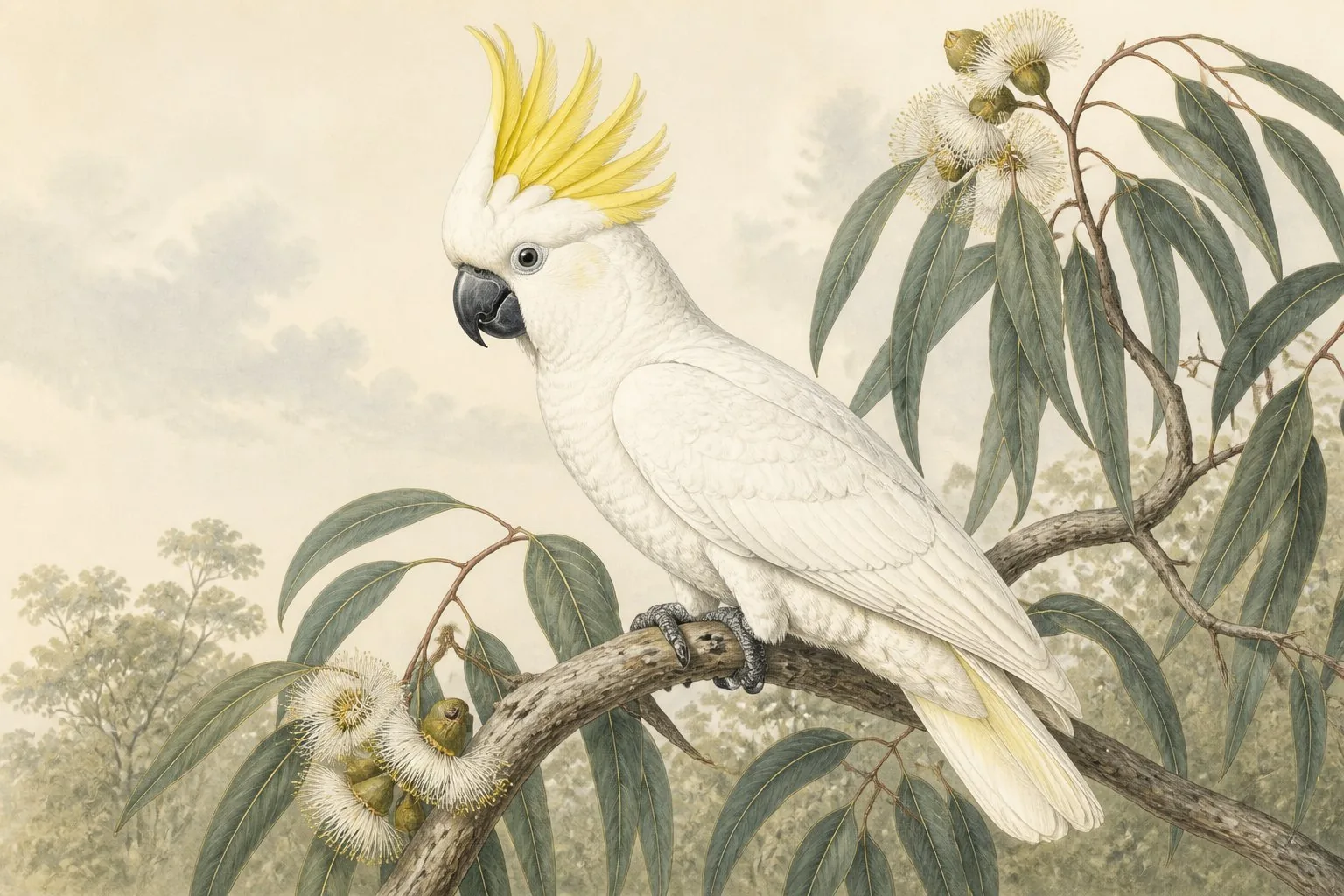
The adult is 44 to 55 centimetres long and weighs between 700 and 950 grams - a large, heavy-bodied bird, all white except for what it wears on its head. The crest is a forward-sweeping fan of bright yellow feathers, usually folded flat but raised instantly when the bird is alarmed, excited, or signalling to a flock-mate. Underwing and undertail feathers carry a faint yellow wash. The bill is black and curved, built for cracking hard seeds and - as Sydney discovered - leveraging fitted lids. Legs are grey. Eye-ring is bare and whitish.
The sexes are nearly identical in plumage, which is unusual for a parrot. The reliable field distinction is the iris: males have dark brown or nearly black eyes; females show reddish-brown to brown irises. This difference is visible in decent light at moderate range.
The crest is the diagnostic field mark. No other large white bird of the Australian bush or suburb carries that sulphur-yellow fan. In flight, flocks produce a sharp, carrying call that announces them before they are visible.
The voice
The call is one of the loudest sounds in Australian urban bird life - a repeated, raucous screech that carries through closed windows and across several city blocks. Cornell’s Birds of the World notes that Australian populations produce calls with a higher proportion of mechanical-sounding, harsh elements compared to the more melodious calls of New Guinean populations. This is not a pleasant sound in the way that a thrush or a cardinal is pleasant. It is designed for long-distance forest communication, a signal that cuts through canopy noise without nuance.
Flocks announce their arrival at feeding sites, sound a continuous alarm when approached, and quieten only briefly when they settle to feed. In urban areas, the volume is the second most common complaint about the species after the bin-opening. Both are features, not errors.
Range and habitat
The species ranges across eastern Australia from the Cape York Peninsula in Queensland south through New South Wales, Victoria, and into Tasmania. A separate subspecies, C. g. fitzroyi, occupies northern and northwestern Australia east from the Fitzroy River. Introduced populations have established in Perth, New Zealand, Singapore, and Palau.
Preferred habitat in Australia spans open woodland, savannah, forest edge, and farmland - anywhere that offers large hollow-bearing trees for nesting and open ground for foraging. The species has adapted to suburban parks, golf courses, and public gardens as a secondary habitat, drawn by reliable food from grass seeds, garden plantings, and, increasingly, unsecured bins. Cornell’s Birds of the World distinguishes the Australian C. g. galerita and fitzroyi from the New Guinean forms, which occupy denser rainforest and produce distinctly different vocalisations - a difference recent genomic research published in 2024 suggests may warrant treating them as a separate species, Cacatua triton.
The IUCN lists Cacatua galerita as Least Concern, with a large and stable range across Australia and the adjacent archipelago. In some agricultural regions, particularly grain-growing areas of eastern Australia, the species is considered a pest.
Diet
Foraging happens on the ground and in the canopy. The staple diet is seeds and nuts cracked by that heavy curved bill. The species also takes fruits, blossoms, insect larvae, and roots dug from soft soil. Flocks move through grain crops in number and can strip planted fields - which is why the species has a complicated relationship with Australian farmers even as it charms urban birdwatchers.
Sentinel behaviour is observed in feeding flocks: one or two birds perch high above the group and watch, calling alarm when a predator or human approaches while the rest of the flock feeds below. This division of watchfulness is characteristic of highly social species that live in open or semi-open habitat where predators can approach at distance.
Breeding and nesting
The Sulphur-crested Cockatoo is monogamous and breeds once per year. In northern Australia, breeding runs roughly May through September. In southern populations it shifts to August through January. The pair nests in a tree hollow - large, old eucalypts with cavities deep enough to hold two to three eggs are the preferred site. Both parents incubate for 27 to 30 days. Both feed the chicks, which fledge after approximately 70 days and remain with the parents for some months after leaving the hollow.
Hollow-bearing old-growth trees are scarce in agricultural and suburban landscapes, which limits breeding density outside intact forest. Pairs are territorial around active nest sites. Outside the breeding season the birds are gregarious, assembling in flocks of dozens to several hundred.
Sexual maturity arrives at three to four years of age. Wild birds typically live 20 to 40 years, with documented individuals reaching 57 years. In captivity, with appropriate diet and veterinary care, 70 years is achievable - there are records of captive birds exceeding that.
The behaviour that matters
The bin-opening story is often told as a curiosity. It is more than that. Social transmission of a novel foraging technique - observed in one individual, copied by neighbours, spreading geographically at a rate that tracks social contact rather than independent discovery - is what researchers call cultural behaviour. It is the same mechanism that allows human tool use to spread through a population. The Current Biology study by Klump and colleagues is careful and specific about this: the geographic spread of the technique matched a social network model, not a random diffusion model. The birds were learning from each other.
The Sulphur-crested Cockatoo is not using tools in the way a New Caledonian Crow does. But it is demonstrating something that most birds do not: the capacity to observe a complex action, retain it, and reproduce it in a new context. That capacity scales. The bin trick was learned in one decade. The species has been adapting to Australian landscapes for vastly longer.
A large flock lifting off a eucalyptus in morning light, all white against blue sky, crests flat in flight and raised on landing - this is one of the defining images of eastern Australian birdlife. It is also, if you know what you are looking at, a flock of animals that are, by some measures, still figuring out what cities are for.