Field Guide
Newell's Shearwater
It is October on Kauai and somewhere on the wet flank of Waialeale, a fledgling Puffinus newelli is pushing out of the dark. The burrow mouth is almost vertical. The chick has never been outside in daylight and has never been outside at night. It launches into the air - its first flight is also its departure from the island forever, or it is supposed to be. Instead, the bird turns toward the lights of Kapaa on the coast below. It circles for an hour. Then it falls.
The bird on the ground is called a fallout bird. It may be injured. It is certainly exhausted and disoriented. If a passing car does not kill it, if a cat does not find it before dawn, a volunteer from Save Our Shearwaters may arrive with a box. The program has been running since 1979. It has rescued more than 30,500 fledglings from Kauai’s roads, parking lots, and resort grounds, according to the Hawaii Division of Forestry and Wildlife. That number is not a conservation triumph. It is a measure of scale.
Puffinus newelli, the Newell’s Shearwater, known in Hawaiian as ‘A’o, is a bird that spends most of its life hundreds of kilometres from land and cannot survive the first night it tries to reach the sea.
What it looks like
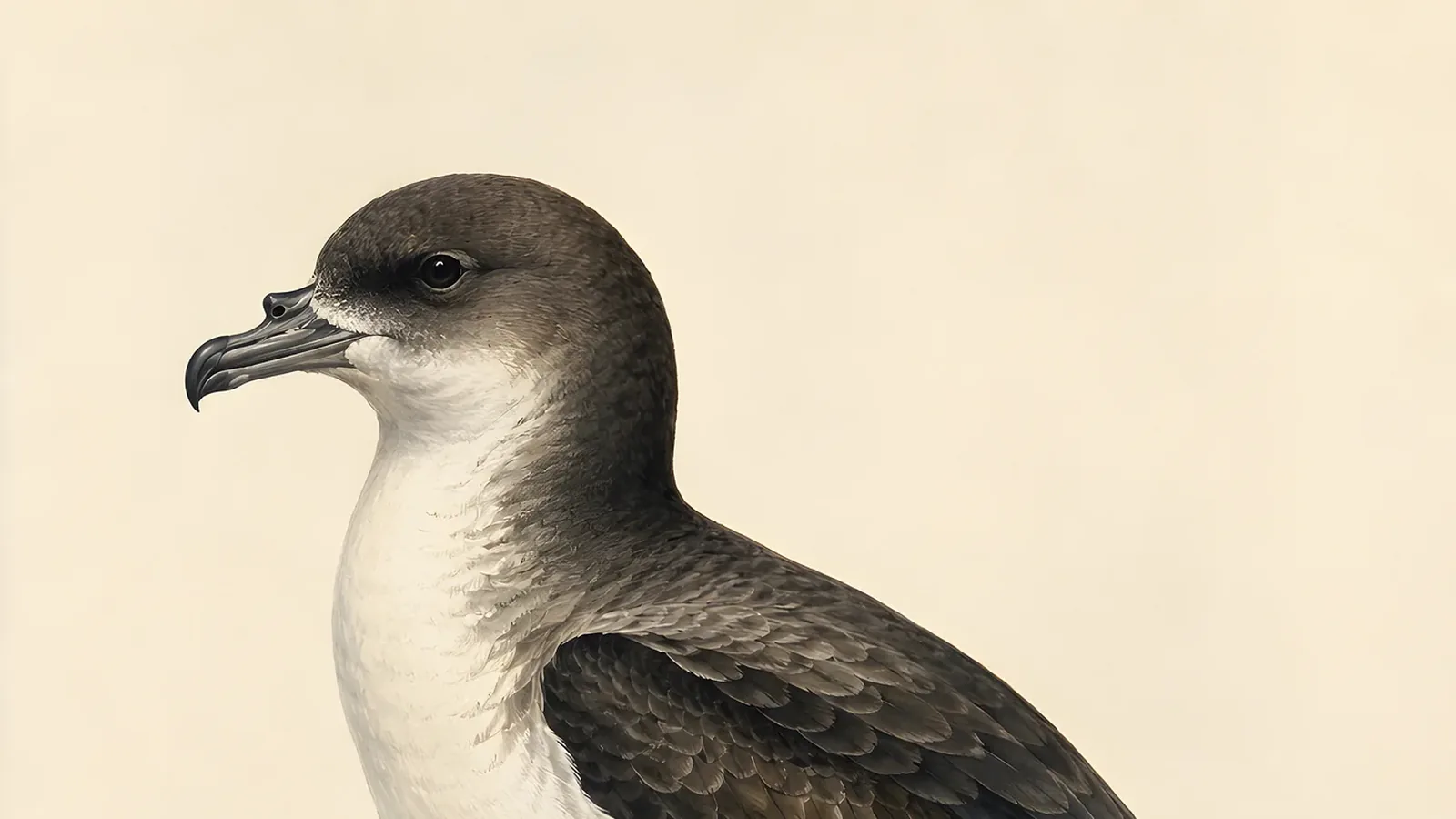
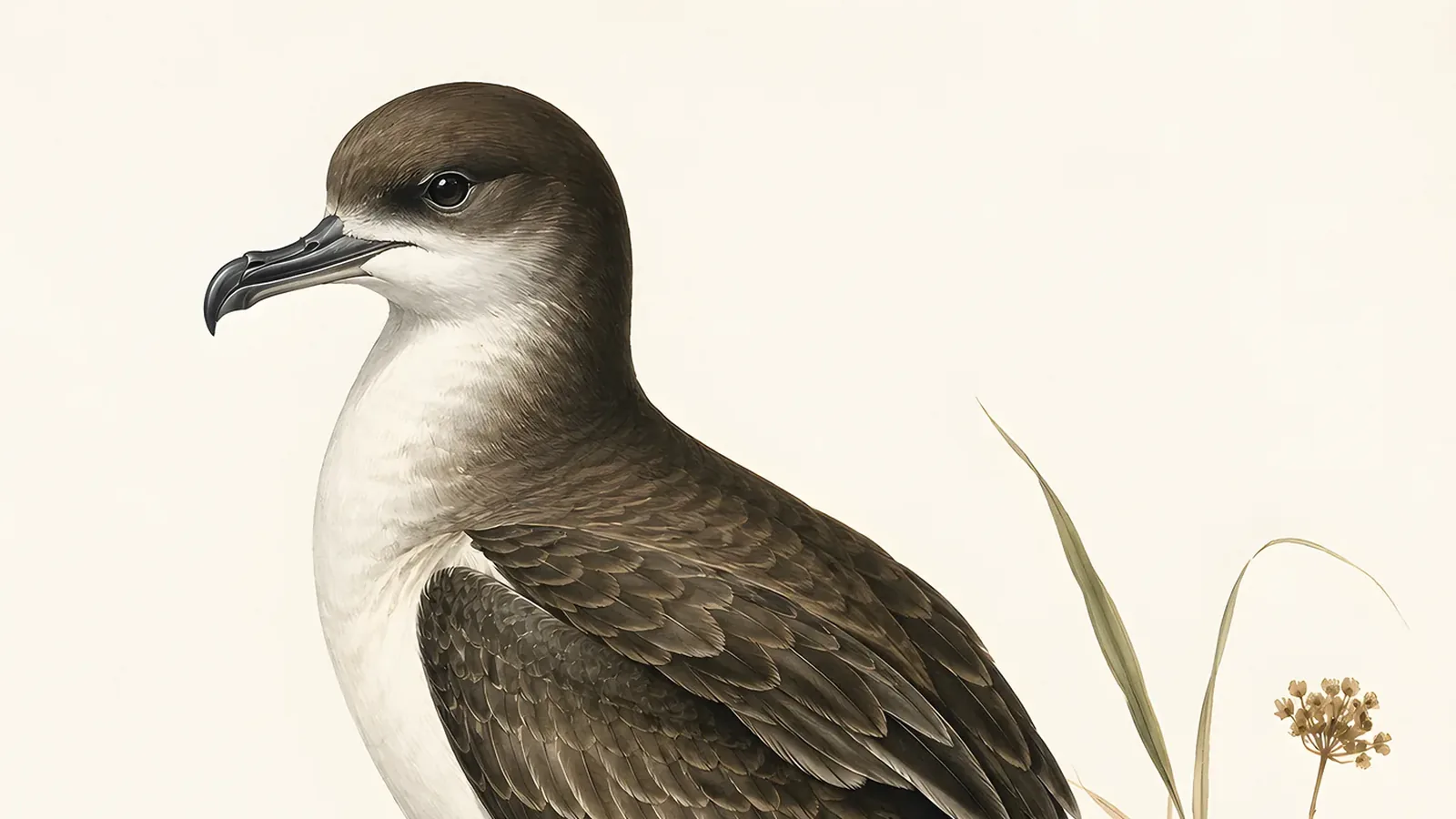
A compact, fast-moving shearwater, smaller than the Hawaiian petrel with which it shares its breeding range on Kauai. Body length is 33 cm. Weight runs from 340 to 425 g. Wingspan approximately 76 to 84 cm, the wings held stiff and swept slightly back in the characteristic posture of the family.
The plumage is blunt in its contrast: sooty black on the crown, mantle, back, upperwings, and tail, and clean white on the chin, throat, breast, belly, flanks, and underwing coverts. The transition is sharp along the sides of the neck, creating a hooded look. No brown, no grey, no iridescence. In sunlight at sea the bird looks almost graphic - a dark kite pulling white from its underside as it banks.
The bill is dark, thin, and hooked. The feet are pale pink at the base, darkening toward black on the outer toes, and they trail behind in flight in the way common to all procellariids.
Flight is rapid - a quicker, almost nervous wingbeat compared to larger shearwaters - alternating with stiff-winged glides low over the water. In calm conditions the bird labours, beating steadily. In swell and trade-wind chop, it reads the surface gradient and skims effortlessly.
| Measurement | Value |
|---|---|
| Body length | 33 cm |
| Weight | 340-425 g |
| Wingspan | 76-84 cm |
| Estimated lifespan | 25-40 years |
| First breeding age | 6-7 years |
| Incubation | 53-54 days |
| Chick fledging | 81-94 days after hatching |
| Clutch | One egg |
The mountain burrows
‘A’o nests on steep, forested mountain slopes between 160 and 1,200 metres elevation, choosing terrain where native ‘ohi’a canopy shelters a dense understory of ‘uluhe fern and moss. This habitat concentrates on Hawaii’s island of Kauai, which holds more than 90 per cent of the remaining global population, according to the Kauai Endangered Seabird Recovery Project. Smaller confirmed colonies exist on Hawaii Island, Maui, Molokai, and Lehua islet.
Pairs dig burrows half a metre or more into the root mat of the fern understory, returning to the same site in successive years with strong site fidelity. The bond between partners is long-term. Both parents incubate and both brood the chick. What is notable is that neither parent is ever at the burrow in daylight. Adults leave before first light and return only after dark, calling to their partners as they approach.
This nocturnal habit is a predator-avoidance strategy of deep antiquity. It works well against hawks. It works less well against feral cats, small Indian mongooses, rats, and barn owls, none of which are native to Hawaii and all of which hunt perfectly effectively in darkness. Pigs do not hunt the birds directly, but they root through the fern understory and destroy nest sites, and their tracks open corridors that predators then follow into previously sheltered forest.
The non-breeding season runs from December through March, when both adults are entirely at sea. The return to Kauai’s ridges begins in April. Egg-laying occurs in early June. Fledglings leave the colony from late October into November.
Fallout: the lights and the young
A fledgling shearwater navigates by moonlight and stars. It is built - over millions of years - to distinguish the reflective glimmer of open water below from the dark mass of land. Artificial light scrambles this. A resort hotel lit against the mountainside is brighter than the moon. A fledgling heading toward it is not making an error, exactly. It is following the only orientation system it has, pointed at the wrong target.
“On Kaua’i, approximately 350 fledglings were recovered annually from fallout in 1999 to 2010, far fewer than the thousands found per year in the late 1970s when the Save Our Shearwaters program began.” - Hawaii Division of Forestry and Wildlife
The drop from thousands to hundreds is sometimes read as progress. André Raine and colleagues, writing in Endangered Species Research in 2020, tracked 38 rescued fledglings and 12 naturally fledging chicks using satellite transmitters. They found that birds undergoing longer rehabilitation had poorer survival after release than birds released quickly, and that all rescued birds showed reduced survival compared to those that fledged naturally. The program matters - some rescued birds did travel more than 2,000 km to North Pacific aggregation zones - but it cannot substitute for fledglings that reach the ocean under their own power on their own first night.
The other major structural killer is the power line. Kauai’s transmission grid crosses the coastal lowlands that shearwaters must traverse between their mountain colonies and the sea. Collisions with wires at night are a documented cause of death and wing injury throughout the fallout period.
The decline
Raine, Holmes, Travers, Cooper, and Day, reporting in The Condor: Ornithological Applications (2017), conducted radar counts at 13 Kauai monitoring sites between 1993 and 2013. They recorded a 94 per cent decline in Newell’s Shearwater numbers over that twenty-year period - an average annual reduction of approximately 13 per cent per year. This is the figure that drove the species from Endangered to Critically Endangered on the IUCN Red List.
For context: in the years immediately after Hurricane Iniki struck Kauai in September 1992, annual Save Our Shearwaters fledgling recoveries averaged 1,511 birds. After 2010 that average fell to 146. Whether this reflects fewer birds arriving at the coast, fewer birds fledging successfully, or both, the trajectory is the same.
The estimated breeding population based on at-sea surveys from 1980 to 1994 was approximately 19,000 pairs, according to the Maui Nui Seabird Recovery Project. That number predates the period of documented steep decline. Current breeding population estimates are considerably lower, and Kauai holds the majority of whatever remains.
The arithmetic of the Procellariidae makes this worse. A bird that does not begin breeding until age six or seven, that raises one chick per season in a burrow on a steep mountain, has almost no margin. Every breeding adult lost to a cat at the nest, every fledgling lost to a power line or a light-confused crash, costs the population years. A pair that fails to fledge a chick in any given season does not get that year back.
What it sounds like
The Hawaiian name ‘A’o is phonetically what the call sounds like. Adults vocalize only at night. The colony call is a low, braying sequence - Kauai Endangered Seabird Recovery Project describes it as a series of two to six gruff, throaty two-syllable phrases, slightly intensifying, something like ahr eh ahr eh, with a ragged, almost donkey-like quality in full bray. The call is given in flight on approach to the burrow, and between paired birds once inside. Chicks in the burrow, when disturbed, produce squeaky versions of this call that deepen as they age.
The sound carries on a wet night above Kauai’s Na Pali coast. It rises from forest you cannot see. Hikers who have camped in the colonies describe the experience as disorienting - a sound with no obvious source, coming up from the ground and from above simultaneously, from birds passing invisible overhead. It is one of the more specifically Hawaiian sounds left in the world.
Breeding
Adults return to their colonies from April onward. After arrival, both partners undergo a “pre-laying exodus” - a return to sea lasting roughly three weeks - before coming back to lay. A single white egg is deposited in early June. Shared incubation lasts 53 to 54 days, each adult taking multi-day stints while the partner forages offshore. Both parents provision the chick across a rearing period of 81 to 94 days, according to data compiled by the Maui Nui Seabird Recovery Project, before departing for the season and leaving the fledgling to manage its own departure.
In 2015, Pacific Rim Conservation began translocating Newell’s Shearwater chicks to a predator-free 2.5-hectare enclosure at Kilauea Point National Wildlife Refuge on Kauai - fitted with artificial burrows and social attraction speakers broadcasting colony calls. By 2020, 86 translocated chicks had fledged, with a 100 per cent survival-to-fledging rate, as reported by Young, Kohley, VanderWerf and colleagues in Frontiers in Conservation Science (2023). A Newell’s Shearwater returned to the site as a breeding adult in the years that followed - the first record of the species establishing at a managed colony.
That single returning bird represents what the whole effort is aimed at. Six or seven years of survival at sea, predator-free fledging, accurate navigation to open water on a dark October night, and then a return to the island and the burrow system - the full closed loop. The failure point is the moment between the mountain and the ocean, between instinct and an island that has decided to stay lit all night. Reducing that light, holding that predator-free perimeter, and recovering enough fledglings quickly enough to matter: these are the three things standing between ‘A’o and silence on the ridgelines of Kauai.