Field Guide
Laysan Albatross
A single bird is banking low over the North Pacific swell, four metres of wingspan barely bowed as it cuts the wind shear between a wave crest and the open air above. It has not flapped in minutes. It will not flap for minutes more. In the long trough between gusts it tilts one wingtip toward the water, sweeps upward into the headwind, banks again - a sinuous figure carved from the vertical gradient of wind speed over ocean. This is dynamic soaring, and Phoebastria immutabilis - the Laysan Albatross - has made it so complete a way of living that the bird’s relationship with wing-beat is closer to that of a glider pilot than a sparrow. Tracking work by Yonehara and colleagues at the University of Tokyo (2017) documented a single bird traveling 1,747 kilometres in 42 hours while airborne for 88 per cent of the journey.
This is the argument the Laysan Albatross makes with its existence: mastery of a physical system can sustain an animal for 75 years, carry it tens of thousands of kilometres from a Hawaiian atoll and return it precisely to the nest. The argument is not comfortable right now. Something has gone wrong in the system the bird relies on, and the wrong thing floats.
What it looks like
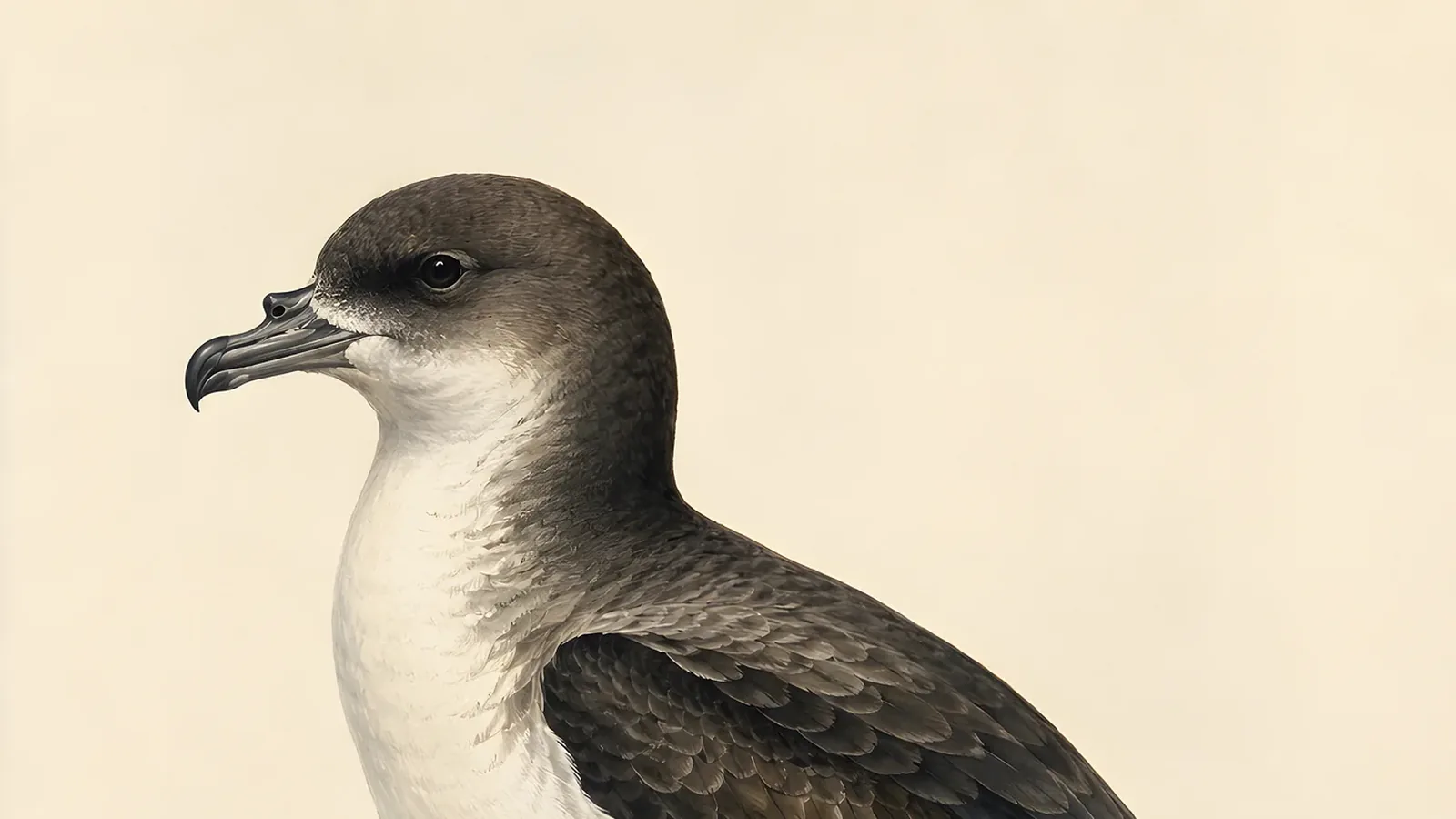
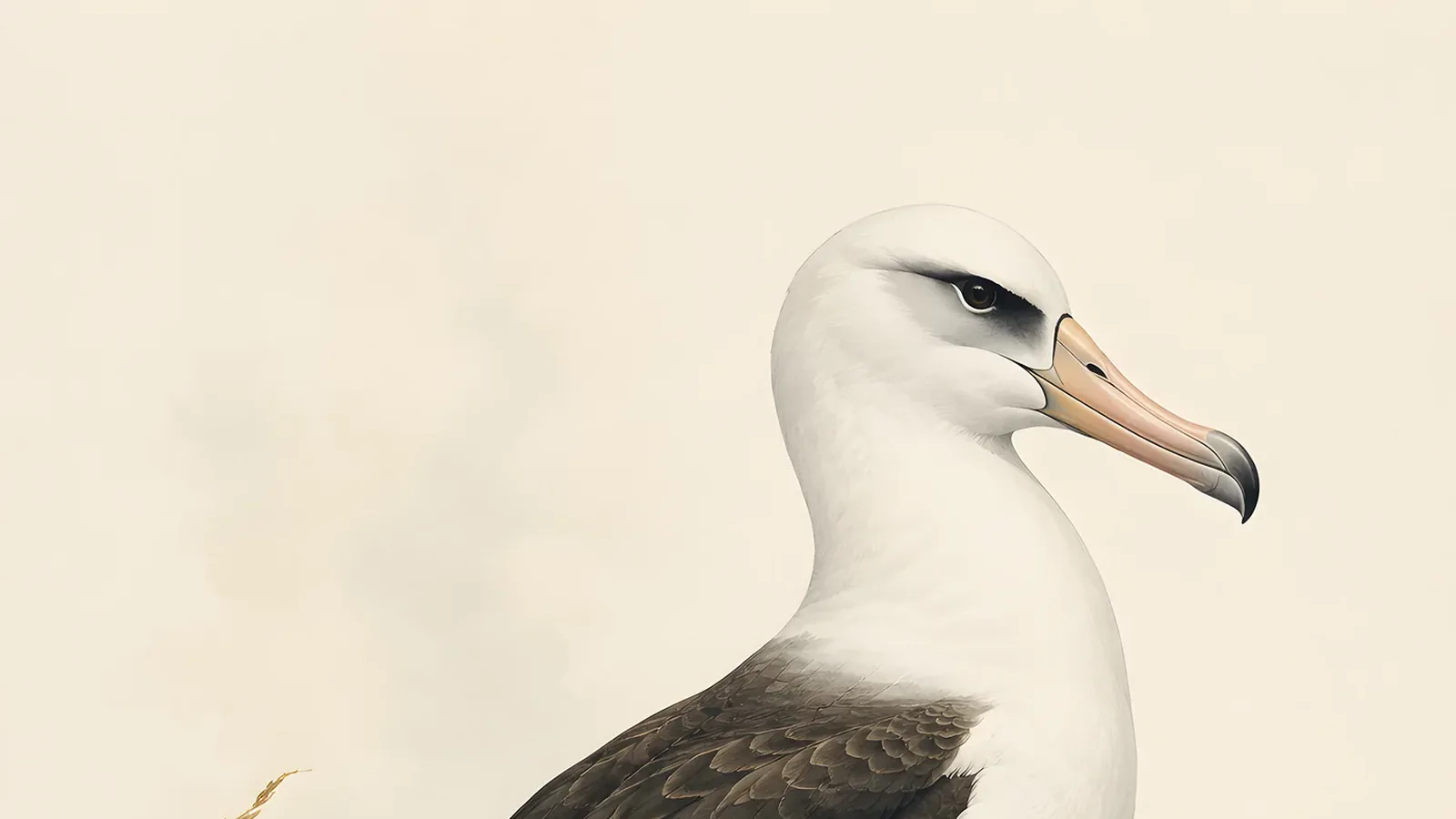
Phoebastria immutabilis runs 79 to 81 centimetres in length and weighs between 2,200 and 4,300 grams. The wingspan reaches 195 to 210 centimetres. The bill is pale pink-grey with a hooked tip and two small nasal tubes running along its upper ridge - structures that let the bird measure exact airspeed in flight.
The plumage is not cryptic. Head and body are white. Back, upperwing, and tail are dark brown to black, a bold contrast visible at distance over a grey sea. The underwing shows white at the centre with dark margins - the pattern pelagic observers use to separate it from the Black-footed Albatross at a glance. Juveniles closely resemble adults. There is no confusing first-year plumage. A bird seen at sea is essentially what it will always look like.
| Measurement | Range |
|---|---|
| Length | 79-81 cm |
| Wingspan | 195-210 cm |
| Weight | 2,200-4,300 g |
| Typical wild lifespan | 40+ years |
| IUCN status | Near Threatened (NT) |
| Primary breeding site | Midway Atoll, Northwestern Hawaiian Islands |
A life on the wind
The Laysan Albatross forages across the North Pacific, concentrating in the mid-to-northern transition zone where cold sub-Arctic water meets warmer currents and squid rise toward the surface at night. The diet is primarily squid, supplemented by fish eggs and crustaceans - prey the bird locates by scent as much as sight, cutting across wind to investigate odour trails then following them upwind to the source.
Foraging trips during chick-rearing can last 17 days and cover 4,000 kilometres in a straight line before the adult returns with a stomach of half-digested squid to regurgitate for its chick. Dynamic soaring extracts momentum from the wind shear gradient - rising into the headwind gains height, banking downwind converts that height to speed, and the cycle repeats every seven to twelve seconds so long as wind persists. In a calm, the bird sits on the water and waits.
The Laysan Albatross breeds almost entirely in Hawaii, with roughly 70 per cent of the global population nesting at Midway Atoll in the Northwestern Hawaiian Islands. The IUCN lists the global breeding population at approximately 1.18 million mature individuals, and classifies the species as Near Threatened - a step back from Vulnerable since 2010, reflecting a recovering trend at protected sites, but not stability everywhere. Sea-level rise is the long-term structural threat to all low-atoll nesting colonies, including Midway.
The dance and the lifelong pair
Laysan Albatrosses do not breed until they are seven to nine years old. The years before first breeding are not idle. Young birds that have never held a territory return to the colonies where they hatched and practice. The courtship display - the “dance” that popular accounts reduce to a single gesture - is a vocabulary of up to 25 discrete movements, each named in the research literature: the Eh-Eh Bow-Stare, the Whinny-Head Flick, the Rapid Bill Clapper, the Sky Call, the Sky Moo. The calls include descending whinnies, long moaning sounds, and rapid bill clapping. Two birds build this into a fluent shared performance over years of practice.
The pair that forms is, in principle, permanent. Laysan Albatrosses mate for life, returning to the same nest site and the same partner each November. Their fidelity is not sentiment - it is investment. A pair that has raised chicks together is more efficient than a pair still learning coordination. Pairs that lose a partner do re-partner, slowly. The dance that was fluent with one bird has to be re-learned with another.
Wisdom, the oldest bird
On December 10, 1956, USGS ornithologist Chandler Robbins banded an adult Laysan Albatross on her nest at Midway and assigned her the code Z333. She was already breeding - at minimum five years old. When Robbins returned to Midway in 2002, he found her again. The band had been replaced over the decades, but the records traced to the 1956 original. The bird on the nest was at least 51 - already the oldest known wild bird on Earth.
She was given the name Wisdom, and she has continued to return.
As of November 2025, Wisdom - now at least 75 years old - arrived at Midway for another nesting season. Her mate (banded EX25) followed on November 26. The U.S. Fish and Wildlife Service confirmed her return via the Friends of Midway Atoll program. She has laid an estimated 50 to 60 eggs and fledged as many as 30 chicks. One of her sons, banded N333, now nests on Midway himself - meaning Wisdom has lived long enough to watch her own offspring become a breeding adult.
“At an approximate age of 75, Wisdom the albatross returned this fall to Kuaihelani, making her the oldest known wild bird in the world.” - U.S. Fish and Wildlife Service, November 2025.
She is the visible extreme of what a Laysan Albatross is capable of - a lifespan measured in decades, built on the engineering economy of a body that crosses oceans on almost no fuel. A seabird’s life does not diminish with age the way a mammal’s does. She is still breeding at 75.
The plastic
The Hawaiian petrel and the Laysan Albatross share the open North Pacific. They share, by proximity, the same accumulation of human debris.
Albatrosses feed at the ocean surface at night. Floating plastic - bottle caps, fishing gear fragments, disposable lighters - registers in the same way as squid in low-light conditions. The adult swallows it or carries it back to the nest and regurgitates it directly into the chick’s open bill.
Young, Vanderlip, Duffy, Afanasyev, and Shaffer (2009, PLoS ONE) compared bolus contents from chicks at Kure Atoll and Oahu - colonies 2,150 kilometres apart. Kure chicks were fed almost ten times the volume of plastic as Oahu chicks, a difference the researchers attributed to Kure adults foraging closer to the Western Garbage Patch. The plastic load varied by where the parents happened to be foraging, not by any choice the chick could make. The chick sat in the nest and received what the ocean had given its parent.
Papahānaumokuākea Marine National Monument estimates five tons of plastic are delivered to albatross chicks at Midway each year. Plastic does not digest. It occupies stomach volume, signals satiation, and starves the chick from the inside. Photographers working the colony floor have documented the boluses of deceased chicks: hundreds of fragments per individual, laid out against the sand - a precise inventory of what was floating at the coordinates the parent happened to visit.
Breeding
Pairs arrive at Midway and other Northwestern Hawaiian colonies in November. After the reunion dance - a re-synchronising of a vocabulary unused for months - the female lays a single egg in December or January. Incubation runs 64 to 65 days, shared in shifts that can last weeks, the sitting bird fasting the entire time. The chick fledges at approximately 165 days, in July, and heads out to sea. It will not touch land for several years - possibly five - before returning to the colony to begin practicing the dance and wait its turn.
The colony at Midway holds hundreds of thousands of breeding pairs. From within, the birds are constant: sleeping, preening, feeding chicks, dancing with prospective partners, filling the air with whinnies and the clatter of bills. It is one of the great seabird spectacles of the North Pacific, and it belongs almost entirely to one chain of low-lying coral atolls a metre or two above current sea level.
That concentration is the species’ strength and its exposure. Wisdom has been returning to the same few square metres of Midway for at least 70 years. The question the next 70 years will answer is whether those square metres will still be there.