Field Guide
Hawaiian Petrel
It is two in the morning on the summit of Haleakala. The volcano is at nearly 3,000 metres and the air is cold enough to ache. Then, from somewhere below the cinder fields, a sound rises out of the dark. A low, mournful baying, part cry and part moan, curling up through the scrub. The Hawaiians named this bird ‘Ua’u for that cry. Once you have heard it on a dark Hawaiian slope you understand the name absolutely.
Pterodroma sandwichensis, the Hawaiian Petrel, is one of the rarest seabirds on earth. It breeds on five Hawaiian islands, forages across thousands of kilometres of open Pacific, and manages - despite all of that movement and range - to be going quietly extinct between the moment a fledgling leaves its burrow and the moment it reaches the sea.
What it looks like
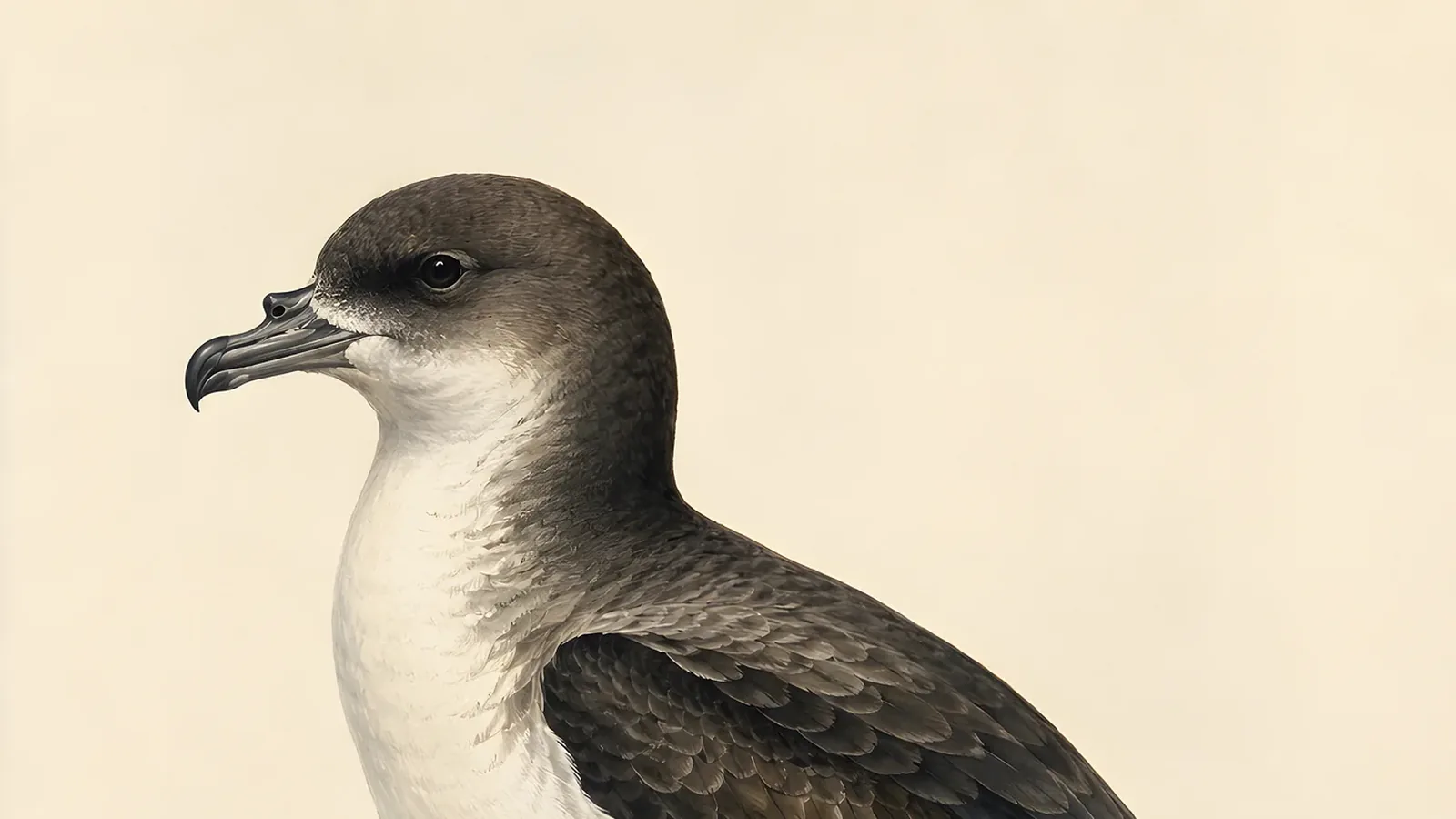
A large gadfly petrel, built for open ocean. Body length 40 to 46 cm. Weight approximately 434 to 448 g, according to data compiled in the Longevity Records of North American Birds (USGS Patuxent Wildlife Research Center). Wingspan 95 to 99 cm - long, narrow, and angled sharply back at the wrist in the way of birds that cover enormous distances on minimum fuel.
From above, the plumage is uniformly dark: grayish-black across the mantle, back, and upperwings. The head carries a dark cap that extends well down over the face, giving the bird a hooded look. In strong light, a pale grey tone shows at the base of the bill.
From below, the picture reverses. The throat, forehead, and most of the underparts are white. The underwings are mostly white too, but framed with a broad black margin along the leading and trailing edges, and marked with a diagonal dark bar across the inner wing. The tail is dark. The bill is stout, grey-black, and hooked at the tip. The feet are pink at the base with black outer toes, and they trail behind the body in flight in the characteristic posture of the Procellariidae.
In the air over open water, Pterodroma sandwichensis moves in long, arcing sweeps. It scales wind shear and drops in banking curves rather than beating steadily. When the sea is rough, it climbs high and tilts and drops, using the energy in the wave-gradient to stay airborne for hours without effort.
The volcano burrows
The Hawaiian Petrel nests in two distinct habitat types, and both are high and remote. On Maui, the colonies sit on the upper slopes of Haleakala, the great shield volcano, above 2,500 metres in an almost alpine landscape of cinder cones and sparse scrub. On Hawaii Island, birds breed on the high flanks of Mauna Loa at equivalent elevations, excavating burrows in lava crevices where soil is thin or absent. On Kauai, Lanai, and western Maui, the species uses lower elevations - dense native ohia forest with an understory of uluhe fern - and there it digs proper burrows in the soil.
The bird is a creature of darkness at the colony. Adults depart before dawn and return only at night, calling as they approach. The nocturnal habit evolved as a defence against Hawaiian hawks (Buteo solitarius), which once represented the principal aerial threat. It did not evolve as a defence against rats, mongooses, or feral cats, which arrived with humans and can hunt perfectly well in the dark.
Fossil bones preserved in Hawaiian lava tubes tell what this restriction to high elevation actually cost. Storrs Olson and Helen James, in their landmark 1982 study published in Science, documented that before human settlement - Polynesian and later European - the Hawaiian Petrel and other procellariids nested at low elevations across all the main islands. The high-mountain refuges where colonies persist today are not the original habitat. They are what is left after centuries of predation and harvest pushed the species to terrain where introduced mammals cannot easily follow.
| Measurement | Value |
|---|---|
| Body length | 40-46 cm |
| Weight | 434-448 g |
| Wingspan | 95-99 cm |
| Max recorded lifespan | 13.1 years (wild) |
| Breeding age | 5-6 years |
| Incubation period | ~56 days (shared) |
| Chick fledging | 100-115 days after hatching |
| Clutch | One egg |
A life on the open Pacific
For nine months of the year, Pterodroma sandwichensis lives entirely at sea. During the breeding season, adults provision their chick with a regime of extraordinary effort: a single foraging trip can cover more than 9,600 km, according to tracking data reported by the Kauai Endangered Seabird Recovery Project, as the adult sweeps north and west into the central Pacific before returning to the burrow. The primary prey is squid - squid makes up roughly half to three quarters of the diet by volume - alongside goatfish, lantern fish, and crustaceans. The birds do not dive. They seize prey at the surface or snatch it while flying low over the water in a technique called contact-dipping. Much of this foraging happens at night, when many squid species rise from depth.
Hawaiian Petrels hunt in mixed-species groups over schools of predatory fish. Tuna and mahimahi drive smaller animals upward, and the petrels work the surface above. The result is that the bird’s foraging fortunes are tied to the health of tuna stocks across the North Pacific - a dependency that adds another layer of long-term fragility to an already thin population.
The USFWS estimates the global population at between 7,500 and 20,000 mature individuals, with a declining trend.
The voice in the dark
“‘Ua’u” - the Hawaiian name is itself a phonetic rendering of the bird’s call, a low, resonant, repeated cry given as the adult navigates back to the colony in darkness. (Hawaii Division of Forestry and Wildlife)
The call is what makes the first encounter with a petrel colony so strange. You are standing on a cold volcanic slope at midnight, looking at nothing, and then the sound comes from below you, or from an invisible bird passing overhead, and it is not remotely what you expect a seabird to sound like. It is not a gull call. It is lower, slower, softer - something between a howl and a moan, repeated every few seconds. Hawaiian oral tradition held this bird as a navigator and an omen. The name records what their ancestors heard on those same slopes a thousand years ago.
The threats
The Hawaiian Petrel is federally listed as Endangered under the US Endangered Species Act, a status it has held since 1967. The IUCN Red List assessment places it as Vulnerable, reflecting a global population that is declining but not yet at the steepest level of risk.
Introduced predators are the primary cause of nest failure. Feral cats take incubating adults and chicks in the burrow. Small Indian mongooses prey on eggs and chicks at lower-elevation colonies - mongooses cannot access the highest Haleakala sites, which is partly why those colonies persist. Rats take eggs and small chicks. Feral pigs disrupt nest burrows and open gaps in the vegetation that provide predators with access to previously sheltered areas.
What happens after fledging is a different category of catastrophe. Fledglings make their first flight to sea entirely at night, using moonlight and starlight for orientation. Artificial lighting disrupts this mechanism. On Kauai, luxury resort lighting on coastal bluffs attracts fledglings in what biologists call fallout events - the young birds circle the lights until they fall to the ground exhausted, or strike structures and power lines. American Bird Conservancy has documented approximately 10,000 bird strikes per year on power lines on Kauai alone, with over 1,000 of those lethal. The lines were repositioned above treetop height after Hurricane Iniki in 1992, in a location where seabirds cannot see them in the dark.
Raine, Holmes, Travers, Cooper, and Day, writing in The Condor: Ornithological Applications in 2017, documented a 78% decline in Hawaiian Petrel numbers on Kauai between 1993 and 2013 - an average annual reduction of approximately six per cent per year, recorded across 13 radar monitoring sites. At 62% of those sites, the decline was statistically significant across the full study period. Kauai holds a third of the global breeding population. A 78% loss there is not a local problem.
Breeding
The breeding season begins in late February, when adults return to Maui colonies from the open Pacific. On other islands, arrival runs roughly a month later. The pair reunites at the same burrow it occupied the previous year - site fidelity is strong, and the pair bond is long-term, though research by Simons and Bailey (Birds of the World, 2020) notes that the bond should properly be understood as fidelity to the burrow, with the same partners typically meeting at it.
After arrival, adults undergo a pre-laying exodus - a second departure to sea - before returning to lay. A single white egg is deposited in June. Both adults share incubation, each taking extended shifts of several days while the partner forages at sea. Incubation lasts approximately 56 days. The chick hatches in early August, covered in dark down, and is provisioned by both parents through September and October. Fledging occurs from October to December, with the young bird leaving the burrow alone on its first night, flying directly out over a dark island toward an ocean it has never seen.
Most birds do not attempt breeding until age five or six, which is characteristic of the procellariids as a group. The consequence is that every adult that dies before breeding age, or fails to return from a foraging trip, represents years of lost reproductive potential. The maximum recorded longevity in the wild, from banding data compiled in the Longevity Records of North American Birds, is 13.1 years. That is not old for a procellariid - the Atlantic puffin can exceed 40 years - and it suggests that current mortality rates may be cutting the Hawaiian Petrel’s life short before it achieves its biological potential.
The question that sits underneath all of the conservation work - the predator control at Haleakala, the light-shield ordinances, the power line modifications - is whether the species can recover fast enough. A bird that does not breed until it is six, that raises one chick per season, that fledges its young into a landscape of lights and wires and cats, has almost no buffer. The ancient bones in the lava tubes describe a species that once filled these islands from coast to summit. What remains is a fragment, still calling from the dark.