Field Guide
Mourning Dove
At dawn on any morning in any US state except Hawaii, before the cardinals have found the feeder and before the robins have made their first run across the lawn, a sound rises that most people hear without registering. A low, hollow cooing. Four notes, give or take, descending and then lifting slightly at the end. You might mistake it for an owl if you heard it from a bedroom window. You would not be the first.
That sound is Zenaida macroura, the Mourning Dove - and the thesis of this field guide is a simple one: this is the most underestimated bird in North America. It is everywhere. It is on every continent-level survey, every breeding bird atlas, every backyard checklist. It is also almost completely unexamined by the average birder, who files it away under “common brown bird” and moves on. This is a mistake. The Mourning Dove is doing something physiologically singular at its nest every day, it is the most hunted bird on the continent, and it has successfully colonised every habitat type in the United States without adapting to any of them. That is worth a closer look.
What she looks like
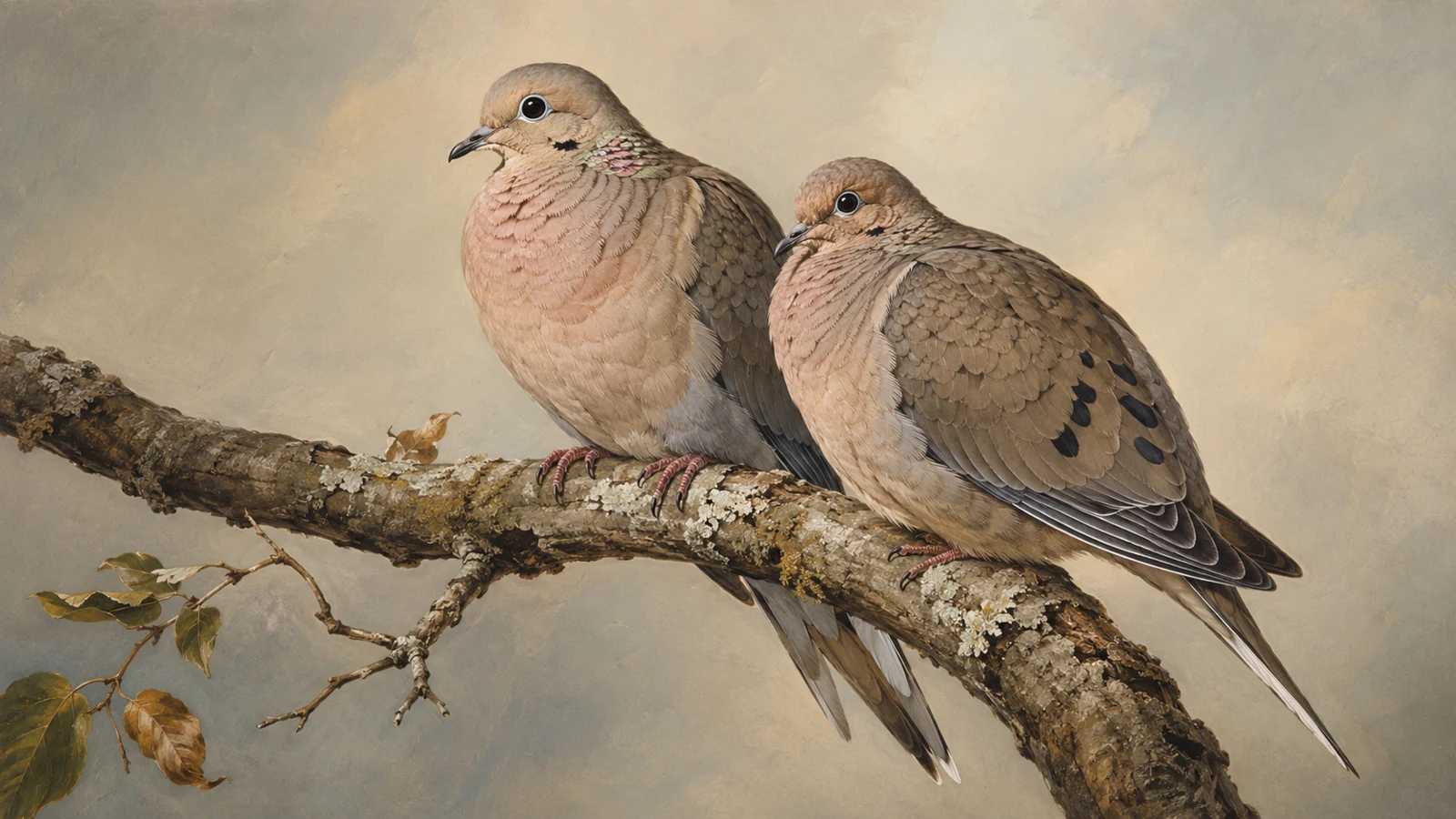
The Mourning Dove measures 23 to 34 centimetres from bill to tail tip and weighs 85 to 170 grams. The wingspan runs 37 to 45 centimetres. She is slim, long-tailed, and built for ground-level foraging, with a small rounded head that bobs as she walks.
The colour scheme is warm grayish-brown on the back and wings, shifting to a softer pinkish-buff on the chest. The male is slightly brighter, with a blue-gray crown and a visible rosy wash on the breast. On his neck, just below the ear, sits a small patch that in good light shifts between iridescent green and purple. It is brief and easy to miss, but it is there. Both sexes carry a neat row of black spots across the wing coverts, and a single black spot below and behind the eye. The tail is long, pointed, and bordered in white - visible in flight as a flash when the bird banks and turns.
She looks, at first glance, like a field-brown bird of no particular interest. She is not blue, not crested, not conspicuously patterned. She takes some looking at.
The species she is most commonly confused with: the Rock Pigeon, which is twice her bulk and short-tailed; the White-winged Dove, which has bold white wing patches visible at rest; and the Common Ground-Dove, which is smaller and shorter-tailed, with a scaly-looking chest pattern rather than clean buff. In most of the continental US, a slim brown dove with a pointed white-tipped tail is this bird.
What she sounds like
The call that gives the species its name is a four-syllable coo - often written as ooo-woo-woo-woo - produced primarily by the male and used for both territory and mate attraction. The Audubon Field Guide describes it accurately: the sound is “mournful.” It carries. In still air it travels several hundred metres, and because this bird is one of the most abundant landbirds on the continent, the call is omnipresent in suburb and farmland from March through September. That mournful note is also what loaded the bird with centuries of symbolism around grief and peace.
There is a second sound, less noticed but equally distinctive. The wing feathers are modified to produce a clear whistling whistle on takeoff - a dry, papery trill that begins the instant the bird launches from the ground. It functions as an alarm, alerting nearby birds that something has flushed the individual. Once you know it, you will hear it every time a dove lifts off a driveway or path ahead of you.
Range and habitat
The Mourning Dove breeds across virtually all of the lower 48 states, into southern Canada, south through Mexico and Central America, and into the Caribbean. Cornell’s Birds of the World describes it as “among the most abundant and widespread terrestrial birds endemic to North and Middle America.” Northern populations move south in autumn; southern populations are essentially resident year-round.
It is a habitat generalist in the broadest sense. It avoids only dense forest and wetlands. Open ground with nearby perching sites is sufficient: agricultural fields, roadsides, suburban lawns, grassland, desert scrub, chaparral, open woodland edge. The species has expanded its range northward in the 20th century as deforestation opened formerly forested land, and as suburban development created exactly the mix of short grass, ornamental shrubs, and scattered trees it prefers.
Diet
The diet is seeds. Seeds almost exclusively - 99 per cent by volume, according to the Audubon Field Guide. The bird forages entirely on the ground, picking up fallen seeds with its bill. It does not scratch like a sparrow or a towhee. It walks and pecks, methodically, covering a lot of ground.
The range of seeds taken is wide: agricultural grains, millet, milo, safflower, sunflower, ragweed, pokeweed. The bird swallows grit along with its food - small stones that sit in the muscular gizzard and grind hard seeds into digestible fragments. At a backyard feeder, it will clean up spilled millet from the ground beneath a platform feeder, often in groups of six or more birds working the same patch of bare earth.
It does not do well with caged feeders or tube ports. Ground-level feeding is the rule. A flat tray or open platform, or simply seed scattered on bare ground, is what this bird requires.
Breeding and nesting
The nest is a platform of loose twigs - famously flimsy. Audubon’s Field Guide calls it “a very flimsy platform of twigs,” and field observation confirms that the two white eggs are sometimes visible through the bottom of the structure from below. The nest is placed in a shrub or tree, usually below 12 metres, and construction by both adults takes less than a day.
Both parents incubate the two white eggs for 14 days. Both feed the nestlings. This is where the Mourning Dove diverges sharply from most other birds, and from seed-eaters in particular: the chicks are fed ‘crop milk,’ a protein- and fat-rich secretion produced in the crop lining of both parents. The young bird inserts its bill into the parent’s throat to drink it. No seed is offered until the chicks are several days old.
Crop milk allows the Mourning Dove to breed in places and at times when insects - the nestling food of most small birds - are scarce or absent. It decouples breeding success from insect abundance. The practical result is a breeding season of exceptional length: in the southern states, a pair can raise five or six broods annually, with nesting attempts beginning as early as February and continuing into October.
Cornell’s Birds of the World notes that individual nesting attempts occur roughly every 30 days across this extended season, with each cycle producing two fledglings that are independent within two weeks of hatching. The mathematics of this are not subtle. A pair raising five broods in a year produces up to 10 young. The species’ natural mortality is high - average adult lifespan in the wild runs one to five years - but the reproductive rate more than compensates.
The behaviour worth knowing
Every autumn, something quiet and specific happens: the bird drinks differently from almost any other land bird.
Most birds sip water and then tilt the head back, letting gravity move the liquid to the throat. The Mourning Dove - like all pigeons and doves in the family Columbidae - does not do this. It inserts its bill and sucks continuously, drinking without lifting its head, the way a horse drinks from a trough. This means it can take on water quickly, which matters for a bird that spends most of its time on exposed open ground in heat. It is a small anatomical distinction with a visible field character: watch a dove at a birdbath and you will see the head stay down through the entire drink.
The other behaviour worth noting is the sheer scale of what this species endures. Cornell’s Birds of the World records that over 20 million Mourning Doves are harvested in the United States annually, making it the most hunted gamebird in North America by a considerable margin. Despite this pressure, the species remains abundant and classified as Least Concern by the IUCN. The combination of high reproductive rate, broad habitat tolerance, and flexibility of diet has made it essentially bulletproof at the population level - a bird designed, in effect, to absorb loss.
A thought to carry
The Mourning Dove was recorded by Alexander Wilson in the early 19th century as one of the most numerous birds in eastern North America. It is still among the most numerous birds in eastern North America. The landscape around it has changed past recognition. The bird has not needed to change at all.
That is not mediocrity. That is precision of a different kind - a fit so exact to the conditions of an entire continent that the conditions can transform and the bird remains. The call you hear before the cardinals wake up is not a background sound. It is a 30-million-year lineage of pigeon biology delivering a daily status report: still here, still working, still holding the territory at first light.