Field Guide
Tufted Puffin
In late April on the Farallon Islands, a Tufted Puffin stands on a basalt ledge twenty meters above the Pacific and looks like it was designed for a different world.
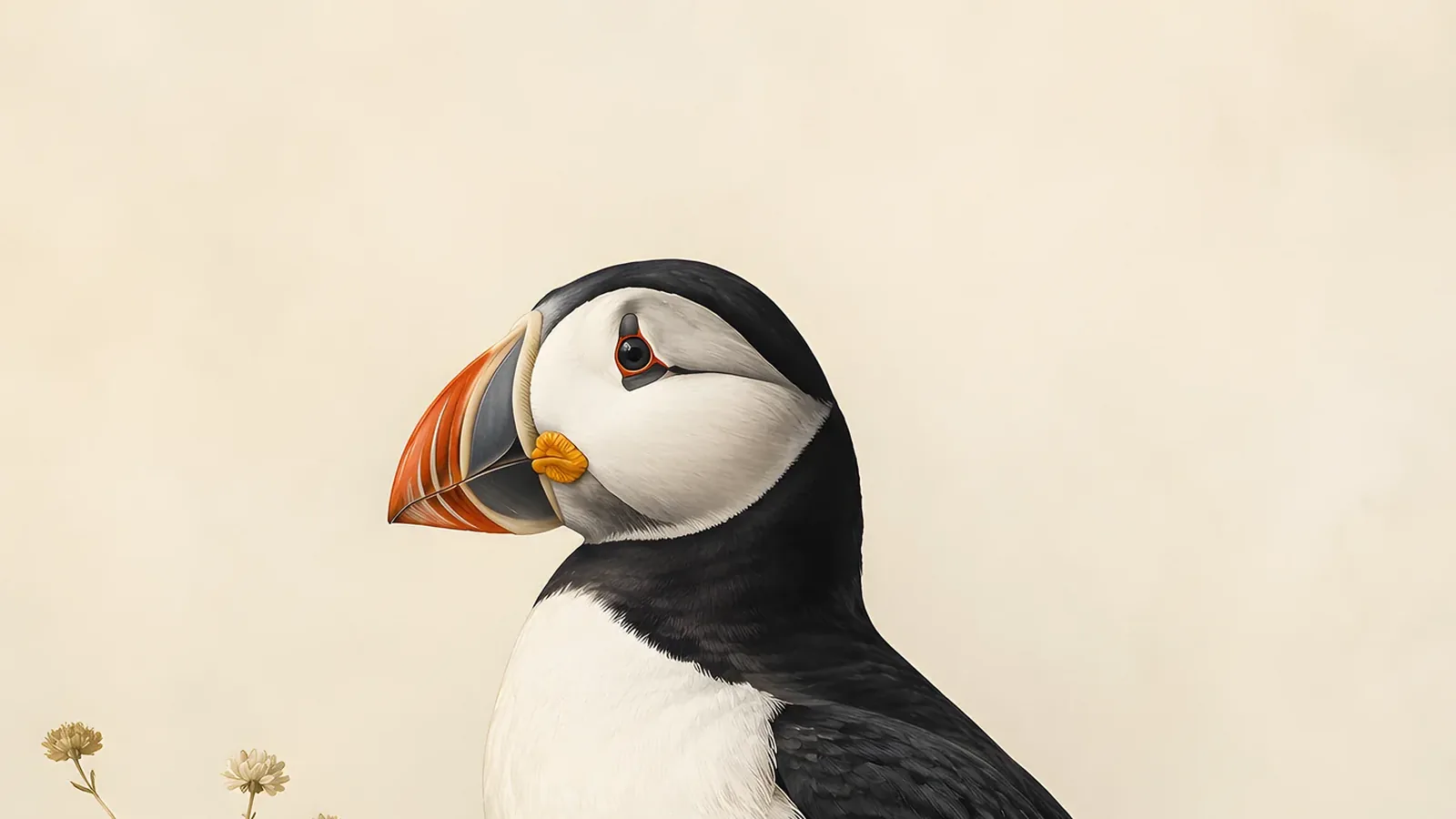
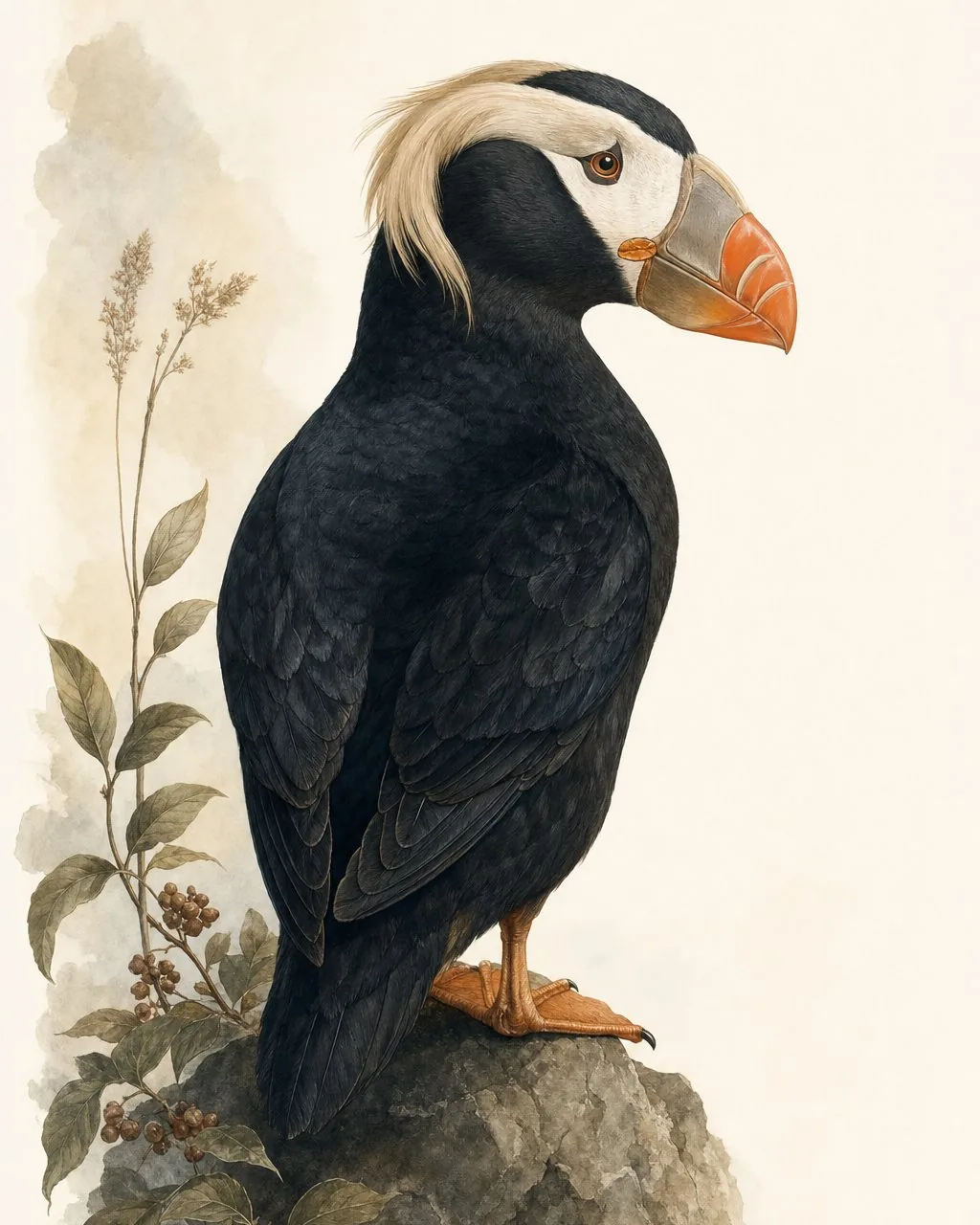
The body is entirely black - a dense, solid black that absorbs light rather than reflecting it. Against the black, the face is startling: a broad white cheek patch, an enormous bill flaring orange-red at the tip and yellow at the base, and above the eye, cascading back past the nape, a pair of golden-yellow plumes that sweep like a long brushstroke applied by someone who couldn’t decide whether they were making a bird or a painting. The tufts are the thing. In a decent wind they stream behind the head. In still air they drape. Either way, they mark this bird as belonging to a particular and uncompromising aesthetic.
It stands there long enough for you to form an impression. Then it throws itself off the ledge into the Pacific fog, and it is gone for another ten months.
What It Looks Like
The Tufted Puffin is the largest of the three North American puffins and the darkest. Where the Atlantic Puffin has a pale gray or white face and a pale belly, the Tufted is black from wingtip to wingtip, broken only by the white facial patch and the orange bill. The underparts in flight show no pale contrast - the bird is black below as well. It reads as heavier and more solid than the Atlantic.
In breeding plumage the bill is impressive: large, deep, and laterally compressed, with a red-orange outer sheath and a yellow base that gives the whole structure a banded look. The bill sheath is partly shed after the breeding season, leaving a smaller, duller bill through winter.
Non-breeding adults lose the tufts entirely. The white face patch fades to gray. The bill reduces in both size and color. The transformation is enough that a winter-plumage Tufted Puffin at sea, seen briefly in poor light, can be mistaken for other alcids. The breeding bird, by contrast, is unmistakable.
Females are similar to males in plumage but average slightly smaller. Juveniles lack the tufts, have a dark face without the white patch, and carry a smaller, duller bill in their first year.
At sea, the Tufted sits low and heavy on the water, diving frequently. In flight, the wingbeats are rapid and whirring - puffins do not glide, they beat - and the large bill and head give the bird a front-heavy silhouette.
| Measurement | Range |
|---|---|
| Length | 35 - 41 cm |
| Weight | 550 - 900 g |
| Wingspan | 63 - 66 cm |
| Lifespan | 15 - 30 years |
Voice
At sea, the Tufted Puffin is silent. Weeks on the open Pacific pass without the bird making a sound that a human at the surface would hear. At the breeding colony the picture changes. Both sexes give a low, moaning growl - a deep, rhythmic sound something between a grunt and a purr, repeated from burrow entrances and cliff ledges. The calls carry through the noise of a crowded colony but never cut above it. There is no song in any conventional sense. The calls function as contact and threat signals at close range, not as long-distance advertisements.
The silence at sea is part of the larger pattern: this is a bird that lives much of its life beyond observation. No calls, no colony, no land. Just open water and depth.
Range and Habitat
The Tufted Puffin is a North Pacific species, distributed around the ocean’s rim from California north to Alaska and west across the Aleutian chain to Russia and Japan. The breeding range spans an enormous arc: the Farallon Islands off San Francisco at the southern end, through the Pacific Northwest and British Columbia, to the massive colonies on Kodiak Island, the Alaska Peninsula, and the Aleutians, then west to Kamchatka and the Kuril Islands.
Alaska holds the core of the North American population. The Aleutian Islands and the Alaska Peninsula support hundreds of thousands of breeding birds. By comparison, the colonies at the Farallons and along the lower Pacific Coast are small and represent the edge of the range.
Breeding habitat is specific: steep coastal headlands and sea cliffs with enough accumulated soil to dig a burrow, or rocky slopes with crevices large enough to shelter a nest. The birds are not found inland under any circumstance. They return to the same colony sites, and often to the same burrow, year after year.
Outside the breeding season they are pelagic - ocean birds, rarely approaching land. Wintering Tufted Puffins are thought to disperse widely across the North Pacific, but winter distribution is poorly documented. The open ocean in winter is vast and the birds are small and dark. Systematic observation is almost impossible.
Diet and Diving
The primary food is fish: sand lance above all, followed by herring, capelin, and smelt. Squid and crustaceans contribute to the diet in some areas and seasons.
The Tufted Puffin catches its food by pursuit diving. It enters the water from the surface - or in a plunge from flight - and then uses its wings to propel itself, swimming underwater in a motion that looks exactly like underwater flight. The wings half-fold, the body drives forward, and the bird reaches depths of 60 meters or more in pursuit of prey. Dives of 30 to 40 meters are routine.
The bill adaptation for carrying multiple fish is practical and efficient. The rough palate and the tongue create a grip that holds fish crosswise without losing them when the bill opens for another catch. A bird returning to feed a chick may carry eight or ten small fish in one load, each held neatly by the last. The image of a puffin arriving at a burrow with a row of fish hanging from its bill is partly charming and partly a reminder that the bird’s bill is a working tool, not an ornament.
Chick feeding in the burrow is a significant energetic investment. Both parents make repeated foraging trips over the course of the roughly 45-day nestling period, each time flying out to sea, finding prey, loading the bill, and returning. The round trip from a colony to productive fishing grounds and back may cover 40 or 50 kilometers in a single foraging bout.
Breeding
Tufted Puffins arrive at breeding colonies from late March to May, depending on latitude. The return to land after months at sea is not gradual. One day they are not there; the next, they are.
Pairs that have bred together before tend to reunite at the same burrow. First-time breeders prospect for available sites on the colony periphery. The burrow itself may be up to two meters long, dug into the accumulated organic soil of a cliff slope. Where soil is thin or absent, the birds use rock crevices. Both partners dig and maintain the burrow, though the male typically does more of the excavating.
A single egg is laid in the burrow’s chamber. Both parents incubate in shifts. Incubation runs approximately 45 days. The chick, once hatched, is brooded for the first week or two and then left alone in the burrow between feedings as both parents shift to full-time foraging. The chick fledges after roughly 45 days in the burrow, leaving at night - when gull predation is reduced - and making directly for the water.
After fledging the chick receives no further care. It reaches the ocean and begins its independent life, spending its first one to three years entirely at sea before returning to land to breed.
Conservation
The Tufted Puffin is listed as Least Concern globally, and the total population remains in the hundreds of thousands. But regional trends are cause for attention.
The Farallon Islands colony has declined significantly over the past several decades. From an estimated 5,000 to 6,000 birds in the early twentieth century, the breeding population had dropped to a few hundred pairs by the early 2000s. The causes are not fully resolved. Gill-net bycatch, introduced predators at some colonies, and shifts in prey availability have all been implicated. Warmer ocean conditions in the California Current system affect the distribution and abundance of sand lance and other forage fish, with consequences that ripple up to the puffins that depend on them.
In the Bering Sea, where the largest North American colonies are concentrated, ocean warming and the associated shifts in prey fish assemblages present a long-term concern. The relationship between sea surface temperature, prey availability, and puffin breeding success is well enough established to make monitoring those colonies a conservation priority.
The difficulty with any conservation assessment of this species is the wintering problem. The birds spend roughly eight months of the year on the open North Pacific, well beyond systematic monitoring. Population estimates based on breeding colony counts may not capture mortality or population shifts occurring at sea. Compared to the Atlantic Puffin, which winters in more accessible Atlantic waters and has been studied intensively, the Tufted Puffin’s non-breeding life remains largely opaque.
“The Tufted Puffin is a bird of two worlds - the cliff colony in summer where it can be closely watched, and the open North Pacific in winter where it is effectively invisible. What we know about this species is built almost entirely on four months of observations.” - William Leon Dawson, The Birds of California, 1923
The Other Puffin
Every birder who reaches the Pacific coast eventually wants to see a Tufted Puffin. The Atlantic Puffin is the famous one - the one on the posters, the lighthouse gift-shop postcards, the children’s books. It is a good bird. But the Atlantic Puffin is a bird of places that are visited: Maine, Newfoundland, Iceland, the Outer Hebrides. You can take a boat tour to see it. There are organized pelagic trips, guided whale-watching vessels that double as puffin-watching platforms.
The Tufted Puffin belongs to a wilder ocean. To see it well in breeding plumage, you go to the Farallons on a permitted research vessel, or you travel to Alaska. The birds are not rare. But the access is not easy, and the ocean around them is not gentle. Part of the appeal is exactly that. A bird that wears golden tufts and then disappears into the North Pacific for eight months is not asking for your attention. It has other business.
When you do find one standing on a cliff ledge in May, the tufts streaming, the orange bill lit against gray sky, the whole black body squared into the wind, you understand why someone took the trouble to describe it in the first place. It looks like a bird that was designed for a place too large and too cold and too far out to sea for most of us to ever properly visit. Which is, more or less, exactly right.