Field Guide
Marbled Godwit
At low tide on a Pacific estuary, a long-billed bird the colour of dried grass wades into the shallows, tilts its head, and drives its bill straight down into the mud to the hilt. The probe lasts a second. The bird lifts its head, swallows, and probes again. Work without ceremony. A length of surf-washed mudflat, a winter afternoon, and a tool evolved to reach what other shorebirds cannot.
This is Limosa fedoa - the Marbled Godwit. To understand it, you need to hold two landscapes in your mind at once: the coastal mudflat where it winters, and the dry grass prairie of the northern Great Plains where it was born.
What it looks like
The Marbled Godwit is a large bird by any shorebird standard. Body length runs 42 to 48 centimetres, weight from roughly 285 grams in small males to 780 grams in large females - a female can weigh nearly three times a small male, a degree of size difference unusual even among shorebirds. The wingspan reaches 74 to 99 centimetres.
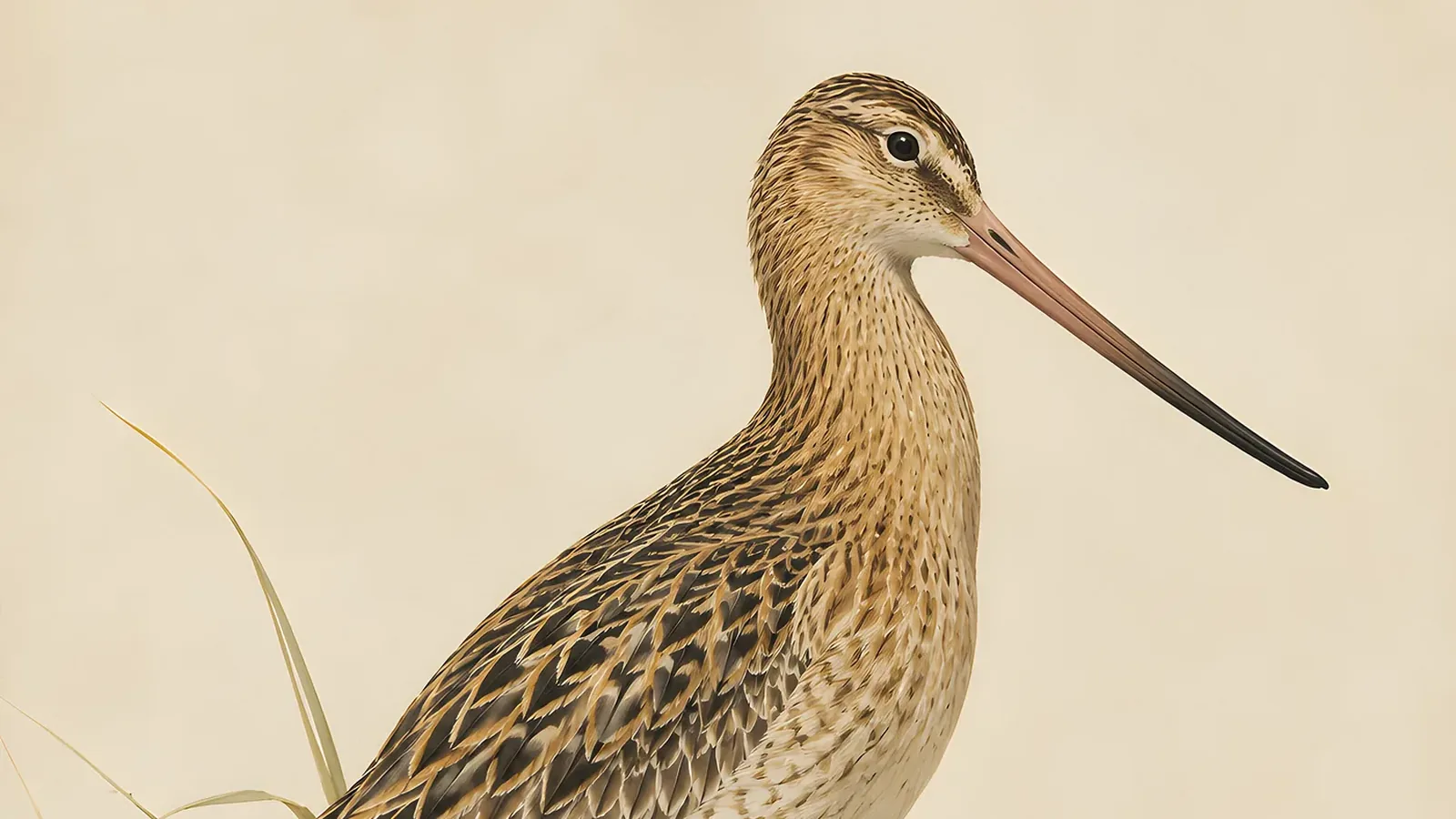
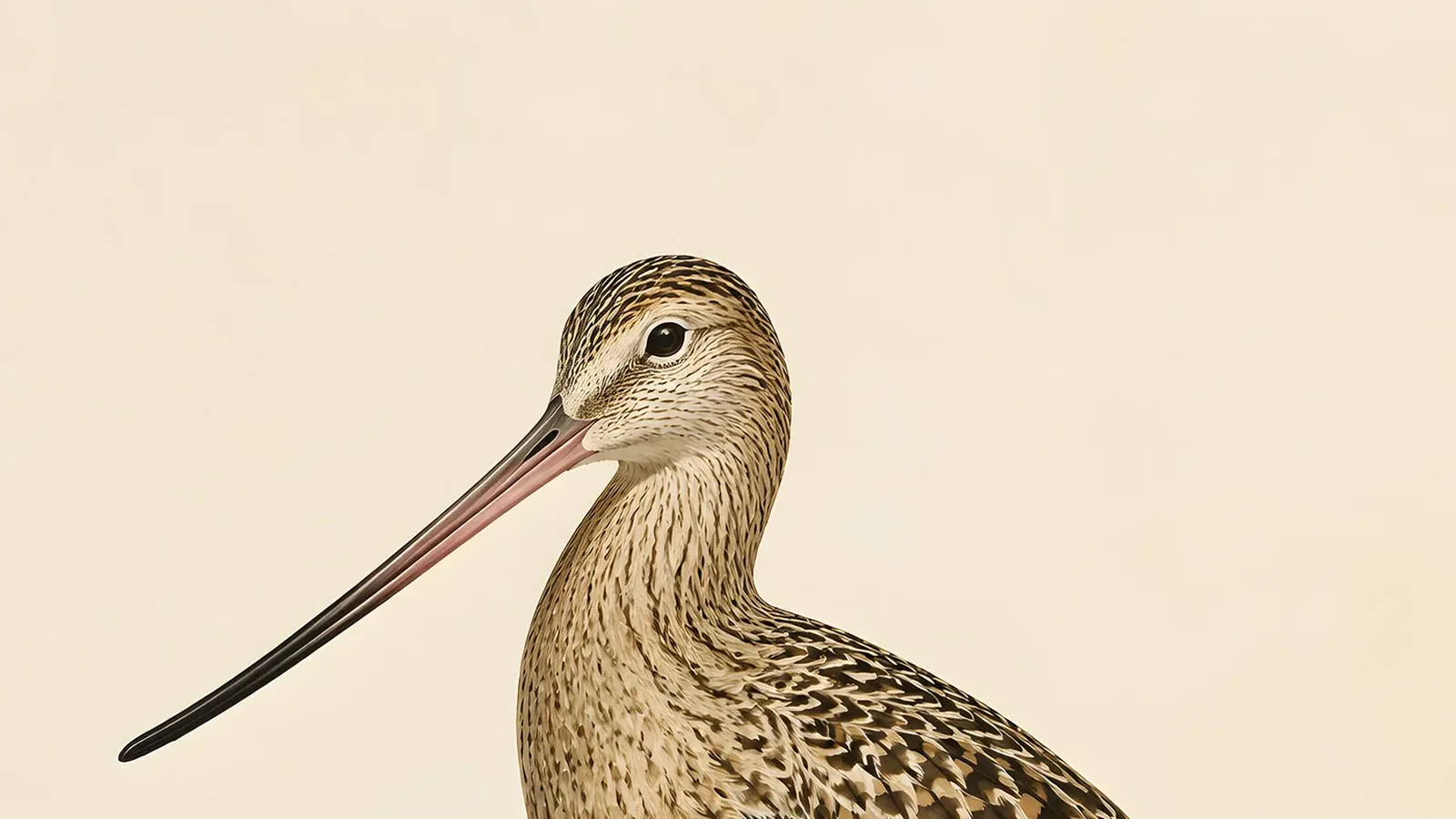
The plumage is the thing. Warm, buffy cinnamon covers the upperparts, the breast, and the belly, with darker brown barring across the back and flanks. There is no bold contrast, no white supercilium, no bright patch to shout with. The Marbled Godwit is tawny and quiet, the colour of winter grass or dried reed. But spread the wings, and cinnamon burns bright from the underwing coverts - the same rich rufous hue runs through every primary and secondary feather. It is a bird that hides its best colour until it moves.
The legs are grey-blue. The bill is the length of a pencil and angles very slightly upward.
| Measurement | Range |
|---|---|
| Body length | 42 - 48 cm |
| Weight | 285 - 780 g |
| Wingspan | 74 - 99 cm |
| Oldest banded record | 13 years, 4 months (Cornell Lab) |
The bill
Study it closely and you understand the whole ecology of the bird.
The bill of the Marbled Godwit is long - proportionally one of the longest of any North American shorebird - and two-toned: pink and fleshy at the base, darkening to near-black at the tip. The slight upward curve is subtle enough that you have to look for it, but the functional anatomy matters. Like the Long-billed Curlew, the godwit probes deep into soft substrates, sometimes submerging its entire head. The bill tip is flexible, armed with mechanoreceptors called Herbst corpuscles that detect prey by touch rather than sight. This is not guesswork. The bird finds a buried clam the way a doctor finds a pulse.
Research by Sandercock and Gratto-Trevor (Ecology and Evolution, 2023), drawn from a seven-year field study at managed Alberta wetlands, documented apparent annual survival rates for Marbled Godwits of 0.953 - among the highest reported for any large-bodied shorebird population. When prey buries deep and the cost of each probe is high, a long-lived body plan makes sense.
A prairie breeder
The godwit’s reputation is coastal, but its life begins on the grass.
The Marbled Godwit is not a seabird that breeds in the interior. It is a grassland bird that winters at the coast - a distinction that flips the usual mental image. The North Dakota Game and Fish records that the state supports roughly 15 percent of the global breeding population, the single highest proportion of any state. South Dakota, Montana, and the Canadian provinces of Saskatchewan, Alberta, and Manitoba hold most of the rest. Both subspecies - the main fedoa population of the Great Plains and the smaller beringiae population of Alaska - breed inland, not on beaches.
On the breeding grounds, the godwit nests on the ground in short, sparse grass. The male scrapes several shallow depressions. The female picks one. Vegetation at the nest is typically less than 15 centimetres tall. North Dakota surveys found 90 percent of nests without top cover - the birds choose open sight lines over concealment, a strategy that rewards alertness over hiding. The clutch is four eggs, olive to greenish-buff with brown spotting. Both parents incubate for 21 to 26 days. Incubation is shared almost equally.
Courtship in May on the northern prairie is conspicuous. Males climb to 90 metres or more and circle their territory in slow, exaggerated wingbeats, calling continuously - a rising, twisting ger-whit that sounds more operatic than careful. On the ground the birds give a nasal, laughing call that Audubon’s field guide transcribes simply as “god-wit,” the call that gave the whole family its English name. Males chase rivals in figure-eight flights. The territory is large: average holdings in North Dakota exceed 80 hectares.
Coast and grassland
The migration between these two worlds is a hard logistical problem.
Most of the global Marbled Godwit population - estimated at 140,000 to 200,000 individuals by Morrison et al. (2001, Waterbirds) - breeds in a relatively compact area of the northern Great Plains. This geographic concentration is both the species’ strength and its vulnerability. It means a single weather event or agricultural shift in a small region can affect a large fraction of the world population in a single season.
By late summer the birds leave the prairies and move to coastal staging areas - Pacific and Atlantic tidal flats, Gulf Coast estuaries - where they gather in flocks that can number in the hundreds. The bar-tailed godwit makes headlines for its nonstop transoceanic flights, but the Marbled Godwit’s migration is quieter, shorter, and oriented along the coasts rather than across open ocean. It is not an aerial athlete so much as a methodical commuter, moving from one food supply to another.
On the wintering grounds the birds favour tidal mudflats, salt marshes, and the sandy margins of estuaries - habitats where tidal exposure brings buried invertebrates within reach. Roost sites are high beaches and sandbars above the tide line. Flocks at roost stand packed together, bills tucked under wing, facing into the wind. When the tide falls, they move.
Diet
“The bill drives the whole migration. Where it goes, the bird follows: summer grasshoppers on the prairie, winter clams in the mud.”
On the breeding grounds the Marbled Godwit is largely insectivorous. Grasshoppers dominate the summer diet, supplemented by aquatic insect larvae, earthworms, leeches, plant tubers, and the seeds of sedge and pondweed. The diet is opportunistic and rich in invertebrate protein, calibrated to the demands of incubating and raising young in a short northern summer.
On the wintering coast the shift is complete. Polychaete worms, small bivalves, crabs, marine shrimp - the diet of an estuary specialist. The godwit probes deep, sometimes standing belly-deep in tidal channels, submerging head and neck to reach prey buried well below the surface. The two-toned, slightly upturned bill reaches places other bills cannot.
Breeding
Marbled Godwits are monogamous. Sandercock and Gratto-Trevor (2023) documented mate reunion rates of 85 percent in Alberta study pairs - the birds return to the same wetland complex and find the same partner, year after year. Median dispersal between reunited pairs was roughly 315 metres. Female godwits changing mates moved substantially farther, averaging over a kilometre. This fidelity to place and partner, combined with high annual survival, means the breeding population at any given site is slow to change. A field in North Dakota that holds godwits one summer will likely hold them the next.
The chicks leave the nest within hours of hatching and feed themselves almost immediately. Both parents guard the brood, but the female often departs the breeding area before the young are fully grown, leaving the male to complete parental duty alone. Fledging takes roughly four weeks. By early August most birds are moving south toward the coast.
The Marbled Godwit is one of the longest-lived shorebirds. The Cornell Lab records a wild individual surviving more than 13 years, and Sandercock and Gratto-Trevor’s survival modelling projects average life expectancy for males at 17 years. For a bird that spends the winter probing for clams in the dark of a mudflat, and the summer incubating in open grass under a prairie sun, 17 years is a long time to get the commute exactly right.
The current IUCN assessment lists the species as Least Concern, but the breeding concentration on the northern Great Plains makes the godwit more exposed than that rating implies. It needs native grassland in summer and intact tidal habitat in winter - two things that have been shrinking for a century. What holds the species now is its longevity. A bird that can survive 17 or 20 years accumulates enough seasons to absorb the occasional bad one. Strip out the habitat, and there are no good seasons left to accumulate.
That is the argument for the mudflat and the prairie both, held at once.