Field Guide
Whooping Crane
On a November morning at Aransas National Wildlife Refuge, a white bird lifts out of the cordgrass and beats low over the Intracoastal Waterway, neck extended, black wingtips pulling at grey air. The wingbeats are slow and deep, unhurried. It circles once and drops back into the saltmarsh shallows, and for a moment the whole enterprise of modern conservation seems to rest in that single, massive, white frame.
Grus americana - the Whooping Crane - is North America’s tallest bird. It is also, by one measure, the continent’s most carefully watched. Every individual in the wild Aransas-Wood Buffalo flock is counted each winter. The annual survey from the U.S. Fish and Wildlife Service has been conducted without interruption since 1938. For most of those years the results were small enough to be heartbreaking. The winter of 1941-42 produced a count of 15 birds.
The argument this page will make is simple: the Whooping Crane is not primarily a bird story. It is a story about what a species can survive when the people who care about it refuse to stop caring.
What it looks like
Grus americana stands 150 centimetres tall - roughly the height of a small adult human - making it the tallest bird in North America. Body length, bill to tail, runs 120 to 152 centimetres. Wingspan reaches 200 to 230 centimetres. Males average 7.3 kilograms, females 6.2 kilograms.
| Measurement | Range |
|---|---|
| Standing height | ~150 cm |
| Body length | 120 - 152 cm |
| Wingspan | 200 - 230 cm |
| Weight (male) | ~7.3 kg |
| Weight (female) | ~6.2 kg |
| Wild lifespan | 22 - 30 years |
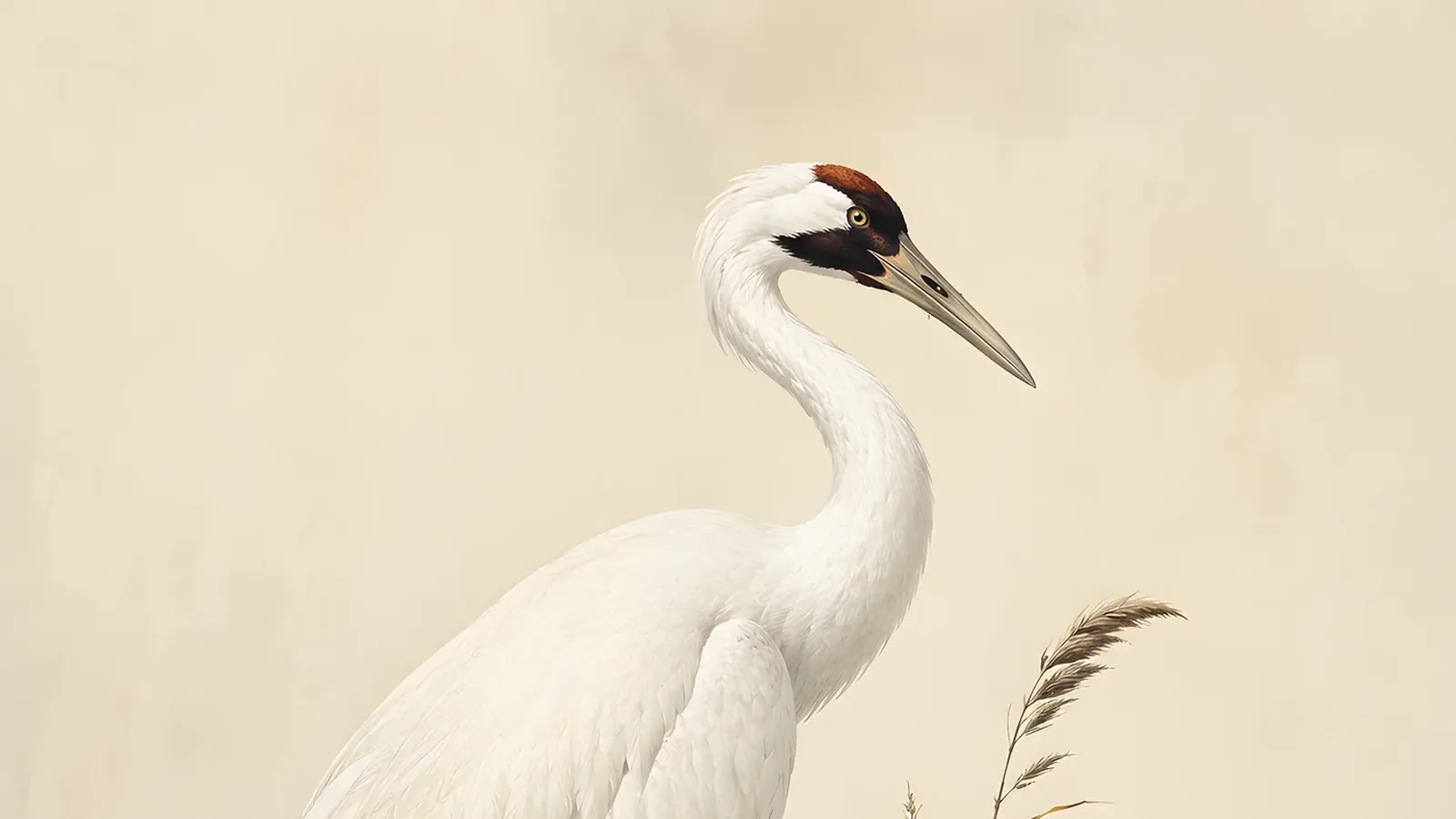
The plumage is snow white across the body, with black primary feathers that are invisible when the wings are folded but visible - brilliantly so - in flight. The crown is a patch of bare red skin, featherless, vivid. The bill is long, grey-green, and heavy. The legs are dark grey and very long. Juveniles hatch rust-cinnamon and gradually bleach toward white over their first year. The red crown develops during the second year.
The black wingtips are the field mark that matters most at distance. Against the white body they read as distinct bands in flight. At rest, when the wingtips are tucked under the folded secondary feathers, a standing Whooping Crane is pure white except for the crown.
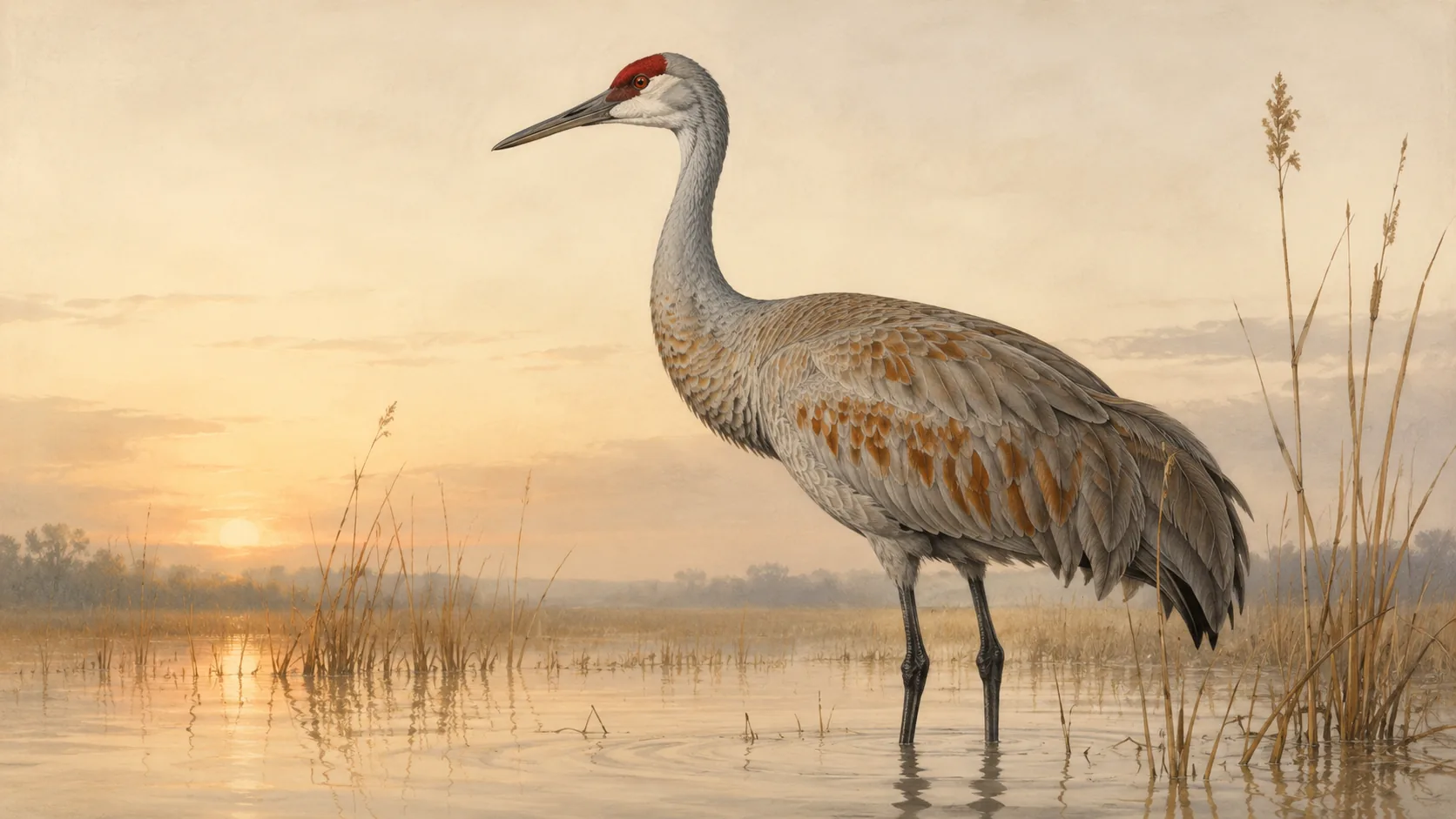
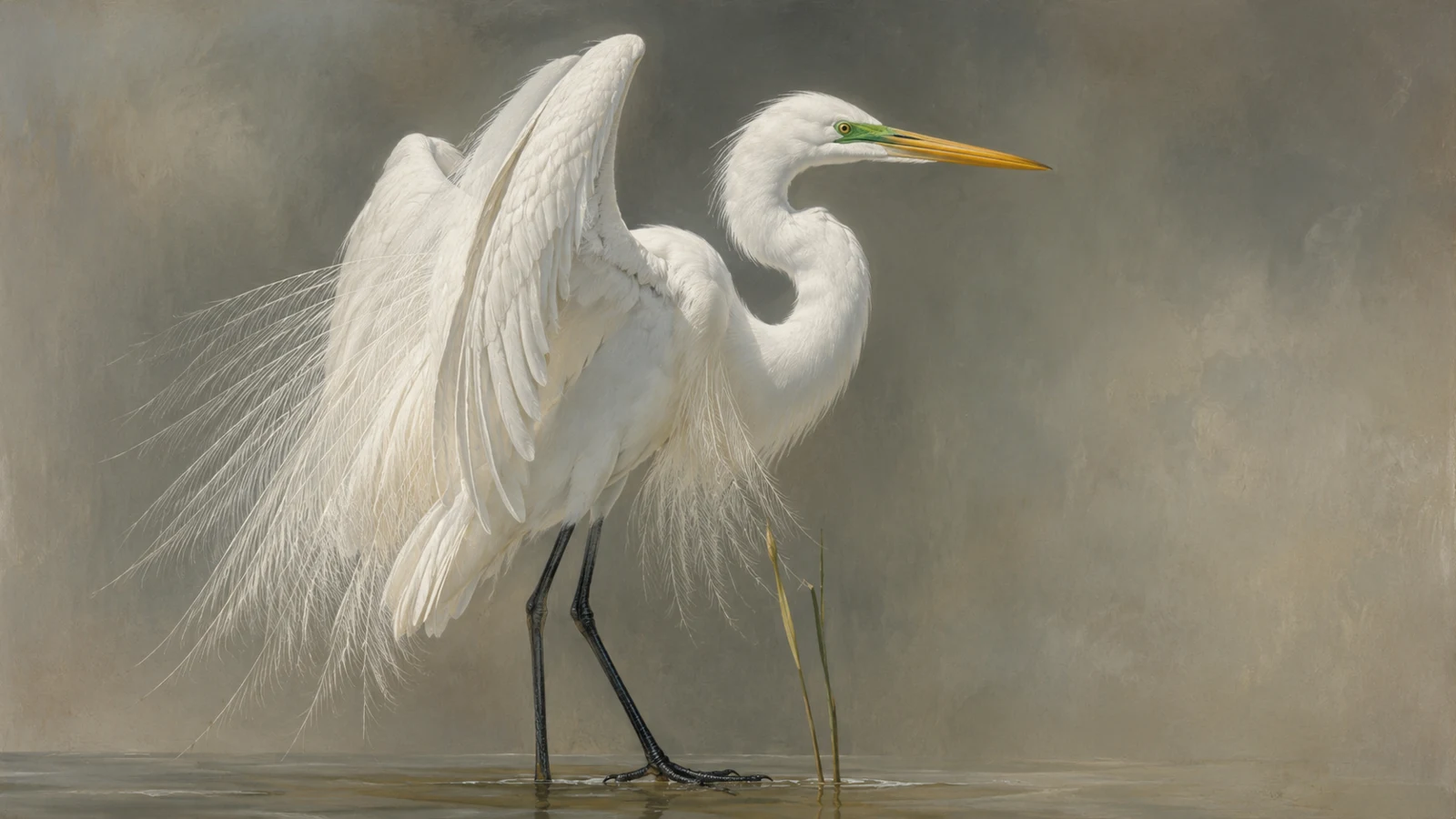
Confusion with the sandhill crane is possible in mixed flocks - the species share a range corridor across the Great Plains - but the Sandhill Crane is noticeably smaller and overall grey, not white. The great egret also appears large and white in wetland settings but folds its neck in flight. Cranes fly with the neck extended.
The voice and the windpipe
The common name is not metaphor. The call is a genuine whoop - a loud, trumpeting bugle that carries for kilometres across open marsh. The vocalisation that gave the species its English name is a single-note alarm call, produced repeatedly, that John James Audubon described in the 1830s as audible at five miles when the wind was right.
The anatomy responsible for this range is specific. A Whooping Crane’s trachea coils into the keel of the sternum, adding approximately 23 centimetres of resonant tube length. The Smithsonian’s National Zoo notes that this coiling “allows for increased volume and variation in pitch.” Research published in the Journal of Comparative Physiology A (Riede and Zuberbuhler, 2003) found that cranes produce their extraordinary calls at remarkably low driving pressures precisely because the elongated trachea amplifies and shapes the airflow. Among cranes, Grus americana shows the greatest degree of intrasternal tracheal coiling in the subfamily Gruinae.
The paired display, called the unison call, is performed by mated birds standing together. Both birds call in coordinated sequence: the male gives single notes, the female responds with two or three notes for each of his. The timing is precise and learned over years of partnership. Biologists at the International Crane Foundation use the unison call to assess pair-bond strength - a well-synchronized pair is a breeding pair.
The migration
Every autumn the Aransas-Wood Buffalo population makes a non-stop crossing of the Great Plains, moving roughly 4,000 kilometres between Wood Buffalo National Park in northern Alberta and the Gulf coast of Texas. They leave Canada in late September and arrive on the Texas Gulf Coast through October and into November. The spring return begins in late March.
The corridor they use is narrow - roughly 270 kilometres wide across the Great Plains. Key stopover areas include the Platte River valley in Nebraska and shallow wetlands in Kansas and Oklahoma. The birds are moving, but they are not dawdling: family groups of two adults and one or two juveniles travel together, gaining altitude on thermals when available and covering up to 700 kilometres in a single day.
Wood Buffalo National Park straddles the Alberta-Northwest Territories border and is the only wild nesting location on earth for the species. The breeding habitat is muskeg - shallow, poorly drained boreal wetlands interspersed with black spruce and tamarack ridges, potholes lined with bulrush and sedge, and marl-bottomed lakes. The birds need the specific combination of dense, vegetated shallows for nesting and open water for feeding.
Diet
On the wintering grounds at Aransas, the Whooping Crane eats blue crabs (Callinectes sapidus) above almost everything else. The marsh estuaries on the Texas Gulf Coast provide an abundant and calorie-dense food source, and cranes wade the saltmarsh flats probing with their bills for crabs, clams, frogs, and small fish. Wolfberries - also known as goji berries - are taken from coastal shrubs and provide additional energy during winter.
On migration, the diet shifts to whatever the landscape offers: waste corn in harvested fields, snails, invertebrates in shallow wetlands. On the breeding grounds in Canada, cranes eat a wider mix of aquatic invertebrates, small rodents, frogs, reptiles, and marsh vegetation.
Breeding
Whooping Cranes are monogamous and form long-term pair bonds, typically beginning to breed at age four or five. Courtship involves full-scale dancing: both members of a pair leap into the air, spread their wings, bow their heads, and call. The display is performed by established pairs and by unpaired birds seeking mates, sometimes in groups.
Nesting begins in late April in the Wood Buffalo wetlands. Both parents build the nest - a large mound of bulrush and sedge anchored to emergent vegetation in shallow water. The female lays one or two eggs, olive-coloured and heavily blotched, averaging 100 millimetres in length. Incubation lasts 29 to 31 days, shared by both parents. Only one chick typically survives. Sibling competition in the nest is intense, and the smaller chick rarely fledges. Chicks walk and swim within hours of hatching. They fledge at 80 to 100 days, remain with their parents through the first migration and winter, and separate the following spring.
Reproductive rate is very low by design. A species with a 30-year potential lifespan does not need to replace itself every year. What it cannot survive is losing adults faster than chicks enter the breeding population.
From 21 birds
The Whooping Crane was once broadly distributed across North America - estimates of the pre-settlement population run to 10,000 or more. By the mid-1800s, intensive hunting and wholesale wetland drainage had collapsed that number to perhaps 1,400 birds. By 1938, when USFWS began systematic counts, the Aransas-Wood Buffalo flock stood at 29. Three years later it was 15.
The recovery is one of the longest and most incremental in conservation history.
The first organized protection came with the Migratory Bird Treaty Act of 1918, which made it illegal to kill cranes anywhere on the flyway. The Wood Buffalo breeding grounds were identified only in 1954, after a wildlife biologist and a photographer aboard a helicopter stumbled on the nesting area by chance. This was not a well-known species with a well-known range. It was a bird the science of the time barely understood.
The population climbed slowly through legal protection alone - 57 birds by 1970, 214 by 2005. But two additional strategies accelerated recovery.
The first was costume rearing. Beginning in 1985, the International Crane Foundation developed a technique in which human caretakers wore full white crane costumes and used crane-puppet gloves to interact with captive chicks. The goal was to prevent imprinting on humans - a chick that bonds with a person cannot function as a wild bird. Handlers raised chicks dressed as cranes from hatch through fledging, feeding them, socializing them, and modeling foraging behaviour. The first costume-reared chicks were reintroduced to Florida in the early 1990s.
The second was the ultralight-aircraft-led migration program, operated by Operation Migration beginning in 2001. Whooping Crane chicks raised in Wisconsin were trained from their first weeks to follow ultralight trikes - small, slow aircraft whose sound the birds imprinted on as fledglings. In autumn, pilots flew the migration route from Wisconsin south to the Florida Gulf Coast, and the cranes followed in formation. Between 2001 and 2015, more than 200 juvenile birds made their first southward migration behind an aircraft. The program ended in 2016, when USFWS determined the method was producing birds that struggled to establish normal wild behaviours. The eastern reintroduced population, though smaller and less stable than the Aransas-Wood Buffalo flock, continues independently.
“The 2024-2025 wintering survey marks the first time the Aransas-Wood Buffalo Population has been estimated to exceed 550 individuals.” - U.S. Fish and Wildlife Service, June 2025
The species remains Endangered (EN) on the IUCN Red List. The threats that remain are precisely the threats that have always surrounded this bird: collision with power lines, habitat degradation in the migration corridor, oil spill risk along the Intracoastal Waterway, and the simple statistical fragility of a population still small enough that a bad drought year in Texas can suppress reproductive success across the entire flock.
But 550 birds from 15 is not a fact that leaves any reasonable argument for despair. The crane made the crossing. It is still making it.
What the Whooping Crane demands of us now is not admiration - the bird has never needed that. It demands the same thing it has always demanded: that we hold the habitat, maintain the counts, keep the marsh wet and the corridor open, and get out of the way. The bird will do the rest.