Field Guide
Koloa Maoli (Hawaiian Duck)
At the edge of a lo’i kalo - a flooded taro field on Kauai’s north shore - a small brown duck forages in water perhaps ten centimetres deep. She tips forward, bill skimming mud, orange feet paddling against the current. She looks, at first glance, like a rather dark female mallard. She is not. She is Anas wyvilliana, the koloa maoli, and she may represent one of the last concentrations of genetically pure individuals of her kind on earth. On every other main Hawaiian island, birds that look just like her are something else - or something in between.
The argument this page wants to make is a difficult one, because it asks you to care about a creature that is being erased not by chainsaws or oil spills but by reproduction. By the ordinary act of ducks mating with ducks.
On Oahu, Maui, and Hawaii island, virtually every duck that looks like a koloa is now genetically a hybrid. Kauai alone holds a significant population of birds that are still what they were before the mallard arrived.
What it looks like
Anas wyvilliana is a small, compact dabbling duck, the male measuring 48 to 50 centimetres in length, the female slightly shorter at 40 to 43 centimetres. Males weigh around 604 grams on average, females closer to 460 grams. The wingspan sits between 68 and 76 centimetres - broad enough for efficient movement between wetland sites on volcanic terrain, but not built for long migration.
The species is nearly monomorphic, which is itself unusual in the dabbling duck family. Both sexes wear mottled brown plumage - dark brown feather centres, buffed edges - and both carry a blue-green speculum bordered by white on the wing. Males have slightly darker heads and an olive-green bill. Females show an orange bill marked with dark splotches. Both sexes have orange to yellow-orange legs and feet. The tail is uniformly dark.
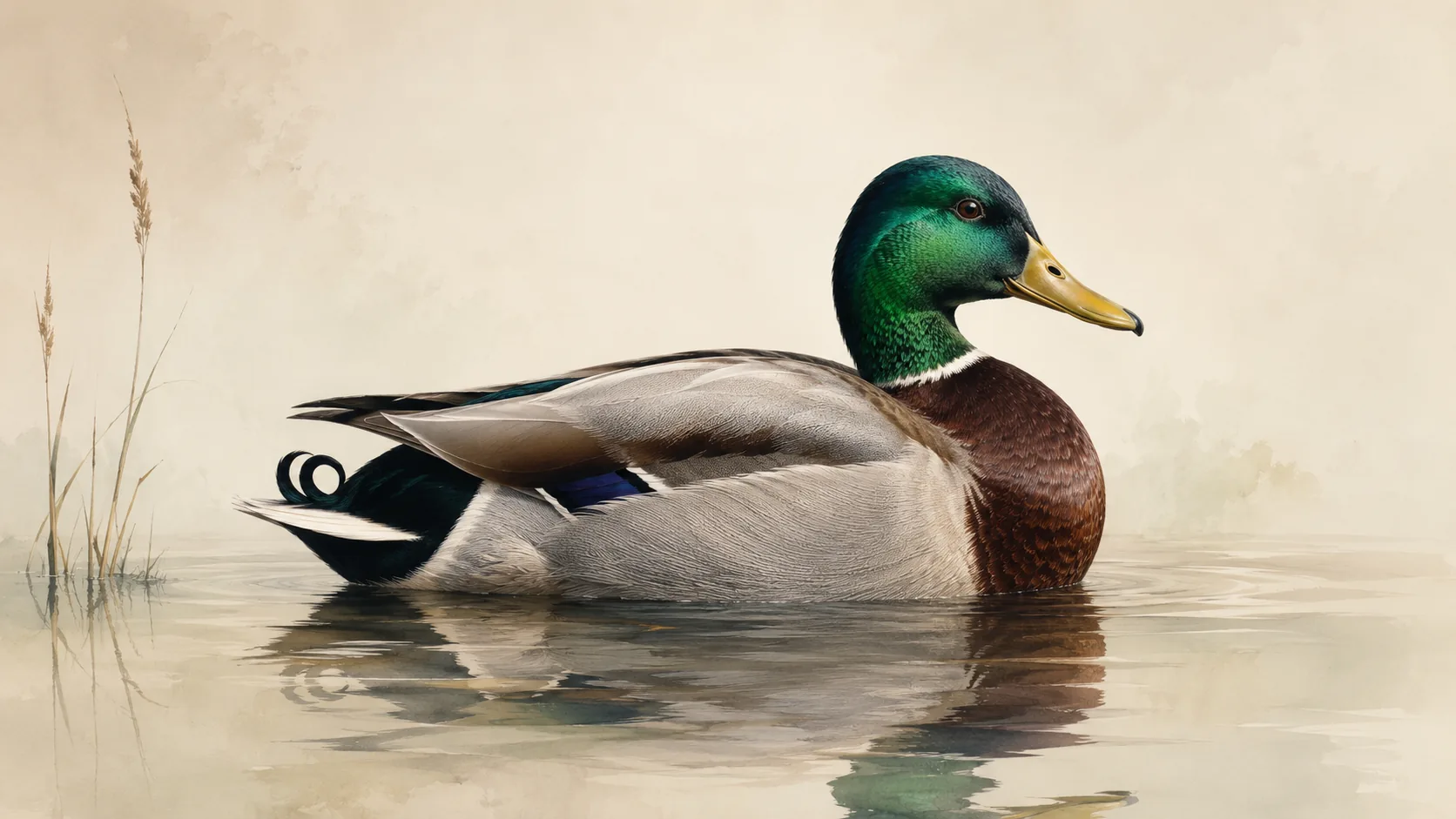
Compared to the mallard the koloa is smaller and darker, lacking the male mallard’s iridescent green head and curling tail. At a distance on open water the size difference is the surest field mark - a koloa beside a feral mallard looks noticeably more compact, sitting lower on the water.
The voice is softer than a mallard’s. Females produce a gentle quacking - the same descending cadence but quieter, less insistent. Males give a low, rasping call that carries only a short distance. In the lo’i kalo and the mountain streams where the species evolved, noise was not advantageous.
| Measurement | Male | Female |
|---|---|---|
| Length | 48-50 cm | 40-43 cm |
| Weight | ~604 g | ~460 g |
| Wingspan | 68-76 cm | 68-76 cm |
| Bill | Olive-green | Orange with dark markings |
| Feet | Orange | Orange |
An endemic of the islands
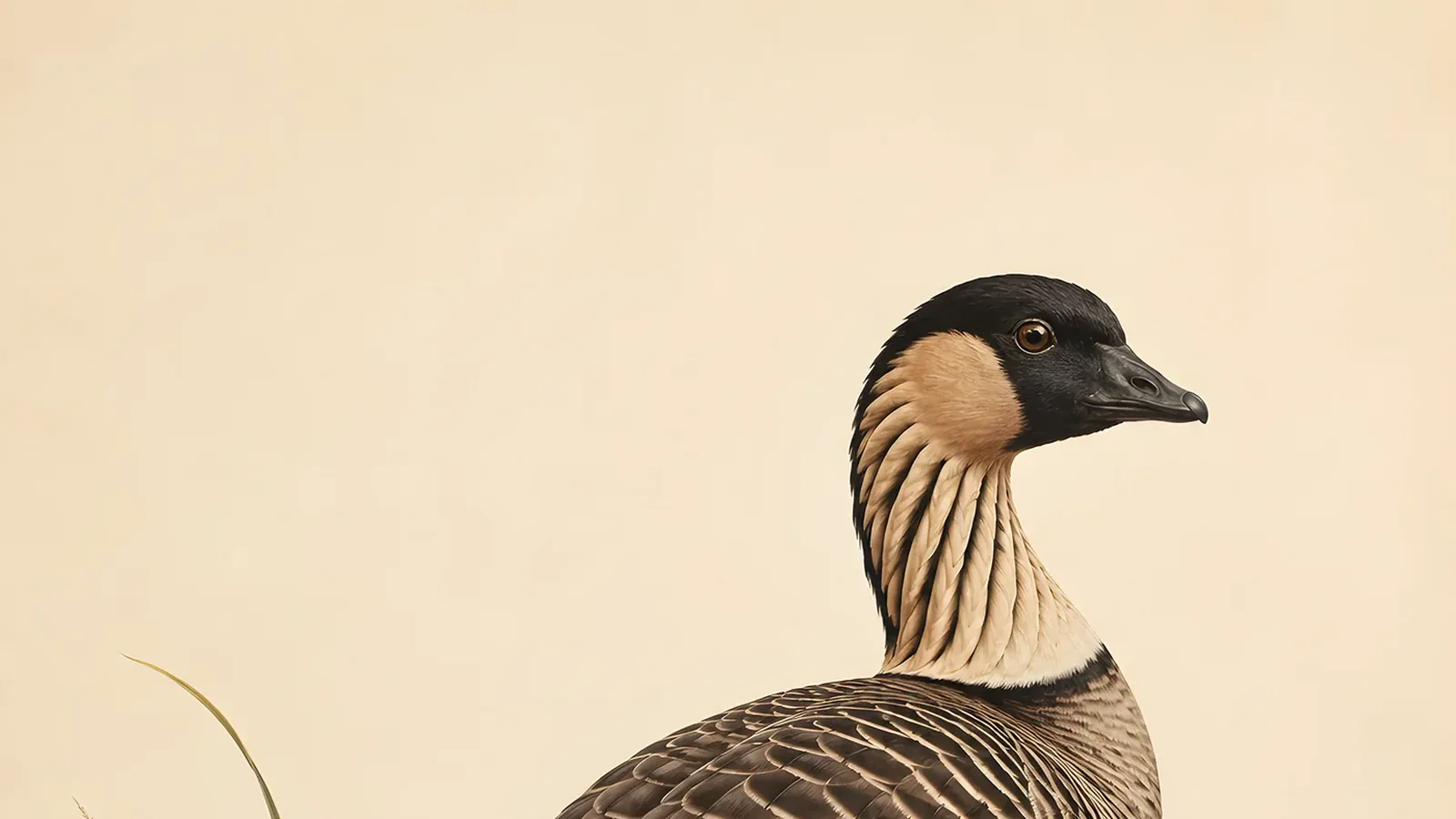
The koloa maoli is one of only three surviving native Hawaiian waterbirds, alongside the nene (Hawaiian goose) and the Laysan duck (Anas laysanensis). It is the only native dabbling duck in the main Hawaiian island chain. Its closest living relatives are the mallard and the Laysan duck - and this is not a coincidence of geography. Lavretsky, Engilis, Eadie, and Peters (2015, Journal of Evolutionary Biology) demonstrated through genetic analysis that the Hawaiian duck carries “nearly equal contributions” from ancestral mallard and Laysan duck lines in its nuclear DNA, with mitochondrial DNA sitting closer to the mallard side. Their data suggest the species arose through an ancient hybridization event near the Pleistocene-Holocene boundary - which means the koloa maoli is, in evolutionary terms, itself a successful hybrid that spent tens of thousands of years becoming something distinct, something adapted, something irreplaceable.
That origin story matters, because what is now happening to the koloa is the same process run in reverse, under human pressure, at high speed. The bird arrived at its current form through admixture and spent thousands of years becoming distinct. It is now being unbecome.
The koloa was federally listed as Endangered under the U.S. Endangered Species Act in 1967. The IUCN Red List carries the same Endangered designation. The Hawaii state government’s Division of Forestry and Wildlife (DLNR) identifies hybridization with nonnative mallards as “currently the most important threat” to the species - a ranking that places interbreeding above habitat loss, above predation, above disease.
The hybrid swarm
The problem begins with the mallard. The mallard is the most adaptable duck on earth - a species that can interbreed with at least 40 other Anatidae and has done so wherever it has been introduced. Feral mallards arrived in Hawaii through the release of domestic birds, initially as a food source or for sport. Once established, they began pairing with koloa. The offspring are fertile. The hybrids pair with koloa. The koloa gene pool, on islands where feral mallards are numerous, gets progressively diluted.
Caitlin P. Wells, Philip Lavretsky, and colleagues published the definitive genetic survey of this process in 2019 in Molecular Ecology (Wells et al., doi: 10.1111/mec.15286). They examined 425 birds across the main Hawaiian Islands, gathering more than 3,300 genetic data points per bird. Their finding was stark: on Oahu, Maui, and Hawaii island, “all of the birds were hybrids or feral mallards.” Kauai alone retained a population of largely pure koloa - birds whose genetic signatures matched the endemic species rather than the hybrid intermediate.
The study also documented why the 1980s captive breeding and reintroduction programme failed. Pure koloa were bred in captivity and released onto multiple islands. But feral mallards were never removed from those islands first. Within twenty years, the released birds had hybridised into new swarms. The conservation intervention built without addressing the underlying pressure simply created hybrid populations in new locations.
What makes this genetically catastrophic rather than merely complicated is the asymmetry of numbers. Wells and colleagues found that as long as feral mallards outnumber pure koloa, the proportions in the hybrid pool shift steadily away from koloa ancestry. The direction of drift does not reverse on its own. As Wells noted in a 2019 press release from Colorado State University: “If you don’t have pure koloa parents that outnumber the feral mallards, you’re not going to get any decreases in those hybrid proportions.” The math is pitiless. A gene pool, once swamped, does not reassemble itself.
Range and the Kauai stronghold
The koloa maoli historically occupied all of the main Hawaiian Islands - Kauai, Oahu, Maui, Hawaii island, Molokai, Lanai, and Niihau. By the late 1960s the species had already disappeared from most islands through overhunting, introduced predators, and wetland loss. Only Kauai and Niihau retained meaningful populations.
Today Kauai is the stronghold. The Hanalei National Wildlife Refuge on the north shore and the montane streams of the interior represent core habitat. Estimates of approximately 2,200 pure or near-pure birds represent the entire viable breeding population of the species. A 2013 study by Underwood, Silbernagle, Nishimoto, and Uyehara (PLoS One, 8(6): e67872) noted that standard waterbird surveys systematically undercount the koloa because the species also uses montane streams and bogs that fall outside coastal transect routes.
On Hawaii island, Oahu, and Maui, birds visible in wetlands are largely hybrid swarms - carrying koloa ancestry in varying proportions but not representing the species as a coherent genetic entity.
Diet
The koloa maoli is a generalist feeder within aquatic environments. The DLNR documents its diet as including snails, dragonfly larvae, earthworms, grass seeds, green algae, and the seeds and leaf parts of wetland plants. The species forages in shallow water less than 13 centimetres deep, dabbling at the surface or grazing at wetland margins. Elevation range extends from sea level to around 3,000 metres - a vertical spread unusual for a dabbling duck, reflecting adaptation to Hawaii’s terrain across millennia in the absence of mainland competitors.
Breeding
The koloa breeds year-round, with peak nesting activity recorded between December and May. Females lay clutches of eight to ten eggs in ground nests concealed in dense vegetation near water, lining the nest with down. Incubation is approximately four weeks, carried out by the female alone. Ducklings are precocial - self-feeding and mobile from hatching - and reach flight capability around nine weeks after hatching.
The species nests at wetland margins, in dense grass and sedge cover, and along montane stream banks. Nest success is constrained by introduced predators - rats, mongoose, and feral cats - that were absent from Hawaii when the species evolved.
The breeding biology is not, in itself, the vulnerability. A duck that nests year-round and produces eight to ten eggs per clutch is not physiologically fragile. The vulnerability is in mate choice. Koloa select mates largely by plumage similarity, and hybrid birds and feral mallards share enough of the koloa’s visual cues that pairing occurs across genetic lines. A 2026 preprint by Keerthipriya and colleagues (bioRxiv, doi: 10.64898/2026.01.29.702521) found that koloa form preferential social associations but not on the basis of plumage traits or genetic relatedness - meaning the birds are not selecting mates in ways that protect genetic integrity. They choose by behaviour and proximity, not by the genetic criteria that would slow the swarm.
The koloa maoli may need humans to do the selecting for it. Captive breeding, mallard removal from key refuges, and managed translocation of genetically verified birds represent the current toolkit. None of it is simple. What the research makes clear is that this species is not vanishing because its habitat was destroyed or because it was hunted to the edge. It is vanishing because another duck found it attractive - and that is either a tragedy or an irony, depending on how long you have spent thinking about what a species actually is, and what we lose when one dissolves into another.