Field Guide
Long-billed Curlew
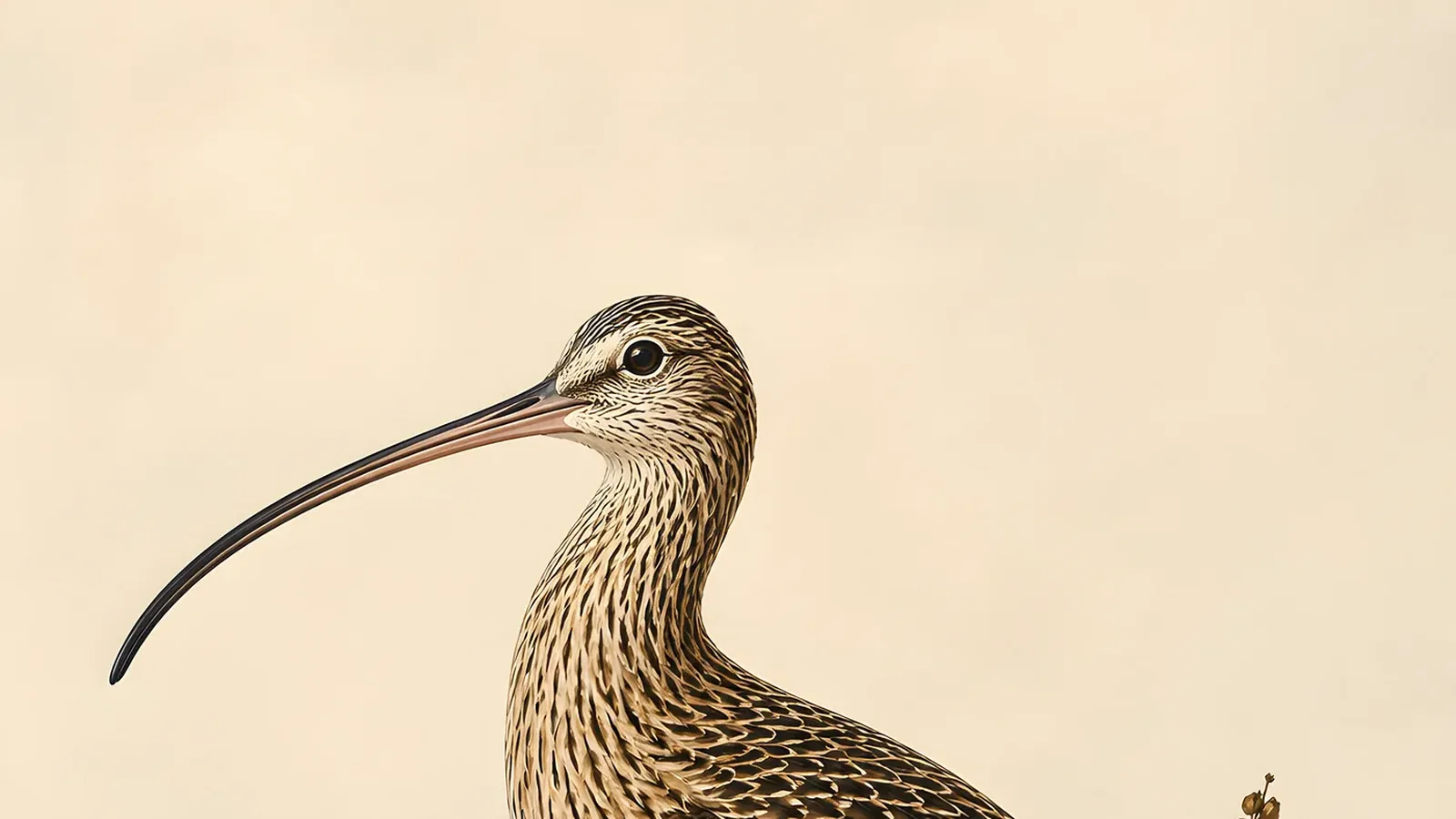
Stand at the edge of a shortgrass prairie in Montana on an April morning and you will hear the bird before you see it. A long, liquid whistle descends from somewhere overhead - cur-leee, cur-leee - and then the silhouette appears against the pale sky: a large, slow-flying bird with its neck stretched forward and, below that neck, a bill so long and so smoothly curved downward that the whole creature seems improbably weighted at the front. This is Numenius americanus, the Long-billed Curlew, the largest shorebird in North America, and it has just arrived from its wintering grounds on the Pacific tideflats to do something that shorebirds are not supposed to do. It is going to raise its chicks on dry land, far from the ocean, in country that looks like it belongs to meadowlarks.
What it looks like
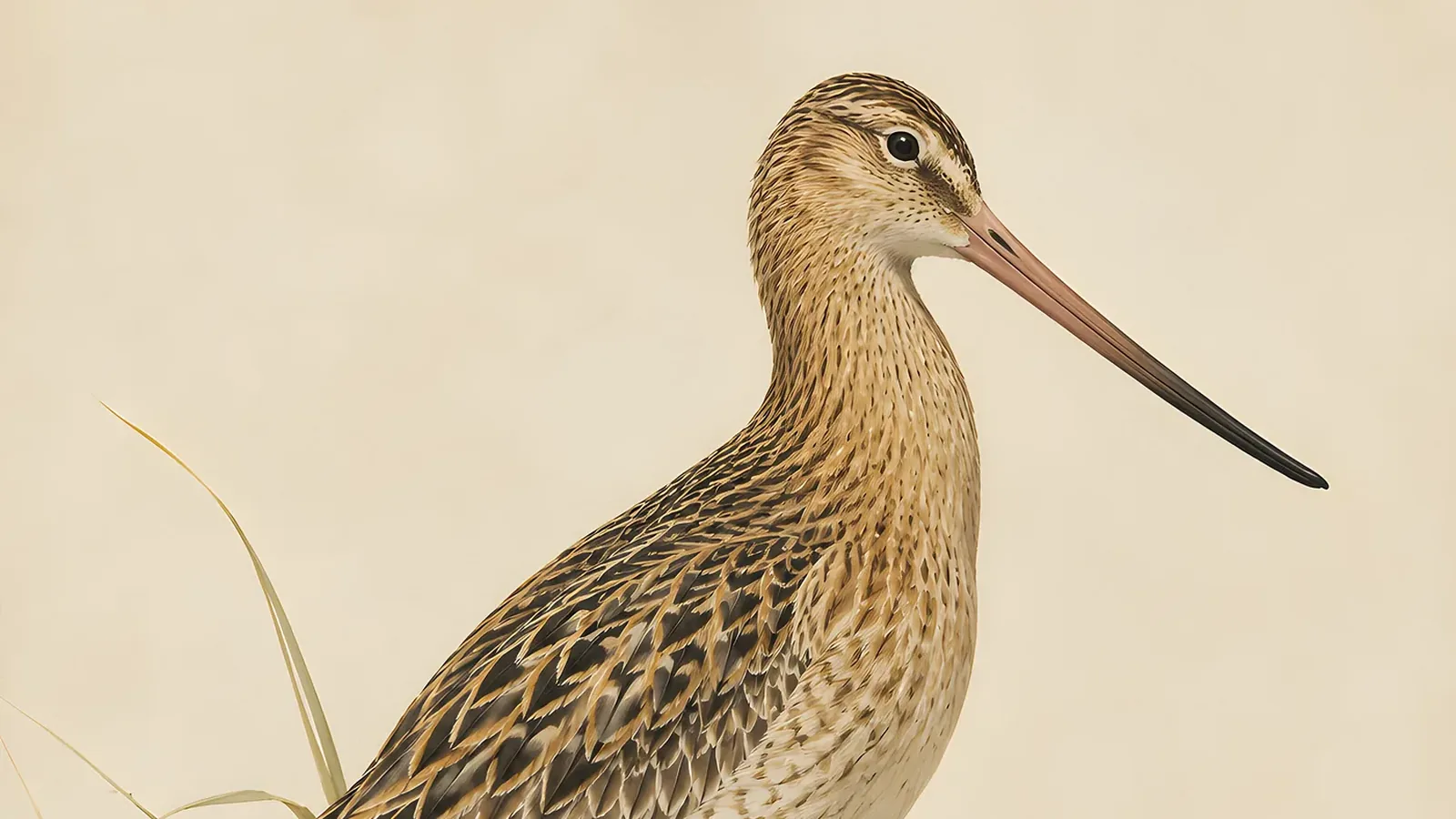
Numenius americanus is a large, warm-toned shorebird - 50 to 65 centimetres long, 490 to 950 grams, with a wingspan of 89 to 101 centimetres. It is built along the lines of a heron in miniature: long neck, long legs, and a body that is neither slender nor heavy but poised. Against a crowd of sandpipers or godwits, it looks oversized. Among wading birds generally, it reads as exactly right.
The plumage is cinnamon-buff overall, warmer and more saturated than any of the other large shorebirds. The upperparts are brown with dark streaking, and the crown carries fine brown streaks rather than the bold lateral stripes seen in some related curlews. But the field mark that resolves every identification is the underwing: when the bird flushes or wheels in flight, it flashes a deep cinnamon-orange from the primary coverts and secondary wing lining - a warm bloom of colour that no other large North American shorebird shows. The Audubon Society’s field guide describes the adult as “cinnamon” below with “warm brown” above, and no description improves on that.
Females are measurably larger than males, and the bill sexual dimorphism is pronounced enough to be obvious in the field. A standing pair reveals immediately that the female is the longer, heavier bird.
The bill
The bill of Numenius americanus is the longest of any shorebird on the continent, and it is the instrument around which the bird’s whole ecology is organized. Male bills average roughly 13.7 centimetres. Female bills average 17 centimetres, and some individuals reach 22 centimetres - more than half the bird’s total body length. The curve is smooth and continuous, deepening progressively from base to tip, without the sudden kink that interrupts a godwit’s bill.
That curve is not ornamental. On the wintering coast, the bird inserts its bill into the entrance of a fiddler crab burrow and follows the burrow’s own curve into the mud, withdrawing the crab intact. The female’s longer bill reaches prey that the male’s cannot, which is the probable evolutionary pressure behind the dimorphism - the two sexes divide the prey field by depth and thereby reduce direct competition between mates on the same wintering grounds. Where the bill is used to probe for shrimp, marine worms, and mollusks in tidal mudflat sediment, the same curved geometry allows extraction from angles that a straight bill cannot reach.
On the breeding grounds, inland and dry, the bill turns to very different work: probing soil for earthworms, picking off grasshoppers and beetles from grass stems, and occasionally taking the eggs or nestlings of other ground-nesting birds from shallow scrapes. The same tool, two radically different landscapes.
A prairie shorebird
| Measurement | Range |
|---|---|
| Length | 50-65 cm |
| Weight | 490-950 g |
| Wingspan | 89-101 cm |
| Bill (male) | ~13.7 cm |
| Bill (female) | ~17-22 cm |
| Lifespan (est.) | 8-15 years |
| IUCN Status | Least Concern |
The classification “shorebird” implies the coast, the tidal flat, the smell of salt. For Numenius americanus, it is accurate for only part of the year. The breeding season sends the curlew to the interior: the shortgrass prairie, the mixed-grass rangeland, the sagebrush steppe. The bird arrives in Montana, Wyoming, Idaho, Colorado, and the Dakotas in March and April, pairing up and claiming territory before the grass has fully greened.
Saalfeld et al. (2010, Waterbirds) documented that roughly 63 percent of breeding-season curlew observations in the United States fell in grassland habitats, with shortgrass prairie accounting for more than half of those records. The preferred vegetation height is four to 15 centimetres - low enough that a sitting bird has a clear sightline in every direction, which is the basic survival requirement for any ground-nesting bird. Proximity to a wetland or prairie pothole increases nesting success, providing an early invertebrate food source for chicks during the critical first weeks.
The mismatch between breeding and wintering habitats is sharper than in almost any other shorebird. The bar-tailed godwit, famous for its oceanic migrations, at least stays near water year-round. The Long-billed Curlew commutes annually between the intertidal zone and the dry interior West, shifting diet, foraging technique, and the entire ecological context of its life with each trip.
The candlestick bird
There is a stadium in San Francisco - Candlestick Park, demolished in 2015 - and a state recreation area on the bay’s edge that still bears the name Candlestick Point. The explanations for that name are several, and one of them is the Long-billed Curlew.
In the nineteenth century, before the bay margins were diked and drained and built upon, the tidal grasslands and mudflats at the southern end of San Francisco Bay held large concentrations of wintering curlews. Local hunters called them “candlestick birds.” The point was a productive hunting ground, and the name stuck to the geography. By 1916, ornithologists reported the species “practically extinct” in San Mateo County. By the time Candlestick Park was built in the 1950s, the flocks were gone. The name outlasted the birds that made it by decades, which is the kind of monument that a hunted species tends to leave behind.
The market hunting pressure of the late nineteenth century removed the bird from much of its former range, including breeding populations that had extended east through the Great Plains as far as Illinois, Minnesota, and Wisconsin. What finished the job in the interior was the conversion of native grassland to cropland. Stanley and Skagen (2007, Journal of Wildlife Management) estimated the U.S. breeding population at 109,000 to 164,000 individuals in 2004 and 2005. Partners in Flight puts the global breeding total at approximately 140,000. The U.S. Shorebird Conservation Plan classifies the species as “highly imperiled.” The IUCN Red List currently places it as Least Concern, but the population trend is negative and the losses are ongoing.
Diet
“It probed each burrow entrance slowly, following the curve of the bill into the mud, and withdrew the crab in one motion. The whole act was deliberate, almost surgical.”
- Eastside Audubon Society observer notes, 2019
On the wintering coast - mudflats, tidal marshes, coastal grasslands from California to Mexico - the diet is dominated by crabs, shrimp, crayfish, marine worms, mollusks, and other large invertebrates. The probing technique for fiddler crabs is particularly well documented: the bird walks slowly across a mudflat, inserts its bill into the entrance of a burrow, and curves it downward to match the burrow’s own geometry. The crab is drawn out whole. Foraging birds work alone or in small groups, reading the surface of the flat for burrow openings rather than sweeping the mud indiscriminately.
On prairie breeding grounds, the diet shifts to grasshoppers, beetles, caterpillars, earthworms, and spiders. The bill that is engineered for crab extraction still works here, though the quarry is shallower and smaller. Prairie chicks, precocial from hatching and foraging on their own within days, follow the parents through the grass and learn the insect gleaning technique before they have their adult bill length.
Breeding
The pair arrives on the breeding territory in early spring. The male’s flight display - a roller-coaster of fluttering ascent and gliding descent over the nest area, while calling - is the primary advertisement and territory proclamation. Nests are shallow scrapes in bare ground or sparse grass, sometimes lined with plant material and animal dung. Clutch size is almost always four eggs, pale buff to olive-buff, spotted brown and dark olive. Both parents incubate over a 27 to 30 day period, with the female taking daytime shifts and the male covering evenings and nights.
Chicks are precocial and mobile within hours of hatching. They fledge in 32 to 45 days but remain with the adults through late summer. After breeding, family groups and non-breeders begin moving toward the coast, arriving on the wintering grounds from August onward. The return to the interior prairie the following spring closes a cycle that is, in its basic structure, the same cycle the species has run for far longer than the cities and stadiums built in its former range.
The bill, the prairie nest, the crab burrow, the cinnamon flash of a departing wing - they belong to a single bird whose ecology refuses to stay within the category printed on its label. The Long-billed Curlew is a shorebird that breeds in the dry West and winters on the coast, and that reversal is not an anomaly. It is the whole point.