Field Guide
Eurasian Tree Sparrow
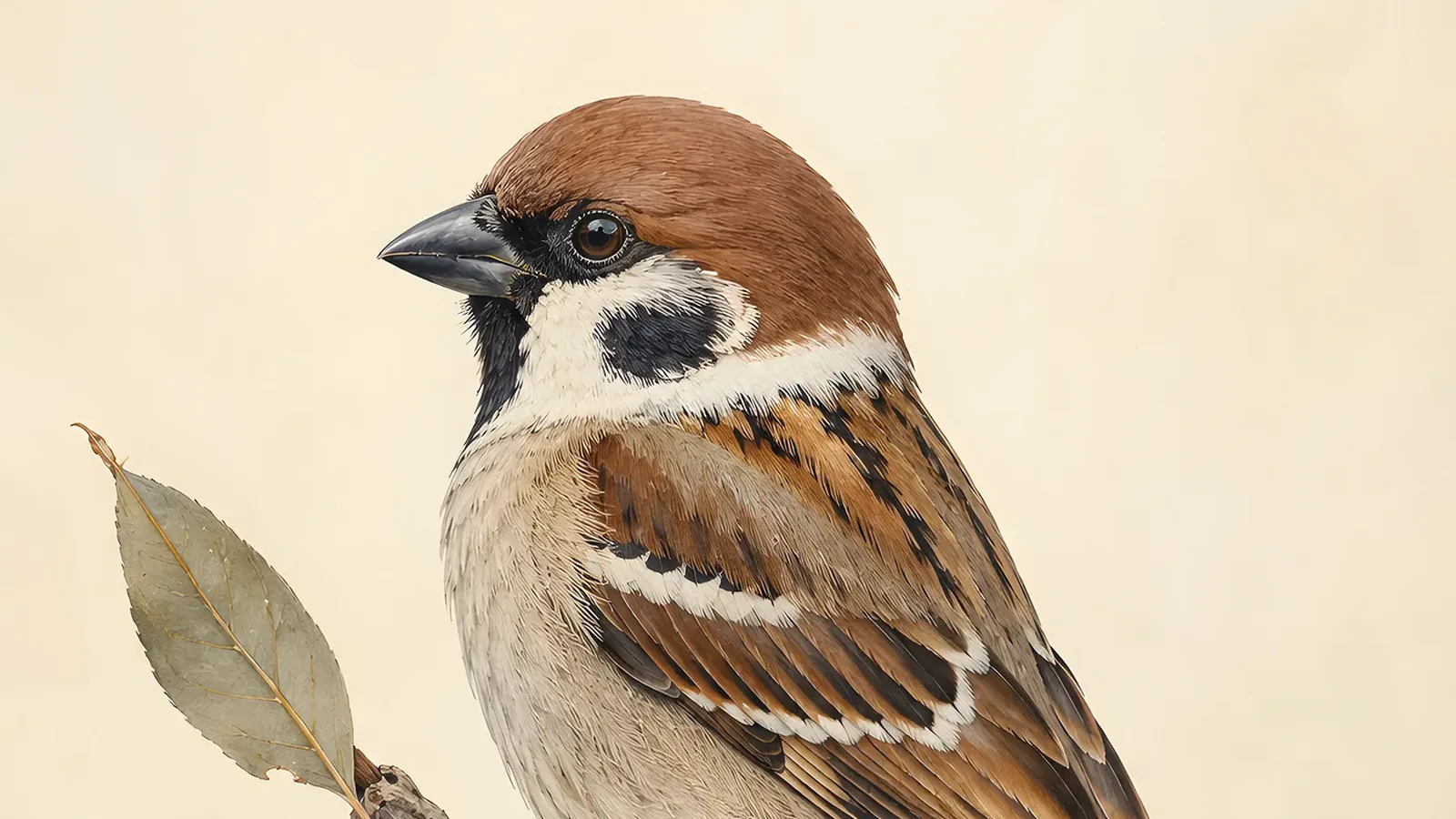
At a feeder in Tower Grove Park, St. Louis, a small sparrow hops along the platform’s edge. The cap is the colour of dark copper. The cheek is white, and centred on that white is a single black comma, precise as a typographer’s mark. This is not the House Sparrow that everyone thinks they know. This is Passer montanus - the Eurasian Tree Sparrow - and in North America it exists almost nowhere else.
Two sparrows were brought to this continent in the nineteenth century. One is now among the most widespread birds on Earth. The other has barely moved from the block where it was released.
What it looks like
Passer montanus is compact and neat, 12.5 to 14 centimetres long, weighing 20 to 25 grams, with a wingspan of 21 to 24 centimetres. That makes it noticeably smaller and tidier than the House Sparrow - not a dramatic difference on any individual bird, but apparent in direct comparison.
The field mark is unambiguous. Both sexes carry a solid chestnut crown, running from the bill base to the nape without any grey. Against that copper dome sits a white cheek, and against the white cheek sits a black spot. No other sparrow in North America combines those three elements. The bill is short and seed-cracking, the throat shows a small black bib - much reduced compared to a male House Sparrow’s chest-patch - and the back is streaked warm brown and black. The underparts are pale buff. The bill shows a yellow base in breeding condition, darkening toward the tip.
| Measurement | Range |
|---|---|
| Length | 12.5 - 14 cm |
| Weight | 20 - 25 g |
| Wingspan | 21 - 24 cm |
| Max. recorded lifespan | 13 years |
The sexes are alike. This is the detail that quiets any ambiguity: if you see this crown and this cheek spot, you need not consider sex, age, or seasonal variation. The bird is what it is.
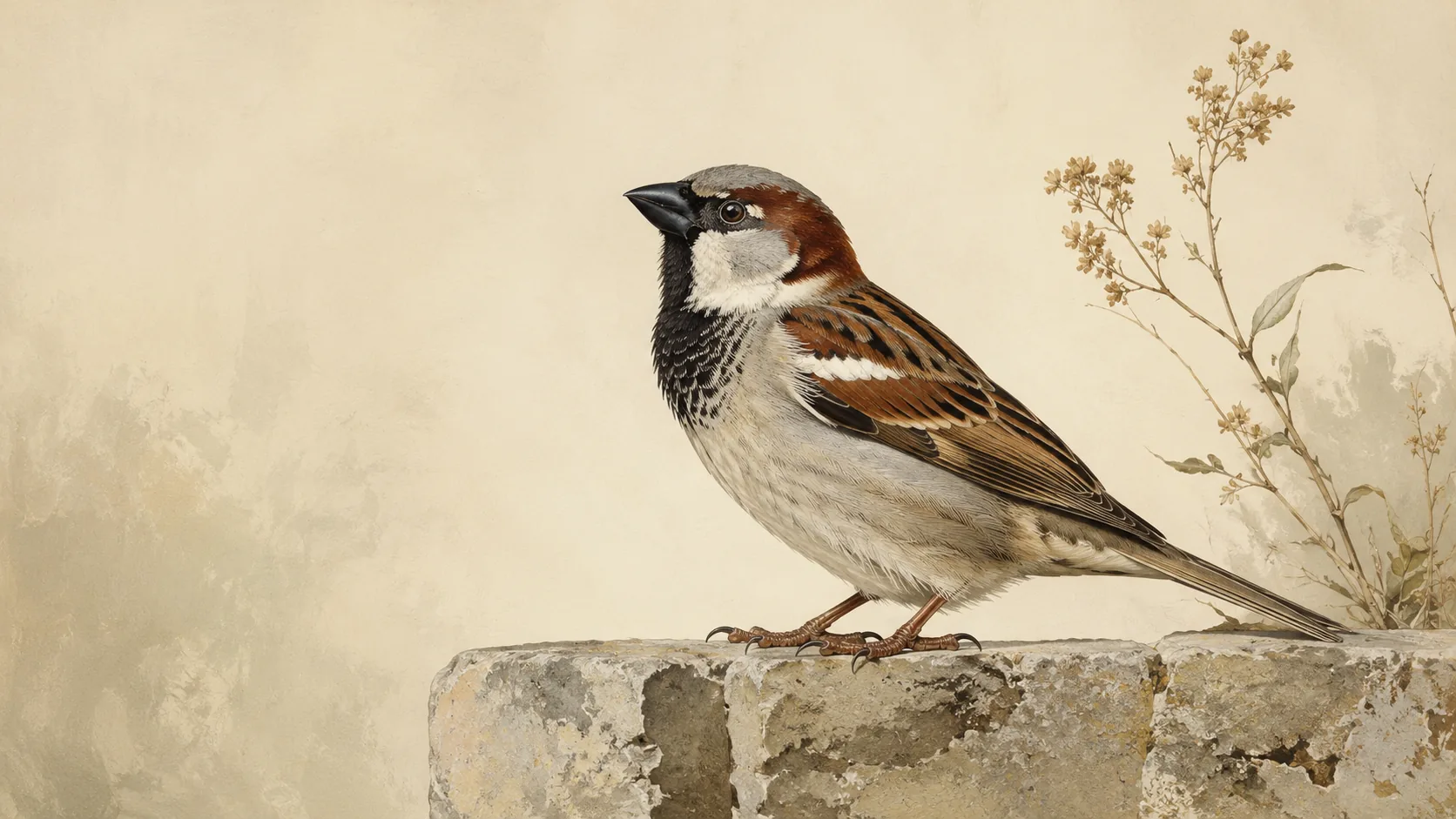
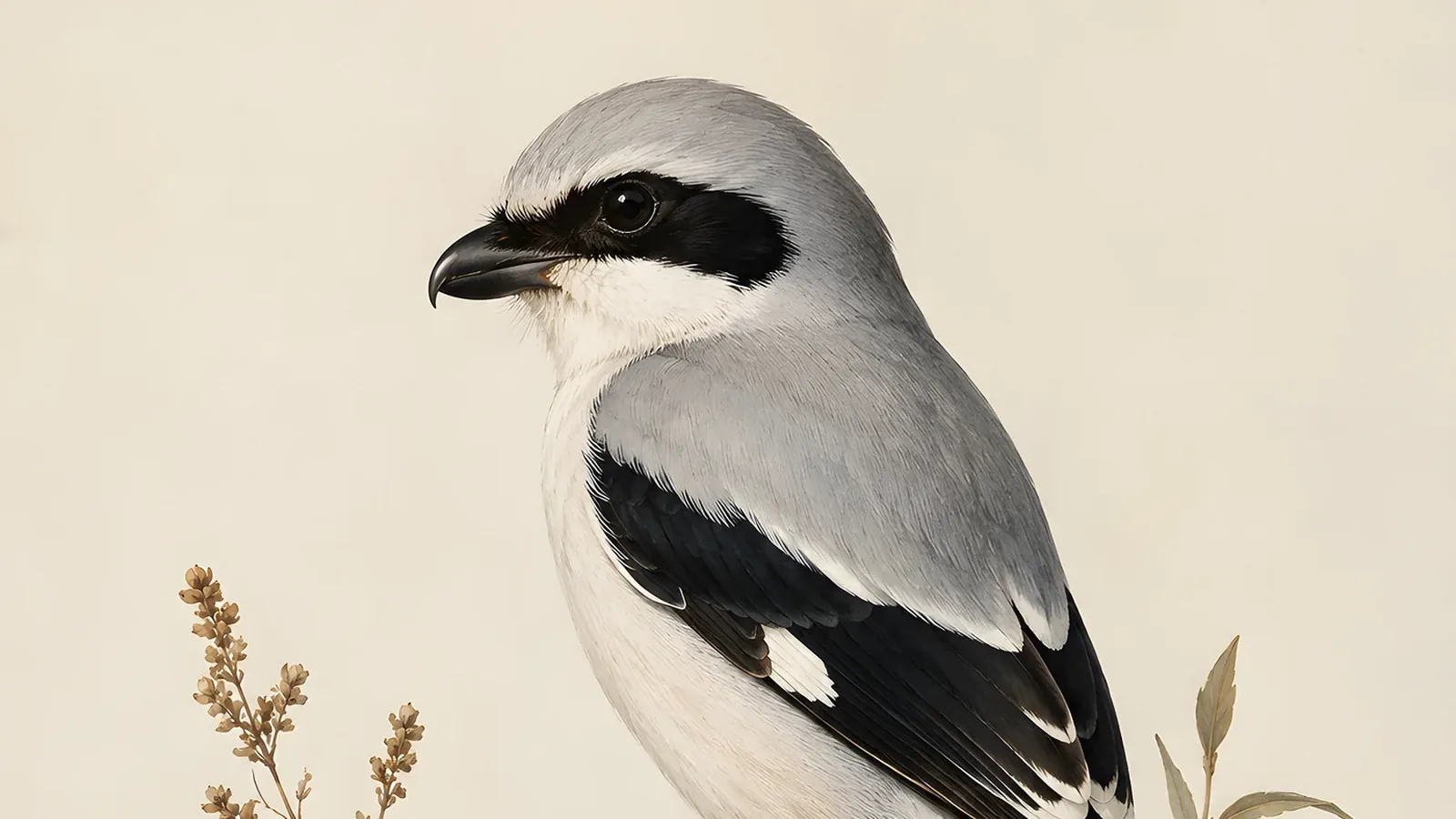
The house sparrow male is the most common confusion, but the contrast is clean once you know it. His crown is grey, not chestnut. His white cheek carries no black spot. The black runs on his chest as a bib, not on his face as a comma. A female House Sparrow lacks any of the sharp markings entirely. The Eurasian Tree Sparrow looks, from a distance, sharper - dressed rather than merely clothed.
The 1870 release
In late April 1870, a consignment of birds arrived in St. Louis from Germany. Among them were approximately 12 pairs of Eurasian Tree Sparrows. They were released in Lafayette Park, a formal Victorian green in what was then the fashionable west side of the city. The release was almost certainly organised by members of an acclimatisation society - a movement then active across the American Midwest, driven by German immigrants who wished to populate the New World with the familiar birds of home.
The sparrows bred. Descendants spread cautiously through the parks and farms around St. Louis, crossed the Mississippi River into Illinois, drifted north through the Illinois River valley, and eventually reached the agricultural margins of southeastern Iowa. That represents, across 150 years, an expansion of perhaps 200 kilometres in any direction.
“The introduced and ancestral (German) populations showed marked divergence in the level of meme sharing… much of the reduction in sharing of syllable types occurred during the founding event.” - Lang and Barlow, The Condor, 1997
Lang and Barlow’s 1997 study in The Condor (vol. 99, pp. 413-423) examined song syllables in the St. Louis population as a proxy for the founding bottleneck. Birds descended from those 12 pairs sing fewer shared song types than their counterparts in Germany, a musical shadow of the narrow founding event itself. Every aspect of this population - song, genetics, distribution - bears the compression of a small beginning.
Why it never spread
This is the question that the bird raises by existing as a curiosity rather than a catastrophe. The House Sparrow, introduced to Brooklyn in 1851 from a shipment comparable in size, reached the Rocky Mountains under its own power within fifty years. The Eurasian Tree Sparrow, released 19 years later in a city already well-populated with House Sparrows, has not reached Kansas City.
Competition explains much of it. The Missouri Department of Conservation field guide notes that Passer montanus has been “displaced from urban centers” by the larger and more aggressive House Sparrow, which competes directly for the same cavity nest sites. Research on nest box use has shown that tree sparrows can only hold ground where entrance holes measure less than 29 millimetres - small enough to exclude the chunkier House Sparrow. In cities and established suburbs, House Sparrows pre-empt the usable cavities. Tree sparrows are pushed into the margins: the small woodlots, the farm hedgerows, the parks where nest sites are less contested.
There may also be a simpler reason. The founding population of 12 pairs was small, and the genetic and behavioural diversity it carried was limited from the start. Lang and Barlow (1997) documented founder effects in song. It is not unreasonable to suppose that dispersal tendency was similarly compressed. The birds in St. Louis may simply not have the colonisation drive that their ancestors in Germany carried, because that drive was never fully represented in the 24 birds that crossed the Atlantic.
The House Sparrow that conquered the continent numbered in the tens of millions within decades. The tree sparrow has hovered at an estimated 15,000 North American individuals for generations. The contrast is not a measure of the tree sparrow’s failure. It is a measure of what 12 pairs can and cannot pass on.
What it sounds like
The call is a hard tik or tek, given repeatedly in flight and sometimes doubled as tik-tik. It carries more sharpness than a House Sparrow’s chirp, and the Missouri Department of Conservation field guide describes the song as “higher pitched than the house sparrow’s and more metallic.” The call note in alarm is a short chit-chup. The song in spring is a repeated series of short, clipped phrases, delivered from a branch or rooftop at moderate volume - not built for long distances, built for the intimacy of a colony.
In Missouri, particularly in the parks and suburban edges of St. Louis, a knowledgeable birder can train the ear to the slightly higher pitch and crisper attack of the tree sparrow among a flock of house sparrows at a feeder. It takes practice. The calls are close relatives.
Range and habitat
The North American range is small enough to memorise: the urban and suburban fringe of greater St. Louis, spreading outward through east-central Missouri, across into west-central Illinois, and north into the agricultural districts of southeastern Iowa. That is effectively the whole of it.
Within that range the birds occupy the spaces the House Sparrow leaves behind: woodland edges, farmsteads with old wooden buildings, cemetery tree rows, suburban parks with mature trees and cavity-rich snags. They are not urban birds. They are rural birds pressed against the edge of cities and held there. In winter they gather in loose flocks and work weedy fields for seed, often mixing with House Sparrows and American Tree Sparrows - a different species, native, with which the Eurasian bird shares a name and a general silhouette but not close kinship.
The species is non-migratory across its North American range. The flock that works a Missouri farmyard in January is the same flock that nested there in May.
Diet and breeding
The diet follows the standard sparrow template: seeds, grains, weed seeds, waste grain from fields and silos, insects and invertebrates during the breeding season, and fruit - mulberry is well-documented - when available. Foraging is almost entirely on the ground or in low vegetation. The Audubon Society field guide notes the diet as “seeds of weeds and grasses, waste grain, insects” with an emphasis on insects during summer months, particularly for provisioning nestlings.
Breeding begins in April in Missouri and can extend through August. Pairs are socially monogamous and raise two or three broods per year. Clutches contain four to six eggs, occasionally seven, white to pale grey and heavily spotted with brown. Incubation lasts 11 to 14 days. Nestlings fledge at 12 to 14 days. Both parents incubate and feed the young.
Nests are placed in natural cavities in trees, gaps in old timber buildings, nest boxes, and occasionally in the base of larger birds’ nests. The nest material is grass, straw, fine plant fibre, and feathers - untidy and well-insulated. The preference for small cavities, as noted above, is what keeps the species viable where House Sparrows are also present. A nest box with a 28-millimetre entrance hole is tree sparrow territory.
Two sparrows were introduced to this continent within twenty years of each other. One found that every town, every grain elevator, every suburban garden, and every airport was habitat. The other found that St. Louis was habitat, and stayed there.
Passer montanus is sometimes called a conservation failure, an introduced species that never achieved the reach to become a problem. That is the wrong frame. It is a population that has persisted in a narrow corridor of the American Midwest for 155 years, carrying the genetic memory of 12 birds on a transatlantic crossing, singing songs that diverged from their German source the moment the cage was opened. The chestnut cap and the black cheek-spot appear at the feeder and ask nothing beyond a seed and a hole in a wooden beam. That any of them are here at all - that 12 birds became 15,000 and held on - is the more interesting story.