Field Guide
Evening Grosbeak
The Evening Grosbeak is a finch built like a heavyweight. Stocky body. A short, deep bill the colour of pale ivory. When a flock drops into a snow-quiet yard, you hear them before you see them.
How to know it
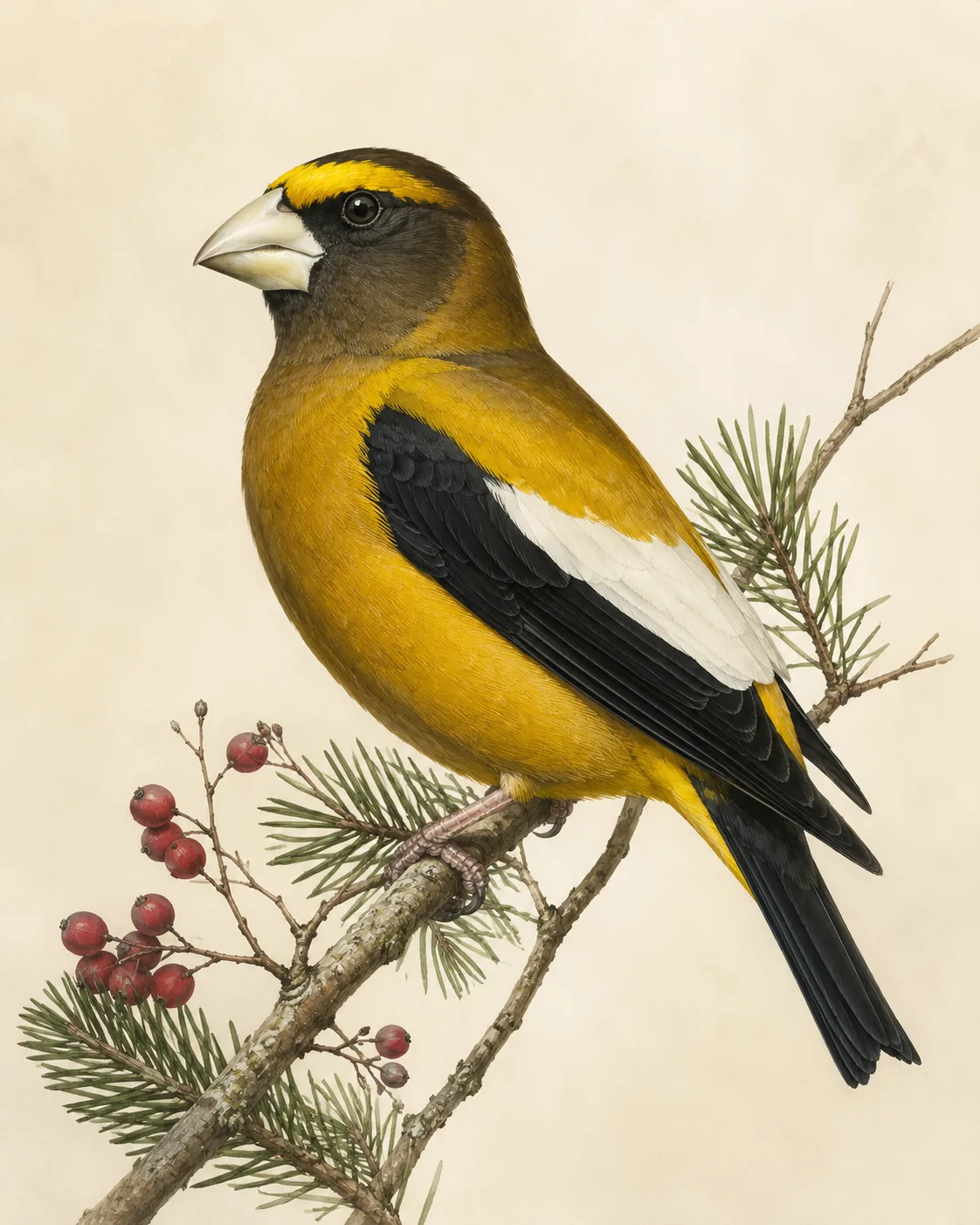
Look for the bill first. It is huge, conical, and pale green to bone-white, made for cracking hard seeds.
The male is unmistakable. A deep golden-brown body that brightens to bright yellow on the belly and forehead. A black tail. Black wings split by a large white patch that flashes in flight.
The female is quieter. Soft grey-brown, washed with yellow at the neck, the same white wing markings but more restrained.
This is a big finch, near seven to eight inches long, blunt-headed and heavy through the chest.
Range and habitat
A bird of the cold north and the high country.
It breeds across the coniferous and mixed forests of Canada and the western mountains of the United States, favouring spruce, fir, and pine. Once almost unknown east of the Great Lakes, it spread east through the twentieth century and now nests into New England and the Maritimes.
Winter changes everything. In some years flocks push far south and east of the usual range, settling into deciduous groves, box elders, maples, and fruiting shrubs.
These southward winters are irruptions. Driven by seed crops, not the calendar. A yard that hosts them one winter may wait years for the next.
Behaviour
A social bird. Grosbeaks travel and feed in flocks, and they are not shy.
They favour the seeds of maples and box elders, prising them open with that powerful bill. In summer they take buds and add insects, and they have a fondness for the larvae of the spruce budworm.
At feeders they go straight for sunflower seed and arrive in numbers. A platform feeder can fill with a dozen birds at once, all cracking shells, all jostling.
Voice
Less a song than a chorus of calls.
The common note is a loud, ringing chirp, sweet and far-carrying. A flock in flight keeps up a steady chatter of these clear, piping notes.
There is no rich warble here. The Evening Grosbeak speaks in short bright phrases, and a winter flock can make a surprising amount of noise for a bird that spends so much of the year in silence.
A note on its numbers. Once a familiar winter visitor across much of the continent, the Evening Grosbeak has declined steeply in recent decades and is now listed as Vulnerable. A flock at the feeder is a gift worth marking.