



In January 1940, a pet shop on Long Island released a cage of small finches into a January wind to avoid prosecution. The birds had been sold illegally under the trade name ‘Hollywood Finches.’ They were native to the desert Southwest and Mexico, birds of dry canyons and chaparral, and they had no business surviving a New York winter.
They survived. They bred. By the 1960s there were eastern House Finch colonies from New England to the Carolinas. By the 1990s the eastern and western populations had met somewhere in the Great Plains. Today Haemorhous mexicanus is one of the most numerous birds in North America, present in every US state, much of southern Canada, Mexico, and Hawaii. The species did not disperse across a continent. It was transplanted across a continent and then dispersed anyway, at the rate of about 80 kilometres per year.
The thesis of the House Finch is this: adaptability, not beauty, is the trait that matters. He is not the most striking red bird at your feeder. But he is the one who will still be there in fifty years.
Identification
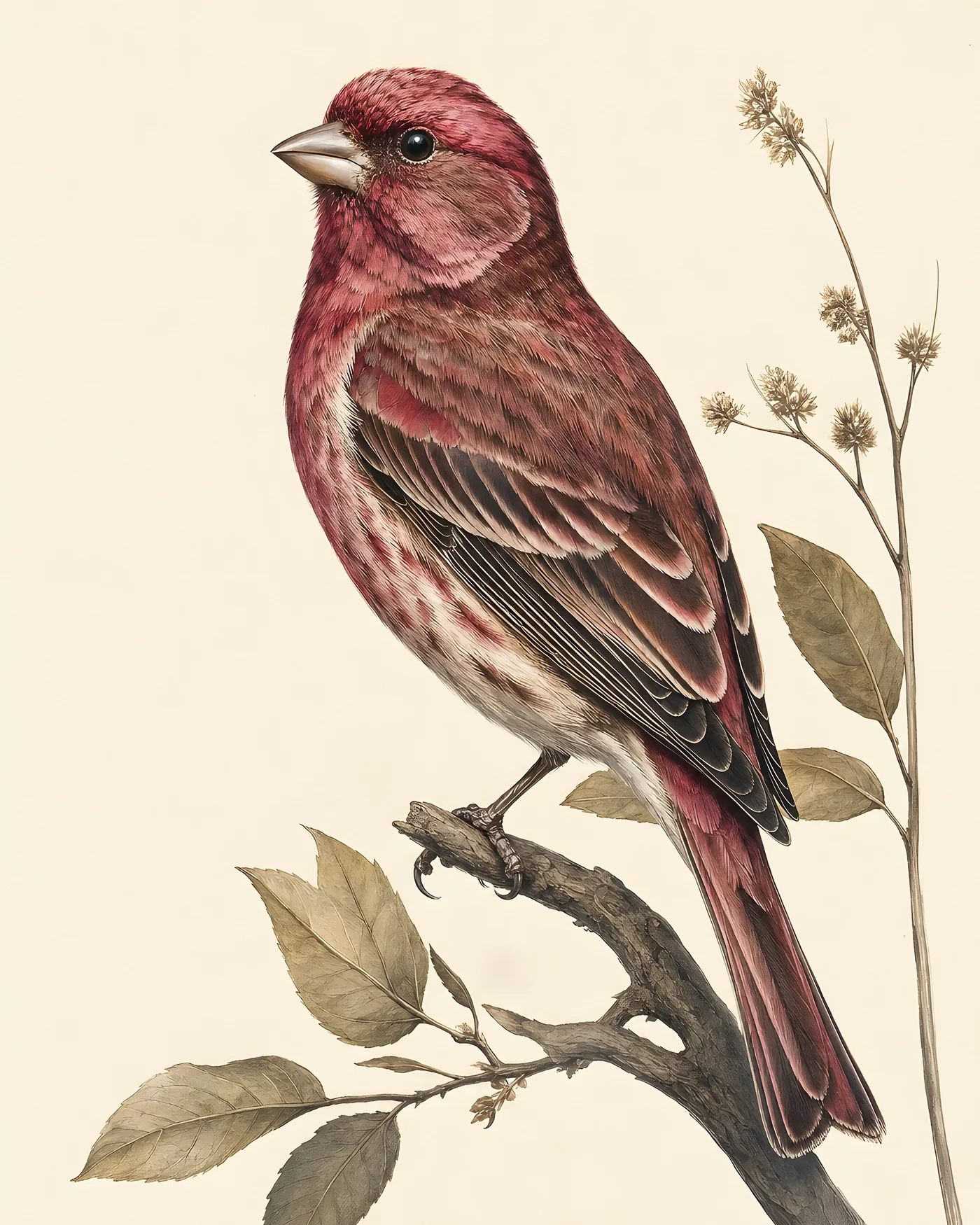
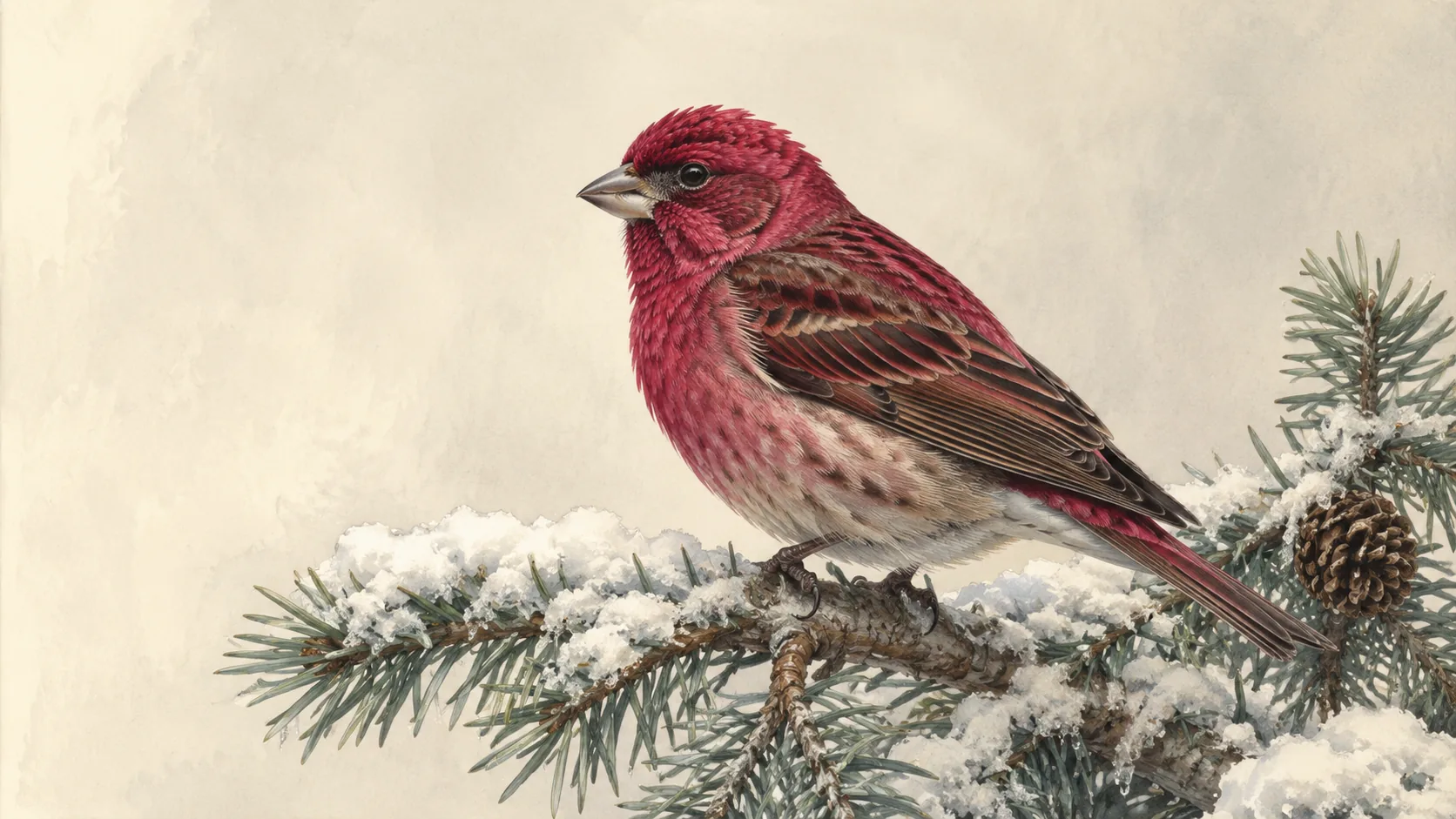
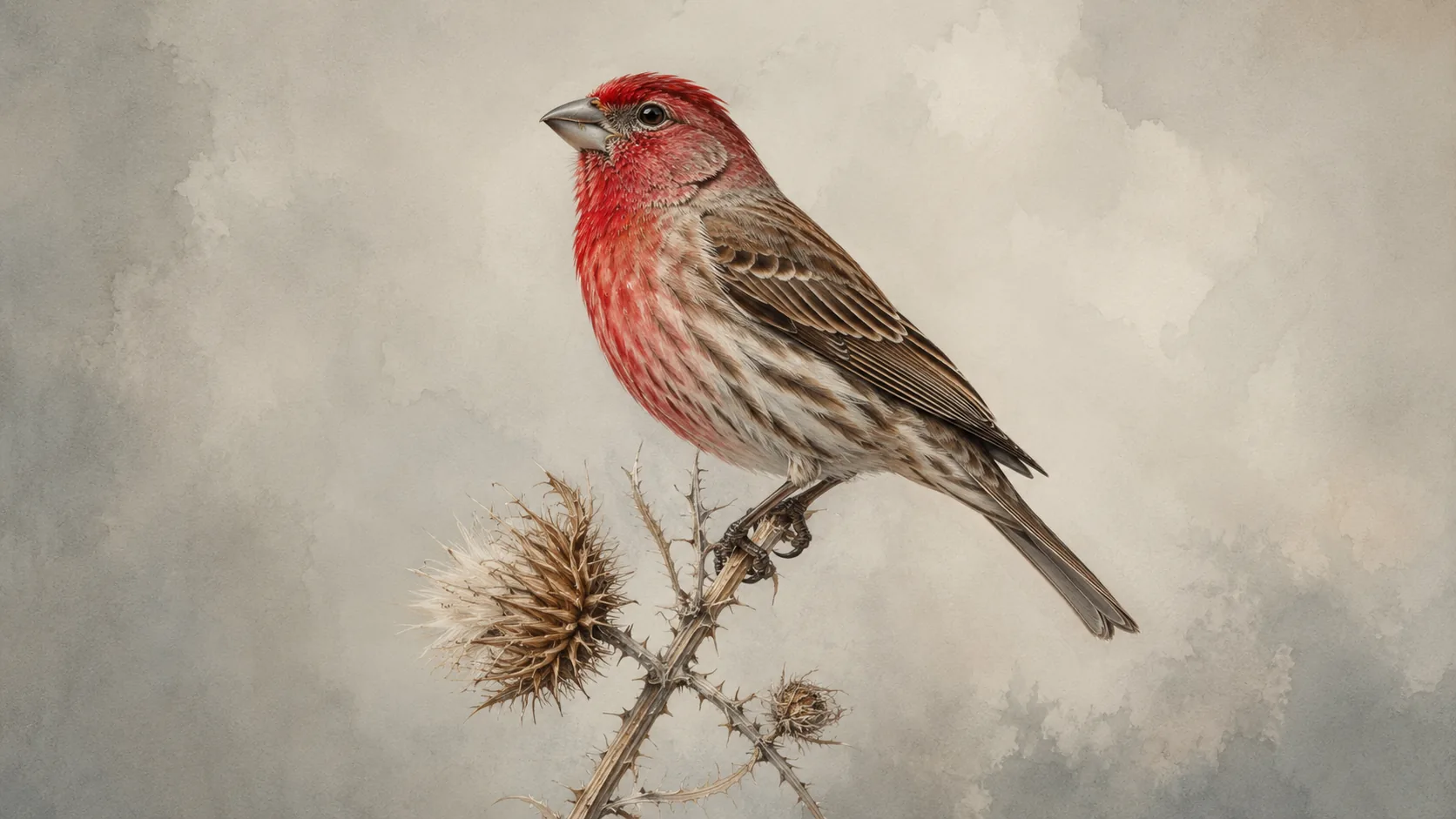
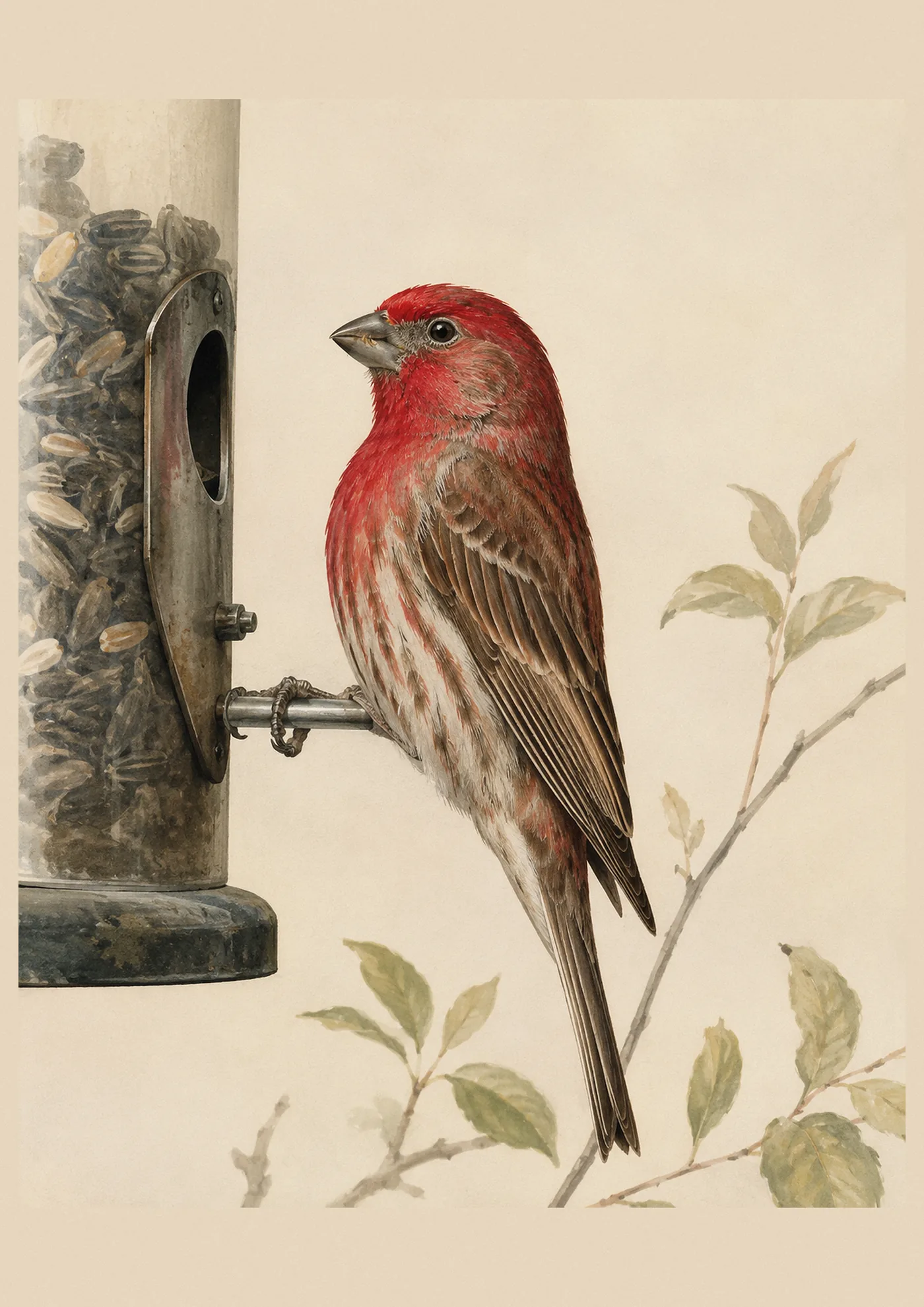
The male is 12 to 15 centimetres long, weighs 16 to 27 grams, and spans 20 to 25 centimetres at the wing. His red is not uniform. It concentrates on the forehead, the eyebrow stripe, the throat, the breast, and the rump, while the crown remains brown - a detail that separates him at a glance from the Purple Finch, whose male wears a more saturated wine-red over the entire head. The red’s intensity varies considerably: some males are pale orange, some are deep crimson, and a small fraction are yellow or orange, all depending on the carotenoid pigments available in the diet during the previous moult. This is dietary red, not genetic red. A male raised on carotenoid-poor food moults out pale and cannot deepen the colour until the following year.
His back is brown and streaked, his wings lack bold wingbars, and his tail is square-cut. The belly is white with brown streaking along the flanks. The bill is small, conical, curved at the culmen - a seed-cracker, not a generalist.
The female is entirely different. She is a study in brown streaks: plain brown above, white below, with blurry brown streaking running from throat to belly and no trace of red anywhere. Her face lacks any strong pattern. She is one of the more plain-faced streaked sparrow-like birds a new observer will encounter, and she is routinely misidentified at feeders. Next to a female Purple Finch she looks almost featureless - the Purple Finch female has a bold white eyebrow stripe and a cleaner face pattern.
Voice
He is a persistent and cheerful singer. The song is a loose, hurried warble lasting two to three seconds, rising and falling without strong structure, and ending in a characteristic upward-slurred note. Cornell’s Birds of the World describes the repertoire as including a clear call note, a flight-call chip, and the full song, which males deliver from exposed perches from late winter through early summer. At a busy feeder in February, his singing is often the first sign that spring is being negotiated, weeks before other species begin.
He does not mimick. He does not alarm in the corvid manner. His sound world is simpler and more domestic than a jay’s or a wren’s, which is part of why he has become the default songbird of the American suburb.
Range and Habitat
The native range covered the arid interior West: the Sonoran and Mojave deserts, Baja California, the Mexican highlands, and the coastal ranges as far north as southern British Columbia. This is a bird of open, dry country - canyon mouths, desert scrub, dry grassland edges, juniper woodland.
The introduced eastern population, descended from those 1940 Long Island birds, now occupies nearly every habitat type in the eastern half of the continent: rooftop HVAC units, hanging baskets of geraniums, Christmas wreaths still on the door in March, open cup nests tucked into the hollow of a downspout. Where the native bird required specific arid conditions, the introduced bird has demonstrated an almost contemptuous flexibility. Birds of the World notes that eastern populations now occupy “nearly all types of landscapes and climates in North America, from edges of northern taiga to ocean coasts to metropolitan areas.”
He does not migrate in the classic sense. Most populations are year-round residents. Some northern individuals move south in hard winters. He is not restless in the way of a warbler.
Diet
The House Finch is, by the standards of birds, almost entirely vegetarian. Seeds are the staple - weed seeds primarily, including thistle, dandelion, nettle, and grass seeds, plus grain when it is available. He takes buds, flower petals, and berries in season. His insect consumption is low even by passerine standards.
The more telling fact is what he feeds his nestlings. Most songbirds feed their young insects, which are protein-dense and suitable for rapid growth. The House Finch feeds his young regurgitated plant matter - seeds and pulp. This is unusual enough to merit attention. It means a successful House Finch nest does not require an insect bloom in the neighbourhood. It means he can breed successfully in conditions where insect-dependent species would fail. It is another expression of the same adaptability that got him from Long Island to Nova Scotia in three decades.
Breeding and Nesting
Breeding begins early, sometimes in February in southern populations, and a pair may raise two to six clutches in a single season. The female builds the open cup nest alone, in two to three days, in almost any cavity or sheltered site: a cactus arm, a conifer branch, a window box, a hanging fern, the nest of a Cliff Swallow. She lays two to six eggs, pale blue-green with sparse dark spotting. Incubation lasts 12 to 14 days and is done entirely by the female, who is fed by the male throughout. Nestlings fledge 11 to 19 days after hatching.
The male’s red matters here. Females prefer the reddest males available, and redder males are more attentive feeders of incubating females. The colour is an honest signal: a male who found enough carotenoid-rich berries and fruits in his winter foraging to moult out deeply red is a male who is good at finding food. Audubon’s field guides note this preference as a well-documented feature of House Finch mate selection.
The 1994 Disease
In January 1994, birdwatchers in the Washington DC area began reporting House Finches with swollen, red, weeping eyes at feeders. The birds were disorientated. Some were nearly blind. Cornell Lab of Ornithology’s Project FeederWatch, which enlists volunteer birdwatchers to track feeder species across the continent, began collecting reports.
The pathogen was identified as a unique strain of Mycoplasma gallisepticum, a bacterium previously known in domestic poultry. It caused mycoplasmal conjunctivitis, a disease that spread from bird to bird at feeders where infected individuals contaminated shared surfaces. The House Finch’s gregarious feeder behaviour - the packed clusters, the high contact rates - was the mechanism. A disease that might have fizzled in a more solitary species moved through House Finch flocks like fire through dry grass.
By the late 1990s the bacterium had crossed the continent. The Cornell Wildlife Health Lab estimates millions of birds died. The eastern population, already dense, took the hardest hit.
Project FeederWatch tracked the outbreak from 1994 through 2008. The data it produced - assembled by ordinary people at kitchen windows - became one of the most detailed longitudinal records of a wildlife disease ever compiled. The House Finch was the patient. The backyard birder was the epidemiologist.
The species recovered. It always does.
The House Finch was supposed to die in a New York winter in 1940. He did not, and the continent has not been quite the same since.