Symbolism
What the great horned owl actually means
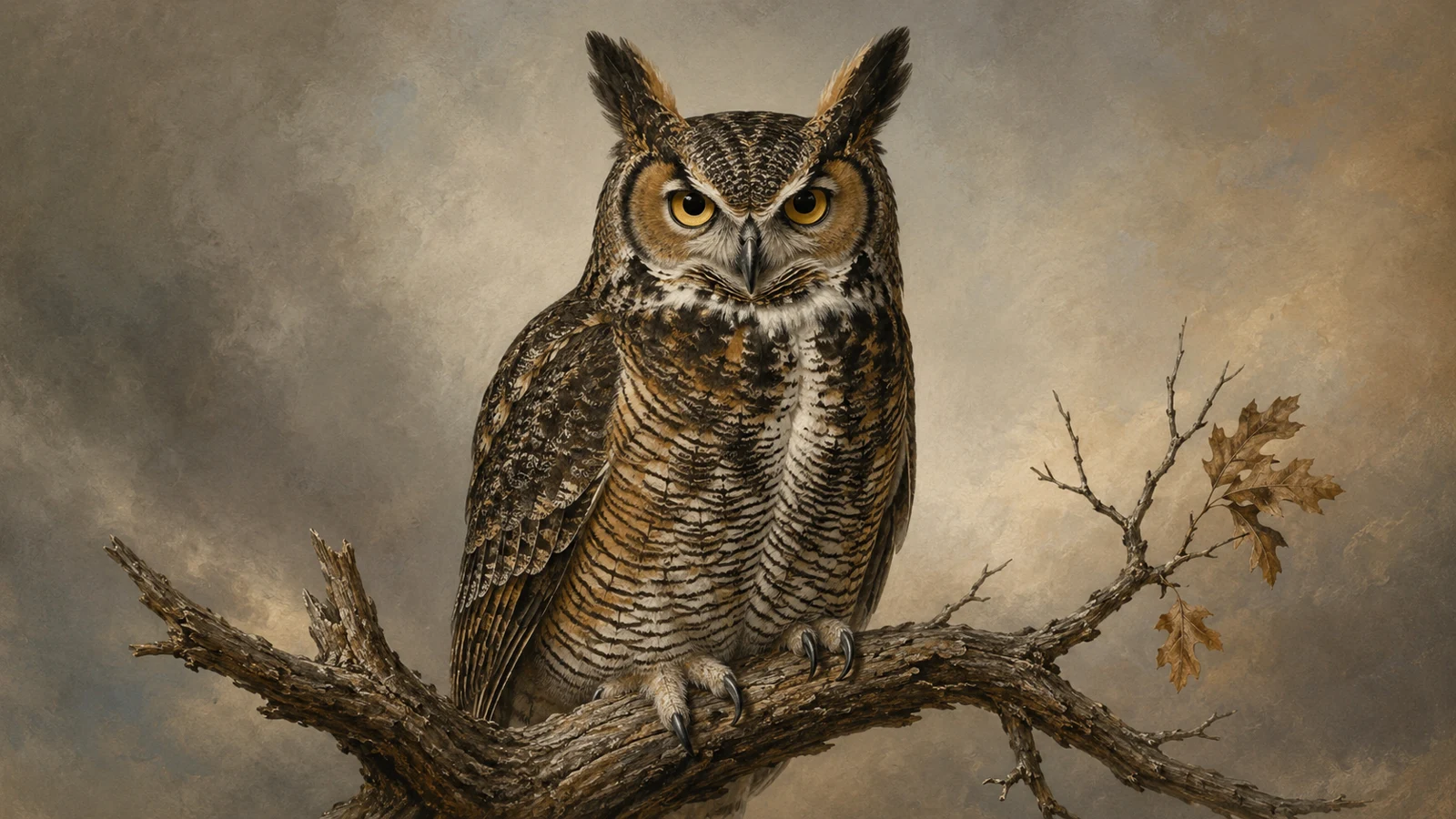
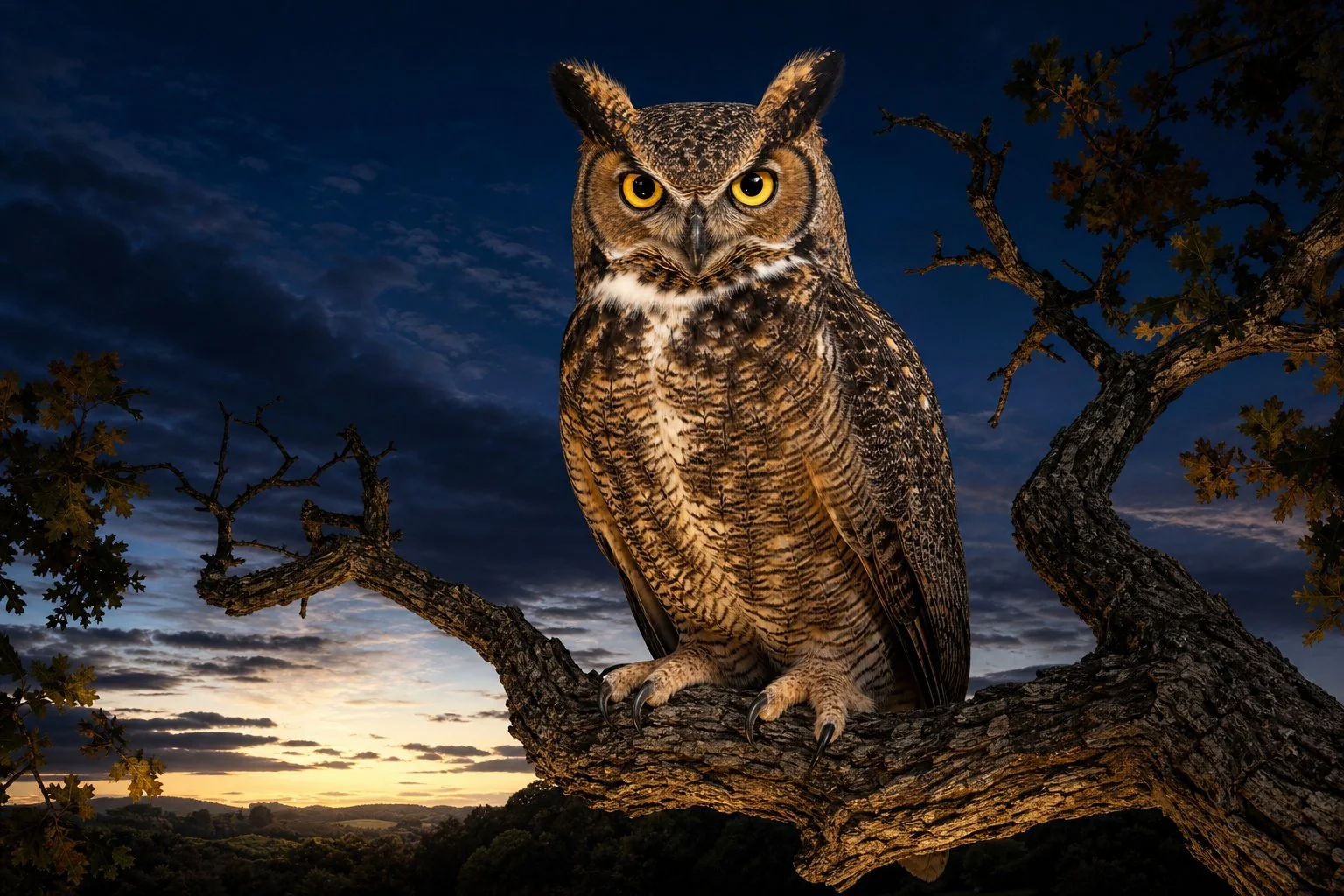
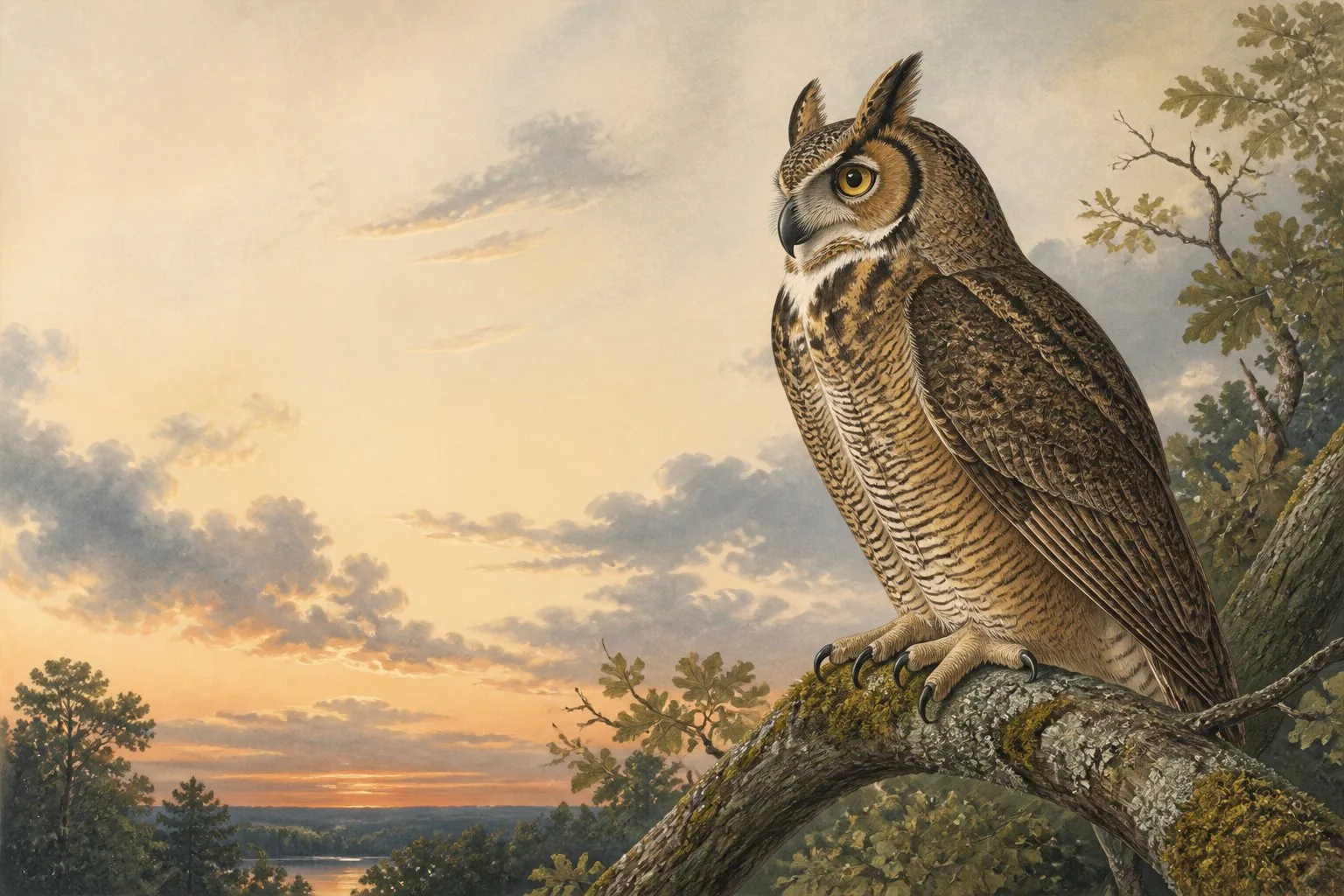
The prominent horns on a great horned owl are not ears.
They are called plumicorns - from the Latin pluma (feather) and cornu (horn). They play no role in hearing. The real ears are asymmetric slits hidden beneath the facial disc feathers, the right one sitting slightly higher than the left, positioned so sound arrives at fractionally different times on each side. That time difference lets the owl triangulate prey in three dimensions. It can detect a mouse moving under a foot of snow. The facial disc itself acts as a parabolic reflector - the owl raises those short feathers to amplify incoming sound the same way a person cups a hand behind an ear.
The plumicorns are probably used for camouflage (breaking the head silhouette against bark while roosting), intraspecies signaling (functioning like expressive eyebrows), and possibly threat display. A 2025 study in the family Strigidae found ear tufts correlate with enhanced camouflage in nocturnal owls facing visually-oriented predators during daytime rest.
The horns that made this bird look like a demon are probably just eyebrows.
What the biology explains
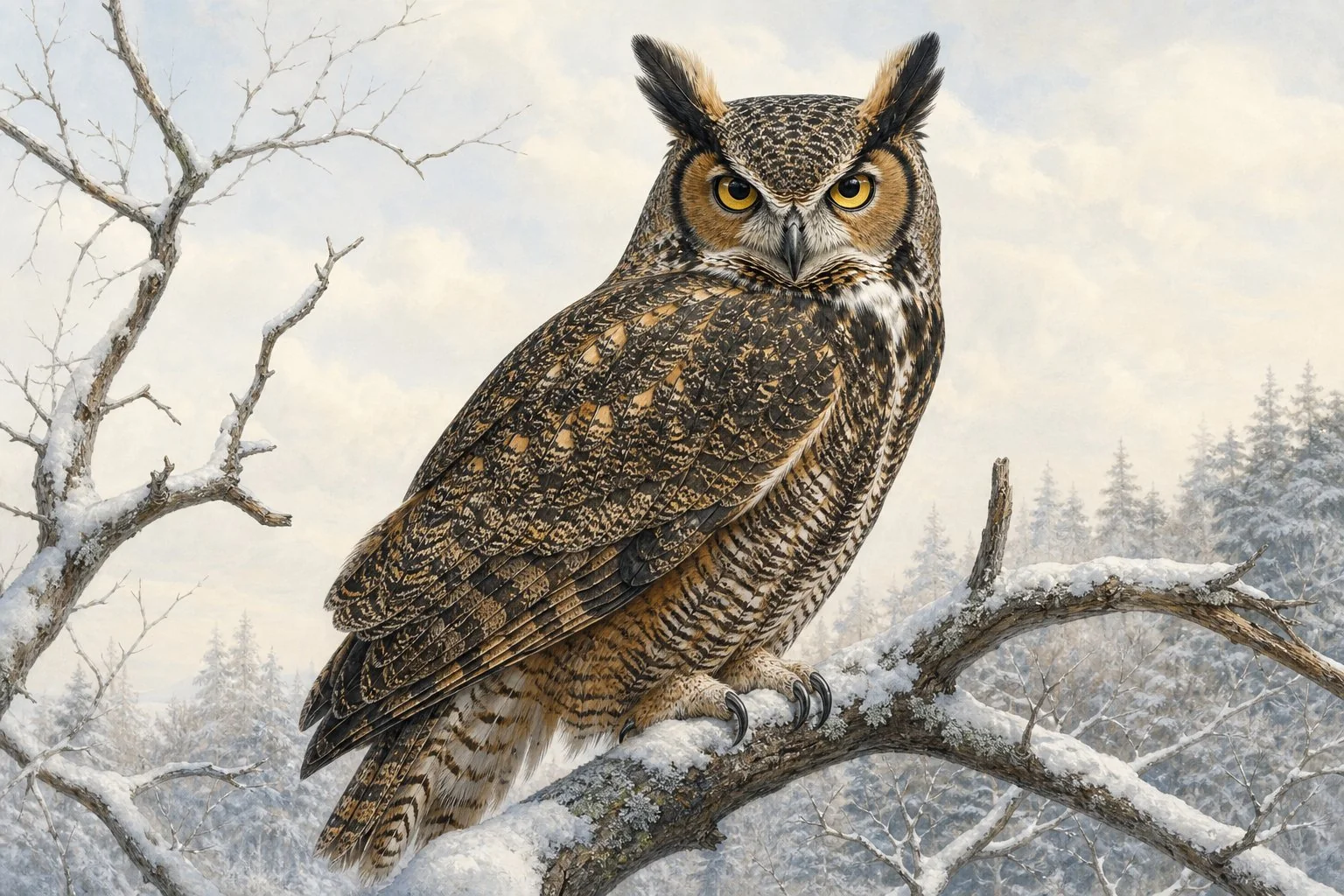
The great horned owl hoots in the dead of winter. Pair bonding begins in November; eggs are laid from late January through March in northern populations. The five-note hoot - hoo-h’HOO-hoo-hoo - operates at a frequency that travels through dense forest canopy over a mile. A deep resonant sound arriving out of midwinter darkness, with no visible source. Northern communities heard this when food was scarce, people were dying of exposure, and the nights ran to sixteen hours.
The association between this bird and death is not superstition. It is observation.
The great horned owl’s eyes cannot rotate in their sockets. They are fixed, forward-facing, and large enough that they account for most of the skull’s front - the bird can see only directly ahead, which is why it rotates its head 270 degrees. The forward-facing binocular gaze, held without blinking, gives the face a quality that observers across cultures described as human, or supernatural. The owl looks at you and does not look away.
The great horned owl hunts with a talon grip that operates at 300 pounds per square inch. A strong human athlete grips at around 70. The talons lock via a ratchet mechanism - interlocking ridges on tendons and tendon sheaths that maintain killing pressure without continuous muscle effort. It takes 28 pounds of force to open a closed great horned owl talon. Death arrives silently (the comb-like serrations on the leading flight feathers break up turbulence), and when the grip closes, the spine severs.
The great horned owl regularly takes skunks - it is the only predator that ignores the spray. It takes domestic cats, Canada geese, great blue herons, porcupines, and in documented cases, peregrine falcons and red-tailed hawks. It has no natural predators as an adult. It is the apex of the nocturnal food chain.
It also cannot build a nest. It occupies nests built by red-tailed hawks, crows, and great blue herons - moving in during November and December before the original builders return in spring, then leaving the nest wrecked. The apex nocturnal predator is also a squatter.
The Cherokee: same word, two meanings
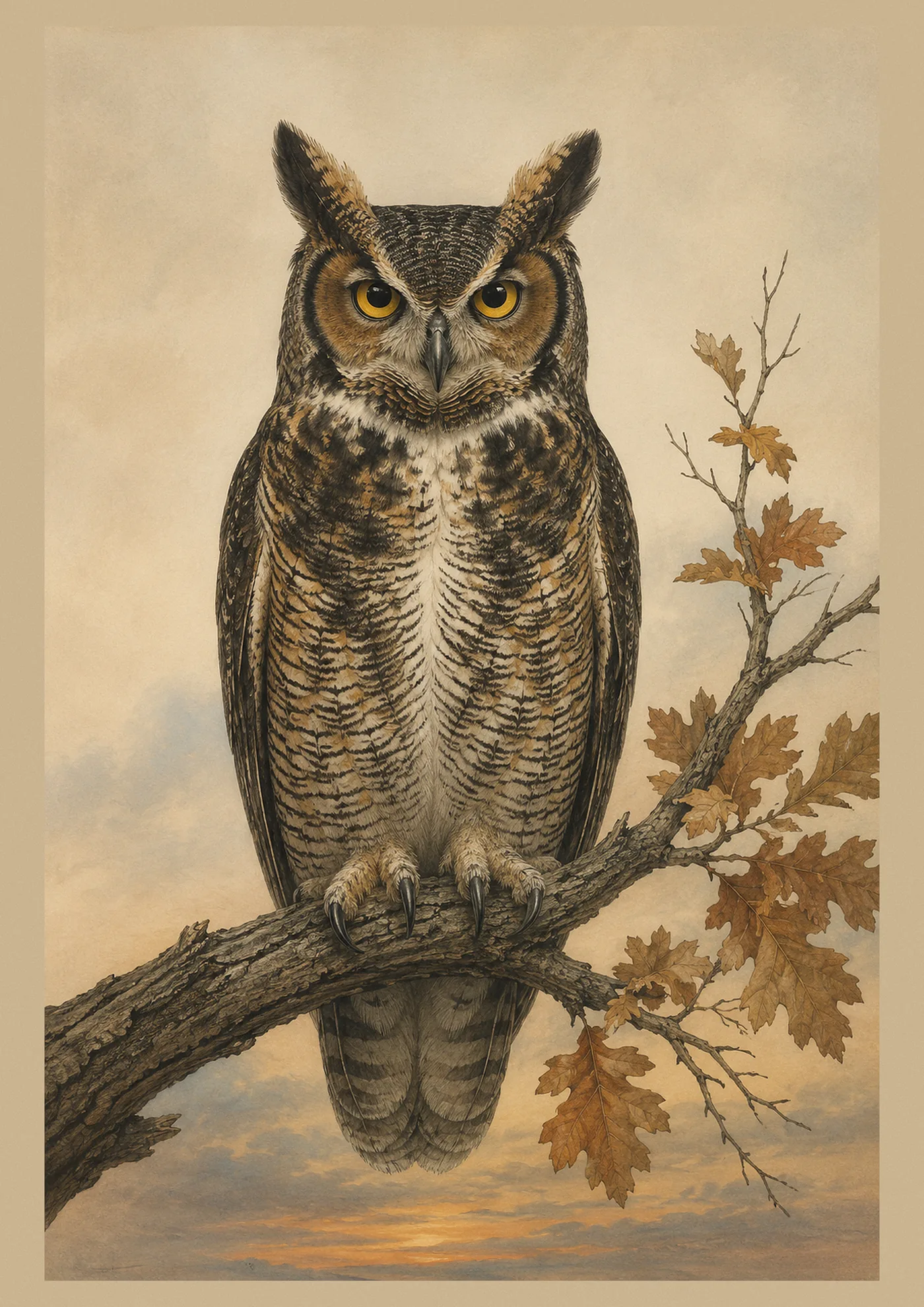
The Cherokee word “skili” - also rendered tsgili - means simultaneously the great horned owl and a witch. Not a metaphor. Not an analogy. The same lexical item applied to both.
James Mooney, the ethnographer who lived on the Qualla Boundary in western North Carolina in the 1880s and published “The Sacred Formulas of the Cherokees” (1891) and “Myths of the Cherokee” (1900), documented this directly: “Owls and other night-crying birds are believed to be the embodied ghosts or disguised witches, and their cry is dreaded as a sound of evil omen.”
The great horned owl IS the witch in animal form. A witch IS doing what a great horned owl does. The identification is not symbolic - it is categorical.
From Cherokee dark magic formulas, George Ellison documented a destructive spell that invokes “the black owl that hunts the darkness for your heart and soul.” The Cherokee also used screech owl calls for battle divination: calls from the right or left of a war party signaled victory; calls from ahead or behind signaled defeat. The owl was an oracle with a directional grammar.
The Navajo: unreliable prophet
The Navajo word ne’eshjaa’ covers owl generally, but the death-omen beliefs in Navajo territory attach most intensely to the great horned owl - the largest, loudest, and most common species in the region.
Hearing a great horned owl hoot near the hogan is an omen that someone in the family will die. Owl feathers found on the ground are left untouched.
The chindi is the ghost-residue left after death - everything that was negative about a person: their pain, fear, anger, disappointment. It leaves the body with the last breath and lingers near the bones and possessions. Traditional practice was to have a person die outdoors so the spirit could disperse. The great horned owl calling at night near a home was interpreted as either a chindi or its messenger.
But the Navajo Monster Slayer creation narrative gives the owl a specific and important qualification. Monster Slayer transforms a monstrous being into owl form and speaks this prophecy: “In days to come men will listen to your voice to know what will be their future. Sometimes you will tell the truth and sometimes you will lie.”
The owl is made an unreliable oracle. It warns, but it may also deceive. The death omen is real but not guaranteed. This ambiguity is documented, and it matters: the great horned owl is not simply the Navajo harbinger of death - it is the Navajo symbol of the kind of truth that cannot be trusted completely.
Navajo owl feathers are used in the Enemy Way ceremony to banish negative energy and protect against chindi influence. The bird that signals death also provides the ritual tool against death. This is the same object carrying opposite functions, and it is consistent across multiple Indigenous traditions.
The Hopi: policeman, not omen
The Hopi great horned owl kachina is named Mongwa. He is a warrior kachina and a disciplinarian.
In the Mixed Kachina Dance, Mongwa stands at the edge of the dance circle while Koshari clowns perform. Near the end of the ceremony, a group of Mongwa kachinas swoop down on the clowns, beat them with yucca whips, douse them with water, and leave them piled in the center of the plaza. The owl enforces proper behavior. He is the serious cop who stops the clowns from going too far.
The Hopi also observe that great horned owls eliminate rodents from peach orchards and agricultural fields. This is accurate: a great horned owl takes enormous numbers of rodents in any given territory. The Hopi pragmatic relationship to the bird - it keeps the crops safe - maps directly onto its ceremonial role. The owl is a guardian of order.
Mongwa kachina dolls are documented and collected artifacts, held in Southwest galleries and museum collections. This is one of the most specifically documented cases of great horned owl ritual identity in any Indigenous tradition.
The Choctaw: Ishkitini
The Choctaw word for the horned owl is Ishkitini. The Choctaw Nation’s own publication Iti Fabvssa documented it in October 2015: the Ishkitini “was believed to prowl at night killing men and animals. A screech from the Ishkitini meant sudden death, like murder.”
Choctaw witches (hatukchaya) could transform into owls to harm people. The distinguishing signs of a witch-owl: an unusually deep or strange hoot, the ability to laugh, unusual height, and human-like movement.
The Iti Fabvssa piece includes a contemporary account. Two elders encountered an unusually tall, bulky owl that danced. The next day, a local Indian doctor was hospitalized and had his leg amputated.
The Hopi / Navajo contradiction
The Hopi and Navajo are neighbors in the American Southwest. Their great horned owl traditions are almost mirror images.
For the Navajo: the owl signals death, its feathers left on the ground untouched, its presence requiring avoidance and ceremony.
For the Hopi: the same bird is a named supernatural figure, ceremonially central, his feathers used in kachina regalia, his image carved into dolls for children.
Same bird. Same geography. Opposite ritual positions. Any article that says “Native American traditions see the owl as…” has collapsed this distinction into nonsense.
The nations that don’t fear it
Pacific Northwest Coast nations - Haida, Tlingit, Gitxsan, Kwakwaka’wakw - carved owls into totem poles. The Gitxsan use the owl as a family crest symbol. Among the Kwakwaka’wakw, the sound of the owl summoned the spirit world, and in ceremony, Owl represents the Wise One and keeper of knowledge. This is closer to the European association of owl with wisdom than anything documented in Plains or Southwest traditions.
The Ojibwe/Anishinaabe position - documented by Ojibwe scholar Anton Treuer and academic Wendy Makoons Geniusz - is that owls are messengers, and meaning depends on context and behavior. An owl that comes unusually close to a home, that persists, that seems to seek attention: this is significant. An owl passing in the distance at night is not. The traditional Ojibwe response to a meaningful owl encounter is tobacco, prayer, and smudging - engagement, not avoidance.
The Lakota used owl feathers to protect children from evil spirits. The Lakota also associated some owls with the restless dead. A 2015 interview with an Oglala Lakota informant stated directly that while other cultures see owls as death omens, the Lakota see owls as representing “hope and power and wisdom.” First-person testimony is not overridden by secondary summaries.
What “owl = wisdom” actually means
The wisdom association is Greek, filtered through Renaissance European scholarship. The owl of Athena on the ancient Athenian coin is a tawny owl (Athena noctua) - an entirely different species, native to the Mediterranean. When symbolism articles invoke Athena and apply the meaning to the great horned owl, they are connecting two birds that never shared a continent.
The great horned owl is not found in Europe. European owl mythology - barn owl, tawny owl, little owl - developed around species that look nothing like this one and behave differently. The long shadow of “owl = wisdom” cast over great horned owl symbolism is a case of misapplied taxonomy.
The one consistent thing
Across documented traditions from the Choctaw in the Southeast to the Navajo in the Southwest to the Cherokee in Appalachia - nations that had no significant contact with each other for most of their histories - the great horned owl attracted the most intense supernatural associations of any North American bird.
The biology explains this. A five-pound animal that kills skunks, goats, and hawks. A grip you cannot open without 28 pounds of force. A hoot that arrives out of total darkness and travels a mile through winter trees. Eyes that find you and hold you without moving. Active during the coldest months, when people died.
What all these traditions share is that they were paying attention. The Hopi watched it police the orchards and made it the ceremonial policeman. The Cherokee noticed it moved like a witch and decided it was one. The Navajo heard it predict deaths and found it an unreliable prophet.
The symbolism is downstream of observation. The biology came first.