Field Guide
California Condor
The shadow arrives before the bird. Over the limestone rim of the Vermilion Cliffs in northern Arizona, a shape crosses the ground: not a cloud, not an aircraft, but something alive with a span wider than a man is tall, riding a thermal in absolute silence. Gymnogyps californianus - the California Condor - hangs there. Then it tilts one primary feather and peels away across 250 kilometres of open country to look for something dead.
That this bird is here at all is not natural history. It is a moral outcome. Whether that outcome holds is an open question.
What it looks like
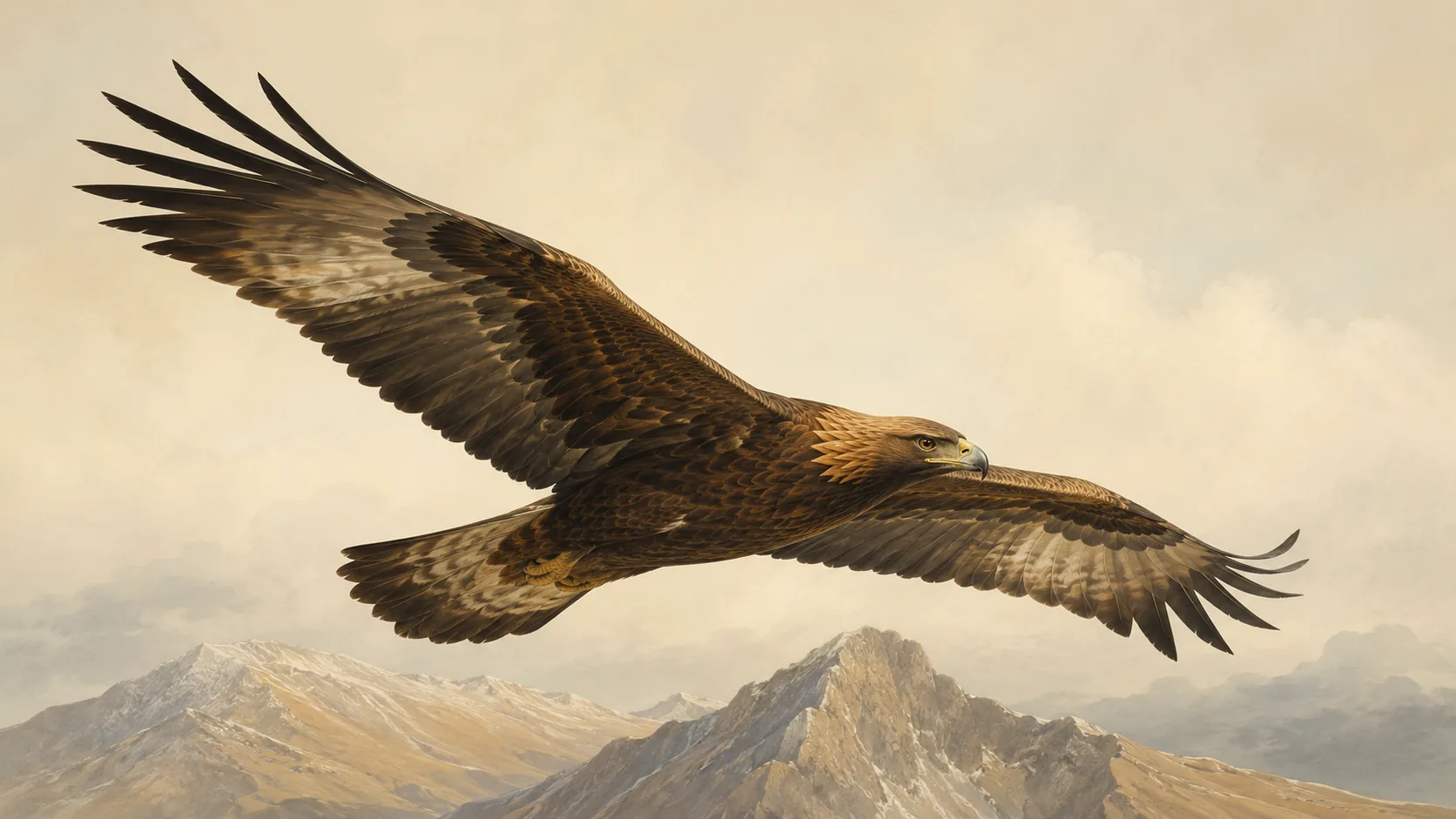
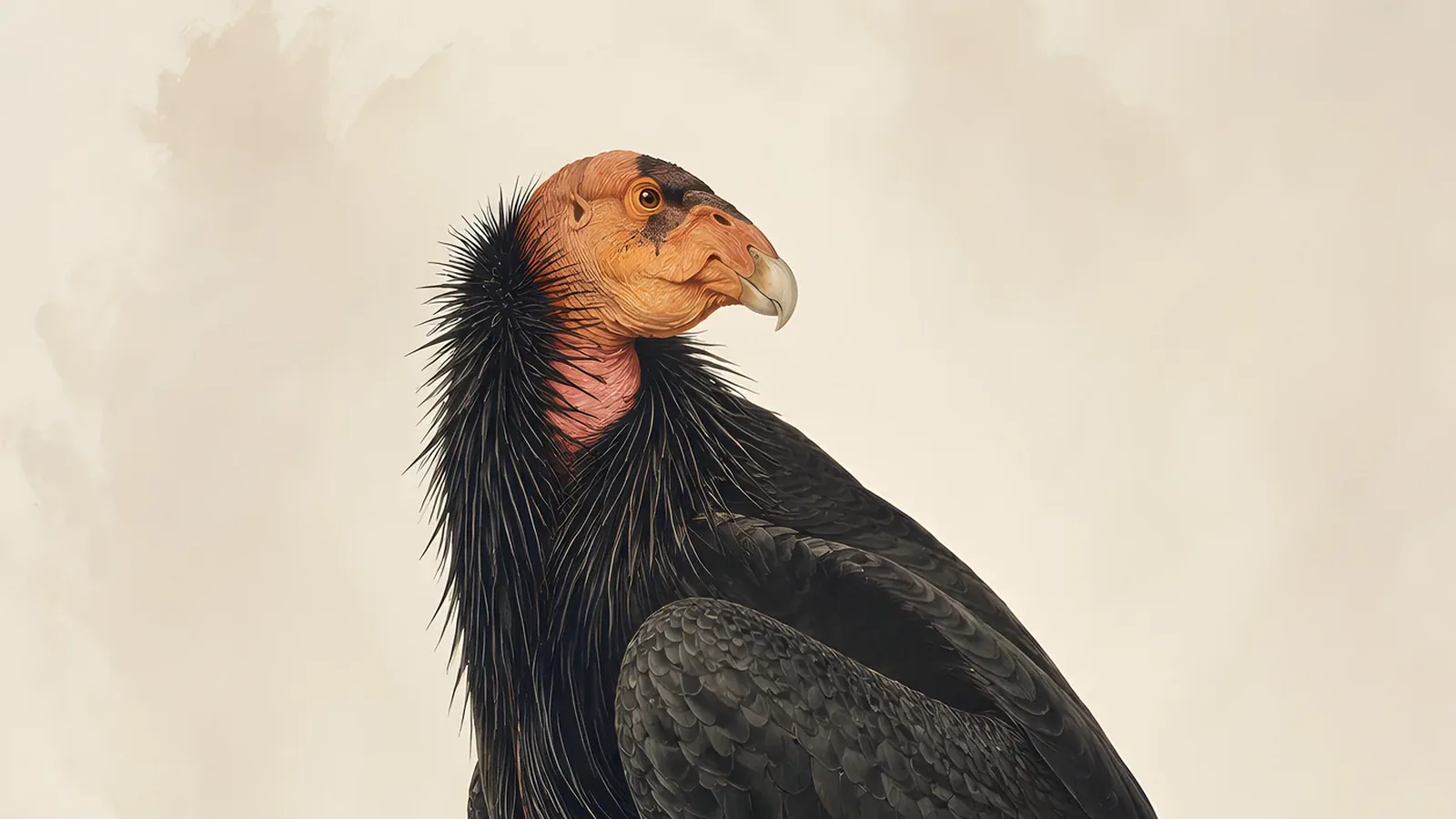
An adult Gymnogyps californianus is 117 to 134 centimetres long with a wingspan of 249 to 300 centimetres and a weight of seven to eleven kilograms. No land bird in North America surpasses it in either wingspan or the authority of its silhouette against sky.
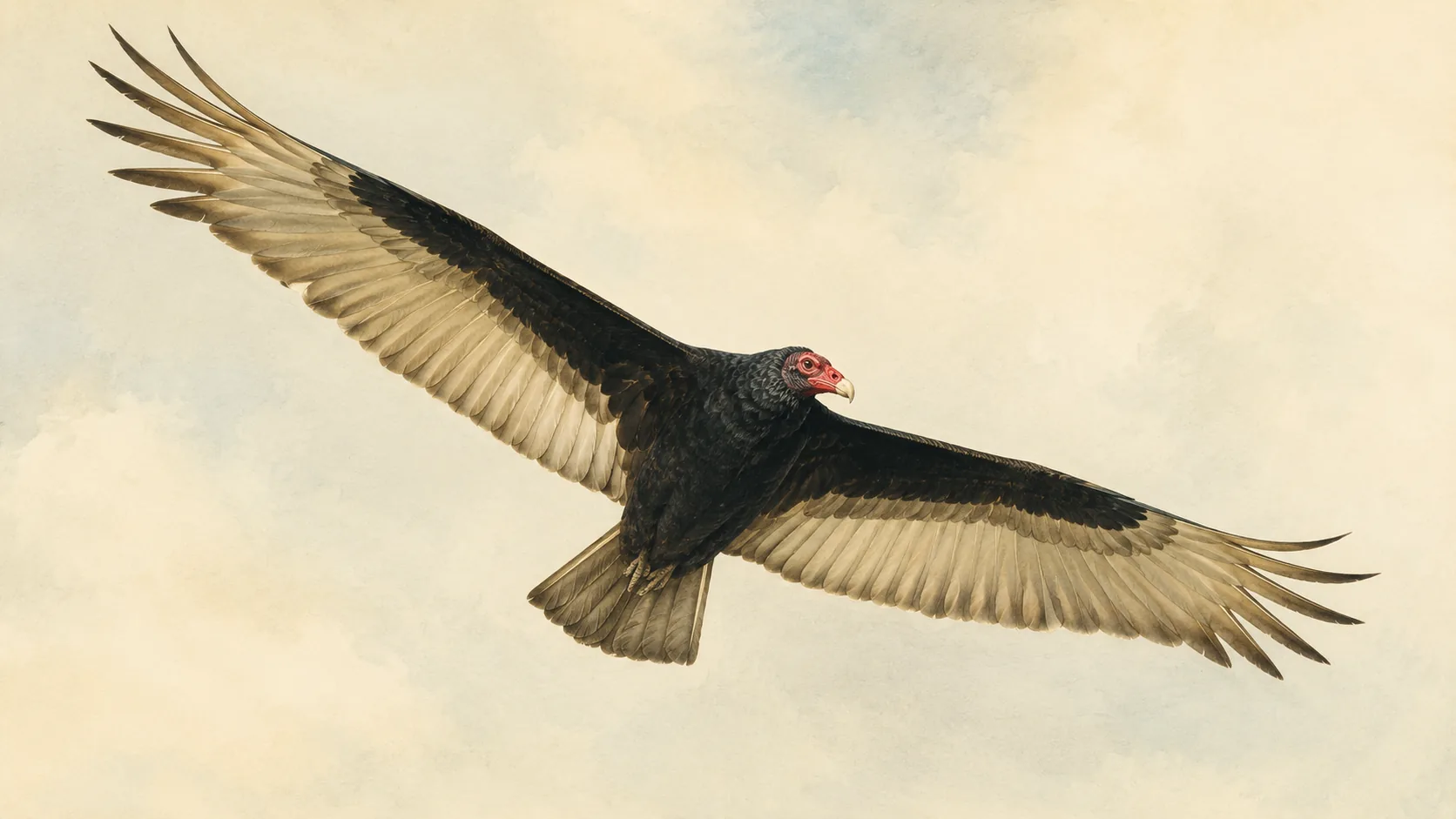
The plumage is jet black across the body and upper wings. The underwings carry a broad triangular white patch toward the leading edge - the primary field mark at any soaring altitude. Juvenile birds show mottled grey in place of the white, and the clean triangle develops through successive moults over five to six years.
The bare head and neck are orange-red to yellow in adults, skin that shifts colour with emotional state and stays cleaner than feathers could when plunging into a carcass. In juveniles the head is charcoal grey. The bill is ivory-white, deeply hooked. A collar of black feathers forms a ruff at the throat.
| Measurement | Range |
|---|---|
| Length | 117-134 cm |
| Wingspan | 249-300 cm |
| Weight (male) | 8.8 kg (7.9-9.9 kg) |
| Weight (female) | 8.1 kg (7.0-8.9 kg) |
| Lifespan | 45-60 years |
| Incubation | 53-60 days |
Males are slightly larger than females - unusual among raptors, where females are typically larger.
The silence
Gymnogyps californianus lacks a syrinx. Most birds use that organ - sitting at the junction of the trachea and the bronchi - to produce song and call. The condor has none. What sound it makes comes from expelled air: hisses when defending a nest, low grunts between individuals, the rapid hiss-grunt sequence of a chick asking to be fed. That is all.
In flight there is one sound audible from below: a steady shrill hiss produced by air passing through the primary feathers. In a long steep dive this becomes a roar sometimes audible at a kilometre. The bird itself makes none of it intentionally.
The silence matters because condors have a complex social hierarchy settled not by calls but by body posture. A submissive bird loosens its wings in a posture that resembles a begging nestling. The message travels without sound. It is a complete social system built without voice.
What it eats
The condor eats carrion exclusively - deer, cattle, sheep, elk, marine mammals washed ashore, and historically the megafauna of the Pleistocene whose disappearance may have left the species ecologically stranded. It does not kill.
Foraging is by eyesight, not smell - unlike the turkey vulture, which tracks volatile decomposition compounds to find carcasses hidden beneath forest canopy. The condor watches other scavengers, reads the sky, and when something below fits the pattern, descends. A single large carcass can draw dozens of birds within hours.
A condor can consume up to 1.4 kilograms of flesh in a single feeding, then fast for days. It travels up to 250 kilometres from a roost (San Diego Zoo Wildlife Alliance), using thermals to cover ground at almost no caloric cost.
Twenty-two birds
In 1982, the entire wild California Condor population had declined to 22 individuals. The decision to capture all remaining wild birds was controversial, but it saved the species from extinction.
- U.S. Fish and Wildlife Service, California Condor Recovery Program
By 1982 the species was in the arithmetic of extinction. Twenty-two birds. Carl Koford had published the first scientific study in 1953. The US Fish and Wildlife Service had listed the condor as endangered in 1967. None of it stopped the slide.
The last wild condor - a male known as AC-9 - was trapped on 19 April 1987. The wild was empty.
The birds went to the San Diego Wild Animal Park (now San Diego Zoo Safari Park) and the Los Angeles Zoo. Egg-pulling - removing the first egg to stimulate a replacement clutch, incubating both artificially - multiplied the breeding rate. Keepers fed chicks using hand puppets shaped like condor heads.
Reintroductions to California began in January 1992. Six birds were released near the Vermilion Cliffs in Arizona in December 1996. A small population was established in Baja California from 1992 onward. By 2022, 347 condors were free-flying and 214 were in captivity (IUCN assessment, 2022). By December 2025, the total reached approximately 600 individuals, with roughly 390 in the wild (Bakker and Finkelstein, Nature Communications, 2026). All modern birds trace their descent from 13 founders.
Every wild condor carries a numbered wing tag visible in the field. Most carry GPS telemetry. Every six months, field teams trap birds for blood draws and replace worn tags.
The lead problem
Finkelstein and colleagues published in the Proceedings of the National Academy of Sciences in 2012 that approximately 50 percent of free-flying condors had required lead poisoning treatment since monitoring began in 1997. The isotope ratios in their blood matched spent ammunition - not geological lead, not paint. Ammunition.
A hunter shoots a deer with lead-core bullets. The bullet fragments on impact. The hunter dresses the animal and leaves the gut pile. A condor finds it. The condor ingests lead fragments too small to see, too numerous to avoid. At sublethal doses, lead impairs neurological function. At higher doses it kills.
Finkelstein calculated that if as few as 0.5 percent of carcasses in condor range contained lead, the probability that each free-flying bird would be exposed over a ten-year period was 85 to 98 percent (Finkelstein et al., PNAS, 2012). A 2026 study by Bakker and Finkelstein at Montana State University and UC Santa Cruz, in Nature Communications, found that birds with potentially lethal blood-lead levels had nearly doubled in the preceding five years as condors ranged farther from monitored release sites. Lead poisoning accounts for approximately 50 percent of known condor mortality from 1992 to 2022.
California banned lead hunting ammunition statewide in 2019. Arizona runs a voluntary non-lead program. Condors now range beyond both. The wild population cannot sustain itself without chelation treatment and return - at a cost of approximately five million dollars annually (Finkelstein et al., PNAS, 2012).
Breeding and the long climb back
California Condors do not breed until they are six years old. A bonded pair produces a single egg per clutch - white or pale blue-green - laid on bare rock or in a cliff cave between January and May. Both parents incubate for 53 to 60 days. A chick can take up to a week to emerge from the shell and remains dependent on its parents for up to two years. A breeding pair may raise one chick every two years under ideal conditions. A population recovering from 22 individuals on this schedule is a slow machine.
The captive egg-pulling program circumvents this: remove the first egg for artificial incubation, the pair lays again, sometimes producing three eggs where wild biology allows one. The San Diego Zoo Safari Park has hatched over 250 condors since 1983 (San Diego Zoo Wildlife Alliance).
Wild-hatched chicks now fledge at five sites in California, Arizona, Utah, and Baja California. In 2023, Highly Pathogenic Avian Influenza killed 21 condors in the Utah-Arizona flock, including 13 individuals from eight breeding pairs - one disease event erasing years of reproductive progress.
What the recovery shows is that the species is biologically capable of persistence. Given safe food and freedom from lead, a California Condor can live 45 to 60 years and raise young. The question the recovery program has not answered - and that Bakker and Finkelstein’s 2026 paper makes urgent - is whether the wild will ever be clean enough for the management to step back. The condor has survived everything except us. Whether it can survive us continuing to use lead ammunition in its foraging range is the only question that matters now. It is not a biological question.