Field Guide
Great Crested Flycatcher
A bird calls from somewhere in the summer oaks of Virginia - loud, rising, slightly raspy, a single upward whistle that carries without effort through the closed canopy. You stop walking. You tilt your head. The call comes again. You search twenty feet up, thirty feet up, scanning the flat dark shade where the crowns of red oaks meet and the light gives out. Nothing. The bird calls a third time and falls silent.
You have just had an entirely standard encounter with Myiarchus crinitus, the Great Crested Flycatcher - a bird that, across much of its range, is heard dozens of times for every once it is seen. It is loud. It is common. It is a fixture of every eastern hardwood forest from May through August. Most people who have walked a summer trail have heard one and never known what it was.
That invisibility is the bird’s first character. Its second is more unusual: it is the only flycatcher breeding in the eastern United States that nests inside a tree hole, and inside that hole it tucks something that has fascinated naturalists for two centuries.
What it looks like
Myiarchus crinitus runs 19 to 22 centimetres in length, weighs 27 to 40 grams, and spans 33 to 38 centimetres from wingtip to wingtip - about the size and heft of a slim American Robin, though it carries itself differently (Animal Diversity Web, University of Michigan 2024). Banding data in the Cornell Lab’s records document one individual reaching at least 14 years and 11 months, making it the longest-lived confirmed Myiarchus on the continent.
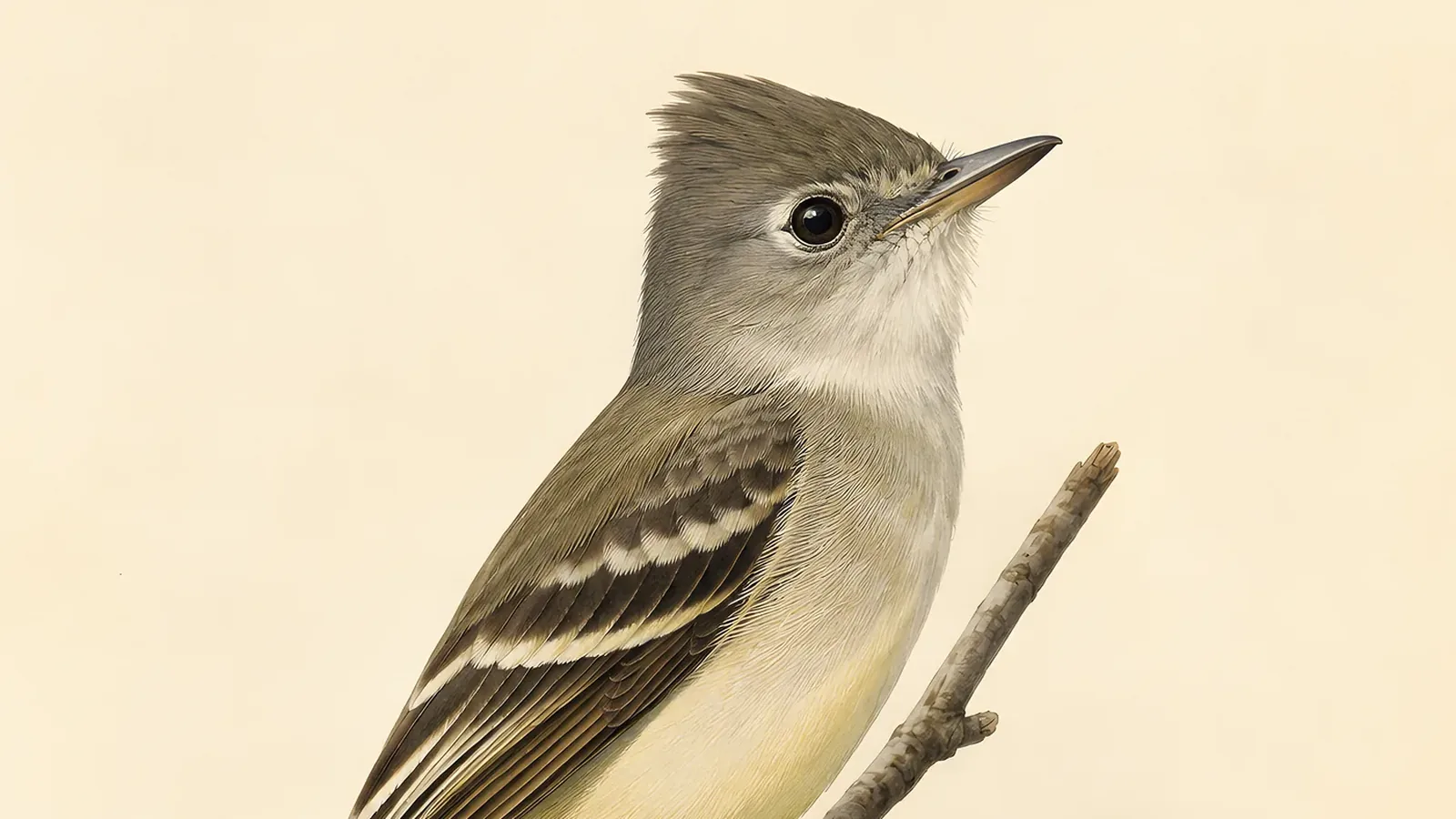
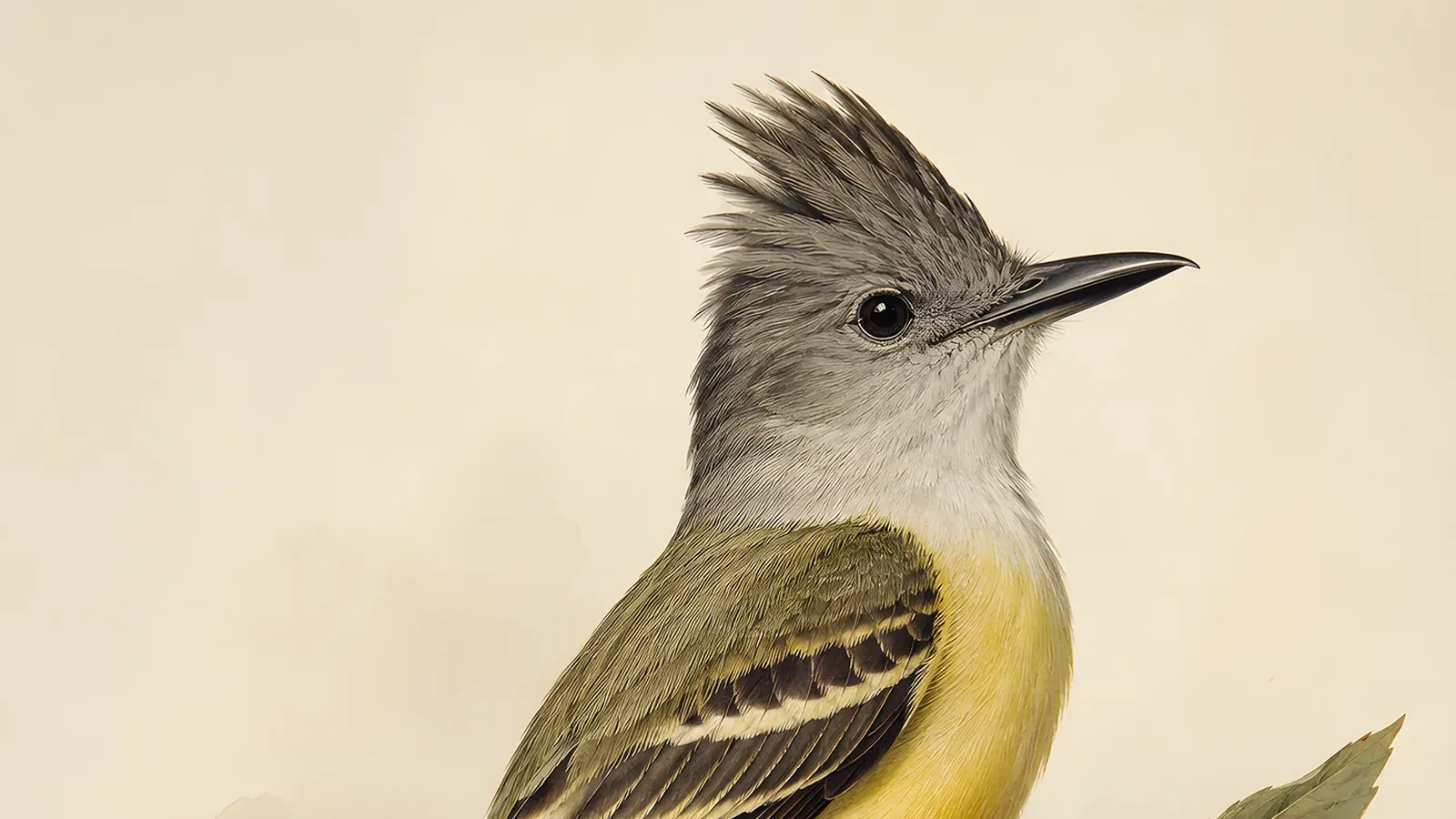
The plumage follows a logic that rewards attention once you know the key: grey where the body faces forward, yellow where it faces down, warm rufous wherever the tail shows.
The crown and face are a dark charcoal-grey, shading to a slightly paler grey on the throat and breast. The back and wings are dull olive-brown. The belly is a clear lemon-yellow - not washed-out or pale, but a solid primary yellow that pulls the eye even in low canopy light. The tail feathers and the secondaries of the wing are cinnamon-rufous, visible as a warm brick glow in flight or when a perched bird fans its tail. The bill is heavy and black, broad at the base, built for a bird that catches large moths and beetles in flight.
The crest is real but modest - a raised cap of darker feathers that lifts when the bird is alert and flattens in calm. Kenn Kaufman, in Lives of North American Birds (1996), describes the overall impression as “olive-brown head and back; clear gray throat and chest contrasting with bright yellow belly.”
| Measurement | Range |
|---|---|
| Length | 19 - 22 cm |
| Weight | 27 - 40 g |
| Wingspan | 33 - 38 cm |
| Lifespan (recorded max) | 14 years, 11 months |
Sexes are identical in plumage. Juveniles are slightly duller overall but structurally identical to adults from the first autumn.
The voice in the canopy
Wheep. A single rising note, loud enough to carry two hundred metres through summer forest. Ask any birder who works the eastern deciduous zone and they will tell you: you learn this call before you learn the bird.
The Audubon field guide describes the primary call as “a loud, whistled, slightly buzzy wheep” (Kaufman 1996). This is the contact and territory call given repeatedly from canopy perches through the breeding season, and it is the sound by which most birders locate the species. A secondary call - a rapid, clipped whit-whit-whit-whit - is given during territorial disputes or when the bird is agitated. A softer churr passes between mated pairs at close range.
The bird’s habit of calling persistently from high perches while remaining invisible to observers below is the direct consequence of its ecology. It works the upper crown of mature deciduous forest, foraging by scanning from a perch and sallying out to take insects in the air or from leaf surfaces - a technique that requires height, not concealment. The same height that makes it an effective aerial hunter makes it nearly impossible to watch at length. Most sightings are brief: a flash of rufous as it turns in light, then gone.
The snakeskin nest
Here is the behaviour that made the Great Crested Flycatcher a footnote in natural history texts long before anyone understood what it meant.
Myiarchus crinitus is an obligate cavity nester. It takes old woodpecker holes, natural tree hollows, and nest boxes, generally choosing cavities 20 to 50 feet above the ground (Kaufman 1996). The female builds the nest herself, filling the cavity with leaves, bark, fur, feathers, grass, and debris - a loose, bulky mass that nearly fills the hole before the actual nest cup is added. And into the lining of the nest she almost always weaves a shed snakeskin.
This habit is recorded in ornithological literature going back to the nineteenth century. Where no snakeskin is available, the bird substitutes crinkly cellophane, plastic wrapper, or any thin shiny material that shares the snakeskin’s reflective, papery quality. The substitution is telling: the bird is selecting for a specific optical property, not for the object itself.
For much of the twentieth century the snakeskin habit was treated as a curiosity with no agreed explanation. In December 2024, Vanya G. Rohwer and colleagues at Cornell University published a study in The American Naturalist (Rohwer, Houtz, Vitousek, Bailey, and Miller 2024, doi: 10.1086/733208) that provided the first strong experimental evidence for what the snakeskin actually does. Examining 78 cavity-nesting species from historical egg-collection records and controlled field trials, they found that cavity nesters incorporate shed snakeskin roughly 6.5 times more often than open-cup nesters. In the field experiment - using nest boxes with and without snakeskin - nest boxes with snakeskin retained all eggs through a 14-day trial period 75% of the time, compared to 38% for boxes without it. Trail cameras identified flying squirrels as the primary predators, and the mechanism proposed is straightforward: small mammals that are themselves prey for snakes show avoidance responses to snake-associated stimuli, and a nest that smells and looks like a shed skin may trigger exactly that response.
The Great Crested Flycatcher, nesting in tree holes shared with snakes and the small mammals snakes eat, appears to have exploited a very old fear.
Range and habitat
The species breeds across the eastern half of North America, from the Atlantic coast west to the Great Plains, and north into the southern tier of Canada - southern Ontario, Quebec, and the maritime provinces. The breeding range covers Pennsylvania, Tennessee, Ohio, Virginia, New York, the Carolinas, and the full extent of the southeastern states. A small, partly resident population exists in southern Florida.
Breeding habitat is deciduous or mixed-deciduous forest with a semi-open canopy - mature woodland with large trees carrying natural cavities or old woodpecker excavations. The species avoids pure conifer stands and dense continuous interior forest equally. It is a bird of mature hardwood edges, second-growth with large snags, and suburban woodlots where big trees remain standing. The critical variable is not tree species but the presence of existing cavities. A forest without dead standing wood is a forest without this bird.
Migration begins in late August, with most birds leaving northern breeding areas by mid-September. Wintering grounds run from southern Mexico through Central America and into northwest South America. The birds return north in April and May, and pairs begin investigating cavities almost immediately on arrival. They travel alone, not in flocks, moving mostly at night.
The species is classified as Least Concern on the IUCN Red List, with populations considered stable across its broad range (BirdLife International). The North American Breeding Bird Survey data shows no significant long-term decline. The primary threats recorded are loss of snags in managed forestland, collision with man-made structures on migratory routes, and pesticide exposure reducing insect prey. Where snags are retained and nest boxes are provided, local populations respond readily: Miller (2002) found nesting success in boxes and natural cavities essentially equal, 37% versus 38% (Miller, K.E. 2002, The Wilson Bulletin, 114: 179-185).
Diet
Myiarchus crinitus is primarily insectivorous during the breeding season. It forages from high perches in the upper canopy, watching for movement and then sallying out in a brief aerial pursuit - a technique called hover-gleaning that takes prey off the surface of leaves, bark, and branches, or catches it mid-air. Prey includes caterpillars, moths and their larvae, beetles, katydids, crickets, grasshoppers, bees, wasps, and flies, along with spiders. The bird occasionally takes small lizards. Necropsy records from Florida document consumption of green anoles.
During migration and on the wintering grounds, the diet broadens considerably. Small fruits and berries become significant, and in some tropical wintering habitats fruit may be the dominant food source. This dietary flexibility is common in tyrant flycatchers and reflects the seasonal absence of large flying insects at temperate latitudes in winter.
The acadian flycatcher fills a different ecological slot: it forages lower in the canopy, over shaded creeks and ravines, and takes smaller prey. The Great Crested stays higher and catches larger insects. The two species often breed in the same forest without direct competition.
Breeding
Pairs form on the breeding grounds shortly after arrival in late April and May. Nest-site selection is driven almost entirely by the female. Natural cavities - old flicker holes, pileated woodpecker excavations, natural splits in large hardwoods - are preferred. Nest boxes with entry holes of five to six centimetres are accepted readily, and the Cornell NestWatch database records hundreds of successful nest-box seasons across the species’ range.
The female builds the entire nest, a process that produces a loose mass of leaves, debris, and soft materials that nearly fills the cavity before the cup itself is formed. A snakeskin - or its synthetic substitute - is woven into this material before egg-laying begins. Clutch size runs four to eight eggs, most commonly five. The eggs are buffy, densely streaked in brown and purple, and among the most distinctively marked eggs in eastern North American passerines. Incubation lasts 13 to 15 days, performed by the female alone. Nestlings fledge at 13 to 15 days and remain in the care of both parents for up to three weeks after leaving the cavity.
The species breeds once per year and does not regularly attempt replacement clutches after loss, though pairs may re-nest after early failure. Sexual maturity is reached at one year in both sexes.
What the snakeskin tells us is something worth sitting with. This is a bird that has been finding and hoarding shed skins since long before any of us were watching - a behaviour old enough that it has transferred seamlessly onto manufactured plastic, because the underlying logic is sound: occupy a dark hole, advertise a predator at the entrance, and survive. The Great Crested Flycatcher has been running this trick in the eastern forest for longer than the oaks have been standing.