Field Guide
Chaffinch
In the 1950s, a Cambridge ornithologist named William Thorpe took young Chaffinches and raised them in acoustic isolation. The birds grew up and sang - but the songs they produced were impoverished, structurally wrong, clearly unfinished. Then Thorpe played them recordings of adult Chaffinch song during a critical window early in their lives. The birds listened, and the songs snapped into shape.
What Thorpe demonstrated was that Fringilla coelebs does not hatch knowing its song. It learns it. And not just any song - it learns the local version, the dialect of the patch where it was raised. Move a young male 20 kilometres and he picks up a slightly different ending, a different flourish on the terminal phrase. Move him 200 kilometres and the song is recognisably different. The Chaffinch carries the acoustic signature of its home ground.
This makes the Chaffinch something more interesting than “a common garden finch.” It is one of the first species for which cultural transmission of learned behaviour was rigorously established in a wild bird, and the experiments have shaped how ornithologists think about song learning ever since.
What he looks like
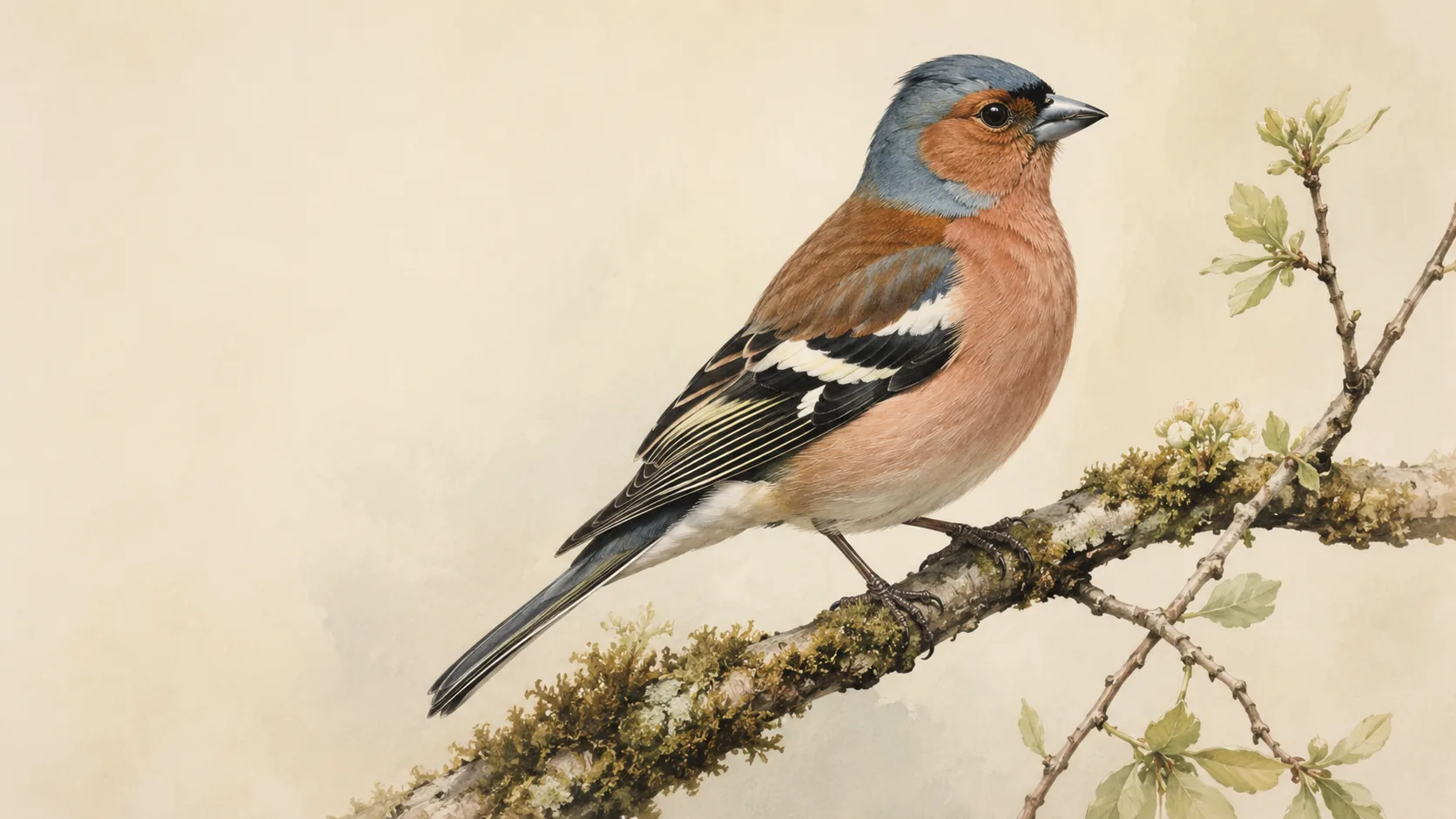
A breeding male is one of the more precisely assembled birds in the British Isles. He is 14 to 15 centimetres long and weighs between 18 and 29 grams - roughly a sparrow’s build, but dressed quite differently. The crown and nape are slate blue-grey. The back is chestnut-brown. The underparts run from a clean pink-peach at the breast fading toward a paler belly. The rump is green. Two sharp white wingbars cut across each wing. The tail shows white outer feathers that flash in flight.
She is not drab - she is cryptic. The female carries a warm olive-brown above with grey-white below, narrower wingbars, and the same green rump. The distinction matters at a feeder: the bird with the pink breast is the one singing. She is the one building the nest.
Both sexes show the white tail flash in flight, which is the quickest field mark at distance. At close range the male’s blue-grey crown is definitive. He is occasionally confused with a Brambling, a winter visitor who shares the white wingbar and upright posture, but the Brambling’s orange shoulder patches and dark back resolve the question immediately.
What he sounds like
The song is a descending run of notes that accelerates into a flourish at the end - a phrase of roughly two seconds that the male repeats from a prominent perch. Each male carries two to four song types and switches between them. Cornell’s Birds of the World notes that the terminal flourish varies across populations, with distinct dialects recorded at regional scales across Europe. Research by Lachlan and Slater (Animal Behaviour, 2003) found that chaffinches show a significant preference for learning from males about 500 metres from their natal territory rather than from immediate neighbours - which may function to reduce inbreeding by creating more diverse local song pools.
Beyond the song, the species has a sharp pink or pink-pink contact call that carries well across garden and field. There is also the ‘rain call,’ a soft plaintive whistle that has given rise to the folk belief that chaffinches predict wet weather. The call precedes rain often enough in some studies to have attracted genuine scientific attention, though whether the bird is responding to barometric change or to some other cue remains unsettled.
Range and habitat across the year
The BTO’s Bird Atlas 2007-11 recorded the Chaffinch in 94 per cent of UK recording squares, making it one of the two or three most widely distributed breeding birds in Britain and Ireland. The global range runs from the Atlantic coast of Europe east to Siberia, and south through the Mediterranean into North Africa. Introduced populations have established in New Zealand and South Africa.
He is a year-round resident across most of the British Isles. In autumn and winter, resident birds are joined by large numbers of migrants from Scandinavia and northern Europe, and these winter flocks can contain thousands of birds moving through farmland and woodland edge. It was the composition of these Scandinavian flocks that gave the species its scientific name: Linnaeus named it coelebs, meaning ‘bachelor,’ because the flocks arriving in Sweden in winter were composed almost entirely of males, the females having wintered further south.
Habitat across the breeding season is broad: oak and mixed deciduous woodland, garden edge, hedgerow, farmland with trees, parks. He is not a bird of open moorland or dense conifers, but almost anything with scattered trees and a clear ground layer where he can forage suits him. The BTO records a significant winter shift toward lowland farmland, where birds forage on stubble and field margins alongside Bramblings, Reed Buntings, and Yellowhammers.
Diet
The Chaffinch is a seed-eater for most of the year, taking fallen seeds from the ground rather than clinging to a seed head. Beech mast is the preferred autumn and winter food in woodland, and flocks of dozens of birds will work the leaf litter under beech trees through October and November. At feeders he tends to forage below rather than on them, picking up what other birds drop.
The diet changes sharply in the breeding season. BTO research has confirmed that chaffinches provision their nestlings almost entirely on invertebrates - caterpillars, aphids, and other soft-bodied larvae - with very little seed given to chicks at any stage. The switch is precise: adults eat seeds, young are fed insects. This means that Chaffinch breeding success is closely tied to the timing of caterpillar emergence on deciduous trees, particularly oak. A cold spring that delays leaf burst delays the caterpillar peak and can compress the window when parents can provision chicks efficiently.
Breeding and nesting
Egg-laying typically begins in late April. The female constructs the nest alone: a deep cup woven from moss, grass, and plant fibres, bound with spider silk and decorated on the outside with lichen and bark fragments. The camouflage is precise - a nest in a fork of silver birch is lined with lichen to match the bark. She lays four or five pale blue-green eggs with purplish-red streaks, and incubates them herself for 12 to 13 days. Both parents feed the chicks, which fledge at 13 to 16 days.
The pair bond is monogamous within a season. Most birds rear one brood, occasionally two in a warm year. The male defends a territory from song perches - his singing in March and April is one of the earliest sustained birdsong sequences of the British spring, starting before many migrants return and overlapping with the first days of consistent warmth.
The behaviour worth knowing
Song dialects are the headline behaviour, but there is a second one that says something interesting about learning in general. Young Chaffinches do not simply copy the nearest adult male they encounter. Research has shown a bias toward acquiring song from birds at a slight distance from the natal territory - neighbours rather than immediate neighbours. The mechanism appears to be a trade-off between learning from a known, trusted local and seeking out the slight novelty that comes from a bird slightly outside the home patch. It produces local dialects without total uniformity. It is, in a small way, a cultural process.
The implications are not trivial. Thorpe’s original experiments established the existence of a sensitive period in song development - a window early in a male’s first year during which he is primed to absorb adult song. Miss the window, and the song never properly forms. Hit it with the right input, and the local dialect is locked in for life. This is the same basic architecture - sensitive periods, social learning, cultural transmission - that underpins language acquisition in humans. The Chaffinch was one of the first animals to show it clearly.
The bird at your garden feeder learned its song from a teacher. The song it sings this April is the song of its particular place, at this particular moment in British woodland history.