Field Guide
Tricolored Heron
A Tricolored Heron does not stand and wait. It runs.
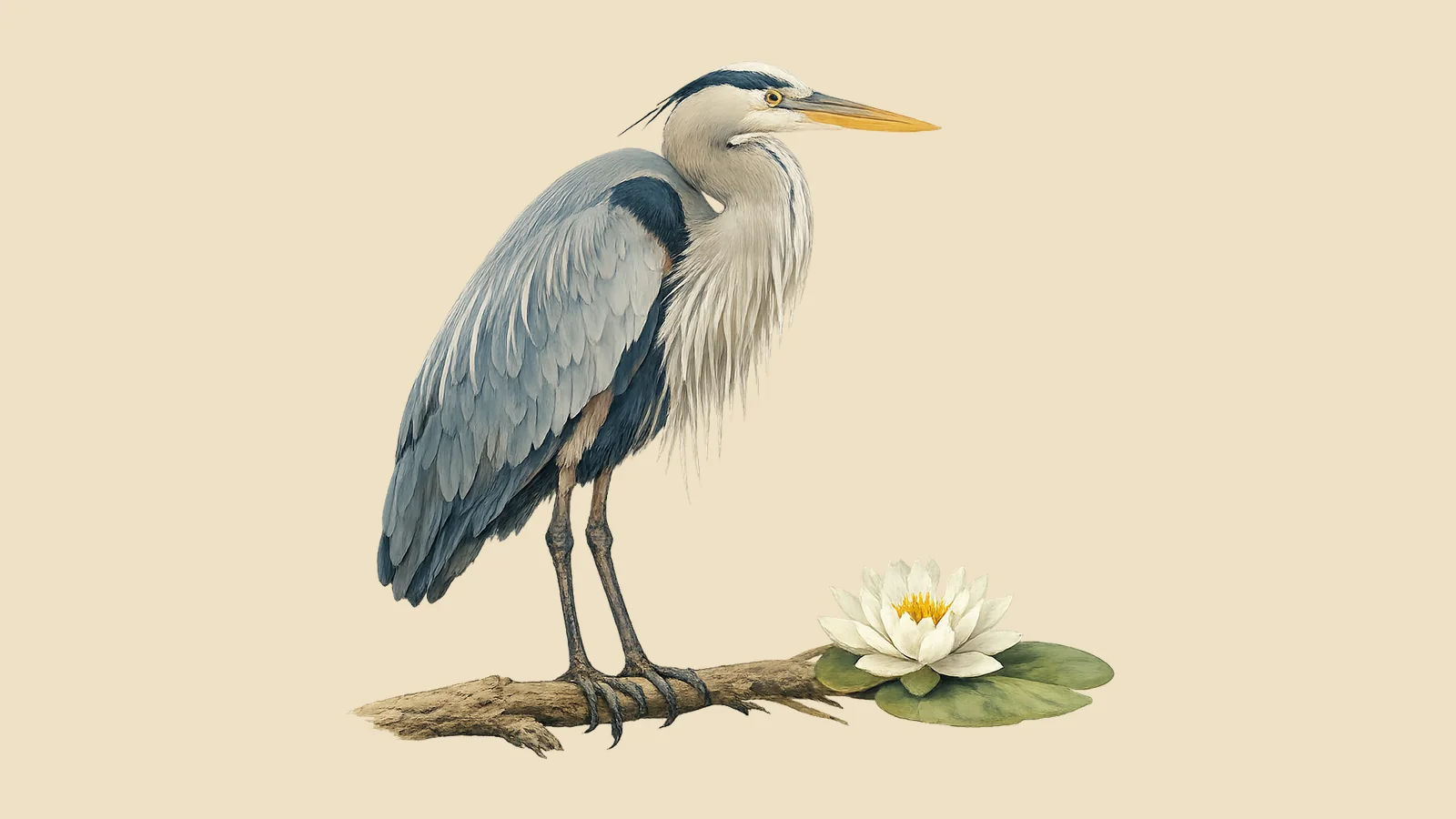
Watch one working a Louisiana tidal flat at low water: it is all forward motion, a long blue-gray body tilted at the shoulders, neck kinked, bill cocked and ready. It sprints three steps, stops hard, tilts, sprints again. Other herons around it - the patient great blue heron frozen in the shallows, the hunched Little Blue at the marsh edge - look like statues by comparison. The Tricolored moves the way a bird moves when it has decided that stillness is a waste of time.
It is not the largest heron on the flat. It is not the most powerful. But it may be the most satisfying to watch, because it is a hunter that seems fully committed to the act of hunting. Every step is intentional. Every pivot has a reason.
What It Looks Like
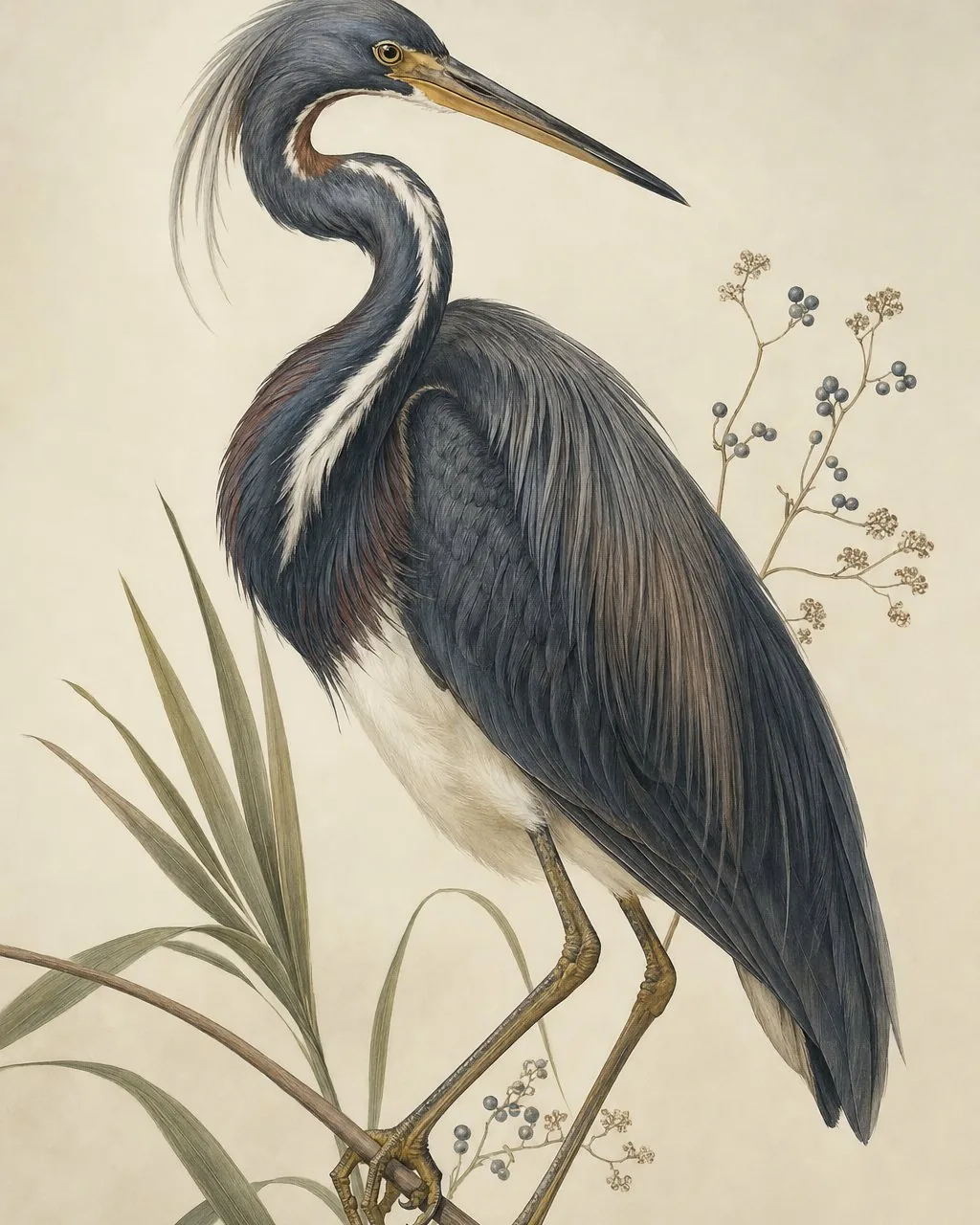
The name refers to the three distinct color zones that mark this bird cleanly from every other American heron.
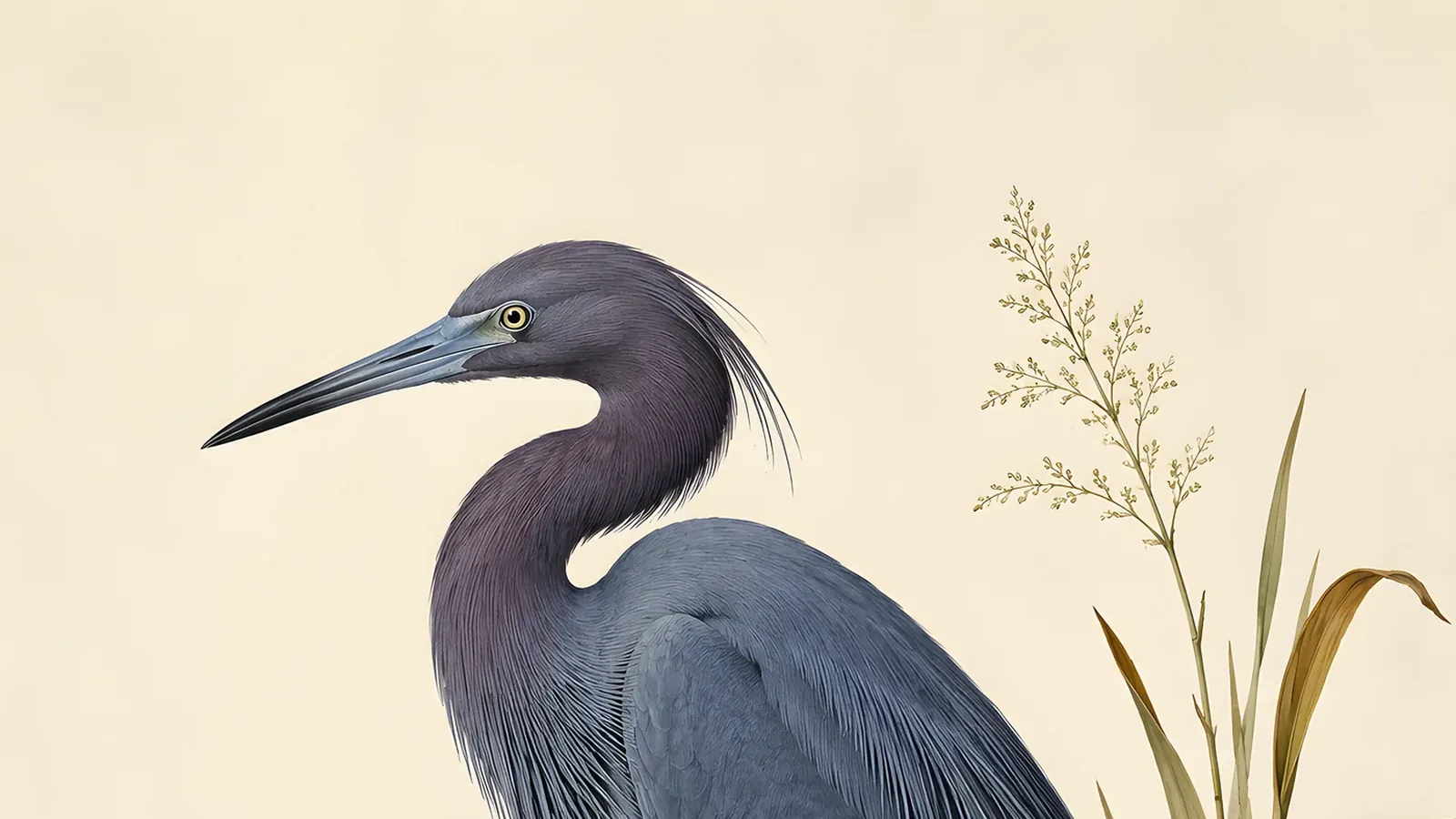
The back, wings, and neck are blue-gray - the same cold slate shade you see on a winter sky over the Gulf. The belly and a stripe running up the center of the foreneck are white, a sharp division that draws the eye. The neck sides and breast carry a wash of rusty chestnut, sometimes with fine white streaking. The loral skin - the bare patch between bill base and eye - is yellow. The bill is long, pointed, and usually bicolored, pale at the base and darker at the tip.
Breeding plumage adds detail. The back grows a set of purple-maroon elongated plumes that drape over the folded wings. The loral skin shifts from yellow to bright blue. Narrow white head plumes appear. The transformation makes an already handsome bird look like it has been dressed for ceremony.
Out of breeding, the bird simplifies: the plumes drop, the loral skin returns to yellow, the chestnut wash fades but does not disappear. The white belly stripe remains year-round and is the best field mark at a distance.
Compared to herons of similar size, the Tricolored reads as particularly lean. The neck is long and thin. The body is narrow. In flight, it looks stretched, almost attenuated, the wingbeats more hurried than a Great Blue’s slow rowing. It is noticeably smaller than a Great Blue but larger and darker-bellied than a little blue heron, which shares much of its range.
| Measurement | Range |
|---|---|
| Length | 56 - 76 cm |
| Weight | 315 - 415 g |
| Wingspan | 90 - 95 cm |
| Lifespan | 7 - 17 years |
Voice
The Tricolored is not a quiet bird at the colony. Away from the nesting site it tends toward silence, occasionally giving a low, raspy croak when flushed or when a rival comes too close on the flats. At the heronry it calls persistently: a rapid, nasal roh-roh-roh or a harsher awk-awk sequence. During courtship the calls escalate into an extended series of low pumping notes. The effect at a large mixed colony is a continuous backdrop of grunts and croaks layered under the occasional shriek.
It is not musical. It does not need to be.
Range and Habitat
The Tricolored Heron is a bird of warm coastal shallows. Its core range in North America runs along the Gulf Coast from Texas to Florida and up the Atlantic seaboard to the Carolinas and occasionally to New England in summer. It breeds throughout the Caribbean, into Central America, and across much of coastal South America.
It is not a bird of open water or deep marshes. It wants edge: the narrow tidal creek where mangrove roots meet open mud, the salt marsh pool that drains to knee-depth at low tide, the shallow impoundment where fish have nowhere to hide in depth. It uses mangroves more than most North American herons, nesting in them, roosting in them, hunting the channels through them.
Freshwater marshes and ponds also work. The bird is flexible about salinity as long as the water is shallow and the prey is there.
For most of the twentieth century this bird was called the Louisiana Heron. The association was earned. Louisiana holds some of the largest and most productive coastal marshes in North America, and the Tricolored was - and remains - woven into the landscape of that coast. The name change came in 1983, when the American Ornithological Society updated the common name to reflect a range that extends well beyond Louisiana’s borders. Tricolored Heron is the accurate name. Louisiana Heron still tells you something true about the bird.
Diet and the Art of Active Hunting
Fish are the primary food. Small ones - killifish, sheepshead minnow, topminnow, whatever the tidal flat is producing that season. Frogs, small crabs, shrimp, and aquatic insects round out the diet when fish are sparse.
The hunting method is what separates the Tricolored from the patient-stalker herons. It pursues. It chases. It covers ground.
A foraging Tricolored covers two or three times the territory that a Great Blue Heron covers in the same period. It runs through shallow water, body pitched forward, neck extended and drawn back simultaneously like a compressed spring. When it spots a fish it strikes - not with a slow uncoiling but with a fast, direct lunge. If the fish dodges, it turns and runs after it. The whole sequence can happen in two or three seconds.
One technique stands out as particularly clever. The Tricolored Heron is one of the few herons that regularly uses canopy feeding: it spreads its wings forward and down, creating a patch of shadow on the water directly in front of it. Fish, in shallow sunlit water, are attracted to shade. They move toward the umbrella. The heron strikes them there. It does this repeatedly, pausing to hold the wing canopy open, scanning the shadow patch below, then folding the wings and moving on. It is not the only heron to use this trick - the Black Heron of Africa has made canopy feeding its signature - but the Tricolored uses it more consistently than any other North American heron.
The combination of active pursuit and canopy technique makes the Tricolored one of the more efficient small-fish hunters on the marsh.
Breeding
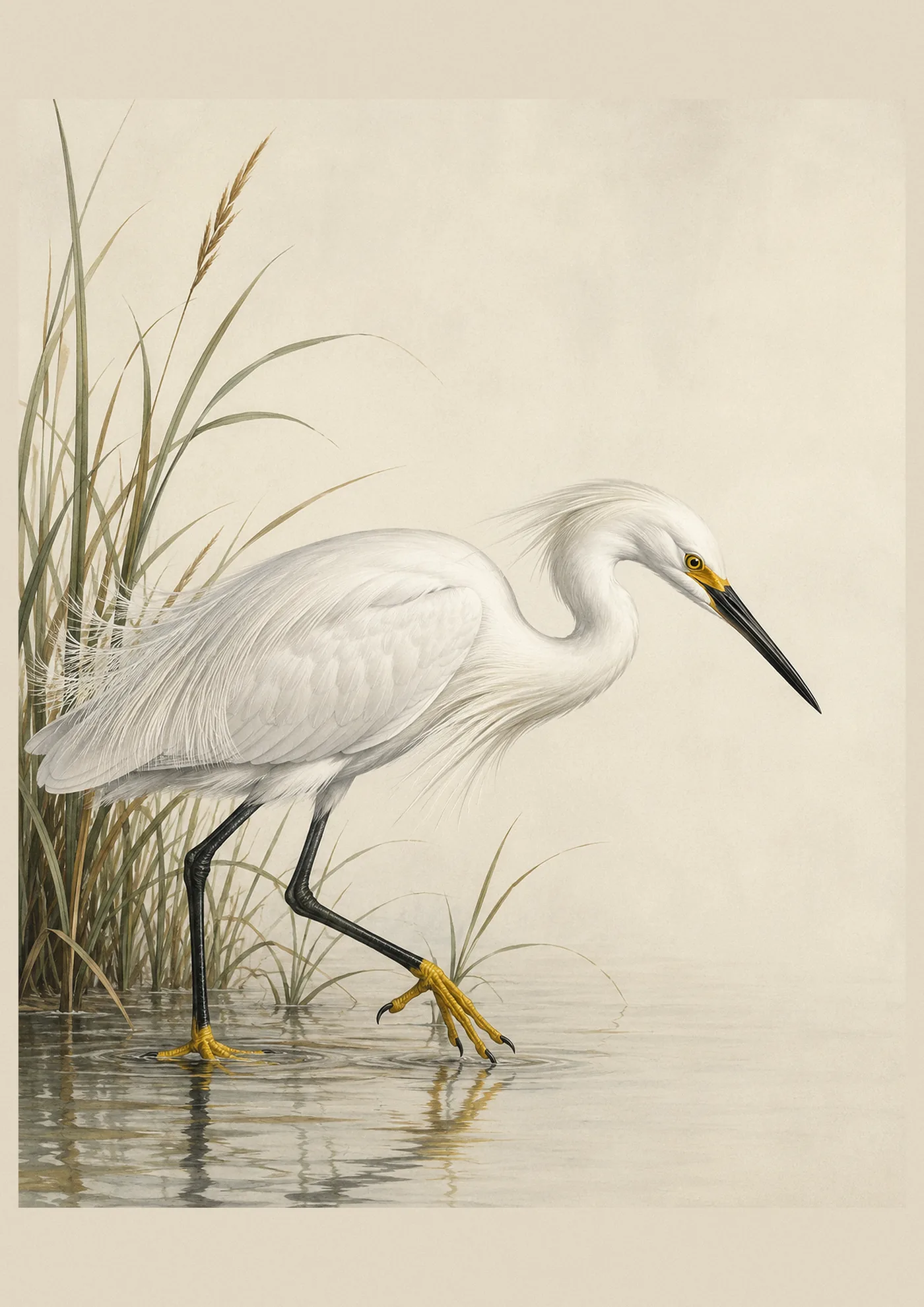
The Tricolored nests colonially, almost always in mixed heronries alongside Little Blue Herons, Snowy Egrets, and Cattle Egrets. Colony sites range from a handful of pairs in a small stand of mangroves to hundreds of nests in a large barrier island rookery. The species does not seem to require large colonies; it uses whatever site is available near productive feeding shallows.
Nests are loose stick platforms built low in mangroves, shrubs, or small trees - usually within a few meters of the ground or water. The male collects sticks and presents them to the female during courtship. Both birds build. The construction is characteristic heron work: untidy to human eyes, functional to the bird’s, and apparently adequate.
Both parents incubate the clutch of three to five pale blue-green eggs. Incubation runs about three weeks. Chicks are fed by regurgitation. Both parents brood and feed through the six weeks before fledging. The young are aggressive feeders from early on, grabbing the parent’s bill and working it up and down to trigger regurgitation - a contact sport by any measure.
Breeding adults begin nest duties in late winter in the southern part of the range. In Texas and Louisiana, colonies are active by March. Further north along the Atlantic coast, the season shifts into late spring.
On the Name
The bird was “Louisiana Heron” in field guides through most of the last century. Audubon drew it under that name. The AOU carried it in the checklist through seven editions before the 1983 switch to Tricolored Heron. The logic was straightforward: the species ranges from Maine to Patagonia, and calling it a Louisiana bird shortchanges the extent of the range.
The new name is better science. But the old name carried something the new one does not. Louisiana Heron placed the bird in a specific landscape and told you something about where you were most likely to see it working at its best - knee-deep in the marsh grass along Vermilion Bay, running hard after a killifish in the last hour of afternoon light. Tricolored Heron tells you what the bird looks like. Louisiana Heron told you where it lived.
Both are true. One lingers.
A Bird That Enjoys Hunting
There is a pleasure in watching a Tricolored Heron work a flat that has nothing to do with rarity or plumage. It is the pleasure of watching a bird that seems to find the job genuinely engaging. The running, the pivoting, the wing-spreading, the quick hard strike - none of it looks obligatory. It looks like a bird that would keep hunting even if it was not hungry.
That is projection, of course. Hunger and evolution explain all of it. But the effect is real, and it makes the Tricolored one of the most watchable birds in a landscape that already has excellent competition. Go to Louisiana in March, stand at the edge of a tidal flat at low water, and find the bird that is moving. That is your Tricolored.