



On a dry morning in the Brazilian cerrado, a Toco Toucan tilts its head skyward and launches a fig down its throat. The motion is mechanical: beak tip catches fruit, head snaps back 180 degrees, the fig drops into the gullet. No chewing. No hesitation. The bill is 20 centimetres long, the tongue inside it is narrow as a feather, and neither is designed for the delicate work of eating. They are designed for reach.
That bill is the argument this species makes to the world, and it is a more interesting argument than it first appears.
The bill: not what you think
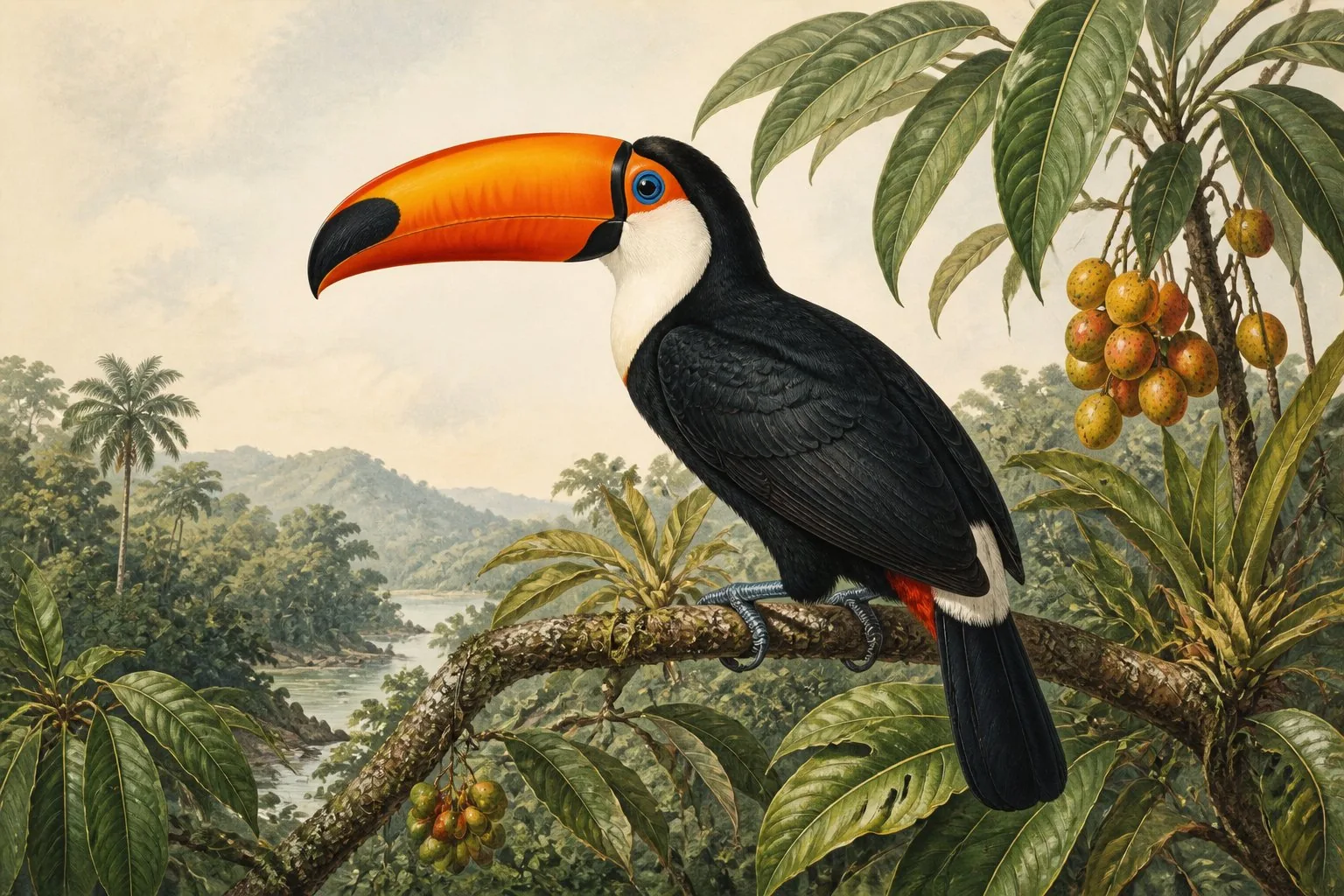
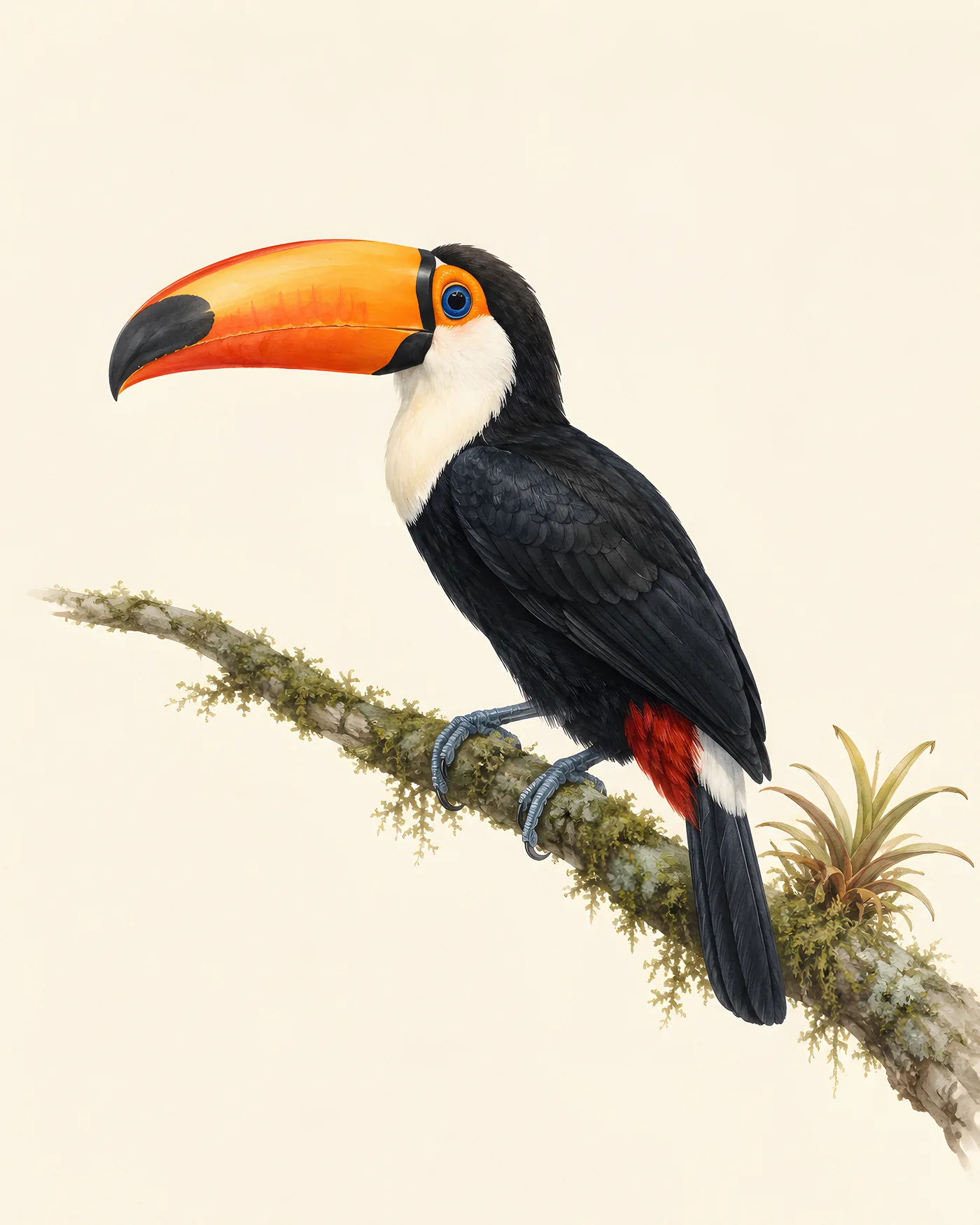
Ramphastos toco, the Toco Toucan, is the largest member of the family Ramphastidae and is found across South America from the Guianas and the mouth of the Amazon south to northern Argentina and Uruguay. At 55 to 61 centimetres in length and weighing between 500 and 860 grams, it is a substantial bird, and its bill - brilliant orange-yellow, marked with a black base and a large black spot at the tip - makes up roughly one-third of its total body length.
For most of the twentieth century, ornithologists treated the bill as a courtship structure, a weapon, or a food-processing tool. A 2009 study by Glenn Tattersall and colleagues, published in Science, settled the question differently. The bill is a thermal radiator. Its surface is densely supplied with blood vessels close to the skin, and the bird dilates or constricts these vessels to control heat loss. Cornell’s Birds of the World notes that the bill accounts for 30 to 60 per cent of the bird’s total heat dissipation at rest - a larger share than any other single body part in any bird species studied to that date. In the heat of a South American afternoon, the Toco Toucan cools itself through its face.
The bill also enables reach. Toucans are poor flyers by the standards of birds their size, moving through canopy in short glides and hops. They cannot hover. The bill lets a perched bird access fruit hanging just beyond wing-range on a slender branch that would not bear the bird’s weight.
Identification
The adult Toco Toucan is unmistakable. The body is black across the back, wings, flanks, and crown. The throat, upper breast, and rump are white. The undertail-coverts are red. Around the brown eye sits a bare orbital ring of sulphur-yellow skin, with a thin blue inner ring - a detail that is easy to overlook and always worth noting. Males average slightly larger and carry longer bills, but the species shows no dramatic sexual dimorphism in plumage. Both sexes are black, white, red, and orange, in that order of dominance.
No other toucan in its range combines this size with these proportions. Smaller toucans and aracaris have more complex colour patterns and narrower bills relative to body size.
Voice
The Toco Toucan is a loud, social bird. Its primary call is a deep, repetitive croak - often described as frog-like - that carries half a mile or more through open woodland. Birds in small groups use a rapid bill-clattering in contact, and the same clatter appears in threat displays between competing individuals. The voice lacks the tonal variety of the Neotropical songbirds it shares habitat with, but its volume more than compensates. Where toucans are calling, the cerrado announces them.
Range and habitat
The Toco Toucan occupies a different niche from most of its Ramphastidae relatives. Where other toucans depend on dense, closed-canopy rainforest, the Toco favours semi-open country: gallery forests along riverbanks, palm stands in inland savannas, forest edges, orchards, and gardens. It is the only non-forest toucan. This preference puts it broadly in line with deforestation’s footprint - cleared land and forest-edge habitat suit it well - which partly explains why, unlike many tropical birds, its population is not sharply declining. The IUCN lists the species as Least Concern, though population trend is noted as decreasing overall.
Elevation range reaches to 1,750 metres. The core of the population sits in Brazil’s cerrado and the Pantanal wetlands, with a range that extends west into southeastern Peru and south into Uruguay.
Small groups of five or six birds travel through the canopy together, gliding in single file from tree to tree. They are not migratory. Individuals remain on home ranges year-round.
Diet
The Toco Toucan is a generalist frugivore. Figs, guavas, palm fruits, and wild peppers form the dietary core, but the species supplements with insects, spiders, bird eggs, and occasionally nestlings - including, on documented occasions, nestlings of the hyacinth macaw. Seed dispersal is a measurable ecological service: large fruit seeds pass intact through the gut and are deposited at distance from the parent tree.
The feeding posture - head thrown back to receive each fruit - is a direct consequence of bill anatomy. The tongue cannot push food rearward in the ordinary way. Gravity does it instead.
Breeding and nesting
The breeding season varies by region but broadly runs from September through February across the southern part of the range. Nest sites are natural cavities in tree trunks, hollow palms, earthen banks, and termite mounds. Both parents excavate or enlarge the cavity. Both incubate the clutch of two to four eggs for 17 to 18 days. Both feed the chicks, which fledge at approximately six to seven weeks.
Young toucans hatch with closed eyes, bare skin, and small, straight bills. The distinctive bill shape develops over the first several weeks of life. Chicks are fed fruit regurgitated by both parents, with insects added as protein load increases before fledging.
Sexual maturity is reached at approximately two to three years. In the wild, individuals live up to 20 years.
A roost worth knowing
One behaviour sets the Toco Toucan apart from nearly every other large tropical bird. Multiple adults - sometimes five or six - share a single tree cavity to roost at night. The individuals solve the problem of fitting by folding their bill along their back and pulling their tail up over their body, forming a compact, roughly spherical shape. A cavity that appears too small for one large toucan routinely holds several, each tucked into this position. It is a practical solution to a real problem: suitable cavities are rare, and sleeping in the open at night in South America carries costs.
The behaviour is not unique to the Toco Toucan among toucans, but it is most frequently documented in this species precisely because it occupies semi-open habitat where observers can watch. What looks like a peculiar circus act is, on inspection, a resource-sharing strategy.
The bill that radiates heat by day becomes, at night, a lid pulled over the sleeping bird like a door pulled shut. One structure. Two problems solved. The Toco Toucan is an efficient animal wearing a spectacular disguise.