Field Guide
Hawaiian Honeycreepers
Some time between one and five million years ago, a small flock of finches was blown off course in the Pacific. They were probably rosefinch relatives from Asia - a compact, seed-eating bird of no particular distinction. They found land. The land was the Hawaiian Islands, a volcanic archipelago with hundreds of unfilled ecological niches and no competition from the mainland bird families that would have pre-empted those niches anywhere else on earth. The finches began to diversify.
What followed is the most spectacular adaptive radiation in the birds of North America, and one of the most discussed in evolutionary biology. From that single colonist lineage, more than fifty species of Hawaiian honeycreeper evolved over the next several million years. They evolved bills for nectaring, for probing bark, for crushing snail shells, for extracting wood-boring larvae. They evolved plumages that ranged from cryptic olive-green to an arterial, attention-stopping scarlet. They evolved behaviors, songs and ecological roles that parallel those of unrelated bird families on every other continent.
Then humans arrived and the radiation began to run in reverse.
The radiation: from seed-eater to everything
The ancestral honeycreeper probably ate seeds. The evidence is in the shared traits: all honeycreepers retain the ten primaries, thirteen tail feathers and basic passerine body plan of a finch. What diverged was the rest.
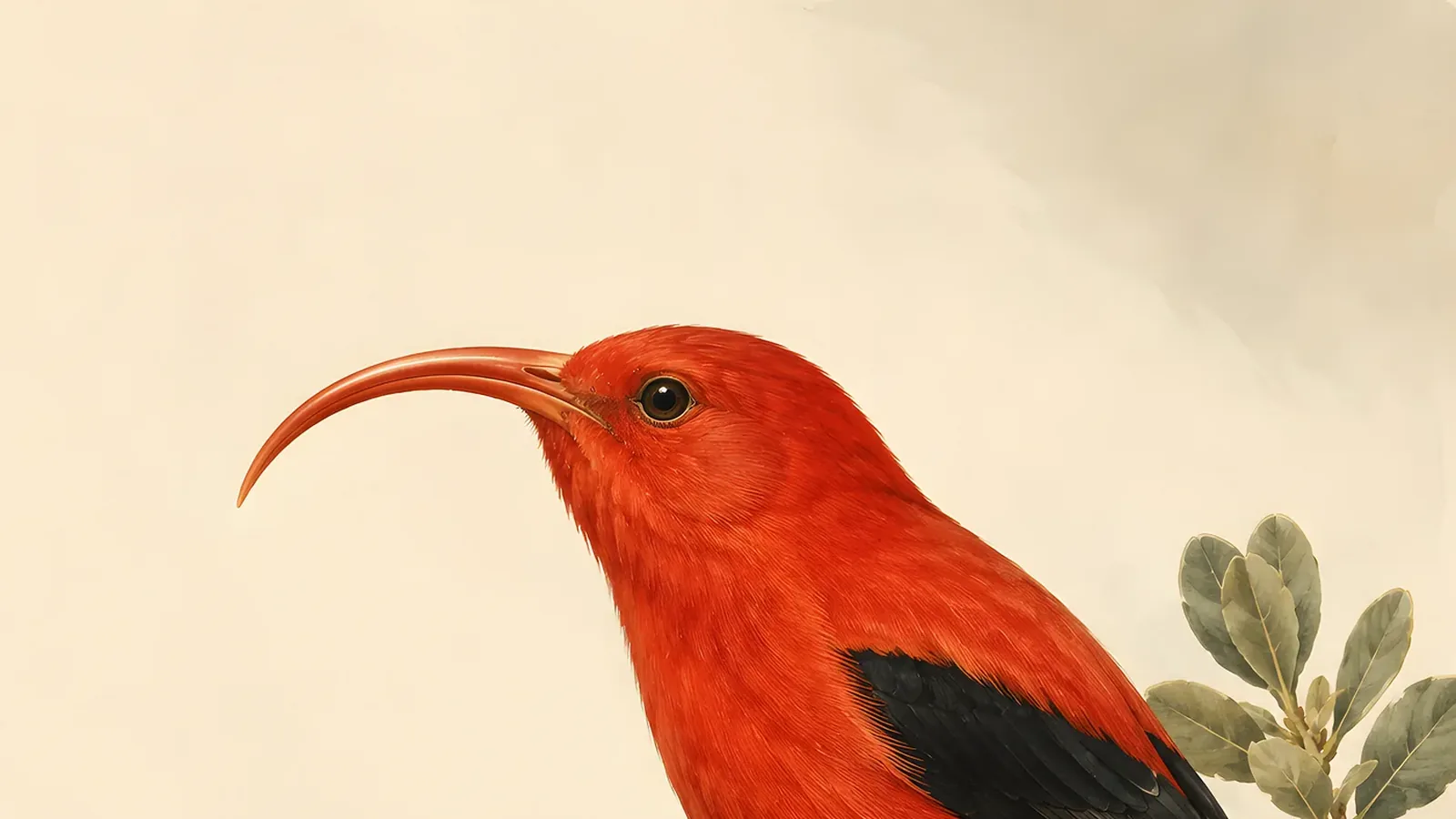
The Iiwi (Drepanis coccinea) is perhaps the most recognizable member. Scarlet-bodied, with jet-black wings and a bill that curves in a long, precise arc matching the curve of the lobelia and native ohia flowers it feeds on. The bill and flower evolved together, a co-evolutionary lock-and-key so precise that some lobelia species cannot be effectively pollinated without the Iiwi. The bird is a full-time nectarivore, though it supplements its diet with insects.
The Apapane (Himatione sanguinea) is similarly red, with white undertail coverts and a shorter, less dramatically curved bill. It is the most abundant honeycreeper remaining, found in native forest above the mosquito line across several islands.
The Akiapolaau (Hemignathus wilsoni) went in a different direction entirely. Its upper bill is long, curved and wooden-extraction shaped. Its lower bill is short, straight and chisel-like. The bird uses the short lower bill to hammer bark like a woodpecker, then inserts the long curved upper bill to extract grubs. No woodpecker ever colonized Hawaii. The Akiapolaau evolved to fill the woodpecker niche from finch raw material, bill and all.
There were honeycreepers with bills for crushing snails. Honeycreepers that foraged on the ground. Honeycreepers that mimicked other species’ calls to mob them away from flowers. The radiation answered every question the Hawaiian forest ecology posed.
“Fifty species from one ancestor, each one a different answer to the same question: what can a small bird become when the world is empty and time is long?”
What they look like
No single description covers a group this diverse. The Hawaiian Honeycreeper page covers the Iiwi in detail. A broad sketch: most species are small to medium passerines, 9 to 20 centimetres, with bills that range from the short, finch-like bill of the Laysan Finch to the extreme decurved tube of the Iiwi. Males of the nectarivorous species tend toward red or yellow plumage. Insectivores and bark-foragers trend toward olive, green or grey. A number of species were sexually dimorphic, the males dramatically more colorful than the females.
Many of the most distinctive species are already gone, known only from museum skins and fossil records.
| Measurement | Range |
|---|---|
| Length | 9 - 20 cm |
| Weight | 8 - 45 g |
| Wingspan | 15 - 28 cm |
| Lifespan | 3 - 15 years |
Voice
Hawaiian honeycreepers fill the forest with sound. The Iiwi gives a squeaky, creaking song with electronic-sounding components. The Apapane is a more liquid singer, producing a series of rapid, rich phrases that carry through the ohia canopy. The Akiapolaau calls with thin, high whistles. Many species were described by nineteenth-century naturalists as major components of a forest soundscape that has now largely disappeared at lower elevations.
Range and habitat
Native Hawaiian forest, particularly ohia-tree forest, above 1,200 metres on the islands of Hawaii, Maui, Kauai and Oahu. The elevation restriction is not preference - it is survival. Below the cloud forest, avian malaria transmitted by introduced mosquitoes reaches near-total infection rates for honeycreepers, which have no evolved immunity. Native forest above the mosquito line is the last refuge.
The islands of Molokai, Lanai and Kahoolawe have lost essentially all their honeycreeper species. Oahu retains only a few individuals in isolated mountain areas.
Diet
Entirely dependent on the structure of the group. Nectarivorous species feed primarily on ohia and native lobelia flowers, taking nectar with tubular tongues while simultaneously effecting pollination. Insectivorous species forage in bark and foliage. The co-evolutionary relationships between specific honeycreepers and specific plants mean that declining honeycreeper populations have measurable effects on plant pollination and, in some cases, plant reproduction.
Breeding
Details vary widely by species. In general: small cup nests in native trees, clutches of one to three eggs, extended parental care by both parents. Many species breed slowly, which is an additional vulnerability - low reproductive rates cannot compensate for high adult mortality.
The collapse
Seventeen or more species of Hawaiian honeycreeper are now extinct. The losses began with the arrival of Polynesian settlers around 1,200 years ago - rats, pigs and direct hunting drove the first wave of extinctions, and archaeologists have identified at least nine species that disappeared before European contact. European settlement after 1778 accelerated the losses. Cattle, goats and pigs destroyed the native understory. Mosquitoes arrived in 1826, in a water cask. Rats, mongooses and introduced predatory birds killed adults and raided nests. Introduced songbirds brought diseases. Land was cleared for agriculture and development.
The mosquito is now the primary driver. Avian malaria (Plasmodium relictum) kills naive honeycreepers with near-complete efficiency. A single infected bird, a single mosquito bite. Native birds have no evolutionary experience with the parasite and no immune response. Forest above the cloud inversion layer - roughly 1,500 metres - stays cool enough that mosquitoes cannot complete their life cycle. Below that line, the birds die.
Climate change is raising temperatures at elevation. The mosquito line is moving upslope. There is no higher ground.
The response now underway is extraordinary in the history of wildlife conservation: a program to release Wolbachia-infected sterile male mosquitoes across high-elevation forests, suppressing mosquito populations without pesticide use. Preliminary results are encouraging. The program is being scaled urgently. It may be the only tool capable of reversing the trajectory before the remaining honeycreeper species follow the extinct ones into the fossil record.
The Iiwi - that scarlet bird with the impossible bill, arriving at the ohia flower like a piece of the flower itself - is now listed as threatened under the Endangered Species Act. Its population is falling. Forest bird surveys on the Big Island show dramatic declines even at high elevations over the past decade.
One finch, blown off course in the Pacific. Fifty answers to the question of what a bird can become. Seventeen of those answers already gone. The rest, dependent on a program that controls mosquitoes with bacteria, in a forest that may not stay cold enough to protect them.
The radiation continues. Whether it ends here depends on choices being made now.