Field Guide
European Robin
On a January morning in an English garden, before first light, a robin sings. Not at dawn - ahead of dawn, alone in the dark, his song carrying into streets where nothing else stirs. He is not greeting the day. He is holding territory in a season when the cost of losing it is starvation.
Erithacus rubecula is a bird Britain has turned into a Christmas card and systematically misread. The sentiment runs so deep that he was named Britain’s unofficial national bird in a 2015 public poll. The truth underneath the sentiment is more interesting: this is one of the most combative small birds in a temperate woodland, a species whose red breast functions as both signal and provocation, and whose willingness to fight - the British Trust for Ornithology notes that territorial disputes account for up to 10 per cent of adult robin deaths in some areas - makes him something closer to a red-breasted sparring machine than the gentle garden companion of popular imagination.
What he looks like
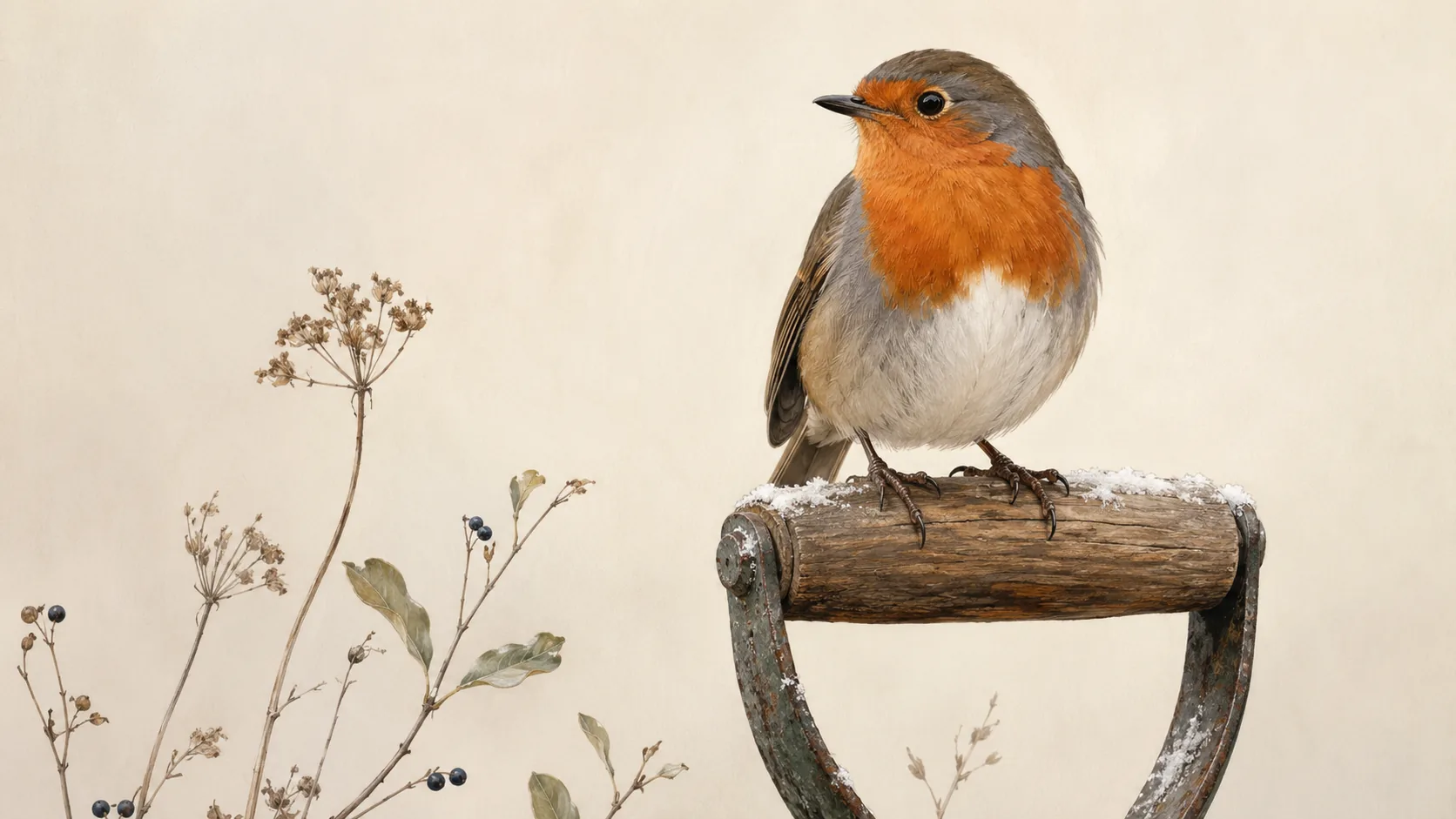
At 12 to 14 centimetres long and 16 to 22 grams, the robin is smaller than he looks in a garden - roughly the weight of three pound coins. The orange-red face and breast are the field mark; no other common British garden bird replicates them at this size. The upperparts are plain warm brown, the underparts white, with a thin bluish-grey line bordering the orange on the sides of the neck and chest. The eye is large and dark, adapted to foraging in dim woodland understorey. Bill short and fine, built for invertebrates rather than seed-cracking.
Males and females are identical in plumage, which is unusual for a territorial species. Both sexes hold territories and both sing - she sings in winter to defend a feeding patch, he sings year-round for breeding rights. The red breast reads the same way to a rival robin regardless of the bird displaying it.
Juveniles are unrecognisable: entirely brown and mottled with buff spots, no red visible. The adult plumage develops over two to three months post-fledging. A speckled brown bird in a garden hedge in July or August is very likely a juvenile robin, not a different species.
Voice
The song is the reason he sings before dawn in January. It is a series of short, flowing phrases - cascading, liquid, slightly melancholy in quality - that shift key and direction without settling into a repeating pattern. No two song phrases are identical. The RSPB describes it as “a melodic, high-pitched whistle” with “varied verses of short, gushing phrases,” and the variation is precisely the point: a predictable song is easier to habituate to, easier to ignore.
He sings year-round except during the midsummer moult, which lasts three to four weeks. The BTO records song activity peaks in spring and again in autumn, with a pronounced dip through July and August. Robins in urban areas have adapted their timing further: as ambient noise levels rise through the day with traffic and human activity, urban birds increasingly sing at night, using streetlight as their cue. A robin singing at midnight near a lit road is not confused. He is acoustically rational.
The alarm call is a sharp, repeated tic - quick and hard-edged, distinct from the song in the same way a whistle differs from a shout.
Range and habitat
Across the UK and Ireland the robin is a year-round resident, occupying 94 per cent of breeding squares according to BTO atlas data. He is absent mainly from exposed uplands above 400 metres and the remoter Scottish islands. The UK breeding population stands at approximately 7.4 million territories, a figure that has risen by 55 per cent since 1967, making him one of the great avian success stories of the monitored era.
Beyond Britain, his range runs from western Siberia across all of Europe into North Africa and the Atlantic islands - Azores, Madeira, Canaries. The British and Irish populations are largely sedentary. The robins arriving in eastern England each autumn from Scandinavia and Russia are a different matter: these are migrants, moving westward ahead of the continental winter, and they look identical to the residents they land among. A garden with 20 robins in November contains birds from three countries, none of them distinguishable by eye.
He occupies deciduous and mixed woodland, scrub, hedgerow, farmland, parks, and gardens. The common thread is shade and leaf litter - conditions where earthworms are accessible and insects overwinter in the soil. The garden relationship is real but it is a secondary adaptation: he followed the woodland-edge habitat humans accidentally created, not the humans themselves.
Diet
Earthworms are the staple. He takes them by watching from a low perch - a stone, a fork handle, a low branch - then dropping to the ground for a clean strike. The famous habit of following a gardener with a spade is not tameness. It is efficient opportunism: turned soil reveals worms that would otherwise require several minutes of watching to locate.
In autumn and winter he adds berries, fruit, and seeds. He visits bird tables for soft food - suet, mealworms, grated cheese - particularly in freezing weather, when the soil hardens and earthworm access drops sharply. The Woodland Trust notes that a robin can lose up to 10 per cent of its body weight during a single freezing winter night. The table supplements are not a convenience. In hard winters they are the margin.
Breeding and nesting
The first clutch is typically laid around 18 April, though mild winters push the season into March. The nest is a cup of dead leaves, moss, and grass, often placed in a hollow - a tree root, a wall nook, a kettle left in a shed. Robins exploit any enclosed space at low height. Open-front nestboxes succeed where conventional closed boxes do not because they replicate the natural cavity shape.
Clutch size averages four to five eggs, cream or buff with reddish-brown speckles. The female incubates alone for 14 to 16 days; both parents feed the young through a fledging period of similar length. Two broods per season is standard, three possible. The BTO’s ringing data records the first average fledging date falling in late May for the first brood.
The male defends his breeding territory with the same intensity he applies in winter, but the focus shifts from food to access. Encounters between males are ritualised in escalating stages - song display, posture, then the red breast presented full-on - before escalating to physical contact. The breast-forward posture is the signal; the signal is usually enough. When it is not, the fights are fast and sometimes fatal.
The red breast
This is the detail that the Christmas card version erases. The red breast is a threat display, not an ornament. Experiments recorded by ornithologists have shown that a robin will attack a crude bundle of red feathers placed in its territory - red triggers the response regardless of the shape carrying it. The signal works on both sexes because both sexes hold territories. A male presenting his breast at a rival male and a female presenting hers at a rival female in winter are running the same behavioural programme.
The breast serves one social function in winter and a different one in spring: territory advertisement becomes, in the breeding season, part of mate choice. He faces her; she reads the saturation and extent of the red; and she makes a judgement about his condition and the quality of his genes. The same signal, read twice, for different purposes. The bird Britain decided was cute picked the most honest signal it could.
A bird widely believed to symbolise gentleness turns out to have evolved one of the most direct territorial displays in European ornithology. The garden robin is not mild. He is simply small enough that we mistake the scale.