Symbolism
The Robin on Your Christmas Card Is a Victorian Postman
The robin on your Christmas card is a postman.
Not metaphorically. The red-breasted bird delivering greetings through snow on Victorian Christmas cards was a direct visual substitution for the Royal Mail postman in his scarlet uniform jacket. Londoners in the 1850s and 1860s nicknamed their postmen “Robins” because the uniform red matched the bird’s breast. By the 1880s, illustrators stopped drawing the man and drew the bird instead - perched on a pillar box, carrying a card in its beak, hopping through frost with a letter tucked under a wing. The postal joke was explicit. The original joke was forgotten within a generation, and the bird was left holding centuries of symbolism it inherited by accident.
That is the most recent layer. The older ones are stranger.
The Bird That Follows You to the Grave
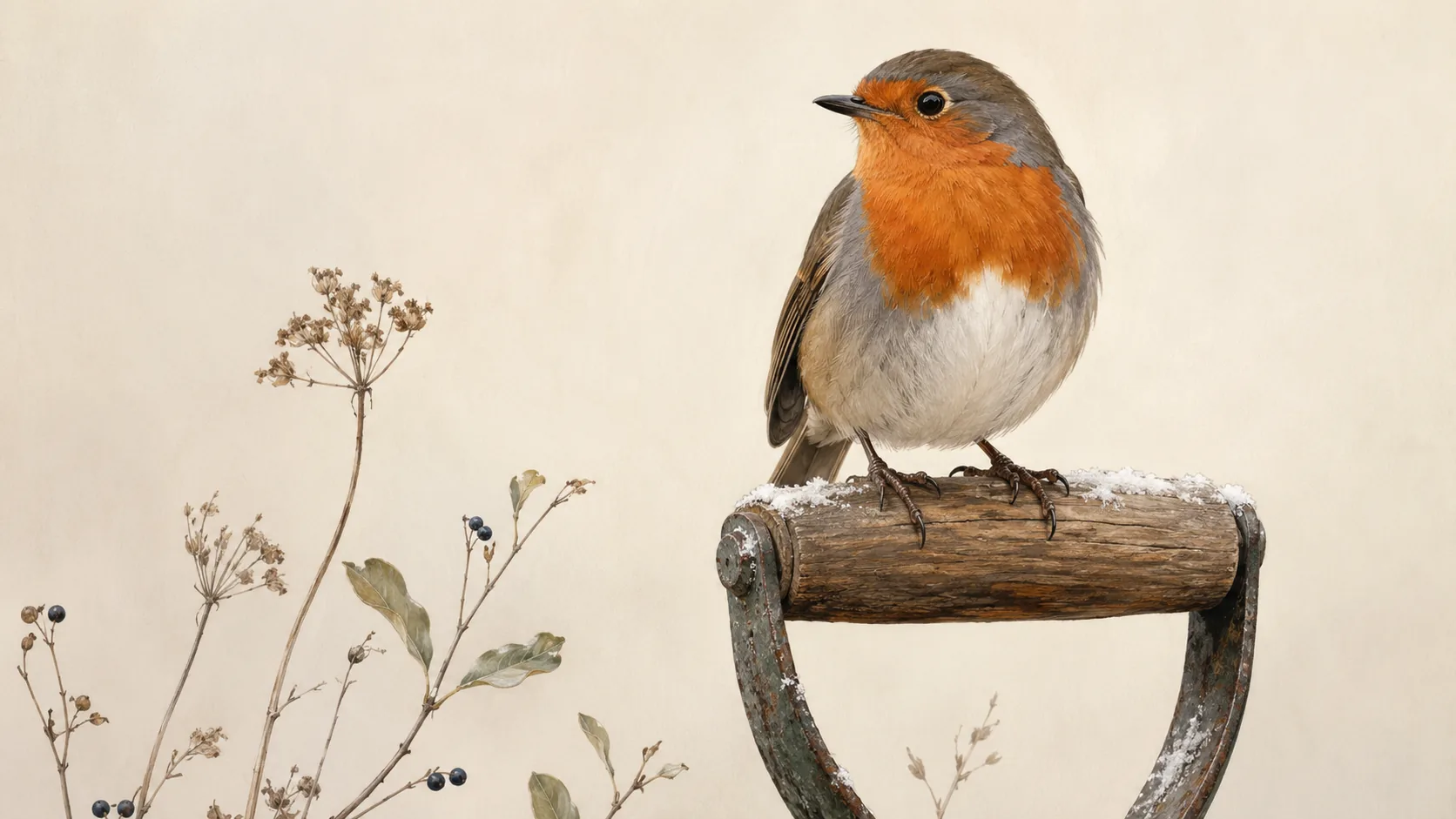
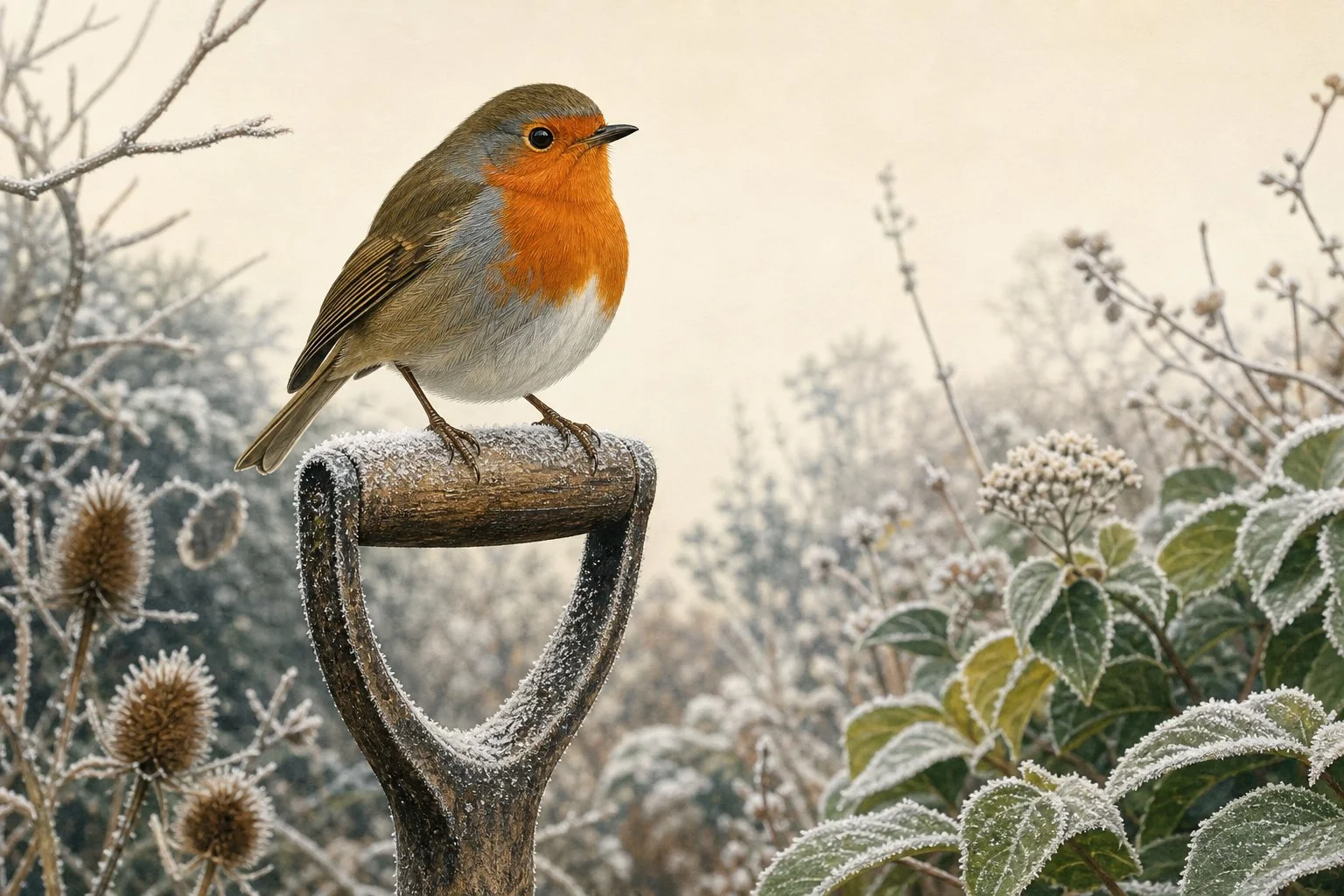
The European robin (Erithacus rubecula) originally learned to follow large animals - wild boar, deer, badgers - rooting through soil and disturbing invertebrates. When humans started digging, the robin transferred the behavior. In Britain and Ireland, centuries of protective taboo against harming robins selected for individuals willing to approach within thirty centimetres of a working gardener. They will perch on the handle of a spade you are actively using.
This proximity is not universal to the species. On the European continent, the same bird is shy and keeps to woodland. The tameness is a British and Irish phenomenon, built by centuries of people who believed killing a robin would curse them. The personality is a cultural artifact.
That following behavior, the robin appearing reliably wherever a human digs, drove the earliest dark folklore. In Irish tradition, one name for the robin was applied sardonically: the bird that counts your corpses. It arrived wherever humans disturbed the earth. It arrived at graves. It was witnessed perching near dying people, singing close to those who were about to leave. Irish and Scottish folk belief concluded it was carrying messages from the dead.
The folk prohibition was precise. In Ireland and Wales: kill a robin and the hand that did it would shake forever, never still again. In some traditions the cow’s milk would come out bloody. The house would burn. The curse survived in rhyme: “Kill a robin or a wren, never prosper, boy or man.”
A.E. Bray recorded in 1838 in Devon: “Very few children in this town would hurt the redbreast, as it is considered unlucky to do so.” That is one of the earliest contemporaneous English written records of the protective taboo. The belief was already old enough not to require explanation.
How the Breast Got Red: Two Stories
Neither version has a medieval written source. Bestiary manuscripts, hagiographic texts, and sermon collections from the medieval period have been searched and the robin-blood connection is not there. What exists is older evidence in language, and a younger crystallisation in literature.
The Welsh word for robin is bronrhuddyn: scorched breast. The word itself encodes the pagan fire-bringer myth. In the Welsh version, a plain brown bird flew into hell to bring water to the suffering dead. It was scorched in the attempt. Its breast was permanently stained. In some tellings it is fire it carries, not water - a bird that volunteers to singe itself to bring warmth to humans from the gods.
The Christian version shifts the setting. A cold night in Bethlehem. The fire in the stable is dying. A plain brown bird fans the embers with its wings to keep the newborn Jesus warm, and its breast is burned red in the process. The moral is the same as the Welsh pagan version: the robin is scorched while performing an act of selfless warmth for others.
The Crucifixion version runs parallel. A robin, seeing Christ suffering on the cross, flew to the crown of thorns and tried to pull a thorn free with its beak. A drop of blood fell on the breast and stained it permanently. In some tellings the robin succeeds in removing one thorn. In others it only tries.
The literary crystallisation of the Crucifixion story is not medieval. It is 1904, written by Selma Lagerlof in her Christ Legends - a Swedish Nobel laureate giving novelistic form to an older oral tradition. Her specific text reads: “A robin flew close to the crucified Christ and drew with his little bill a thorn that had been embedded in the forehead of the crucified one. As he did this there fell on his breast a drop of blood from the crucified one; it spread quickly and colored all the little fine breast feathers.” This version, or a derivative of it, circulates online today as though it were a medieval legend. It is a 1904 Swedish literary text.
The County Clare variant of the blood legend skips Calvary entirely. The Virgin Mary fled to Egypt on foot. Her feet were cut by thorns and brambles. A robin followed her bleeding track, covering the footprints with leaves, pressing them down with its breast, which was stained with her blood. The robin was known in Clare as spideog Mhuire: Mary’s Robin. This is the gentlest of the versions. It is also the one with the most specific geographic attribution - County Clare, parts of south County Derry, and reportedly Gaelic Scotland.
The Dead and the Living
The first surviving English literary text placing the robin with dead human bodies is “The Babes in the Wood,” a broadside ballad published in Norwich by Thomas Millington in 1595:
“No burial these prettye babes / Of any man receives, / Till Robin-redbreast painfully / Did cover them with leaves.”
Two children abandoned in a forest die of cold. The robin covers their bodies. This is not a metaphor. The folk belief underlying it - that robins covered unburied corpses with leaves as an act of compassion - was apparently literal enough to require no explanation in 1595.
John Webster used it the same way in 1612. In The White Devil, Cornelia speaks over the body of her murdered son:
“Call for the robin-red-breast and the wren, / Since o’er shady groves they hover, / And with leaves and flow’rs do cover / The friendless bodies of unburied men.”
John Skelton, writing between 1505 and 1508 in “Phyllyp Sparowe,” made the robin the officiating priest at a sparrow’s funeral, singing requiem mass. The robin’s connection to death ritual in English literary consciousness predates Shakespeare.
The phrase “robins appear when loved ones are near” is on memorial cards and crematorium leaflets across Britain today. Pure Cremation and similar services use it. This sentiment culture is probably Victorian in origin, a softened version of the genuine folk belief. The genuine folk belief is that if a robin enters your house unbidden, someone in the family will die. The blessed bird is also the death bird. The same tradition holds both.
Who Killed Cock Robin, and Who Knows
The earliest printed record of “Who Killed Cock Robin” is Tommy Thumb’s Pretty Song Book, around 1744. The extended version did not appear in print until around 1770. A stained glass window at Buckland Rectory in Gloucestershire, dating to the 15th century, depicts a robin killed by an arrow - which suggests the image, if not the rhyme, is older than 1744.
The Walpole political allegory is the most plausible specific claim. Robert Walpole - “Robin” to his allies - fell from power in 1742. The rhyme was first printed in 1744. Peter Opie, the definitive historian of nursery rhymes, noted that an existing older rhyme may have been adapted to fit. The rhyme received a documented political second life in 1819, when a satirical pamphlet about the Peterloo Massacre - cavalry charging unarmed civilians in Manchester - adapted it directly under the title “A Satirical Tragedy, or Hieroglyphic Prophecy on the Manchester Blot.” The pamphlet is held in the University of Manchester’s Peterloo collection.
The theories connecting the rhyme to Norse mythology, Celtic sun gods, or pre-Christian seasonal sacrifice are speculative and have no direct textual evidence. The Norse god Balder killed by mistletoe, the Welsh solar deity “Coch Rhi Ben” read as “Cock Robin” - these are folklorist interpretations applied retrospectively. The structure of the rhyme - a communal funeral, each creature assigned a role, a bird killed by an arrow - does match a real genre of bird-funeral verse that existed in English literature. It may encode genuine folk beliefs about how birds mourn. The political adaptations suggest the form was robust enough to carry new content across centuries.
That a probable 18th-century nursery rhyme was used to protest a cavalry massacre is remarkable. The animal funeral became a protest against killing. That is cultural recycling.
The Winter Singer Is Not Comforting You
The European robin sings through winter. It sings in December and January. The winter song is softer and more plaintive than the spring breeding song, and both males and females sing it - females also hold individual winter territories, which is unusual among songbirds. The hormonal driver is elevated testosterone in both sexes during the non-breeding season.
The robin is singing to warn other robins away from its earthworm patch.
It is among the most aggressive small birds in Britain. Territorial confrontations are physical. Robins fight to the death over resources. David Lack, who spent four years at Dartington Hall in Devon ringing and tracking individual robins for his 1943 study The Life of the Robin, documented the territorial aggression in detail. He placed stuffed robins in occupied territories and watched residents attack them. He documented birds dying from combat injuries sustained defending their patch.
The December robin singing from a frosty branch is not offering companionship or courage to the human gardener watching it. It is issuing a territorial warning to every robin within earshot. The beauty of the song is real. The peace is an illusion.
This is the biological engine of the winter symbolism. The song is genuinely lovely in winter. The bird is genuinely conspicuous. The red breast glows in low winter light. The interpretation is anthropomorphism applied to a creature engaged in resource defense. The symbols are human. The bird is indifferent.
The American Cardinal Is Probably the British Robin
In North America, the Northern Cardinal (Cardinalis cardinalis) occupies exactly the same symbolic role the robin occupies in Britain. A conspicuous red bird appears at or after a funeral and is interpreted as the soul of the deceased visiting. Grief counseling websites, funeral homes, and memorial card companies in the US use cardinal imagery in precisely the way British equivalents use the robin.
The mechanism is identical: a red bird, associated through color with blood and warmth, assigned a death-mediating role in folk belief. The cardinal belief appears to be largely a 20th-century development. One plausible reading: British and Irish immigrant communities who held the robin-as-soul belief arrived in North America, where the European robin does not exist, and attached the displaced belief to the nearest equivalent conspicuous red bird.
The two species are not related. They share only the color and the symbolism.
Claims that the cardinal-as-dead-relative belief derives from specific Indigenous American nations should be treated with skepticism. There are Indigenous traditions involving birds as soul-carriers, but the specific cardinal belief reads as a colonial-era or later Anglophone development when attributed to unnamed “Native Americans.” The British robin tradition has four hundred years of documented literary evidence behind it. The cardinal tradition is younger and the origin is murkier.
The Six Contradictions
The robin is simultaneously the bird that signals a death is coming (entering a house unbidden) and the bird that comforts the dying (perching and singing at the window of someone near death). The same tradition holds both.
The most approachable bird in Britain is approachable because people did not eat it. Remove the taboo and continental wariness returns. The companion personality is a cultural artifact.
The winter singer is fighting, not accompanying. The December robin is issuing aggression, not offering peace.
The Christmas card robin is a Victorian postal pun. The bird that now represents midwinter mysticism and the souls of the departed started its Christmas card career as a visual joke about Royal Mail delivery.
Selma Lagerlof won the Nobel Prize in Literature in 1909. Her 1904 literary version of the Crown of Thorns story now circulates online as ancient Celtic wisdom.
The blood legend has no identified medieval written source, but the Welsh word for robin - bronrhuddyn, scorched breast - preserves a version of the myth in the language itself, which is older than any text.
The robin is still in your garden, watching you dig. It is waiting for the earthworms you disturb. It has been doing this since before any of the legends. The legends are the humans’ contribution. The bird was already there.